Russia Content Analytics Market Size & Growth Rate (2026-2032)
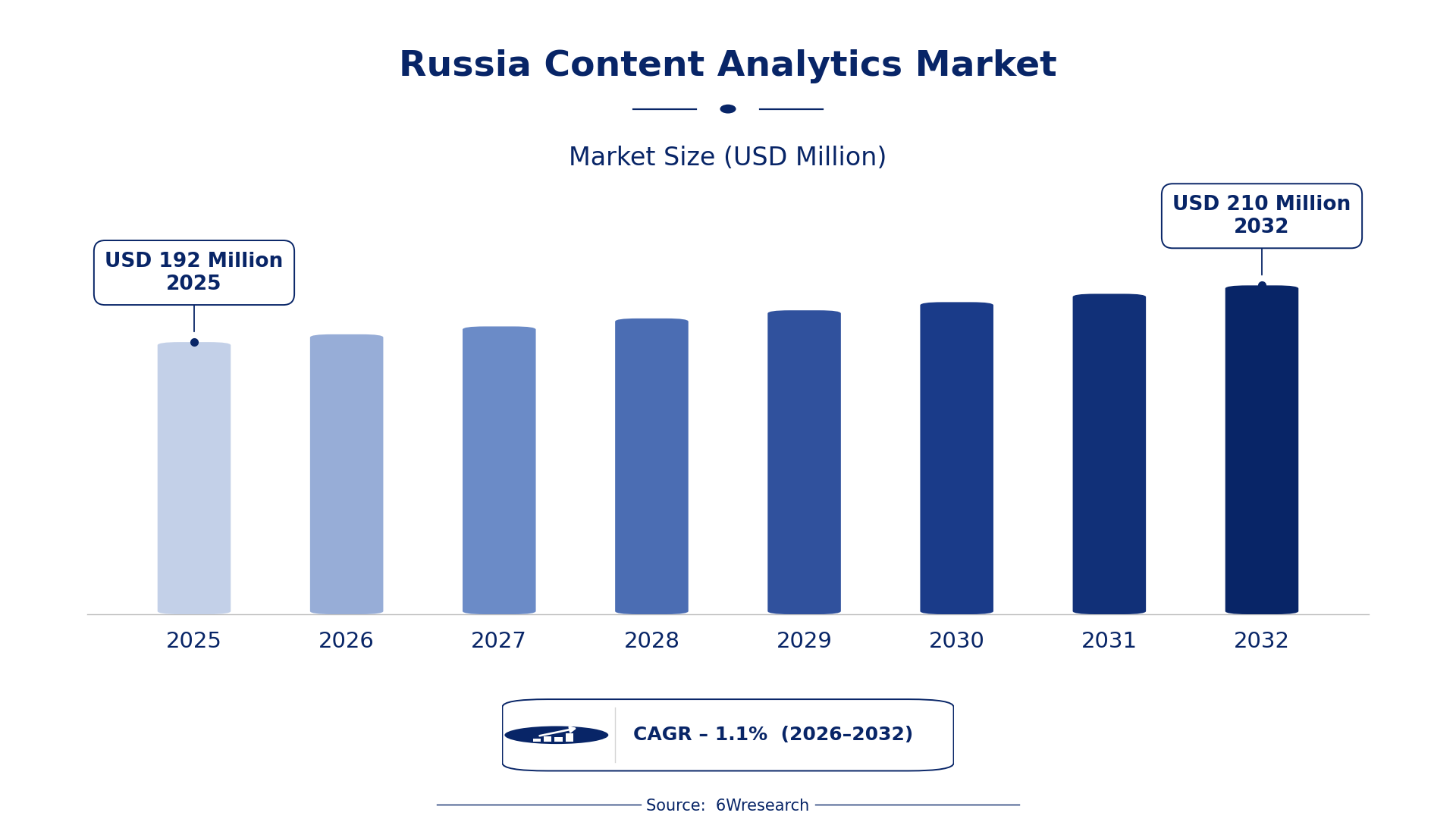
The Russia Content Analytics Market was estimated at USD 192 Million in 2025 and is projected to reach USD 210 Million by 2032, growing at a CAGR of 1.1% from 2026 to 2032.
Russia Content Analytics Market Synopsis
The Russia Content Analytics Market is witnessing a noteworthy surge as businesses increasingly embrace advanced analytics to sift through vast amounts of digital data. This growing trend is particularly driven by the need for actionable insights that can enhance customer engagement and optimize operational strategies.
Organizations across various sectors, including retail, healthcare, and finance, are recognizing the competitive edge that content analytics provides. The integration of AI and machine learning into these analytics tools is also becoming crucial, as businesses seek real-time insights to stay ahead of rapidly changing market dynamics.
Russia Content Analytics Market Year-wise Growth Rate and Key Drivers
This graph illustrates the annual growth rates of the Russia Content Analytics Market from 2021 to 2032, highlighting a steady upward trajectory and projected expansion over the forecast period.
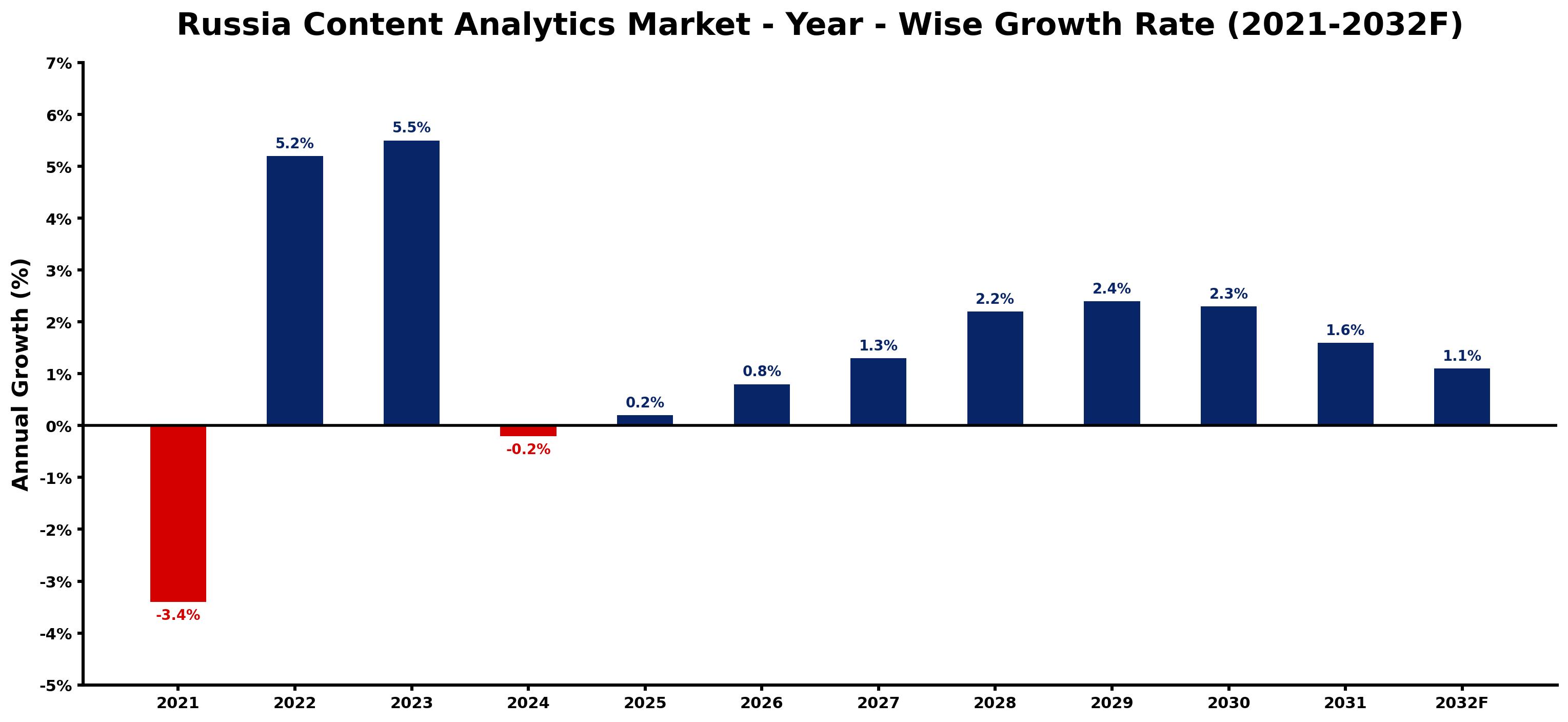
The table below presents the year‑wise growth rates along with the key drivers influencing the market
| Year | Growth Rate | Major Drivers |
| 2021 | -3.4% | Russian government's censorship policies hindered data analytics growth. |
| 2022 | 5.2% | Increased demand for social media content analysis tools. |
| 2023 | 5.5% | Emphasis on localizing content for Russian advertising regulations. |
| 2024 | -0.2% | Declining investment in technology due to Western sanctions. |
| 2025 | 0.2% | Growth in e-commerce platforms needing customer insights. |
| 2026 | 0.8% | Rise of user-generated content requiring better sentiment tracking. |
| 2027 | 1.3% | Development of government-backed digital marketing standards. |
| 2028 | 2.2% | Emergence of Russian startups focusing on AI-driven analytics. |
| 2029 | 2.4% | Government initiatives promoting digital literacy among businesses. |
| 2030 | 2.3% | Demand for analytics in improving local media engagement. |
| 2031 | 1.6% | Increase in online gaming popularity and audience analysis needs. |
| 2032 | 1.1% | Parallel growth of influencer marketing in Russian sectors. |
Note: Market size estimations and growth projections presented in this report are based on 6Wresearch's proprietary forecasting methodology, utilizing the latest available industry data, government publications, and primary research inputs.
Russia Content Analytics Market Key Takeaways
Below are some of the specific key takeaways from the market, including:
- Rapid adoption of real-time analytics solutions is reshaping decision-making processes.
- AI and machine learning technologies are enhancing the capabilities of content analytics tools.
- Sentiment analysis is becoming an essential feature for understanding consumer behavior.
- Regulatory changes are influencing data management practices in the content analytics sector.
- The diverse Russian market presents unique challenges and opportunities for content analytics providers.
Evaluation of Restraints in Russia Content Analytics Market
Despite its growth, the Russia Content Analytics Market faces notable restraints that could hinder progress. Chief among these are stringent data privacy regulations that mandate the localization of personal data. Companies must navigate a complex regulatory environment, which can lead to increased operational costs and the necessity for compliance strategies that may divert resources from innovation.
Language complexities also pose a significant barrier, particularly for tools that analyze Russian content. The intricacies of the language can lead to misinterpretations, affecting the accuracy of analytics. on top of that, regional cultural differences can complicate the analytics landscape, requiring a nuanced approach to content analysis that many providers are still adapting to.
Russia Content Analytics Market Trends
Key trends are emerging that shape the Russia Content Analytics Market. A shift toward real-time analytics is evident, driven by the need for immediate data-driven decisions. Organizations are increasingly prioritizing solutions that provide instant insights, reflecting the fast-paced nature of the digital economy.
The incorporation of AI and natural language processing technologies is enabling more sophisticated data analysis capabilities. This evolution is allowing businesses to better understand customer sentiment and preferences, ultimately leading to improved strategic outcomes. As these trends continue to gain traction, the market is set to evolve further.
Russia Content Analytics Market Opportunities
Investment opportunities within the Russia Content Analytics Market are robust, fueled by the burgeoning demand for data insights across various sectors. Industries such as media and e-commerce are particularly ripe for growth, with companies seeking innovative analytics solutions to enhance their competitive positioning.
Technological advancements in AI and machine learning offer avenues for startups and established companies to develop cutting-edge analytics tools. As organizations increasingly recognize the value of data-driven strategies, the potential for growth in this market becomes more pronounced, presenting a lucrative landscape for investment.
Government Initiatives in the Russia Content Analytics Market
Government policies are actively shaping the dynamics of the Russia Content Analytics Market. Regulatory frameworks focusing on data privacy and localization are critical, as they dictate how companies manage sensitive information. These regulations not only aim to protect consumer rights but also impact operational procedures for analytics providers.
- A recently completed initiative focused on enhancing data protection laws to comply with international standards.
- Current efforts are underway to develop a national strategy for digital infrastructure, impacting analytics capabilities.
- A planned regulatory framework expected to be introduced in 2026 will mandate greater transparency in data handling practices.
- Ongoing initiatives are promoting partnerships between government agencies and tech firms to foster innovation in analytics.
- Recent amendments to data privacy laws have created new compliance challenges for content analytics providers.
Future Insights of the Russia Content Analytics Market
Looking ahead to 2026-2032, the Russia Content Analytics Market is set for steady growth as organizations increasingly rely on data to inform strategic decisions. The trend toward real-time analytics will intensify, driven by the escalating volume of digital content generated daily.
As AI and machine learning technologies become more integrated into content analytics solutions, businesses will gain access to more refined data interpretations. This evolution will likely fuel demand across sectors such as e-commerce and media, making the analytics market a crucial player in Russia's digital economy.
Russia Content Analytics Market Latest Developments
In the last 12-14 months, the Russia Content Analytics Market has seen a flurry of activity as companies strive to enhance their analytics capabilities. The focus on real-time data processing has prompted several firms to upgrade their analytics tools, integrating advanced technologies to meet market demands.
- A major technology vendor launched a new sentiment analysis tool in early 2025, enhancing capabilities for real-time consumer insights.
- An initiative that began in mid-2025 is currently underway, focusing on the collaboration between analytics providers and local businesses to tailor solutions.
- A rollout expected to begin in the second half of 2026 aims to expand access to content analytics tools in underserved regions of Russia.
- A leading regional operator completed an upgrade of its analytics platform in late 2025, improving data processing speeds.
- Plans for a comprehensive training program aimed at enhancing workforce skills in data analytics are set to kick off in early 2026.
Russia Content Analytics Market - Key Attractiveness of the Report
- 10 Years of Market Numbers
- Historical Data Starting from 2022 to 2025
- Base Year: 2025
- Forecast Data until 2032
- Key Performance Indicators Impacting the Market
- Major Upcoming Developments and Projects
Key Highlights of the Report:
- Russia Content Analytics Market Outlook
- Market Size of Russia Content Analytics Market, 2025
- Forecast of Russia Content Analytics Market, 2032
- Historical Data and Forecast of Russia Content Analytics Revenues & Volume for the Period 2022-2032F
- Russia Content Analytics Market Trend Evolution
- Russia Content Analytics Market Drivers and Challenges
- Russia Content Analytics Price Trends
- Russia Content Analytics Porter's Five Forces
- Russia Content Analytics Industry Life Cycle
- Historical Data and Forecast of Russia Content Analytics Market Revenues & Volume By Application for the Period 2022-2032F
- Historical Data and Forecast of Russia Content Analytics Market Revenues & Volume By Speech Analytics for the Period 2022-2032F
- Historical Data and Forecast of Russia Content Analytics Market Revenues & Volume By Text Analytics for the Period 2022-2032F
- Historical Data and Forecast of Russia Content Analytics Market Revenues & Volume By Web Analytics for the Period 2022-2032F
- Historical Data and Forecast of Russia Content Analytics Market Revenues & Volume By Social Media Analytics for the Period 2022-2032F
- Historical Data and Forecast of Russia Content Analytics Market Revenues & Volume By Others for the Period 2022-2032F
- Historical Data and Forecast of Russia Content Analytics Market Revenues & Volume By Deployment Type for the Period 2022-2032F
- Historical Data and Forecast of Russia Content Analytics Market Revenues & Volume By On-Premises for the Period 2022-2032F
- Historical Data and Forecast of Russia Content Analytics Market Revenues & Volume By Cloud/Hosted for the Period 2022-2032F
- Historical Data and Forecast of Russia Content Analytics Market Revenues & Volume By Vertical for the Period 2022-2032F
- Historical Data and Forecast of Russia Content Analytics Market Revenues & Volume By BFSI (Banking, Financial Services and Insurance) for the Period 2022-2032F
- Historical Data and Forecast of Russia Content Analytics Market Revenues & Volume By Retail & Consumer Goods for the Period 2022-2032F
- Historical Data and Forecast of Russia Content Analytics Market Revenues & Volume By IT & Telecom for the Period 2022-2032F
- Historical Data and Forecast of Russia Content Analytics Market Revenues & Volume By Healthcare for the Period 2022-2032F
- Historical Data and Forecast of Russia Content Analytics Market Revenues & Volume By Media & Entertainment for the Period 2022-2032F
- Historical Data and Forecast of Russia Content Analytics Market Revenues & Volume By Government for the Period 2022-2032F
- Historical Data and Forecast of Russia Content Analytics Market Revenues & Volume By Travel & Hospitality for the Period 2022-2032F
- Historical Data and Forecast of Russia Content Analytics Market Revenues & Volume By Others for the Period 2022-2032F
- Russia Content Analytics Import Export Trade Statistics
- Market Opportunity Assessment By Application
- Market Opportunity Assessment By Deployment Type
- Market Opportunity Assessment By Vertical
- Russia Content Analytics Top Companies Market Share
- Russia Content Analytics Competitive Benchmarking By Technical and Operational Parameters
- Russia Content Analytics Company Profiles
- Russia Content Analytics Key Strategic Recommendations






































