Russia Content Intelligence Market Size & Growth Rate (2026-2032)
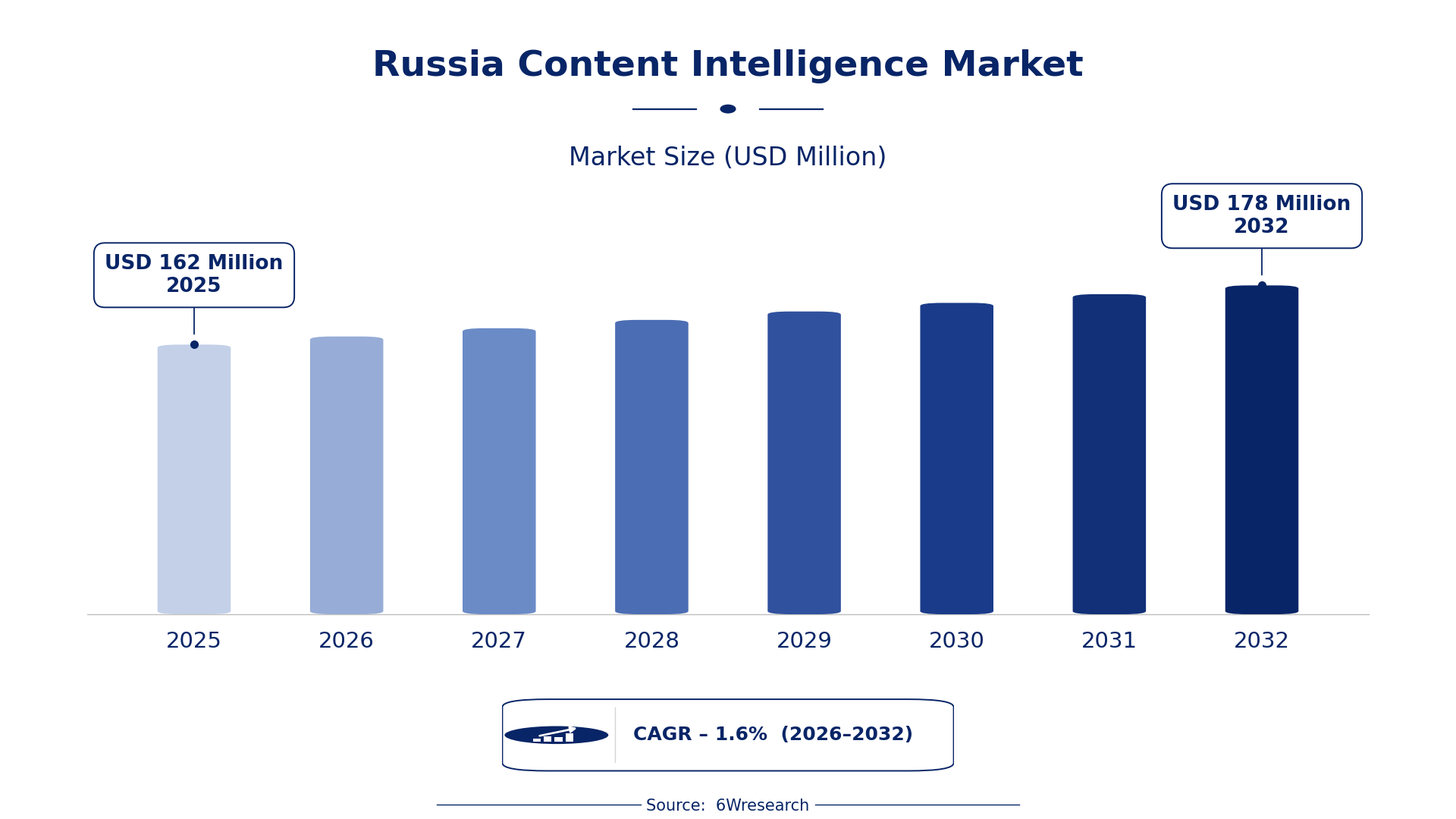
The Russia Content Intelligence Market was estimated at USD 162 Million in 2025 and is projected to reach USD 178 Million by 2032, growing at a CAGR of 1.6% from 2026 to 2032.
Russia Content Intelligence Market Synopsis
The Russia Content Intelligence Market is on an upward trajectory, reflecting a growing recognition among organizations of the value of data-driven insights. Companies are increasingly focusing on enhancing their content strategies through advanced analytics, AI, and machine learning technologies.
Looking ahead, the demand for personalized and targeted content is set to intensify. As businesses strive to improve customer engagement and optimize their digital presence, the need for sophisticated content intelligence tools will only grow.
Russia Content Intelligence Market Year-wise Growth Rate and Key Drivers
This graph illustrates the annual growth rates of the Russia Content Intelligence Market from 2021 to 2032, highlighting a steady upward trajectory and projected expansion over the forecast period.
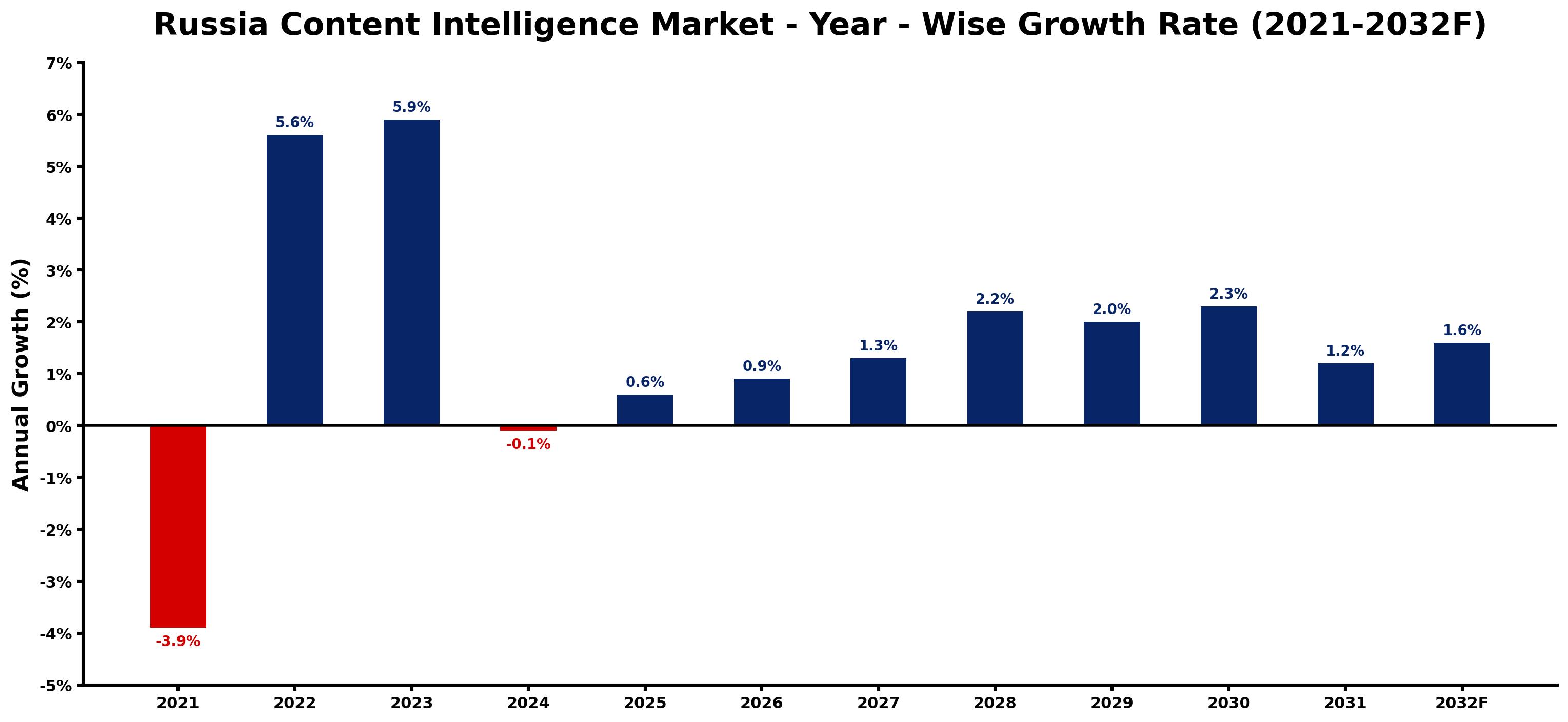
The table below presents the year‑wise growth rates along with the key drivers influencing the market
| Year | Growth Rate | Major Drivers |
| 2021 | -3.9% | Sanctions hinder investment in technology and infrastructure. |
| 2022 | 5.6% | Increased online media consumption amid political events. |
| 2023 | 5.9% | Rising digital literacy fostering content creation opportunities. |
| 2024 | -0.1% | Declining demand due to rising internet censorship laws. |
| 2025 | 0.6% | Local startups innovating in AI-driven content analytics. |
| 2026 | 0.9% | Government endorsement of digital sovereignty in media. |
| 2027 | 1.3% | Surge in streaming services boosting content intelligence needs. |
| 2028 | 2.2% | Increased social media engagement driving analytics demand. |
| 2029 | 2.0% | Growing interest in targeted marketing strategies in Russia. |
| 2030 | 2.3% | Regulatory pressure for content compliance enhancing analytics use. |
| 2031 | 1.2% | Evolving consumer preferences demand adaptive content strategies. |
| 2032 | 1.6% | Emergence of new platforms necessitating advanced content insights. |
Note: Market size estimations and growth projections presented in this report are based on 6Wresearch's proprietary forecasting methodology, utilizing the latest available industry data, government publications, and primary research inputs.
Russia Content Intelligence Market Key Takeaways
Below are some of the specific key takeaways from the market, including:
- The market is witnessing steady growth driven by increased demand for data-driven insights.
- AI and machine learning are central to the development of advanced content intelligence solutions.
- Businesses are prioritizing personalized content delivery to enhance customer experiences.
- Sentiment analysis and predictive analytics are becoming critical components of content strategies.
- Challenges such as data privacy and language barriers need to be addressed for market expansion.
Evaluation of Restraints in Russia Content Intelligence Market
The Russia Content Intelligence Market is currently constrained by various factors that limit its potential. Data privacy regulations are stringent and evolving, making compliance a significant hurdle for companies. Organizations often struggle to navigate these regulations while attempting to gather and analyze data effectively.
Additionally, language barriers present challenges in accurately analyzing Russian content. Many content intelligence tools may not be fully equipped to handle the nuances of the Russian language, leading to potential gaps in insights. Limited access to quality data sources further compounds these issues, making it essential for providers to innovate solutions tailored to the unique landscape of this market.
Russia Content Intelligence Market Trends
Several trends are shaping the Russia Content Intelligence Market. The integration of natural language processing is enhancing content analysis capabilities, enabling more nuanced understanding of consumer sentiments. The growing reliance on predictive analytics is guiding content optimization efforts, allowing marketers to create more relevant and engaging content.
on top of that, as businesses emphasize targeted advertising, the demand for content personalization tools is escalating. Companies are actively seeking solutions that can provide actionable insights to better connect with their audiences.
Russia Content Intelligence Market Opportunities
The Russia Content Intelligence Market presents various growth opportunities for businesses. There is a clear demand for advanced content personalization solutions that cater to specific audience segments. Companies capable of harnessing big data to deliver tailored insights will find ample room for innovation.
on top of that, the rise of social media monitoring tools offers significant investment potential. As organizations look to gauge public sentiment and engagement, solutions that can effectively analyze social media content will be highly sought after.
Government Initiatives in the Russia Content Intelligence Market
Government regulations are significantly shaping the Russia Content Intelligence Market. The current regulatory environment places a strong emphasis on data privacy and security, which impacts how companies operate within this space. Compliance with these regulations is crucial for any organization looking to succeed in the market.
- A regulatory framework introduced in 2022 mandates data localization, requiring companies to store sensitive information within Russian borders.
- Current initiatives focus on enhancing cybersecurity measures, ensuring that organizations adhere to strict data protection standards.
- Upcoming guidelines expected in late 2025 will set new parameters for the use of encryption technologies in data analysis.
- A national program aimed at improving digital infrastructure is currently underway, facilitating better access to data sources.
- Ongoing government efforts to monitor online content aim to ensure compliance with national security interests and prevent misinformation.
Future Insights of the Russia Content Intelligence Market
Looking ahead to 2026-2032, the Russia Content Intelligence Market is set to continue its growth trajectory. As organizations increasingly prioritize data-driven decision-making, the demand for content intelligence tools will expand. Innovations in AI and machine learning will lead to more sophisticated solutions capable of providing deeper insights.
on top of that, as businesses refine their digital strategies, the focus will shift towards enhancing customer engagement through personalized content delivery. This will create further opportunities for growth and differentiation in an already competitive market.
Russia Content Intelligence Market Latest Developments
Recent months have seen a flurry of activity within the Russia Content Intelligence Market, reflecting a heightened interest in data-driven content strategies. Companies are actively seeking to enhance their offerings through innovative solutions tailored to local market needs.
- A major technology vendor launched an advanced content analysis tool in early 2025, allowing businesses to gain deeper insights into consumer behavior.
- An initiative that began in mid-2025 focuses on developing partnerships between local firms and international content intelligence providers to share best practices.
- By late 2025, a leading regional operator is expected to roll out a new platform that integrates sentiment analysis capabilities for better content strategy formulation.
- A public-private initiative aimed at expanding access to quality data sources is currently underway, promising to bridge gaps in available information.
- Upcoming regulations set to be introduced in early 2026 will enhance compliance measures for data privacy in the content intelligence sector.
Russia Content Intelligence Market - Key Attractiveness of the Report
- 10 Years of Market Numbers
- Historical Data Starting from 2022 to 2025
- Base Year: 2025
- Forecast Data until 2032
- Key Performance Indicators Impacting the Market
- Major Upcoming Developments and Projects
Key Highlights of the Report:
- Russia Content Intelligence Market Outlook
- Market Size of Russia Content Intelligence Market, 2025
- Forecast of Russia Content Intelligence Market, 2032
- Historical Data and Forecast of Russia Content Intelligence Revenues & Volume for the Period 2022-2032F
- Russia Content Intelligence Market Trend Evolution
- Russia Content Intelligence Market Drivers and Challenges
- Russia Content Intelligence Price Trends
- Russia Content Intelligence Porter's Five Forces
- Russia Content Intelligence Industry Life Cycle
- Historical Data and Forecast of Russia Content Intelligence Market Revenues & Volume By Component for the Period 2022-2032F
- Historical Data and Forecast of Russia Content Intelligence Market Revenues & Volume By Solutions for the Period 2022-2032F
- Historical Data and Forecast of Russia Content Intelligence Market Revenues & Volume By Services for the Period 2022-2032F
- Historical Data and Forecast of Russia Content Intelligence Market Revenues & Volume By Vertical for the Period 2022-2032F
- Historical Data and Forecast of Russia Content Intelligence Market Revenues & Volume By BFSI for the Period 2022-2032F
- Historical Data and Forecast of Russia Content Intelligence Market Revenues & Volume By Government & Public Sector for the Period 2022-2032F
- Historical Data and Forecast of Russia Content Intelligence Market Revenues & Volume By Healthcare & Life Sciences for the Period 2022-2032F
- Historical Data and Forecast of Russia Content Intelligence Market Revenues & Volume By IT & Telecommunications for the Period 2022-2032F
- Historical Data and Forecast of Russia Content Intelligence Market Revenues & Volume By Manufacturing for the Period 2022-2032F
- Historical Data and Forecast of Russia Content Intelligence Market Revenues & Volume By Media & Entertainment for the Period 2022-2032F
- Historical Data and Forecast of Russia Content Intelligence Market Revenues & Volume By Retail & Consumer Goods for the Period 2022-2032F
- Historical Data and Forecast of Russia Content Intelligence Market Revenues & Volume By Deployment Type for the Period 2022-2032F
- Historical Data and Forecast of Russia Content Intelligence Market Revenues & Volume By Cloud for the Period 2022-2032F
- Historical Data and Forecast of Russia Content Intelligence Market Revenues & Volume By On-Premises for the Period 2022-2032F
- Historical Data and Forecast of Russia Content Intelligence Market Revenues & Volume By Hybrid for the Period 2022-2032F
- Historical Data and Forecast of Russia Content Intelligence Market Revenues & Volume By Organization Size for the Period 2022-2032F
- Historical Data and Forecast of Russia Content Intelligence Market Revenues & Volume By Large enterprises for the Period 2022-2032F
- Historical Data and Forecast of Russia Content Intelligence Market Revenues & Volume By Small and Medium-sized Enterprises (SMEs) for the Period 2022-2032F
- Russia Content Intelligence Import Export Trade Statistics
- Market Opportunity Assessment By Component
- Market Opportunity Assessment By Vertical
- Market Opportunity Assessment By Deployment Type
- Market Opportunity Assessment By Organization Size
- Russia Content Intelligence Top Companies Market Share
- Russia Content Intelligence Competitive Benchmarking By Technical and Operational Parameters
- Russia Content Intelligence Company Profiles
- Russia Content Intelligence Key Strategic Recommendations






































