Russia Cultured Meat Market Size, Share & Growth Rate
The Russia Cultured Meat Market was estimated at USD 182 Million in 2025 and is projected to reach USD 199 Million by 2032, growing at a CAGR of 1.3% from 2026 to 2032. This growth trajectory is fueled by a burgeoning consumer awareness regarding the environmental implications of conventional meat production, as well as a shift towards healthier eating patterns. The increasing investment in technological advancements and supportive government policies further bolster the market's potential.
Russia Cultured Meat Market Year-wise Growth Rate and Key Drivers
This graph highlights how the Russia Cultured Meat Market has steadily grown over the years, supported by major growth factors.
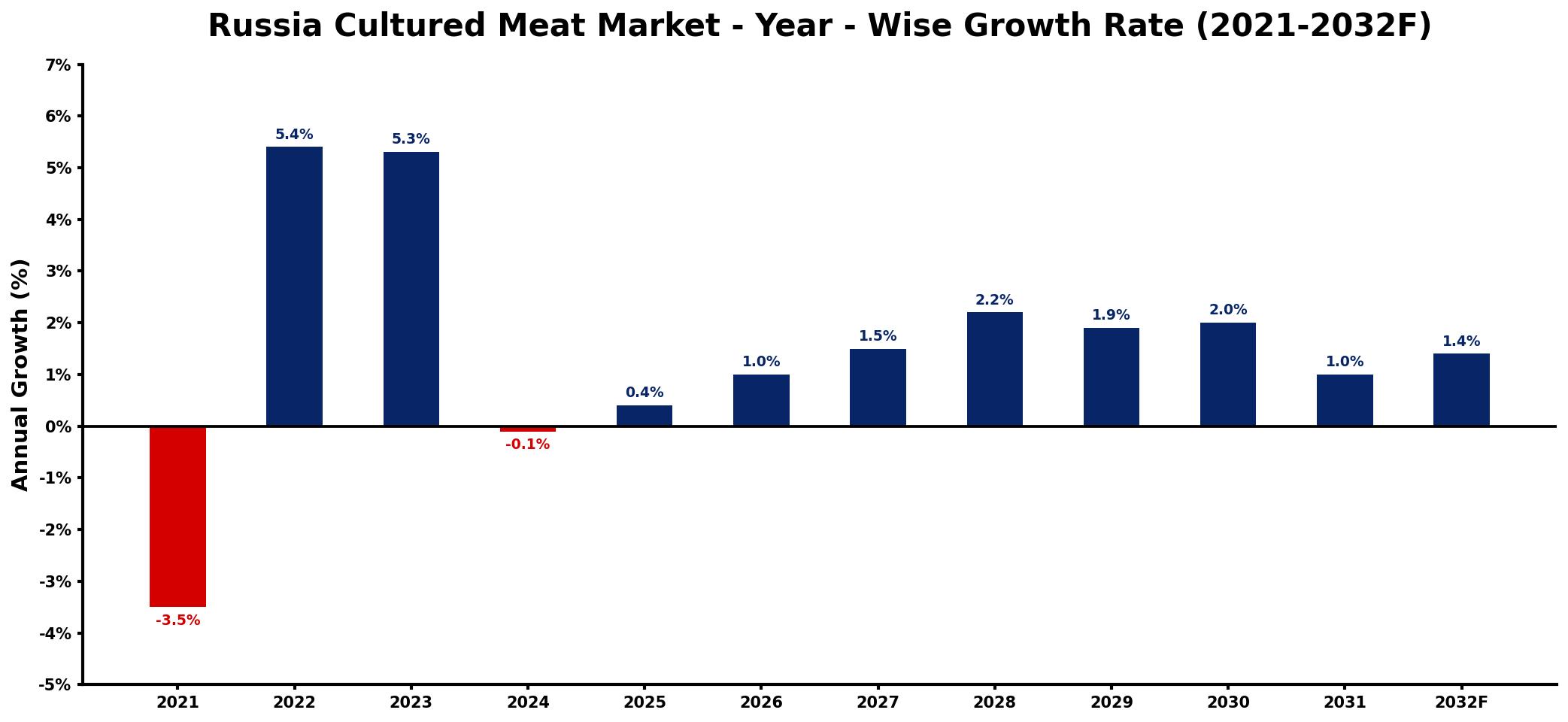
The table below presents the year‑wise growth rates along with the key drivers influencing the market
| Year | Growth Rate | Major Drivers |
| 2021 | -3.5% | Consumer interest in alternatives wanes |
| 2022 | 5.4% | Investments in innovative technologies rise |
| 2023 | 5.3% | New applications attract consumer attention |
| 2024 | -0.1% | Market perception shifts towards traditional |
| 2025 | 0.4% | Sustainability initiatives gain traction |
| 2026 | 1.0% | Retail partnerships expand product offerings |
| 2027 | 1.5% | Health trends favor alternative proteins |
| 2028 | 2.2% | Regulatory support encourages market entry |
| 2029 | 1.9% | Global collaborations enhance market visibility |
| 2030 | 2.0% | Consumer education drives awareness initiatives |
| 2031 | 1.0% | Research funding supports development projects |
| 2032 | 1.4% | Emerging markets show growing interest |
Note: Market size estimations and growth projections presented in this report are based on 6Wresearch's proprietary forecasting methodology, utilizing the latest available industry data, government publications, and primary research inputs.
Russia Cultured Meat Market Synopsis
The Russia cultured meat market is poised for rapid advancement, reflecting a global trend toward sustainable and ethical protein sources. As Russian consumers become more cognizant of the environmental and health impacts of traditional meat consumption, the demand for cultured meat is on the rise, presenting significant opportunities for market players.
Currently, the market remains in its early stages, characterized by increasing investments in research and development aimed at enhancing production techniques. The cooperation between cultured meat innovators and established food industry firms is an encouraging sign of mainstream acceptance, positioning the market for a transformative growth phase.
Russia Cultured Meat Market Key Takeaways
- The market is witnessing a significant shift towards ethical and sustainable protein consumption.
- Government initiatives and support for research are essential drivers of market growth.
- Technological advancements are critical for improving production efficiency and product quality.
- Consumer awareness and education are crucial for overcoming skepticism surrounding cultured meat.
- Strategic partnerships between cultured meat companies and traditional food players are increasing.
Evaluation of Restraints in Russia Cultured Meat Market
Despite the promising outlook, the Russia cultured meat market grapples with several real constraints that could impede its progress. A primary challenge lies in the limited consumer awareness and acceptance of cultured meat, as many potential buyers remain uninformed about its advantages and safety compared to traditional meat options. This skepticism can hinder market penetration and growth.
Furthermore, the regulatory environment poses challenges, as existing frameworks may not adequately address the nuances of cultured meat production and labeling. This uncertainty complicates market entry for new players, potentially delaying innovations and scaling efforts. Therefore, addressing these barriers through consumer education and effective navigation of regulatory landscapes will be vital for industry growth.
Russia Cultured Meat Market Trends
The Russian cultured meat market is increasingly influenced by several key trends. A growing commitment to sustainability among consumers is driving interest in alternative proteins, including cultured meat, as a viable solution to the environmental challenges posed by traditional livestock farming. Additionally, there is a noticeable uptick in investments focused on enhancing production techniques, which is integral for meeting rising consumer demand.
Another trend is the formation of partnerships between cultured meat producers and traditional food industry stakeholders, signaling a notable shift towards broader market acceptance. As these collaborations flourish, they pave the way for increased distribution and access, setting the stage for sustained market expansion.
Russia Cultured Meat Market Opportunities
The Russia cultured meat market is rife with investment opportunities, driven by the increasing consumer demand for sustainable food options. Given the shift towards plant-based diets, there is a compelling case for investors to focus on companies engaged in advancing cultured meat technology and scaling production. Establishing partnerships with government bodies and food industry players will also be essential for navigating regulatory landscapes and securing market acceptance.
Moreover, as consumers become more concerned about health and the environmental impact of meat consumption, the potential for growth in this sector is immense. Targeted investments in infrastructure for production facilities and distribution channels will further facilitate market penetration and capitalize on the growing interest in cultured meat products.
Government Initiatives in the Russia Cultured Meat Market
Currently, the Russian government has not instituted specific policies focused solely on the cultured meat market. However, there is a burgeoning interest in alternative protein sources, including cultured meat, particularly driven by environmental considerations. The government has demonstrated some willingness to support research and development in cellular agriculture, offering funding opportunities and fostering collaborations with scientific institutions.
As the global discourse shifts towards addressing food security challenges, it is anticipated that the Russian government will continue to monitor and potentially introduce regulatory frameworks that facilitate the growth of the cultured meat sector in the future.
Future Insights of the Russia Cultured Meat Market
Looking ahead to 2026-2032, the Russia cultured meat market is expected to undergo considerable growth due to escalating consumer interest in sustainability and ethical consumption practices. The projected expansion will be supported by ongoing technological advancements that promise to enhance the quality and affordability of cultured meat products.
The increasing collaboration between the government and private sector in funding research will likely further augment the industry's development, potentially paving the way for more favorable regulatory conditions. Overall, the markets trajectory appears positive, indicating substantial opportunities for growth and increased consumer adoption.
Russia Cultured Meat Market Latest Developments (2025 - 2026)
Recent developments in the Russia cultured meat market reflect a dynamic industry in flux. There has been a noticeable increase in collaborative ventures between new cultured meat startups and established players within the traditional food sector. This trend signifies a move towards mainstream acceptance and distribution of cultured meat products. Furthermore, ongoing investments in research initiatives are focused on refining production methods, highlighting the sector's commitment to advancing technology and product viability.
Russia Cultured Meat Market - Key Attractiveness of the Report
- 10 Years of Market Numbers
- Historical Data Starting from 2022 to 2025
- Base Year: 2025
- Forecast Data until 2032
- Key Performance Indicators Impacting the Market
- Major Upcoming Developments and Projects
Key Highlights of the Report:
- Russia Cultured Meat Market Outlook
- Market Size of Russia Cultured Meat Market, 2025
- Forecast of Russia Cultured Meat Market, 2032
- Historical Data and Forecast of Russia Cultured Meat Revenues & Volume for the Period 2022-2032F
- Russia Cultured Meat Market Trend Evolution
- Russia Cultured Meat Market Drivers and Challenges
- Russia Cultured Meat Price Trends
- Russia Cultured Meat Porter's Five Forces
- Russia Cultured Meat Industry Life Cycle
- Historical Data and Forecast of Russia Cultured Meat Market Revenues & Volume By Product Type for the Period 2022-2032F
- Historical Data and Forecast of Russia Cultured Meat Market Revenues & Volume By Poultry for the Period 2022-2032F
- Historical Data and Forecast of Russia Cultured Meat Market Revenues & Volume By Beef for the Period 2022-2032F
- Historical Data and Forecast of Russia Cultured Meat Market Revenues & Volume By Seafood for the Period 2022-2032F
- Historical Data and Forecast of Russia Cultured Meat Market Revenues & Volume By Pork for the Period 2022-2032F
- Historical Data and Forecast of Russia Cultured Meat Market Revenues & Volume By Duck for the Period 2022-2032F
- Historical Data and Forecast of Russia Cultured Meat Market Revenues & Volume By End-Use for the Period 2022-2032F
- Historical Data and Forecast of Russia Cultured Meat Market Revenues & Volume By Nuggets for the Period 2022-2032F
- Historical Data and Forecast of Russia Cultured Meat Market Revenues & Volume By Burgers for the Period 2022-2032F
- Historical Data and Forecast of Russia Cultured Meat Market Revenues & Volume By Meatballs for the Period 2022-2032F
- Historical Data and Forecast of Russia Cultured Meat Market Revenues & Volume By Sausage for the Period 2022-2032F
- Historical Data and Forecast of Russia Cultured Meat Market Revenues & Volume By Hot dogs for the Period 2022-2032F
- Historical Data and Forecast of Russia Cultured Meat Market Revenues & Volume By Others for the Period 2022-2032F
- Russia Cultured Meat Import Export Trade Statistics
- Market Opportunity Assessment By Product Type
- Market Opportunity Assessment By End-Use
- Russia Cultured Meat Top Companies Market Share
- Russia Cultured Meat Competitive Benchmarking By Technical and Operational Parameters
- Russia Cultured Meat Company Profiles
- Russia Cultured Meat Key Strategic Recommendations






































