Russia Data Catalog Market Size & Growth Rate (2026-2032)
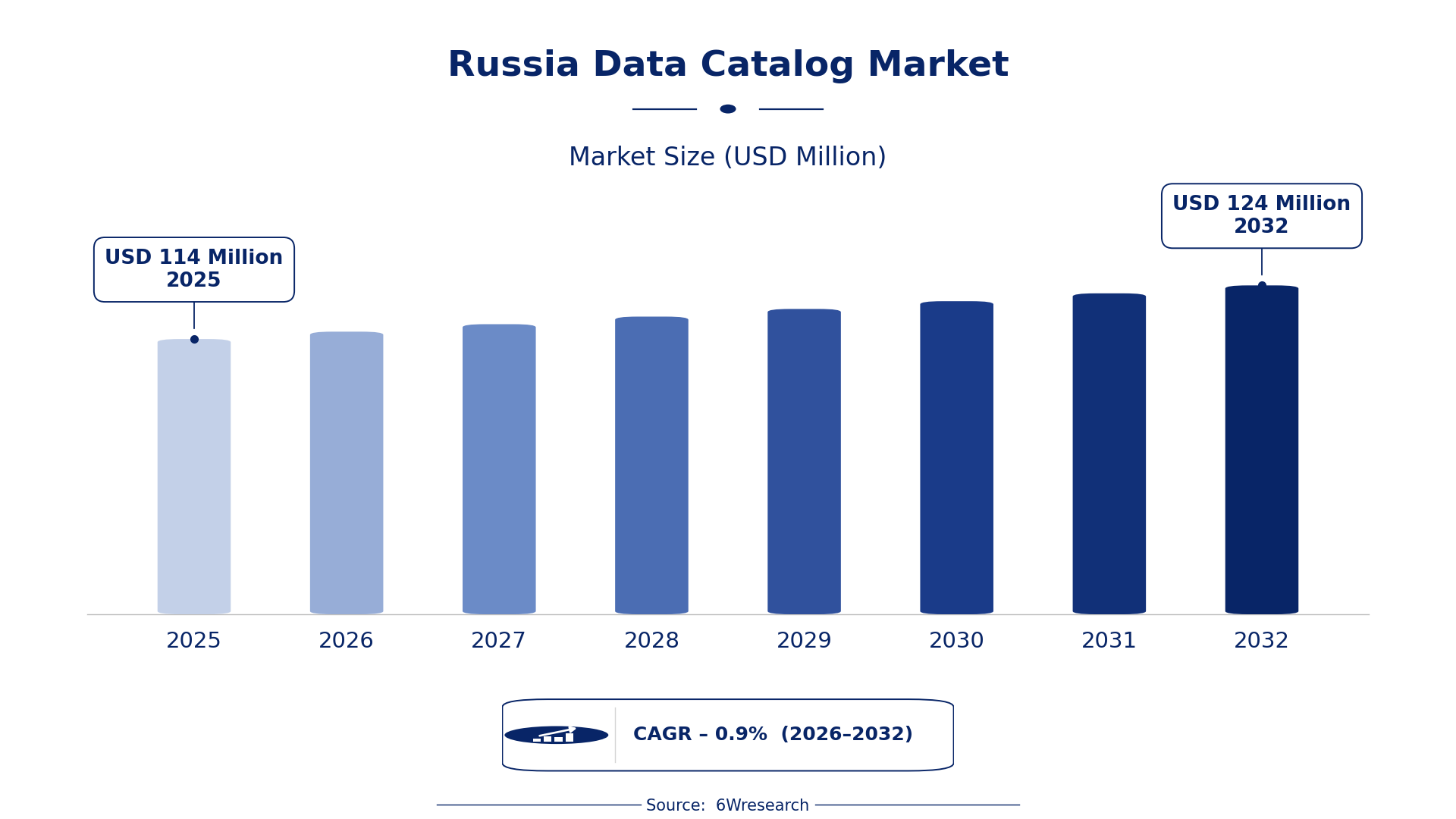
The Russia Data Catalog Market was estimated at USD 114 Million in 2025 and is projected to reach USD 124 Million by 2032, growing at a CAGR of 0.9% from 2026 to 2032.
Russia Data Catalog Market Synopsis
The Russia Data Catalog Market is gaining traction as organizations across various sectors recognize the necessity of effective data management. With the influx of data generated daily, companies are increasingly adopting data catalog solutions to organize and utilize their data resources efficiently.
Industries such as finance, healthcare, and government are leading the charge, driven by the need for enhanced data quality and compliance with local regulations. As businesses prioritize data-driven decision-making, the adoption of cloud-based platforms and AI-enhanced tools is expected to accelerate significantly.
Russia Data Catalog Market Year-wise Growth Rate and Key Drivers
This graph illustrates the annual growth rates of the Russia Data Catalog Market from 2021 to 2032, highlighting a steady upward trajectory and projected expansion over the forecast period.
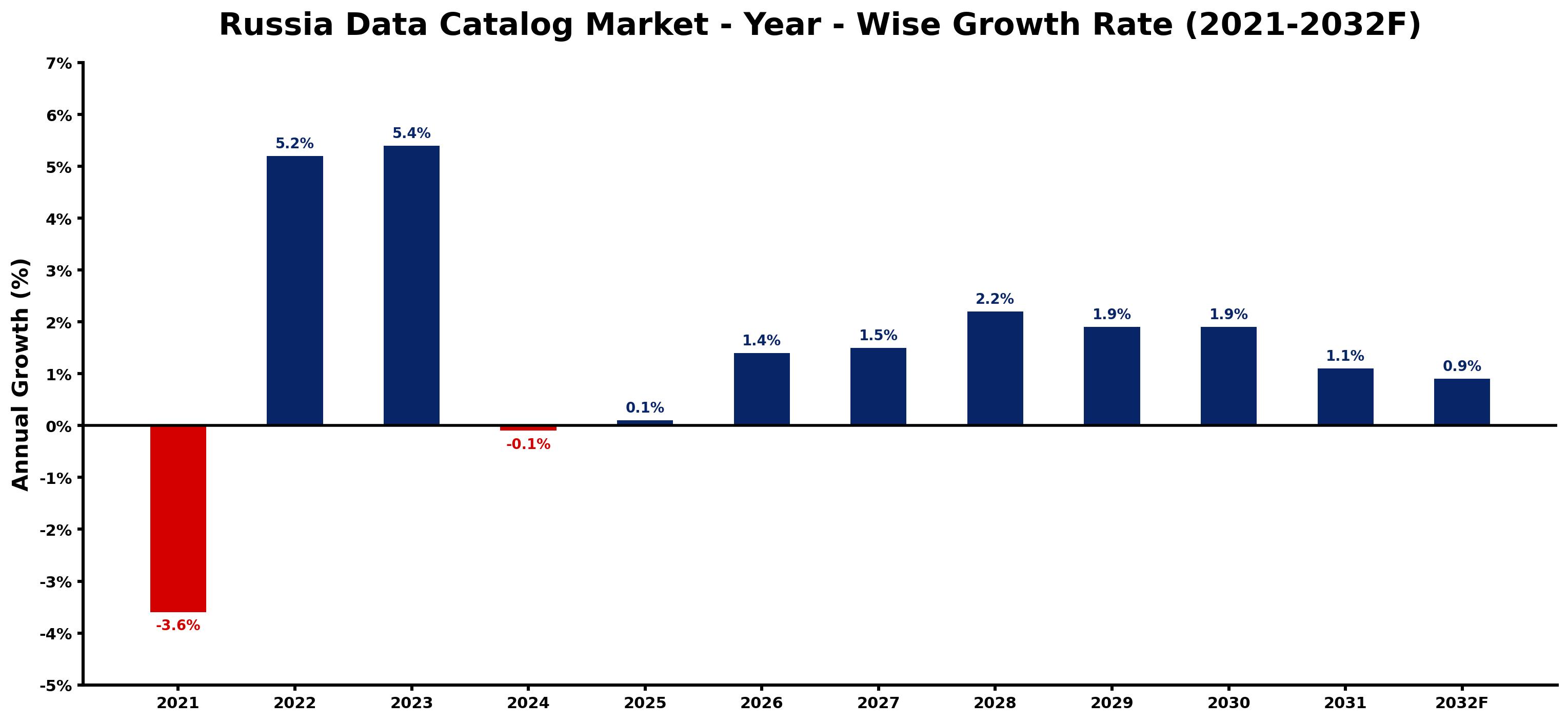
The table below presents the year‑wise growth rates along with the key drivers influencing the market
| Year | Growth Rate | Major Drivers |
| 2021 | -3.6% | Russian government's focus on import substitution policies |
| 2022 | 5.2% | Government support for digital transformation initiatives announced |
| 2023 | 5.4% | Growth in regulatory compliance driving cataloging of data |
| 2024 | -0.1% | Delayed data regulations by Roskomnadzor stifling innovation |
| 2025 | 0.1% | Increased investment in local AI research and development |
| 2026 | 1.4% | Emergence of data-driven startups enhancing market landscape |
| 2027 | 1.5% | Regulatory body mandates improved data catalog accessibility |
| 2028 | 2.2% | Growing interest in open data initiatives by municipalities |
| 2029 | 1.9% | Local businesses adopting cloud solutions for data management |
| 2030 | 1.9% | Public sector digitization projects increasing data catalog needs |
| 2031 | 1.1% | Rise in demand for data transparency among citizens |
| 2032 | 0.9% | Focus on data sovereignty influencing cataloging practices |
Note: Market size estimations and growth projections presented in this report are based on 6Wresearch's proprietary forecasting methodology, utilizing the latest available industry data, government publications, and primary research inputs.
Russia Data Catalog Market Key Takeaways
Below are some of the specific key takeaways from the market, including:
- The market is witnessing a rise in cloud-based data catalog solutions that support remote access and collaboration.
- AI integration in data catalog tools is becoming essential for automating data classification and governance.
- Regulatory compliance and data security are top priorities, influencing purchasing decisions in the market.
- Investment opportunities are growing as businesses seek tailored solutions to streamline data management processes.
- The increasing volume of data necessitates innovative solutions to improve data discovery and accessibility.
Evaluation of Restraints in Russia Data Catalog Market
Data privacy concerns and complex regulations are key limitations in the Russia Data Catalog Market. The stringent data localization laws mandate that personal data of Russian citizens be stored within the country, complicating matters for foreign vendors. Additionally, the absence of standardized data formats poses interoperability challenges, hindering effective data integration and quality assurance. Companies must navigate these obstacles carefully to build trustworthy data ecosystems.
Russia Data Catalog Market Trends
A shift toward cloud-based data catalog solutions is gaining momentum, driven by the need for remote accessibility and teamwork among distributed workforces. AI-powered tools are increasingly sought after, as they enhance data classification and streamline data governance. The emphasis on data security continues to rise, with organizations focusing on solutions that ensure compliance with national regulations while safeguarding sensitive information.
Russia Data Catalog Market Opportunities
There is substantial potential for growth in the Russia Data Catalog Market, especially as businesses seek advanced data management solutions. The rising demand for compliance-focused tools presents lucrative investment opportunities for firms that can provide tailored solutions. As organizations embrace data-driven strategies, the need for efficient data catalog solutions that enhance accessibility and facilitate better insights will likely increase.
Government Initiatives in the Russia Data Catalog Market
Government policy plays a significant role in shaping the Russia Data Catalog Market. Stricter regulations around data localization and protection have created a framework that companies must operate within. These regulations not only influence market entry for foreign entities but also impact how domestic companies develop their data solutions.
- A national data localization policy, enacted in 2025, requires all personal data of Russian citizens to be stored domestically.
- Currently ongoing assessments by the Federal Service for Supervision of Communications, Information Technology and Mass Media aim to ensure compliance with data protection laws.
- Plans are in place for an upcoming regulatory initiative aimed at streamlining data sharing processes while maintaining compliance with privacy standards.
- A public sector digitization programme launched in early 2025 is focused on improving data management practices across governmental agencies.
Future Insights of the Russia Data Catalog Market
Looking ahead to 2026-2032, the Russia Data Catalog Market is expected to expand as businesses increasingly recognize the value of effective data management. Adoption of innovative technologies such as AI and machine learning will enhance data catalog capabilities, further driving growth. As regulatory frameworks evolve, organizations will seek solutions that not only ensure compliance but also empower them to leverage their data assets for competitive advantage.
Russia Data Catalog Market Latest Developments
Recent activities in the Russia Data Catalog Market indicate a strong push towards innovation and compliance. Companies are actively investing in technology upgrades to meet the growing demand for effective data management solutions.
- A major technology vendor announced the launch of a new AI-driven data catalog platform in Q2 2025, aimed at enhancing data discovery and governance.
- An initiative that began in mid-2025 is currently underway, focusing on integrating cloud-based solutions within regional businesses to improve data access.
- By early 2026, a public-private partnership is expected to roll out a nationwide data management framework to enhance compliance and data quality.
- In late 2025, a leading regional operator completed a significant upgrade to its data catalog infrastructure, allowing for better data integration and security.
Russia Data Catalog Market - Key Attractiveness of the Report
- 10 Years of Market Numbers
- Historical Data Starting from 2022 to 2025
- Base Year: 2025
- Forecast Data until 2032
- Key Performance Indicators Impacting the Market
- Major Upcoming Developments and Projects
Key Highlights of the Report:
- Russia Data Catalog Market Outlook
- Market Size of Russia Data Catalog Market, 2025
- Forecast of Russia Data Catalog Market, 2032
- Historical Data and Forecast of Russia Data Catalog Revenues & Volume for the Period 2022-2032F
- Russia Data Catalog Market Trend Evolution
- Russia Data Catalog Market Drivers and Challenges
- Russia Data Catalog Price Trends
- Russia Data Catalog Porter's Five Forces
- Russia Data Catalog Industry Life Cycle
- Historical Data and Forecast of Russia Data Catalog Market Revenues & Volume By Component for the Period 2022-2032F
- Historical Data and Forecast of Russia Data Catalog Market Revenues & Volume By Solutions for the Period 2022-2032F
- Historical Data and Forecast of Russia Data Catalog Market Revenues & Volume By Services for the Period 2022-2032F
- Historical Data and Forecast of Russia Data Catalog Market Revenues & Volume By Data Consumer for the Period 2022-2032F
- Historical Data and Forecast of Russia Data Catalog Market Revenues & Volume By Business Intelligence tools for the Period 2022-2032F
- Historical Data and Forecast of Russia Data Catalog Market Revenues & Volume By Enterprise Applications for the Period 2022-2032F
- Historical Data and Forecast of Russia Data Catalog Market Revenues & Volume By Mobile and Web Applications for the Period 2022-2032F
- Historical Data and Forecast of Russia Data Catalog Market Revenues & Volume By Deployment Mode for the Period 2022-2032F
- Historical Data and Forecast of Russia Data Catalog Market Revenues & Volume By Cloud for the Period 2022-2032F
- Historical Data and Forecast of Russia Data Catalog Market Revenues & Volume By On-premises for the Period 2022-2032F
- Historical Data and Forecast of Russia Data Catalog Market Revenues & Volume By Metadata Type for the Period 2022-2032F
- Historical Data and Forecast of Russia Data Catalog Market Revenues & Volume By Technical Metadata for the Period 2022-2032F
- Historical Data and Forecast of Russia Data Catalog Market Revenues & Volume By Business Metadata for the Period 2022-2032F
- Historical Data and Forecast of Russia Data Catalog Market Revenues & Volume By Organization Size for the Period 2022-2032F
- Historical Data and Forecast of Russia Data Catalog Market Revenues & Volume By SMEs for the Period 2022-2032F
- Historical Data and Forecast of Russia Data Catalog Market Revenues & Volume By Large Enterprises for the Period 2022-2032F
- Historical Data and Forecast of Russia Data Catalog Market Revenues & Volume By Vertical for the Period 2022-2032F
- Historical Data and Forecast of Russia Data Catalog Market Revenues & Volume By BFSI for the Period 2022-2032F
- Historical Data and Forecast of Russia Data Catalog Market Revenues & Volume By Retail and eCommerce for the Period 2022-2032F
- Historical Data and Forecast of Russia Data Catalog Market Revenues & Volume By Manufacturing for the Period 2022-2032F
- Historical Data and Forecast of Russia Data Catalog Market Revenues & Volume By Government and Defence for the Period 2022-2032F
- Historical Data and Forecast of Russia Data Catalog Market Revenues & Volume By Healthcare and Life Sciences for the Period 2022-2032F
- Historical Data and Forecast of Russia Data Catalog Market Revenues & Volume By Telecom for the Period 2022-2032F
- Historical Data and Forecast of Russia Data Catalog Market Revenues & Volume By Media and Entertainment for the Period 2022-2032F
- Historical Data and Forecast of Russia Data Catalog Market Revenues & Volume By Transportation and Logistics for the Period 2022-2032F
- Russia Data Catalog Import Export Trade Statistics
- Market Opportunity Assessment By Component
- Market Opportunity Assessment By Data Consumer
- Market Opportunity Assessment By Deployment Mode
- Market Opportunity Assessment By Metadata Type
- Market Opportunity Assessment By Organization Size
- Market Opportunity Assessment By Vertical
- Russia Data Catalog Top Companies Market Share
- Russia Data Catalog Competitive Benchmarking By Technical and Operational Parameters
- Russia Data Catalog Company Profiles
- Russia Data Catalog Key Strategic Recommendations






































