Russia Debt Collection Software Market Size & Growth Rate (2026-2032)
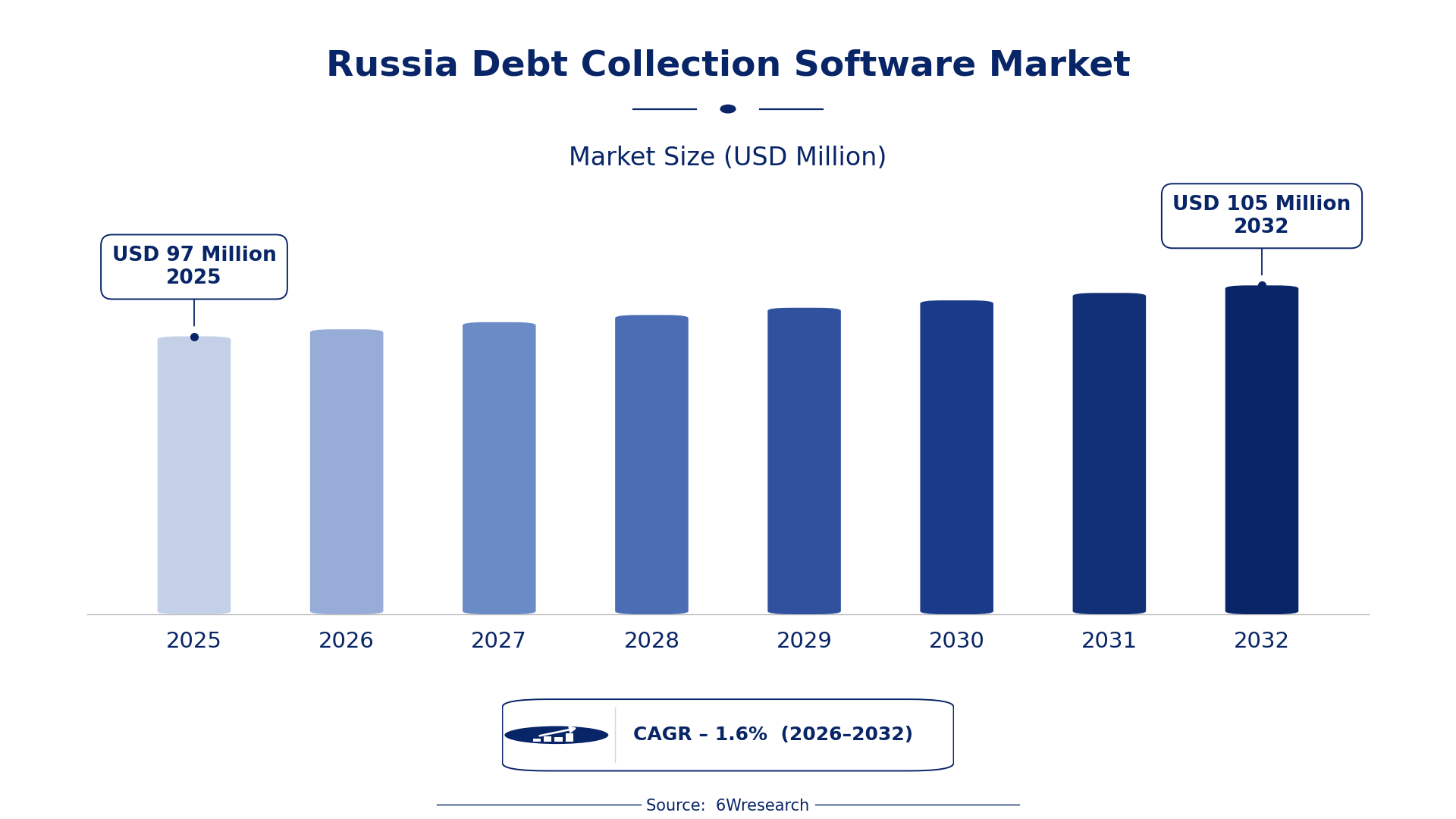
The Russia Debt Collection Software Market was estimated at USD 97 Million in 2025 and is projected to reach USD 105 Million by 2032, growing at a CAGR of 1.6% from 2026 to 2032.
Russia Debt Collection Software Market Synopsis
The demand for debt collection software in Russia is growing as businesses face increasing pressure to manage outstanding debts efficiently. With a rising number of non-performing loans, organizations are turning to technology to streamline their recovery processes and enhance operational efficiency.
This market is characterized by a mix of domestic and international software providers that cater to the unique needs of Russian businesses. Advances in artificial intelligence and automation are shaping the solutions offered, addressing both compliance requirements and the need for effective debt recovery strategies.
Russia Debt Collection Software Market Year-wise Growth Rate and Key Drivers
This graph illustrates the annual growth rates of the Russia Debt Collection Software Market from 2021 to 2032, highlighting a steady upward trajectory and projected expansion over the forecast period.
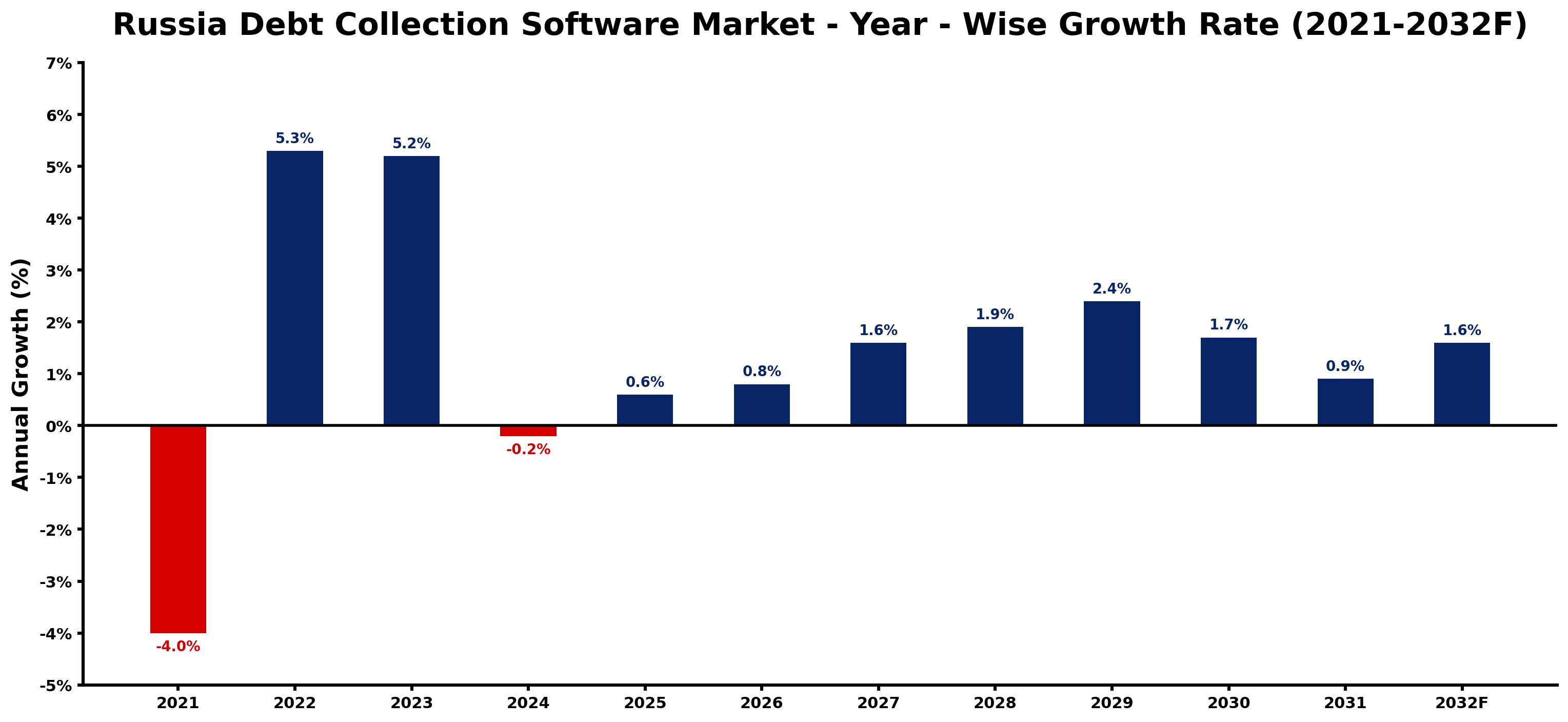
The table below presents the year‑wise growth rates along with the key drivers influencing the market
| Year | Growth Rate | Major Drivers |
| 2021 | -4.0% | Central Bank of Russia tightening credit regulations |
| 2022 | 5.3% | Increased regulatory enforcement by the Central Bank of Russia |
| 2023 | 5.2% | Demand for digital debt recovery solutions rises post-sanctions |
| 2024 | -0.2% | Rising localization requirements hinder foreign software access |
| 2025 | 0.6% | Growing need for personalized customer communication strategies |
| 2026 | 0.8% | Shift to remote debt collection due to economic challenges |
| 2027 | 1.6% | Adoption of AI in debt management by local firms |
| 2028 | 1.9% | Regulatory support for ethical debt recovery practices |
| 2029 | 2.4% | Digital transformation driving automation in collection processes |
| 2030 | 1.7% | Rising consumer awareness of credit rights and protections |
| 2031 | 0.9% | Increased collaboration between banks and software providers |
| 2032 | 1.6% | Evolving legal frameworks favoring online debt resolution |
Note: Market size estimations and growth projections presented in this report are based on 6Wresearch's proprietary forecasting methodology, utilizing the latest available industry data, government publications, and primary research inputs.
Russia Debt Collection Software Market Key Takeaways
Below are some of the specific key takeaways from the market, including:
- The market is driven by the increasing number of non-performing loans and a need for efficient debt recovery solutions.
- Technological advancements, especially in AI and automation, are transforming debt collection practices.
- Cloud-based software is gaining traction for its scalability and flexibility across various business sizes.
- Compliance with local regulations and data security are critical factors for software providers.
- The market presents investment opportunities for specialized software development tailored to Russian businesses.
Evaluation of Restraints in Russia Debt Collection Software Market
The regulatory environment in Russia poses significant challenges for debt collection software providers. The stringent laws governing debt collection practices require software solutions to be meticulously designed to ensure compliance, often complicating development efforts. Additionally, cultural attitudes towards debt repayment influence the effectiveness of these solutions, necessitating a nuanced approach in software design. The presence of a large informal economy also complicates collection efforts, demanding sophisticated tools that can adapt to varying debtor behaviors.
Russia Debt Collection Software Market Trends
A noticeable trend in the Russia Debt Collection Software Market is the increasing demand for automation and integration with existing financial systems. Companies are seeking solutions that not only enhance collection efficiency but also reduce operational costs through automated processes. on top of that, the shift toward cloud-based platforms is enabling organizations to achieve greater flexibility and scalability, making it easier for them to adapt to market demands.
Data security continues to be a top priority as firms look to comply with local regulations. This trend is pushing providers to develop software that prioritizes data protection while also ensuring compliance with the Federal Law on Personal Data.
Russia Debt Collection Software Market Opportunities
The market is ripe with opportunities as businesses increasingly recognize the value of advanced debt collection solutions. Investment prospects exist in developing tailored software that aligns with local regulatory requirements, offering features such as predictive analytics and automation. Companies can also explore partnerships to create comprehensive solutions that address the specific challenges of debt recovery in Russia, enhancing both efficiency and compliance.
Government Initiatives in the Russia Debt Collection Software Market
Government regulations significantly impact the Russia Debt Collection Software Market. The emphasis on data protection laws and fair debt collection practices shapes how software solutions are developed and deployed. With a focus on transparency and consumer protection, the government is fostering an environment that encourages compliance among software providers while promoting ethical debt recovery practices.
- A recently completed initiative involves the introduction of updated guidelines for data protection compliance among debt collection agencies, enhancing consumer trust.
- Currently underway is a nationwide training program aimed at educating debt collection agencies on ethical practices and compliance with local laws.
- A planned regulatory framework is expected to be introduced in 2026, mandating enhanced transparency in communication between creditors and debtors.
- The government is also implementing an oversight body to monitor compliance with debt collection practices, aimed at improving accountability in the industry.
- An initiative focusing on digital infrastructure improvements is anticipated to launch in 2027, facilitating better data management for debt recovery processes.
Future Insights of the Russia Debt Collection Software Market
Looking ahead to 2026-2032, the Russia Debt Collection Software Market is set to expand as businesses continue to prioritize efficient debt recovery solutions. The ongoing rise in non-performing loans, driven by economic fluctuations, will likely sustain the demand for innovative software solutions. As technology advances, organizations will seek more sophisticated tools that not only streamline debt recovery but also ensure compliance with evolving regulations, providing ample opportunities for software providers to innovate and grow.
Russia Debt Collection Software Market Latest Developments
Recent activity in the Russia Debt Collection Software Market highlights a strong push towards modernization and compliance. Over the past year, various companies have been working to enhance their product offerings to meet the demands of a changing regulatory environment while integrating new technologies.
- A leading technology vendor launched an upgraded version of its debt collection software in early 2025, featuring enhanced automation capabilities and compliance tools.
- An initiative that began in mid-2025 and remains underway focuses on integrating AI-driven analytics into existing debt collection systems for improved performance.
- A partnership between software developers and compliance experts was announced in Q1 2026, aiming to create a comprehensive solution that addresses legal requirements in debt collection.
- A major regional operator is planning to expand its cloud-based debt collection services by mid-2026, targeting businesses looking for scalable solutions.
- A pilot program for a new debt recovery framework is set to begin in late 2026, emphasizing ethical practices and improved debtor communication.
Russia Debt Collection Software Market - Key Attractiveness of the Report
- 10 Years of Market Numbers
- Historical Data Starting from 2022 to 2025
- Base Year: 2025
- Forecast Data until 2032
- Key Performance Indicators Impacting the Market
- Major Upcoming Developments and Projects
Key Highlights of the Report:
- Russia Debt Collection Software Market Outlook
- Market Size of Russia Debt Collection Software Market, 2025
- Forecast of Russia Debt Collection Software Market, 2032
- Historical Data and Forecast of Russia Debt Collection Software Revenues & Volume for the Period 2022-2032F
- Russia Debt Collection Software Market Trend Evolution
- Russia Debt Collection Software Market Drivers and Challenges
- Russia Debt Collection Software Price Trends
- Russia Debt Collection Software Porter's Five Forces
- Russia Debt Collection Software Industry Life Cycle
- Historical Data and Forecast of Russia Debt Collection Software Market Revenues & Volume By Component for the Period 2022-2032F
- Historical Data and Forecast of Russia Debt Collection Software Market Revenues & Volume By Software for the Period 2022-2032F
- Historical Data and Forecast of Russia Debt Collection Software Market Revenues & Volume By Services for the Period 2022-2032F
- Historical Data and Forecast of Russia Debt Collection Software Market Revenues & Volume By User Type for the Period 2022-2032F
- Historical Data and Forecast of Russia Debt Collection Software Market Revenues & Volume By Financial Institutions for the Period 2022-2032F
- Historical Data and Forecast of Russia Debt Collection Software Market Revenues & Volume By Collection Agencies for the Period 2022-2032F
- Historical Data and Forecast of Russia Debt Collection Software Market Revenues & Volume By Healthcare for the Period 2022-2032F
- Historical Data and Forecast of Russia Debt Collection Software Market Revenues & Volume By Government for the Period 2022-2032F
- Historical Data and Forecast of Russia Debt Collection Software Market Revenues & Volume By Telecom & Utilities for the Period 2022-2032F
- Historical Data and Forecast of Russia Debt Collection Software Market Revenues & Volume By Others for the Period 2022-2032F
- Historical Data and Forecast of Russia Debt Collection Software Market Revenues & Volume By Deployment Type for the Period 2022-2032F
- Historical Data and Forecast of Russia Debt Collection Software Market Revenues & Volume By On-Premises for the Period 2022-2032F
- Historical Data and Forecast of Russia Debt Collection Software Market Revenues & Volume By Cloud for the Period 2022-2032F
- Historical Data and Forecast of Russia Debt Collection Software Market Revenues & Volume By Organization Size for the Period 2022-2032F
- Historical Data and Forecast of Russia Debt Collection Software Market Revenues & Volume By SMEs for the Period 2022-2032F
- Historical Data and Forecast of Russia Debt Collection Software Market Revenues & Volume By Large Enterprises for the Period 2022-2032F
- Russia Debt Collection Software Import Export Trade Statistics
- Market Opportunity Assessment By Component
- Market Opportunity Assessment By User Type
- Market Opportunity Assessment By Deployment Type
- Market Opportunity Assessment By Organization Size
- Russia Debt Collection Software Top Companies Market Share
- Russia Debt Collection Software Competitive Benchmarking By Technical and Operational Parameters
- Russia Debt Collection Software Company Profiles
- Russia Debt Collection Software Key Strategic Recommendations






































