Russia Digital Lending Market Size & Growth Rate (2026-2032)
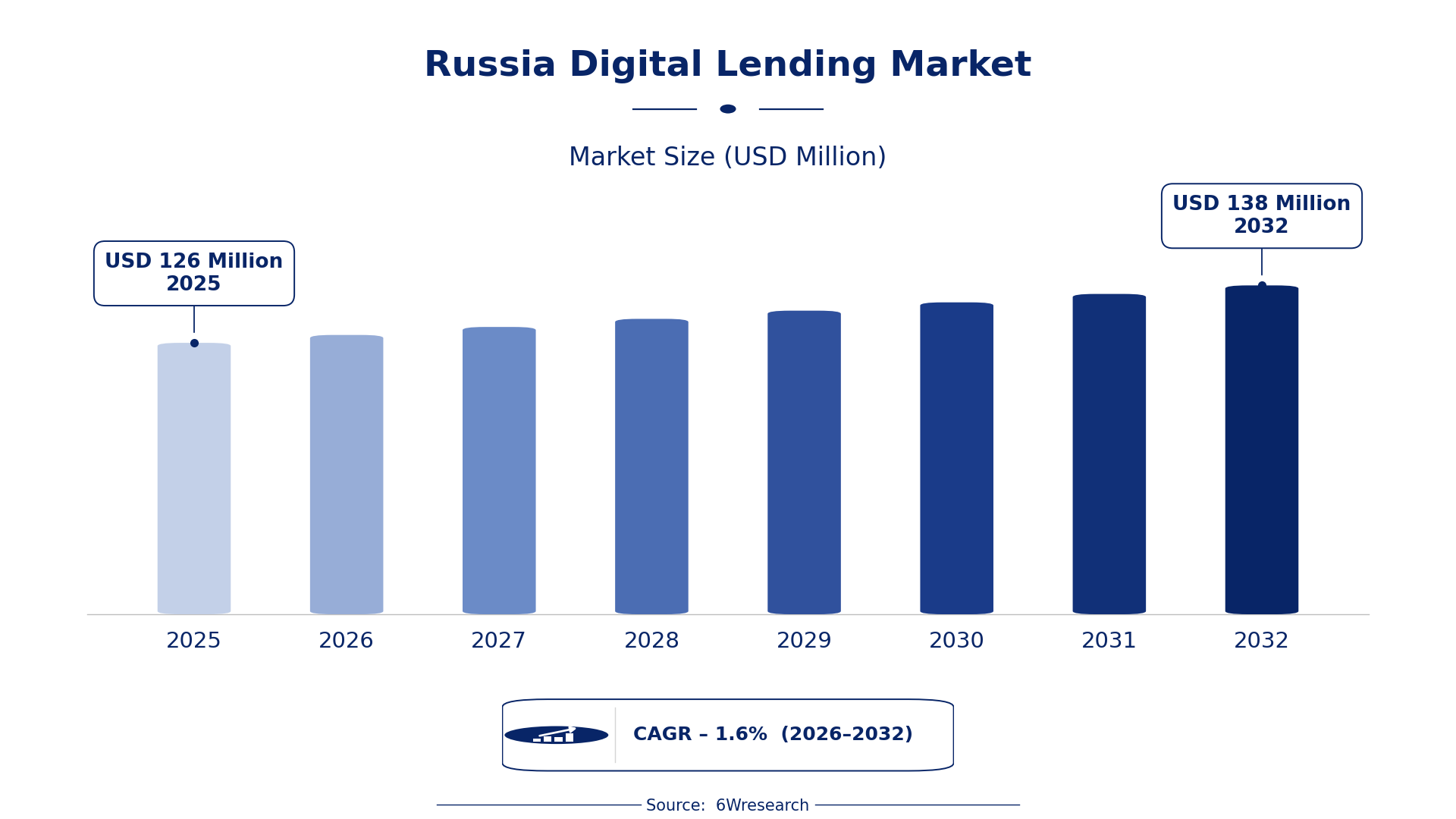
The Russia Digital Lending Market was estimated at USD 126 Million in 2025 and is projected to reach USD 138 Million by 2032, growing at a CAGR of 1.6% from 2026 to 2032.
Russia Digital Lending Market Synopsis
The Russia Digital Lending Market is witnessing a surge in activity, fueled by a population increasingly reliant on digital financial solutions. This shift is driven by rapid smartphone adoption and an internet-savvy middle class seeking accessible credit options.
Traditional banks and nimble fintech firms are both vying for market share, offering diverse products like payday loans and peer-to-peer lending. Regulatory frameworks are evolving, aiming to safeguard consumers while encouraging innovation, further enhancing the market's dynamics.
Russia Digital Lending Market Year-wise Growth Rate and Key Drivers
This graph illustrates the annual growth rates of the Russia Digital Lending Market from 2021 to 2032, highlighting a steady upward trajectory and projected expansion over the forecast period.
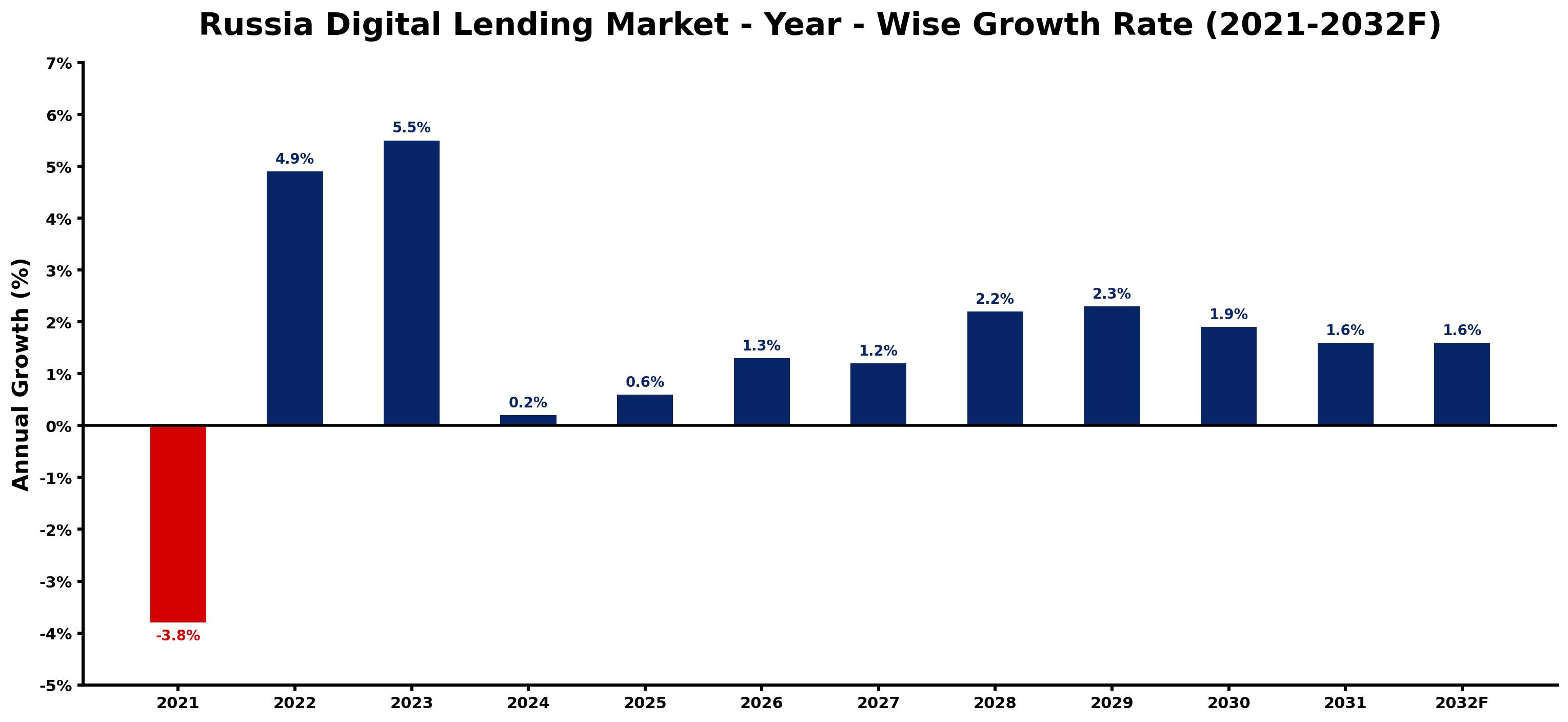
The table below presents the year‑wise growth rates along with the key drivers influencing the market
| Year | Growth Rate | Major Drivers |
| 2021 | -3.8% | Tightened Central Bank lending regulations stifled consumer borrowing. |
| 2022 | 4.9% | Increased adoption of fintech solutions by consumers. |
| 2023 | 5.5% | Enhanced digital verification processes by the Central Bank. |
| 2024 | 0.2% | Growth in mobile payment integration within lending platforms. |
| 2025 | 0.6% | Strong demand for personal loans among young professionals. |
| 2026 | 1.3% | Rise in e-commerce spending boosting online credit services. |
| 2027 | 1.2% | Increased regulatory support for digital lending startups. |
| 2028 | 2.2% | Growing acceptance of alternative credit scoring methods. |
| 2029 | 2.3% | Emergence of P2P lending platforms gaining popularity. |
| 2030 | 1.9% | Focus on improving financial literacy among consumers. |
| 2031 | 1.6% | Increased partnerships between banks and technology firms. |
| 2032 | 1.6% | Rise in demand for instant credit solutions. |
Note: Market size estimations and growth projections presented in this report are based on 6Wresearch's proprietary forecasting methodology, utilizing the latest available industry data, government publications, and primary research inputs.
Russia Digital Lending Market Key Takeaways
Below are some of the specific key takeaways from the market, including:
- The market is characterized by a growing demand for mobile lending applications.
- Fintech companies are increasingly providing AI-driven credit scoring models.
- Regulatory developments are focusing on consumer protection and financial inclusion.
- There is an emerging trend towards instant loan approval processes.
- Partnerships between traditional banks and fintech firms are becoming more common.
Evaluation of Restraints in Russia Digital Lending Market
Despite its growth trajectory, the Russia Digital Lending Market faces notable restraints. A complex and ever-changing regulatory environment poses uncertainty for lenders. Many companies struggle with an underdeveloped credit infrastructure, making it challenging to accurately assess borrower creditworthiness. on top of that, low levels of financial literacy among the population create risks, such as overborrowing and defaults. These issues can hinder the market's overall stability and growth potential.
Russia Digital Lending Market Trends
Several trends are shaping the future of the Russia Digital Lending Market. First, there’s a marked increase in consumer preference for digital platforms that offer quick access to funds. Mobile applications are becoming essential tools for borrowers, facilitating loan applications and approvals at their fingertips. Additionally, the rise of peer-to-peer lending platforms is providing consumers with alternative financing options that bypass traditional banks. Regulatory changes are also ensuring that these platforms operate within a consumer-friendly framework, enhancing trust in digital lending.
Russia Digital Lending Market Opportunities
The market is ripe with investment opportunities, particularly in fintech solutions catering to the growing demand for digital services. Peer-to-peer lending and microcredit platforms are gaining popularity, presenting attractive avenues for investors. As the middle class expands, the need for accessible credit options will likely lead to further innovations in digital lending. Collaborations between fintech startups and established financial institutions can also drive growth, creating a more competitive environment that benefits consumers.
Government Initiatives in the Russia Digital Lending Market
The Russian government is taking a proactive approach in regulating the digital lending sector, focusing on consumer protection and market stability. By instituting clear guidelines, the authorities aim to foster a secure environment for both lenders and borrowers. These regulations are essential in promoting trust and transparency within the digital lending ecosystem.
- A licensing requirement for digital lenders was established by the Central Bank of Russia to ensure credibility.
- Recent initiatives include the introduction of interest rate caps to prevent predatory lending practices.
- Current efforts are focused on developing a regulatory framework for advertising transparency in digital lending.
- Upcoming policies are expected to promote financial literacy programs aimed at educating consumers about borrowing.
- A national initiative for enhancing digital infrastructure is underway, aimed at supporting the fintech sector.
Future Insights of the Russia Digital Lending Market
Looking ahead to 2026-2032, the Russia Digital Lending Market is set for continued expansion. As internet access improves and smartphone usage becomes ubiquitous, more consumers will likely turn to digital lending solutions. The ongoing development of innovative financial products will cater to diverse consumer needs, while regulatory frameworks will adapt to support a safer lending environment. However, the market must remain vigilant against potential data security threats and competitive pressures that could influence its dynamics.
Russia Digital Lending Market Latest Developments
In the past year, the Russia Digital Lending Market has seen a flurry of activity, reflecting the growing interest from both consumers and investors. Companies are increasingly adopting advanced technologies to improve their services and maintain a competitive edge. The trend towards digitalization is evident, with many players enhancing their platforms to offer better user experiences.
- A major fintech firm launched an AI-driven credit scoring system in early 2025, aimed at improving loan approval times.
- In mid-2025, a collaboration between a leading bank and a fintech startup was initiated, focusing on expanding online loan offerings.
- A new regulatory framework mandating transparent loan agreements was introduced in late 2025, enhancing consumer protection.
- Currently, a national campaign is underway to boost financial literacy among the populace, expected to run through 2026.
- Plans for a major digital infrastructure upgrade to support online lending are slated to begin in early 2026.
Russia Digital Lending Market - Key Attractiveness of the Report
- 10 Years of Market Numbers
- Historical Data Starting from 2022 to 2025
- Base Year: 2025
- Forecast Data until 2032
- Key Performance Indicators Impacting the Market
- Major Upcoming Developments and Projects
Key Highlights of the Report:
- Russia Digital Lending Market Outlook
- Market Size of Russia Digital Lending Market, 2025
- Forecast of Russia Digital Lending Market, 2032
- Historical Data and Forecast of Russia Digital Lending Revenues & Volume for the Period 2022-2032F
- Russia Digital Lending Market Trend Evolution
- Russia Digital Lending Market Drivers and Challenges
- Russia Digital Lending Price Trends
- Russia Digital Lending Porter's Five Forces
- Russia Digital Lending Industry Life Cycle
- Historical Data and Forecast of Russia Digital Lending Market Revenues & Volume By Offering for the Period 2022-2032F
- Historical Data and Forecast of Russia Digital Lending Market Revenues & Volume By Solutions for the Period 2022-2032F
- Historical Data and Forecast of Russia Digital Lending Market Revenues & Volume By Services for the Period 2022-2032F
- Historical Data and Forecast of Russia Digital Lending Market Revenues & Volume By Deployment Mode for the Period 2022-2032F
- Historical Data and Forecast of Russia Digital Lending Market Revenues & Volume By Cloud for the Period 2022-2032F
- Historical Data and Forecast of Russia Digital Lending Market Revenues & Volume By On-premises for the Period 2022-2032F
- Historical Data and Forecast of Russia Digital Lending Market Revenues & Volume By End User for the Period 2022-2032F
- Historical Data and Forecast of Russia Digital Lending Market Revenues & Volume By Banks for the Period 2022-2032F
- Historical Data and Forecast of Russia Digital Lending Market Revenues & Volume By Credit Unions for the Period 2022-2032F
- Historical Data and Forecast of Russia Digital Lending Market Revenues & Volume By NBFCs for the Period 2022-2032F
- Russia Digital Lending Import Export Trade Statistics
- Market Opportunity Assessment By Offering
- Market Opportunity Assessment By Deployment Mode
- Market Opportunity Assessment By End User
- Russia Digital Lending Top Companies Market Share
- Russia Digital Lending Competitive Benchmarking By Technical and Operational Parameters
- Russia Digital Lending Company Profiles
- Russia Digital Lending Key Strategic Recommendations






































