Russia Document Management System Market Size, Share & Growth Rate
The Russia Document Management System Market was estimated at USD 137 Million in 2025 and is projected to reach USD 150 Million by 2032, growing at a CAGR of 1.3% from 2026 to 2032. This growth trajectory is largely fueled by the accelerated digitalization across sectors, alongside governmental pushes for more efficient and transparent operations. Organizations are increasingly recognizing the critical role DMS plays in optimizing workflows and ensuring compliance with stringent regulations.
Russia Document Management System Market Year-wise Growth Rate and Key Drivers
This graph highlights how the Russia Document Management System Market has steadily grown over the years, supported by major growth factors.
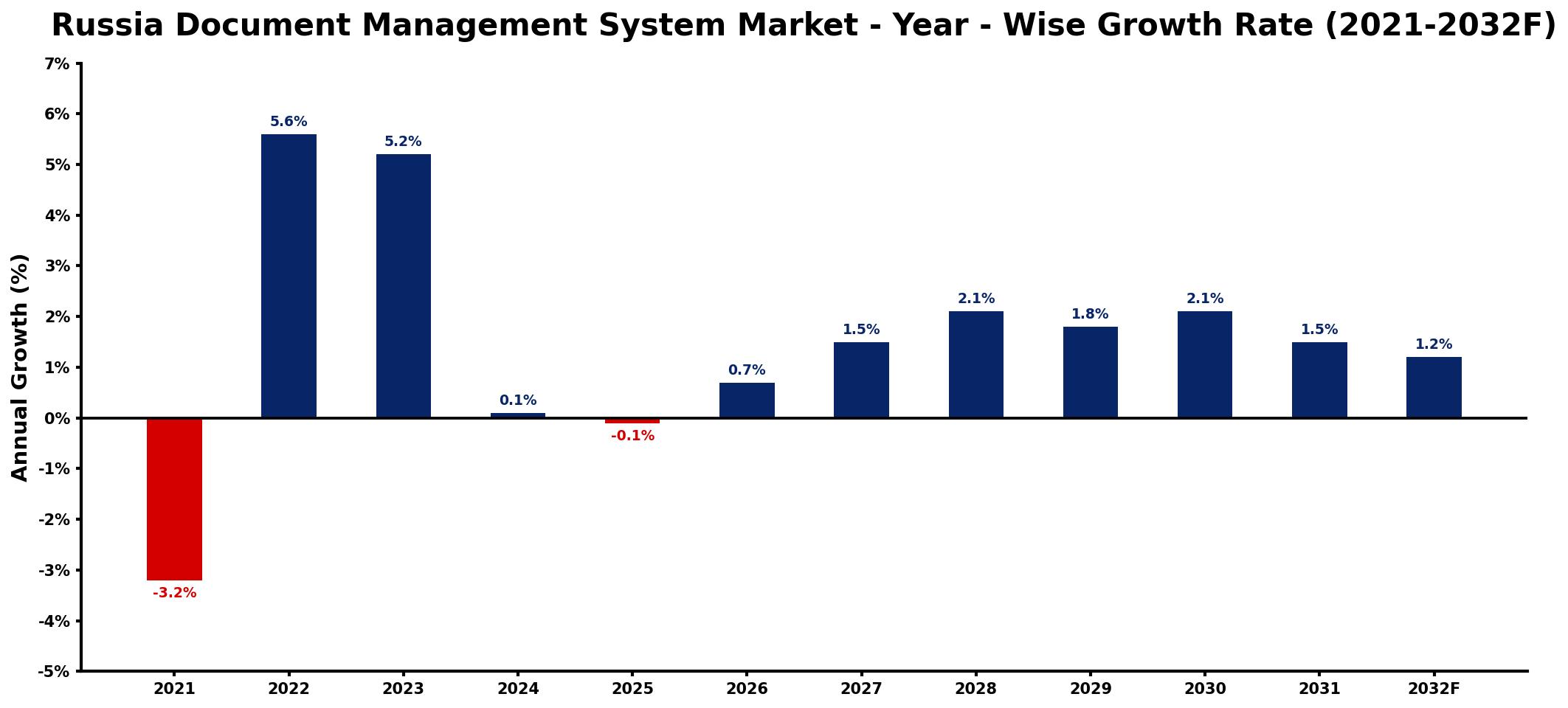
The table below presents the year‑wise growth rates along with the key drivers influencing the market
| Year | Growth Rate | Major Drivers |
| 2021 | -3.2% | decreased enterprise investment activities |
| 2022 | 5.6% | growing adoption of digital solutions |
| 2023 | 5.2% | increased regulatory compliance requirements |
| 2024 | 0.1% | expansion of remote work practices |
| 2025 | -0.1% | declining traditional paper usage |
| 2026 | 0.7% | rising focus on data security |
| 2027 | 1.5% | enhanced operational efficiency initiatives |
| 2028 | 2.1% | growing integration with cloud services |
| 2029 | 1.8% | increased interest in automation tools |
| 2030 | 2.1% | expanding demand for mobile access |
| 2031 | 1.5% | growing need for collaboration platforms |
| 2032 | 1.2% | increased investment in IT infrastructure |
Note: Market size estimations and growth projections presented in this report are based on 6Wresearch's proprietary forecasting methodology, utilizing the latest available industry data, government publications, and primary research inputs.
Russia Document Management System Market Synopsis
The demand for advanced document management solutions in Russia is primarily driven by a collective shift towards digital processes and away from traditional paper-based systems. This transition is supported by both private organizations and public sector initiatives aimed at enhancing productivity and data security.
Furthermore, as the market evolves, there is a notable uptick in the adoption of cloud-based DMS technologies, which facilitate seamless integration with existing business applications. Enhanced security measures and compliance features are increasingly prioritized, reflecting a robust demand for solutions that protect sensitive information in a challenging regulatory landscape.
Russia Document Management System Market Key Takeaways
- The Russia DMS market is experiencing steady growth due to digital transformation initiatives across various sectors.
- Cloud-based solutions are becoming the preferred choice for organizations looking for flexibility and scalability.
- There is an increasing focus on data security and compliance, driving demand for advanced encryption and access controls.
- Integration capabilities with other business systems are pivotal for enhancing operational efficiency.
- Government policies are actively supporting the adoption of electronic document management systems in the public and private sectors.
Evaluation of Restraints in Russia Document Management System Market
Despite the growth potential, the Russia DMS market faces significant barriers that could impede progress. Concerns about data security and privacy remain prominent, particularly in light of stringent government regulations governing information. Additionally, many organizations still cling to entrenched paper-based practices, which can hinder the transition to digital systems. Smaller enterprises often struggle with the high costs associated with implementation and maintenance, alongside a lack of awareness regarding the advantages of DMS. Furthermore, interoperability issues with existing infrastructure and the necessity for comprehensive training to facilitate effective adoption represent real challenges that stakeholders must navigate.
Russia Document Management System Market Trends
The market is increasingly witnessing a shift towards user-friendly, mobile-compatible document management solutions, driven by the rise in remote work dynamics. Organizations are prioritizing technologies that not only enhance collaboration but also streamline document workflows. Furthermore, the integration of artificial intelligence and machine learning into DMS is gaining traction, enabling advanced document processing capabilities and improved data management. These trends collectively underscore a clear movement towards more sophisticated, accessible, and efficient document management systems tailored to meet the unique needs of Russian businesses.
Russia Document Management System Market Opportunities
The Russia Document Management System market offers abundant opportunities for innovation and growth, particularly as organizations strive to digitize and automate their operations. Investing in solutions that emphasize cloud technology, advanced security protocols, and seamless integration with legacy systems is critical. The focus on compliance with local regulations and data protection laws opens up avenues for developers who can deliver tailored DMS solutions catering to the specific requirements of various industries. By aligning offerings with the growing demand for digital transformation, vendors can capitalize on this emerging market.
Government Initiatives in the Russia Document Management System Market
The Russian government has enacted a series of initiatives aimed at enhancing digitalization across public and private sectors. Key policies focus on data localization, requiring companies to store personal data of Russian citizens within the country, and implementing stringent data protection regulations. These efforts are designed to foster an environment conducive to the adoption of electronic document management systems, improving both efficiency and transparency. Moreover, the government provides support programs and incentives to promote the development of domestic DMS solutions, thereby reducing reliance on foreign technologies.
Future Insights of the Russia Document Management System Market
Looking ahead to 2026-2032, the Russia Document Management System market is poised for sustained growth driven by ongoing digitalization initiatives and the escalating need for operational efficiency. As more businesses recognize the advantages of integrated document management systems, the market is likely to see increased investment in advanced technologies, including AI-driven functionalities. Organizations will continue to prioritize user-friendly interfaces and customizable solutions, reflecting an ongoing commitment to enhance collaboration and streamline workflows in an increasingly competitive landscape.
Russia Document Management System Market Latest Developments (2025 - 2026)
Recent developments in the Russia DMS market have highlighted a growing emphasis on security enhancements and user experience improvements. The integration of AI technologies has gained momentum, with new solutions entering the market that leverage machine learning for document processing. Additionally, businesses are increasingly investing in mobile-compatible DMS options to cater to the needs of a remote workforce. Public sector initiatives are also evolving, with increased funding allocated for electronic document management system implementations to boost efficiency across governmental departments.
Russia Document Management System Market - Key Attractiveness of the Report
- 10 Years of Market Numbers
- Historical Data Starting from 2022 to 2025
- Base Year: 2025
- Forecast Data until 2032
- Key Performance Indicators Impacting the Market
- Major Upcoming Developments and Projects
Key Highlights of the Report:
- Russia Document Management System Market Outlook
- Market Size of Russia Document Management System Market, 2025
- Forecast of Russia Document Management System Market, 2032
- Historical Data and Forecast of Russia Document Management System Revenues & Volume for the Period 2022-2032F
- Russia Document Management System Market Trend Evolution
- Russia Document Management System Market Drivers and Challenges
- Russia Document Management System Price Trends
- Russia Document Management System Porter's Five Forces
- Russia Document Management System Industry Life Cycle
- Historical Data and Forecast of Russia Document Management System Market Revenues & Volume By Component for the Period 2022-2032F
- Historical Data and Forecast of Russia Document Management System Market Revenues & Volume By Solution for the Period 2022-2032F
- Historical Data and Forecast of Russia Document Management System Market Revenues & Volume By Services for the Period 2022-2032F
- Historical Data and Forecast of Russia Document Management System Market Revenues & Volume By Deployment for the Period 2022-2032F
- Historical Data and Forecast of Russia Document Management System Market Revenues & Volume By Cloud for the Period 2022-2032F
- Historical Data and Forecast of Russia Document Management System Market Revenues & Volume By On-Premises for the Period 2022-2032F
- Historical Data and Forecast of Russia Document Management System Market Revenues & Volume By Organization Size for the Period 2022-2032F
- Historical Data and Forecast of Russia Document Management System Market Revenues & Volume By Large Enterprises for the Period 2022-2032F
- Historical Data and Forecast of Russia Document Management System Market Revenues & Volume By Small & Medium Enterprises for the Period 2022-2032F
- Historical Data and Forecast of Russia Document Management System Market Revenues & Volume By Industry for the Period 2022-2032F
- Historical Data and Forecast of Russia Document Management System Market Revenues & Volume By BFSI for the Period 2022-2032F
- Historical Data and Forecast of Russia Document Management System Market Revenues & Volume By IT & Telecommunication for the Period 2022-2032F
- Historical Data and Forecast of Russia Document Management System Market Revenues & Volume By Government for the Period 2022-2032F
- Historical Data and Forecast of Russia Document Management System Market Revenues & Volume By Manufacturing for the Period 2022-2032F
- Historical Data and Forecast of Russia Document Management System Market Revenues & Volume By Retail for the Period 2022-2032F
- Historical Data and Forecast of Russia Document Management System Market Revenues & Volume By Healthcare for the Period 2022-2032F
- Historical Data and Forecast of Russia Document Management System Market Revenues & Volume By Others for the Period 2022-2032F
- Russia Document Management System Import Export Trade Statistics
- Market Opportunity Assessment By Component
- Market Opportunity Assessment By Deployment
- Market Opportunity Assessment By Organization Size
- Market Opportunity Assessment By Industry
- Russia Document Management System Top Companies Market Share
- Russia Document Management System Competitive Benchmarking By Technical and Operational Parameters
- Russia Document Management System Company Profiles
- Russia Document Management System Key Strategic Recommendations






































