Russia Financial Analytics Market Size & Growth Rate (2026-2032)
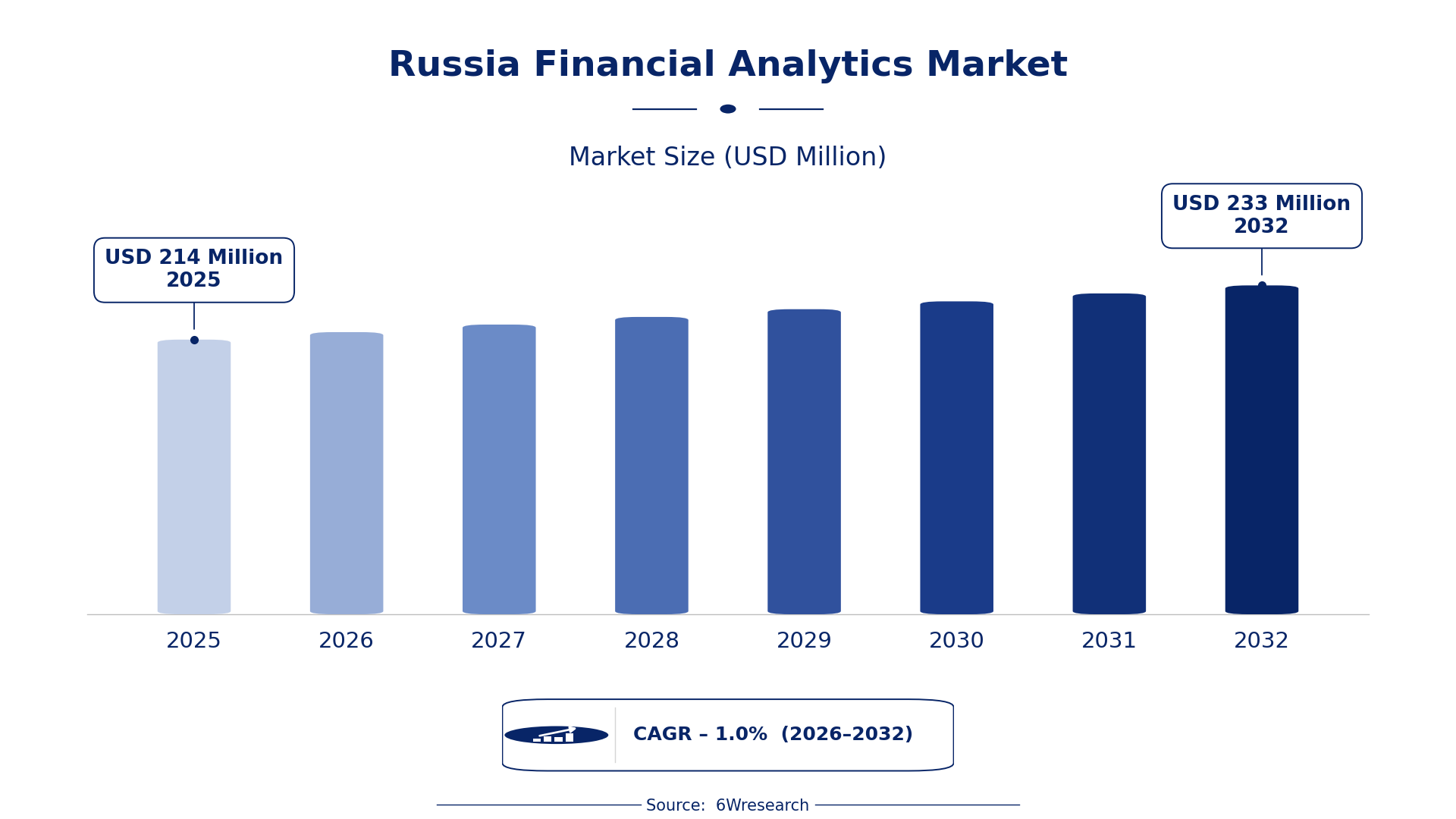
The Russia Financial Analytics Market was estimated at USD 214 Million in 2025 and is projected to reach USD 233 Million by 2032, growing at a CAGR of 1.0% from 2026 to 2032.
Russia Financial Analytics Market Synopsis
The Russian financial analytics sector is currently at a pivotal juncture, fueled by the integration of advanced technologies such as AI and big data analytics. Organizations are increasingly leveraging these tools to enhance their decision-making processes, improve financial performance, and adapt to regulatory requirements that are becoming more stringent.
As digital transformation becomes a priority, the demand for sophisticated financial analytics solutions is surging. This shift is driven by a need for real-time data analysis and actionable insights, positioning the market for further growth and innovation in the coming years.
Russia Financial Analytics Market Year-wise Growth Rate and Key Drivers
This graph illustrates the annual growth rates of the Russia Financial Analytics Market from 2021 to 2032, highlighting a steady upward trajectory and projected expansion over the forecast period.
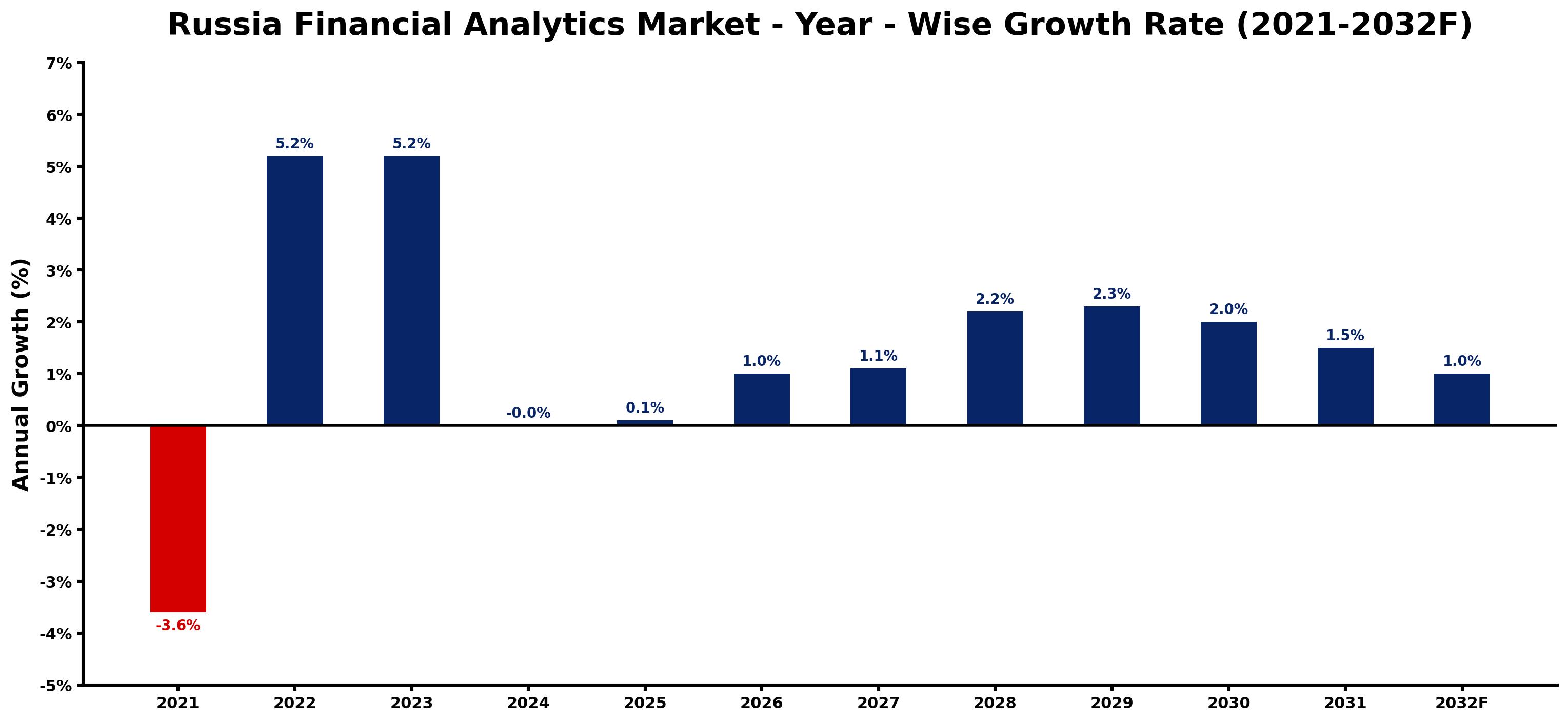
The table below presents the year‑wise growth rates along with the key drivers influencing the market
| Year | Growth Rate | Major Drivers |
| 2021 | -3.6% | Government sanctions hampered financial data transactions. |
| 2022 | 5.2% | Increased demand for compliance analytics post-Ukraine sanctions. |
| 2023 | 5.2% | Higher investment in AI for risk assessment technologies. |
| 2024 | -0.0% | Growing urbanization and commercial development |
| 2025 | 0.1% | Emerging fintech startups drive demand for analytics solutions. |
| 2026 | 1.0% | Government support for digital economy innovations boosts analytics. |
| 2027 | 1.1% | Need for enhanced financial reporting amid economic recovery. |
| 2028 | 2.2% | Growth in e-commerce transactions enhances analytics requirements. |
| 2029 | 2.3% | Rising cybersecurity threats necessitate advanced financial monitoring. |
| 2030 | 2.0% | Adaptation to new taxation policies boosts financial insights. |
| 2031 | 1.5% | Focus on sustainable investments increases financial analytics demand. |
| 2032 | 1.0% | Regulatory changes drive the need for enhanced reporting. |
Note: Market size estimations and growth projections presented in this report are based on 6Wresearch's proprietary forecasting methodology, utilizing the latest available industry data, government publications, and primary research inputs.
Russia Financial Analytics Market Key Takeaways
Below are some of the specific key takeaways from the market, including:
- The increasing adoption of AI and machine learning is reshaping financial analytics capabilities.
- Regulatory compliance and risk management are becoming critical focus areas for financial institutions.
- Real-time analytics tools are in high demand, enabling faster decision-making in a volatile environment.
- Investment opportunities are emerging in fintech and customized analytics solutions.
- Government policies are actively promoting local partnerships and technological advancements.
Evaluation of Restraints in Russia Financial Analytics Market
The Russia Financial Analytics Market faces notable restraints, primarily stemming from complex regulatory frameworks. The inconsistency in financial laws complicates data interpretation, making it challenging for analysts to operate effectively. Additionally, the lack of transparency in financial reporting hinders access to reliable data. Economic volatility, along with geopolitical uncertainties, further exacerbates the difficulties in trend forecasting and strategic planning. These factors necessitate a nuanced approach to data analysis and interpretation.
Russia Financial Analytics Market Trends
A shift towards AI-driven solutions is evident, as financial institutions seek to refine their data processing capabilities. This trend is complemented by an increasing focus on compliance and risk management tools, which are essential for navigating the regulatory landscape. Real-time analytics is becoming a baseline expectation, with organizations prioritizing immediate insights to keep pace with market dynamics. The emphasis on predictive analytics is also growing, as firms aim to proactively address potential financial risks.
Russia Financial Analytics Market Opportunities
Investment opportunities in the Russian Financial Analytics Market are abundant, particularly within the fintech sector. The demand for tailored analytics solutions is on the rise, driven by the need for enhanced decision-making in investment and asset management. Companies offering innovative data analytics services stand to gain significantly as the market matures. The ongoing digital transformation presents a fertile ground for investment in advanced analytics tools that can meet the evolving needs of financial institutions.
Government Initiatives in the Russia Financial Analytics Market
Government policies are playing a significant role in shaping the Russia Financial Analytics Market. The regulatory environment is designed to foster partnerships between foreign firms and local companies, ensuring that domestic players gain access to advanced analytics technologies. Such policies are crucial for strengthening the national financial sector and enhancing its competitive edge.
- A recently completed initiative mandates local partnerships for foreign analytics providers, promoting domestic industry growth.
- Currently underway is a regulatory framework aimed at enhancing data security in financial reporting, addressing potential vulnerabilities.
- Upcoming plans include a government-sponsored program to support the development of fintech startups focusing on analytics solutions.
- Ongoing incentives are being provided for companies investing in AI and machine learning technologies in the financial sector.
- A national initiative to upgrade digital infrastructure is expected to enhance data accessibility across financial institutions.
Future Insights of the Russia Financial Analytics Market
Looking ahead to 2026-2032, the Russia Financial Analytics Market is set for significant evolution. The convergence of AI, machine learning, and big data will drive more sophisticated analytics solutions. As financial institutions increasingly embrace data-driven decision-making, the demand for innovative tools will only intensify. A growing emphasis on compliance and risk management will further fuel market growth, alongside the expansion of fintech companies that cater to diverse client needs. This trajectory positions the market for sustained growth and innovation.
Russia Financial Analytics Market Latest Developments
Recent developments in the Russia Financial Analytics Market indicate a strong push towards technological advancement and innovation. Over the past year, financial institutions have ramped up their investments in analytics solutions, signaling a shift in strategic priorities.
- A major technology vendor launched an AI-powered analytics platform in early 2025, enhancing real-time data processing capabilities.
- An ongoing initiative began in mid-2025 to integrate machine learning models for risk assessment across leading banks.
- By mid-2026, a rollout of a new regulatory compliance tool is expected, aimed at streamlining reporting processes for financial institutions.
- A partnership between two fintech companies is currently underway to develop predictive analytics solutions for investment firms.
- A planned public-private collaboration set for late 2026 aims to improve data transparency and reporting standards in the financial sector.
Russia Financial Analytics Market - Key Attractiveness of the Report
- 10 Years of Market Numbers
- Historical Data Starting from 2022 to 2025
- Base Year: 2025
- Forecast Data until 2032
- Key Performance Indicators Impacting the Market
- Major Upcoming Developments and Projects
Key Highlights of the Report:
- Russia Financial Analytics Market Outlook
- Market Size of Russia Financial Analytics Market, 2025
- Forecast of Russia Financial Analytics Market, 2032
- Historical Data and Forecast of Russia Financial Analytics Revenues & Volume for the Period 2022-2032F
- Russia Financial Analytics Market Trend Evolution
- Russia Financial Analytics Market Drivers and Challenges
- Russia Financial Analytics Price Trends
- Russia Financial Analytics Porter's Five Forces
- Russia Financial Analytics Industry Life Cycle
- Historical Data and Forecast of Russia Financial Analytics Market Revenues & Volume By Components for the Period 2022-2032F
- Historical Data and Forecast of Russia Financial Analytics Market Revenues & Volume By Software for the Period 2022-2032F
- Historical Data and Forecast of Russia Financial Analytics Market Revenues & Volume By Services for the Period 2022-2032F
- Historical Data and Forecast of Russia Financial Analytics Market Revenues & Volume By Deployment Modes for the Period 2022-2032F
- Historical Data and Forecast of Russia Financial Analytics Market Revenues & Volume By On-premises for the Period 2022-2032F
- Historical Data and Forecast of Russia Financial Analytics Market Revenues & Volume By Cloud for the Period 2022-2032F
- Historical Data and Forecast of Russia Financial Analytics Market Revenues & Volume By Application for the Period 2022-2032F
- Historical Data and Forecast of Russia Financial Analytics Market Revenues & Volume By Wealth Management for the Period 2022-2032F
- Historical Data and Forecast of Russia Financial Analytics Market Revenues & Volume By Governance, Risk, and Compliance Management for the Period 2022-2032F
- Historical Data and Forecast of Russia Financial Analytics Market Revenues & Volume By Financial Forecasting and Budgeting for the Period 2022-2032F
- Historical Data and Forecast of Russia Financial Analytics Market Revenues & Volume By Customer Management for the Period 2022-2032F
- Historical Data and Forecast of Russia Financial Analytics Market Revenues & Volume By Transaction Monitoring for the Period 2022-2032F
- Historical Data and Forecast of Russia Financial Analytics Market Revenues & Volume By Claim Management for the Period 2022-2032F
- Historical Data and Forecast of Russia Financial Analytics Market Revenues & Volume By Fraud Detection and Prevention for the Period 2022-2032F
- Historical Data and Forecast of Russia Financial Analytics Market Revenues & Volume By Stock Management for the Period 2022-2032F
- Historical Data and Forecast of Russia Financial Analytics Market Revenues & Volume By Organization Size for the Period 2022-2032F
- Historical Data and Forecast of Russia Financial Analytics Market Revenues & Volume By Small and Medium-sized Enterprises (SMEs) for the Period 2022-2032F
- Historical Data and Forecast of Russia Financial Analytics Market Revenues & Volume By Large Enterprises for the Period 2022-2032F
- Historical Data and Forecast of Russia Financial Analytics Market Revenues & Volume By Verticals for the Period 2022-2032F
- Historical Data and Forecast of Russia Financial Analytics Market Revenues & Volume By Banking, Financial Services, and Insurance (BFSI) for the Period 2022-2032F
- Historical Data and Forecast of Russia Financial Analytics Market Revenues & Volume By Telecom and IT for the Period 2022-2032F
- Historical Data and Forecast of Russia Financial Analytics Market Revenues & Volume By Government for the Period 2022-2032F
- Historical Data and Forecast of Russia Financial Analytics Market Revenues & Volume By Energy and Utilities for the Period 2022-2032F
- Historical Data and Forecast of Russia Financial Analytics Market Revenues & Volume By Manufacturing and Automotive for the Period 2022-2032F
- Historical Data and Forecast of Russia Financial Analytics Market Revenues & Volume By Healthcare and Pharmaceutical for the Period 2022-2032F
- Historical Data and Forecast of Russia Financial Analytics Market Revenues & Volume By Retail and eCommerce for the Period 2022-2032F
- Historical Data and Forecast of Russia Financial Analytics Market Revenues & Volume By Media and Entertainment for the Period 2022-2032F
- Russia Financial Analytics Import Export Trade Statistics
- Market Opportunity Assessment By Components
- Market Opportunity Assessment By Deployment Modes
- Market Opportunity Assessment By Application
- Market Opportunity Assessment By Organization Size
- Market Opportunity Assessment By Verticals
- Russia Financial Analytics Top Companies Market Share
- Russia Financial Analytics Competitive Benchmarking By Technical and Operational Parameters
- Russia Financial Analytics Company Profiles
- Russia Financial Analytics Key Strategic Recommendations






































