Russia Gas Equipment Market Size, Share & Growth Rate
The Russia Gas Equipment Market was estimated at USD 222 Million in 2025 and is projected to reach USD 244 Million by 2032, growing at a CAGR of 1.4% from 2026 to 2032. This trajectory is primarily driven by the increasing adoption of natural gas as a cleaner energy source, especially in power generation and industrial applications. Moreover, ongoing investments in gas infrastructure and modernization initiatives by domestic manufacturers further bolster market confidence.
Russia Gas Equipment Market Year-wise Growth Rate and Key Drivers
This graph highlights how the Russia Gas Equipment Market has steadily grown over the years, supported by major growth factors.
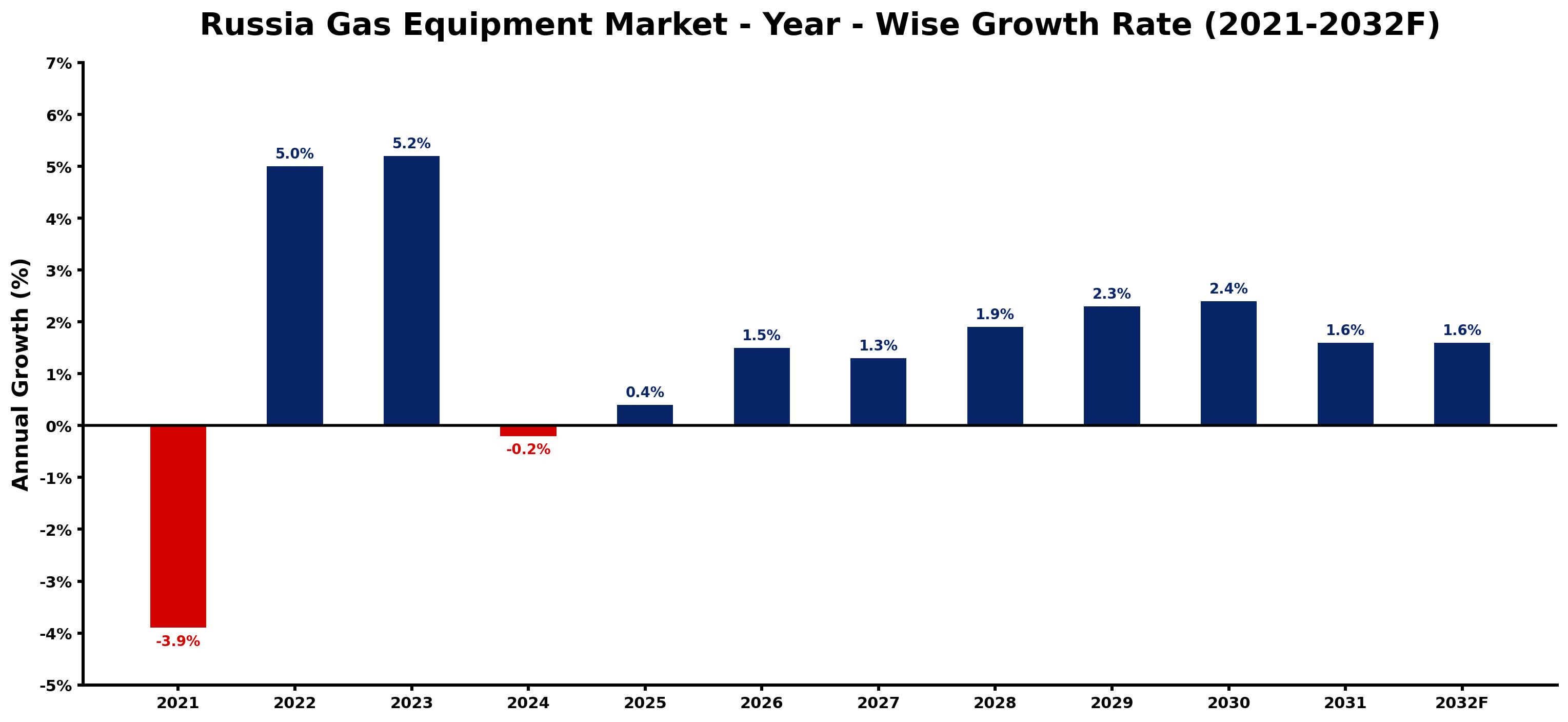
The table below presents the year‑wise growth rates along with the key drivers influencing the market
| Year | Growth Rate | Major Drivers |
| 2021 | -3.9% | Growing urbanization and commercial development |
| 2022 | 5.0% | Increasing adoption of advanced technologies |
| 2023 | 5.2% | Expansion of transportation and logistics networks |
| 2024 | -0.2% | Increasing industrial automation investments |
| 2025 | 0.4% | Increasing industrial infrastructure investments |
| 2026 | 1.5% | Increasing smart city development projects |
| 2027 | 1.3% | Increasing industrial automation investments |
| 2028 | 1.9% | Increasing smart city development projects |
| 2029 | 2.3% | Expansion of transportation and logistics networks |
| 2030 | 2.4% | Growing urbanization and commercial development |
| 2031 | 1.6% | Rapid growth in telecom and data center sectors |
| 2032 | 1.6% | Increasing adoption of advanced technologies |
Note - Market size estimations and growth projections presented in this report are based on 6Wresearch’s advanced forecasting approach, validated with industry datasets as of June 2026.
Russia Gas Equipment Market Synopsis
The Russia Gas Equipment Market is currently undergoing significant transformation, propelled by rising natural gas demand across various sectors. With a strong emphasis on energy efficiency and emissions reduction, the market is adapting to meet new regulatory and consumer expectations.
As domestic manufacturers expand their offerings, the landscape is becoming increasingly competitive. Innovations in technology, alongside government support for local production, are crucial to enhancing the sector's resilience and capability in meeting future demands.
Russia Gas Equipment Market Key Takeaways
- The market is experiencing steady growth, primarily driven by the demand for natural gas in multiple sectors.
- Domestic manufacturers are playing a vital role in providing a diverse range of gas equipment, including meters and compressors.
- Government initiatives are aimed at bolstering local production and ensuring energy security.
- Investment in infrastructure and technology is expected to shape the market's future trajectory.
- Challenges, including geopolitical factors and fluctuating oil prices, may influence market stability.
Evaluation of Restraints in Russia Gas Equipment Market
Despite its growth potential, the Russia Gas Equipment Market faces significant restraints that could hinder progress. Geopolitical tensions continue to create uncertainties, particularly in terms of foreign investment and access to international markets. Additionally, fluctuating oil and gas prices introduce volatility, impacting budgetary allocations for equipment and infrastructure development. Regulatory changes also pose challenges, as they often require rapid adaptation from manufacturers, which can strain resources. Together, these factors necessitate a comprehensive approach to navigate the complexities of the market landscape effectively.
Russia Gas Equipment Market Trends
Current trends in the Russia Gas Equipment Market reflect a significant shift towards cleaner energy sources. The growing preference for natural gas is driving the development of sophisticated technologies such as advanced compressors, valves, and metering solutions. Additionally, digitalization and automation are becoming integral to gas equipment systems, enhancing operational efficiency and reducing human error. As stakeholders increasingly prioritize sustainability, the adoption of eco-friendly and energy-efficient equipment is also on the rise, reflecting broader global trends in the energy sector.
Russia Gas Equipment Market Opportunities
The landscape for investment opportunities within the Russia Gas Equipment Market is rich and varied. Investors can capitalize on the burgeoning demand for natural gas by exploring ventures in the manufacturing of pipeline components, gas processing equipment, and liquefied natural gas (LNG) facilities. Furthermore, modernization projects aimed at upgrading aging infrastructure present significant prospects for companies specializing in advanced technologies. As Russia seeks to enhance its gas exports to Europe and Asia, innovative solutions that align with global environmental standards are likely to gain traction, making this a strategic time for investment.
Government Initiatives in the Russia Gas Equipment Market
Government policies are pivotal in shaping the Russia Gas Equipment Market, focusing on fostering domestic production and ensuring energy security. Initiatives include offering subsidies and incentives designed to stimulate local manufacturing capabilities, which ultimately enhances competitiveness. Furthermore, the government is actively working to diversify gas sources and strengthen the country's gas infrastructure. Such strategic public spending not only supports growth in the gas equipment sector but also aligns with national goals for sustainability and energy independence.
Future Insights of the Russia Gas Equipment Market
Looking ahead to 2026-2032, the Russia Gas Equipment Market is expected to capitalize on several positive trends. The continued shift towards natural gas as a cleaner energy alternative will likely sustain demand across various sectors. Furthermore, as the government persists in enhancing its energy infrastructure and promoting technological advancements, the market will be well-positioned for growth. Nevertheless, industry players must remain vigilant in addressing external challenges, including geopolitical dynamics and market fluctuations, to secure a competitive edge in this evolving landscape.
Russia Gas Equipment Market Latest Developments (May 2025 - June 2026)
In the most recent period, the Russia Gas Equipment Market has seen noteworthy developments, particularly in technological advancements aimed at improving energy efficiency and reducing emissions. Industry stakeholders are increasingly collaborating to innovate gas extraction and processing solutions. Additionally, the government continues to roll out supportive policies that foster domestic manufacturing capabilities, ensuring that local players can effectively compete within the global marketplace. These movements signal a proactive approach to navigate the dynamic challenges and opportunities present in the sector.
Russia Gas Equipment Market - Key Attractiveness of the Report
- 10 Years of Market Numbers
- Historical Data Starting from 2022 to 2025
- Base Year: 2025
- Forecast Data until 2032
- Key Performance Indicators Impacting the Market
- Major Upcoming Developments and Projects
Key Highlights of the Report:
- Russia Gas Equipment Market Outlook
- Market Size of Russia Gas Equipment Market, 2025
- Forecast of Russia Gas Equipment Market, 2032F
- Historical Data and Forecast of Russia Gas Equipment Revenues & Volume for the Period 2022-2032F
- Russia Gas Equipment Market Trend Evolution
- Russia Gas Equipment Market Drivers and Challenges
- Russia Gas Equipment Price Trends
- Russia Gas Equipment Porter's Five Forces
- Russia Gas Equipment Industry Life Cycle
- Historical Data and Forecast of Russia Gas Equipment Market Revenues & Volume By Equipment Type for the Period 2022-2032F
- Historical Data and Forecast of Russia Gas Equipment Market Revenues & Volume By Gas Delivery Systems for the Period 2022-2032F
- Historical Data and Forecast of Russia Gas Equipment Market Revenues & Volume By Gas Regulators for the Period 2022-2032F
- Historical Data and Forecast of Russia Gas Equipment Market Revenues & Volume By Flow Devices for the Period 2022-2032F
- Historical Data and Forecast of Russia Gas Equipment Market Revenues & Volume By Purifiers & Filters for the Period 2022-2032F
- Historical Data and Forecast of Russia Gas Equipment Market Revenues & Volume By Gas Generating Systems for the Period 2022-2032F
- Historical Data and Forecast of Russia Gas Equipment Market Revenues & Volume By Gas Detection Systems for the Period 2022-2032F
- Historical Data and Forecast of Russia Gas Equipment Market Revenues & Volume By Cryogenic Products for the Period 2022-2032F
- Historical Data and Forecast of Russia Gas Delivery Systems Gas Equipment Market Revenues & Volume By Accessories for the Period 2022-2032F
- Historical Data and Forecast of Russia Gas Equipment Market Revenues & Volume By Process for the Period 2022-2032F
- Historical Data and Forecast of Russia Gas Equipment Market Revenues & Volume By Gas Generation for the Period 2022-2032F
- Historical Data and Forecast of Russia Gas Equipment Market Revenues & Volume By Gas Storage for the Period 2022-2032F
- Historical Data and Forecast of Russia Gas Equipment Market Revenues & Volume By Gas Detection for the Period 2022-2032F
- Historical Data and Forecast of Russia Gas Equipment Market Revenues & Volume By Gas Transportation for the Period 2022-2032F
- Historical Data and Forecast of Russia Gas Equipment Market Revenues & Volume By End-Gas for the Period 2022-2032F
- Historical Data and Forecast of Russia Gas Equipment Market Revenues & Volume By Nitrogen for the Period 2022-2032F
- Historical Data and Forecast of Russia Gas Equipment Market Revenues & Volume By Hydrogen for the Period 2022-2032F
- Historical Data and Forecast of Russia Gas Equipment Market Revenues & Volume By Helium for the Period 2022-2032F
- Historical Data and Forecast of Russia Gas Equipment Market Revenues & Volume By Oxygen for the Period 2022-2032F
- Historical Data and Forecast of Russia Gas Equipment Market Revenues & Volume By Carbon Dioxide for the Period 2022-2032F
- Historical Data and Forecast of Russia Gas Equipment Market Revenues & Volume By Others for the Period 2022-2032F
- Historical Data and Forecast of Russia Gas Equipment Market Revenues & Volume By End-Users for the Period 2022-2032F
- Historical Data and Forecast of Russia Gas Equipment Market Revenues & Volume By Metal Fabrication for the Period 2022-2032F
- Historical Data and Forecast of Russia Gas Equipment Market Revenues & Volume By Chemicals for the Period 2022-2032F
- Historical Data and Forecast of Russia Gas Equipment Market Revenues & Volume By Healthcare for the Period 2022-2032F
- Historical Data and Forecast of Russia Gas Equipment Market Revenues & Volume By Oil and Gas for the Period 2022-2032F
- Historical Data and Forecast of Russia Gas Equipment Market Revenues & Volume By Food and Beverage for the Period 2022-2032F
- Historical Data and Forecast of Russia Gas Equipment Market Revenues & Volume By Others for the Period 2022-2032F
- Russia Gas Equipment Import Export Trade Statistics
- Market Opportunity Assessment By Equipment Type
- Market Opportunity Assessment By Process
- Market Opportunity Assessment By End-Gas
- Market Opportunity Assessment By End-Users
- Russia Gas Equipment Top Companies Market Share
- Russia Gas Equipment Competitive Benchmarking By Technical and Operational Parameters
- Russia Gas Equipment Company Profiles
- Russia Gas Equipment Key Strategic Recommendations






































