Russia IoT Connectivity Market Size & Growth Rate (2026-2032)
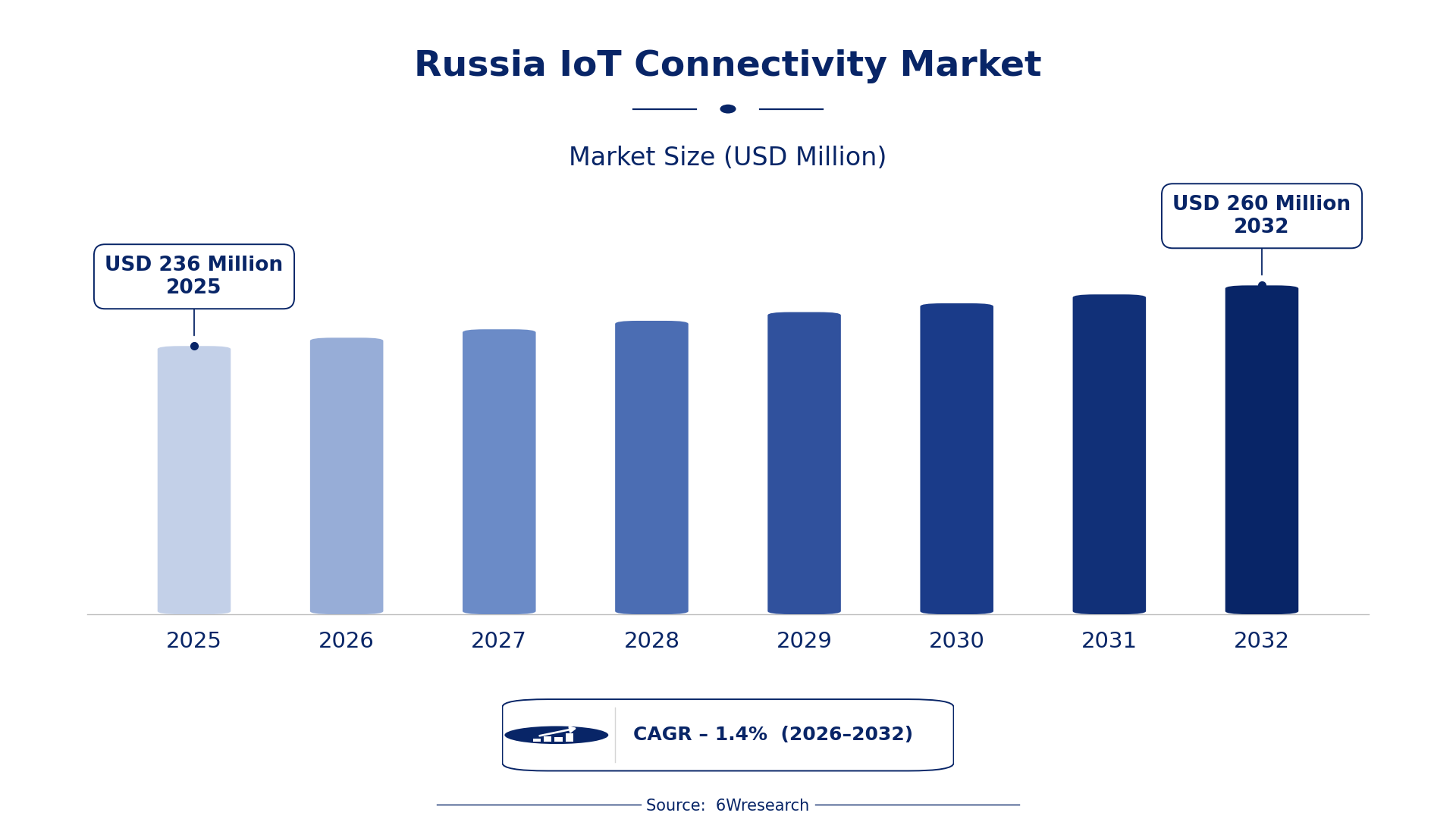
The Russia IoT Connectivity Market was estimated at USD 236 Million in 2025 and is projected to reach USD 260 Million by 2032, growing at a CAGR of 1.4% from 2026 to 2032.
Russia IoT Connectivity Market Synopsis
The IoT connectivity market in Russia is at a critical juncture, marked by rapid technological advancements and increased adoption across various sectors. The integration of 5G and Low-Power Wide-Area Networks (LPWAN) is facilitating a surge in IoT applications, driving demand for effective connectivity solutions.
Looking ahead, the market is poised for steady growth, but it is not without its hurdles. Infrastructure challenges in remote areas and regulatory complexities could hinder expansion efforts, underscoring the need for strategic investments and innovations.
Russia IoT Connectivity Market Year-wise Growth Rate and Key Drivers
This graph illustrates the annual growth rates of the Russia IoT Connectivity Market from 2021 to 2032, highlighting a steady upward trajectory and projected expansion over the forecast period.
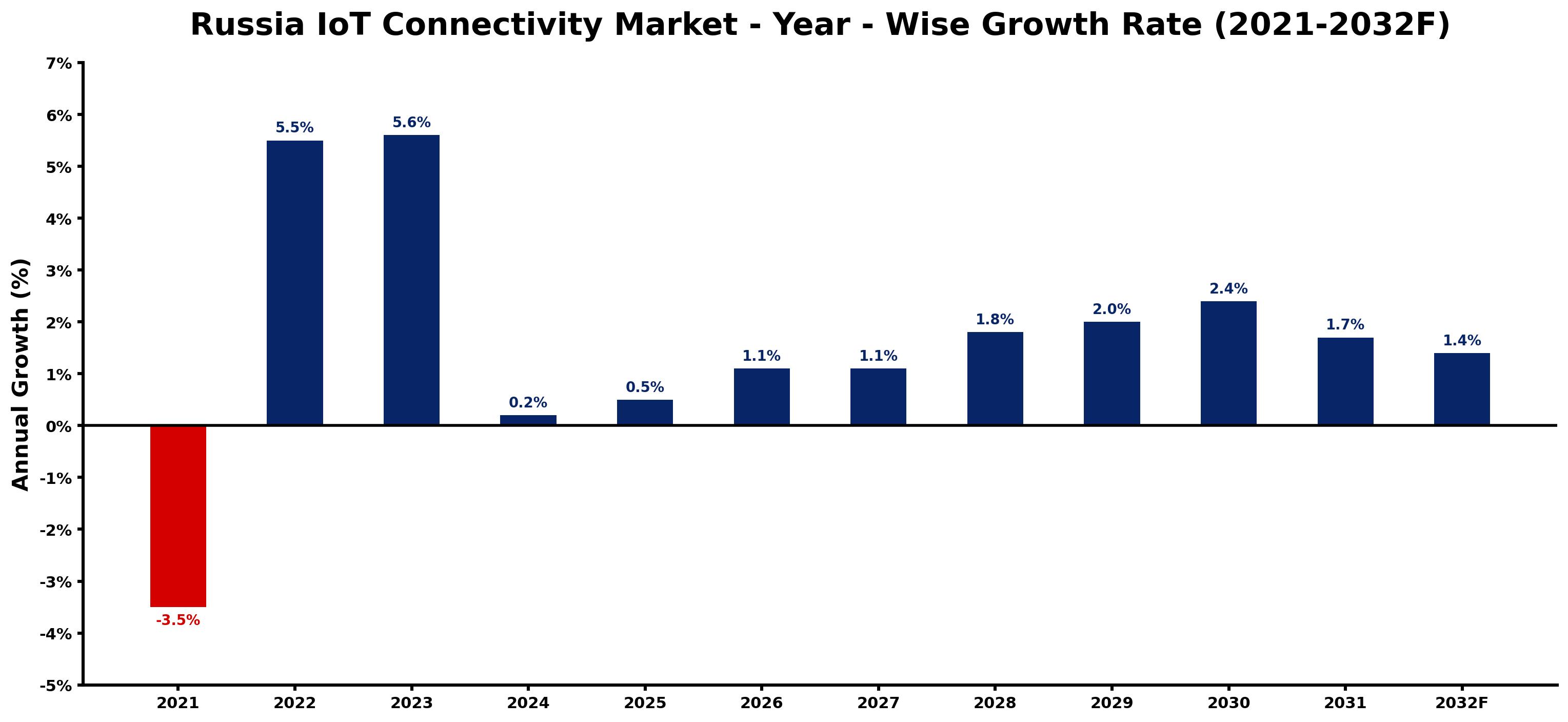
The table below presents the year‑wise growth rates along with the key drivers influencing the market
| Year | Growth Rate | Major Drivers |
| 2021 | -3.5% | Russian government sanctions restrict foreign investment in IoT. |
| 2022 | 5.5% | Increased government support for smart city initiatives |
| 2023 | 5.6% | Rising investment in IoT-enabled energy efficiency projects |
| 2024 | 0.2% | Adoption of IoT for enhanced supply chain management |
| 2025 | 0.5% | Introduction of local IoT innovation grants by government |
| 2026 | 1.1% | Growing interest in connected healthcare technologies |
| 2027 | 1.1% | Regulations promoting IoT cybersecurity standards implemented |
| 2028 | 1.8% | Surge in demand for environmental monitoring solutions |
| 2029 | 2.0% | Increased rural connectivity initiatives enhancing IoT access |
| 2030 | 2.4% | Emergence of local IoT startups driving market growth |
| 2031 | 1.7% | Collaborations between tech firms and public sector increasing |
| 2032 | 1.4% | Focus on optimizing logistics with IoT technologies |
Note: Market size estimations and growth projections presented in this report are based on 6Wresearch's proprietary forecasting methodology, utilizing the latest available industry data, government publications, and primary research inputs.
Russia IoT Connectivity Market Key Takeaways
Below are some of the specific key takeaways from the market, including:
- The market is driven by the increasing deployment of IoT devices across sectors like agriculture, healthcare, and smart cities.
- 5G technology is set to revolutionize connectivity, offering higher data speeds and lower latency.
- LPWAN solutions are gaining traction for their energy efficiency and long-range capabilities.
- Regulatory frameworks are evolving, aiming to foster a competitive environment among connectivity providers.
- Investment incentives from the government are crucial for expanding IoT infrastructure nationwide.
Evaluation of Restraints in Russia IoT Connectivity Market
Several factors are constraining the growth of the Russia IoT connectivity market. High deployment costs associated with advanced networking technologies pose a significant barrier. The need for reliable, high-bandwidth connections is not fully met, particularly in rural areas where infrastructure is lacking. on top of that, regulatory restrictions on spectrum allocation complicate the integration of various connectivity solutions, leading to fragmentation in the market. The absence of uniform standards for IoT connectivity protocols adds another layer of complexity, making it challenging for businesses to implement cohesive IoT strategies.
Russia IoT Connectivity Market Trends
The demand for IoT connectivity is increasingly influenced by several noteworthy trends. The rise of smart cities is one such trend, as municipalities seek to improve infrastructure and public services through IoT applications. Additionally, there is a growing focus on energy-efficient technologies, with LPWAN solutions coming to the forefront. As industries strive for real-time data analytics, the need for enhanced connectivity and faster data transmission will continue to shape the market's evolution.
Russia IoT Connectivity Market Opportunities
The future holds considerable promise for the Russia IoT connectivity market. Key opportunities lie in the expansion of 5G networks, which can significantly enhance connectivity options for various applications. Rural areas present untapped potential for IoT deployment, particularly in agriculture and environmental monitoring. As the government pushes for digital transformation, partnerships between public and private sectors could lead to innovative solutions and infrastructure upgrades, driving growth across the market.
Government Initiatives in the Russia IoT Connectivity Market
Government policy plays a crucial role in shaping the IoT connectivity market in Russia. Recent initiatives are aimed at fostering a conducive environment for the growth of IoT technologies and infrastructure. The government is focusing on regulatory reforms and investment incentives to boost connectivity across urban and rural areas, ensuring universal access to IoT services.
- A national digital infrastructure upgrade programme, recently launched, aims to enhance connectivity in underserved regions.
- Current efforts include a public-private partnership designed to accelerate the deployment of 5G networks nationwide.
- Ongoing regulatory reforms are addressing spectrum allocation challenges to facilitate better connectivity solutions.
- Planned initiatives focus on promoting competition among connectivity providers, expected to be rolled out in the next two years.
Future Insights of the Russia IoT Connectivity Market
Between 2026 and 2032, the Russia IoT connectivity market is likely to undergo significant transformation. The anticipated rollout of 5G will not only enhance connectivity options but also enable new applications and use cases across various sectors. As urbanization continues, the demand for smart city solutions will drive further investments. However, addressing infrastructure limitations and regulatory complexities will be critical to unlocking the market's full potential.
Russia IoT Connectivity Market Latest Developments
In the last year, the Russia IoT connectivity market has seen a flurry of activity as stakeholders position themselves for future growth. Major initiatives have been launched to enhance connectivity options and to develop the necessary infrastructure. This momentum reflects the increasing importance of IoT technologies in Russia's economic landscape.
- A major technology vendor announced a partnership in early 2025 to develop LPWAN solutions tailored for agricultural applications.
- A regional operator launched a 5G pilot project in Q1 2025, focusing on smart city applications, which is currently underway.
- A public-private initiative aimed at enhancing connectivity in remote areas is expected to begin its rollout by mid-2026.
- In early 2025, a telecom provider completed the installation of IoT infrastructure in urban centers, aiming to support smart transportation systems.
Russia IoT Connectivity Market - Key Attractiveness of the Report
- 10 Years of Market Numbers
- Historical Data Starting from 2022 to 2025
- Base Year: 2025
- Forecast Data until 2032
- Key Performance Indicators Impacting the Market
- Major Upcoming Developments and Projects
Key Highlights of the Report:
- Russia IoT Connectivity Market Outlook
- Market Size of Russia IoT Connectivity Market, 2025
- Forecast of Russia IoT Connectivity Market, 2032
- Historical Data and Forecast of Russia IoT Connectivity Revenues & Volume for the Period 2022-2032F
- Russia IoT Connectivity Market Trend Evolution
- Russia IoT Connectivity Market Drivers and Challenges
- Russia IoT Connectivity Price Trends
- Russia IoT Connectivity Porter's Five Forces
- Russia IoT Connectivity Industry Life Cycle
- Historical Data and Forecast of Russia IoT Connectivity Market Revenues & Volume By Component for the Period 2022-2032F
- Historical Data and Forecast of Russia IoT Connectivity Market Revenues & Volume By Platform for the Period 2022-2032F
- Historical Data and Forecast of Russia IoT Connectivity Market Revenues & Volume By Services for the Period 2022-2032F
- Historical Data and Forecast of Russia IoT Connectivity Market Revenues & Volume By Application Areas for the Period 2022-2032F
- Historical Data and Forecast of Russia IoT Connectivity Market Revenues & Volume By Building & Home Automation for the Period 2022-2032F
- Historical Data and Forecast of Russia IoT Connectivity Market Revenues & Volume By Smart Energy & Utility for the Period 2022-2032F
- Historical Data and Forecast of Russia IoT Connectivity Market Revenues & Volume By Smart Manufacturing for the Period 2022-2032F
- Historical Data and Forecast of Russia IoT Connectivity Market Revenues & Volume By Connected Health for the Period 2022-2032F
- Historical Data and Forecast of Russia IoT Connectivity Market Revenues & Volume By Smart Retail for the Period 2022-2032F
- Historical Data and Forecast of Russia IoT Connectivity Market Revenues & Volume By Smart Transportation for the Period 2022-2032F
- Historical Data and Forecast of Russia IoT Connectivity Market Revenues & Volume By Others (Education and Agriculture) for the Period 2022-2032F
- Historical Data and Forecast of Russia IoT Connectivity Market Revenues & Volume By Organization Size for the Period 2022-2032F
- Historical Data and Forecast of Russia IoT Connectivity Market Revenues & Volume By Large Enterprises for the Period 2022-2032F
- Historical Data and Forecast of Russia IoT Connectivity Market Revenues & Volume By SMEs for the Period 2022-2032F
- Russia IoT Connectivity Import Export Trade Statistics
- Market Opportunity Assessment By Component
- Market Opportunity Assessment By Application Areas
- Market Opportunity Assessment By Organization Size
- Russia IoT Connectivity Top Companies Market Share
- Russia IoT Connectivity Competitive Benchmarking By Technical and Operational Parameters
- Russia IoT Connectivity Company Profiles
- Russia IoT Connectivity Key Strategic Recommendations






































