Russia Managed Mobility Services Market Size & Growth Rate (2026-2032)
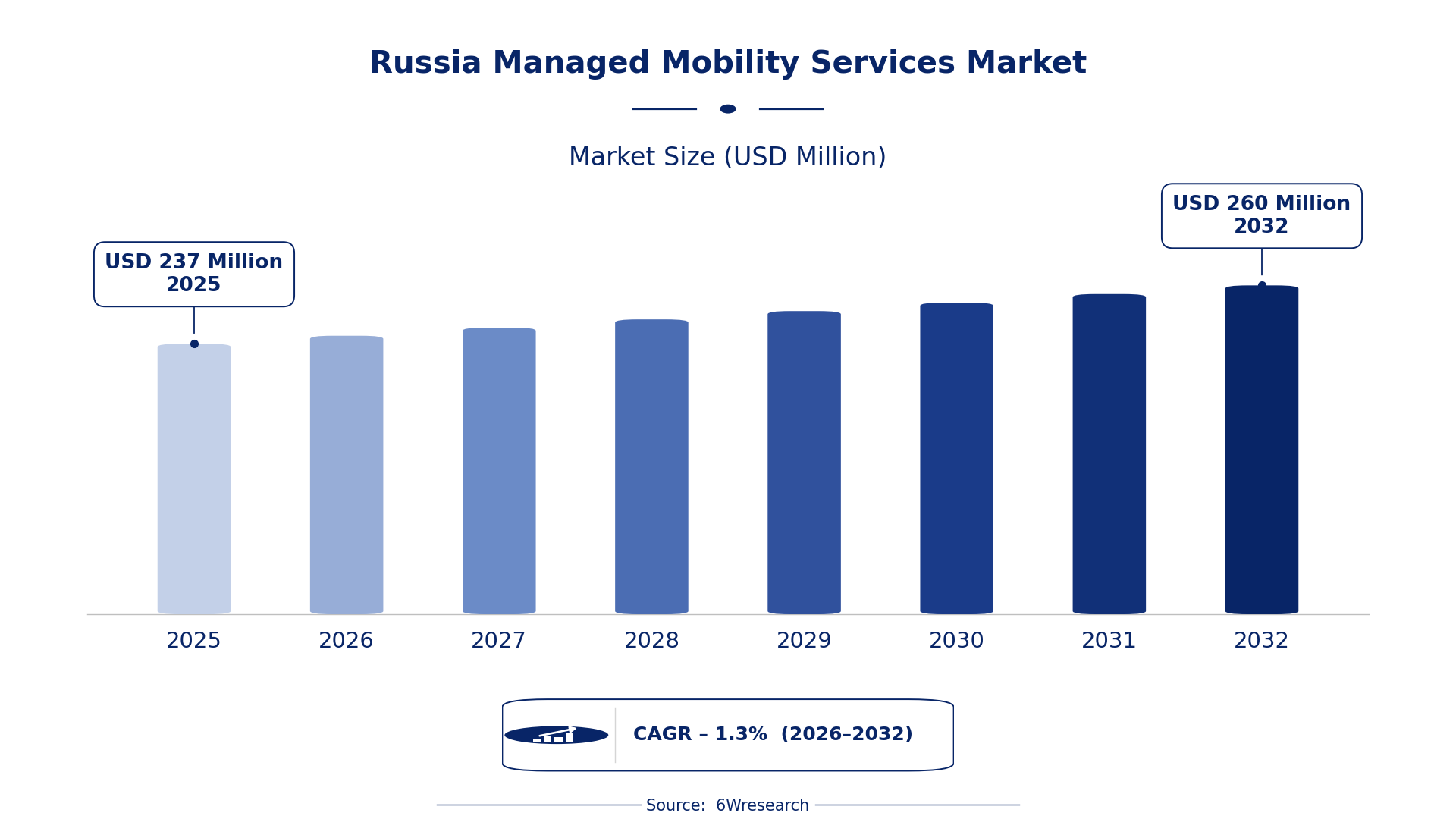
The Russia Managed Mobility Services Market was estimated at USD 237 Million in 2025 and is projected to reach USD 260 Million by 2032, growing at a CAGR of 1.3% from 2026 to 2032.
Russia Managed Mobility Services Market Synopsis
The momentum of the Russia Managed Mobility Services market has surged recently, with businesses keen on optimizing their mobile operations. This trend is a response to the rising demand for mobile technologies, which is reshaping how organizations approach workforce management.
As firms increasingly transition towards digital transformation initiatives, the expectation for sophisticated mobility solutions is rising. The market is aligning with this demand, promising to enhance mobile device management, security, and support services that are crucial for operational efficiency.
Russia Managed Mobility Services Market Year-wise Growth Rate and Key Drivers
This graph illustrates the annual growth rates of the Russia Managed Mobility Services Market from 2021 to 2032, highlighting a steady upward trajectory and projected expansion over the forecast period.
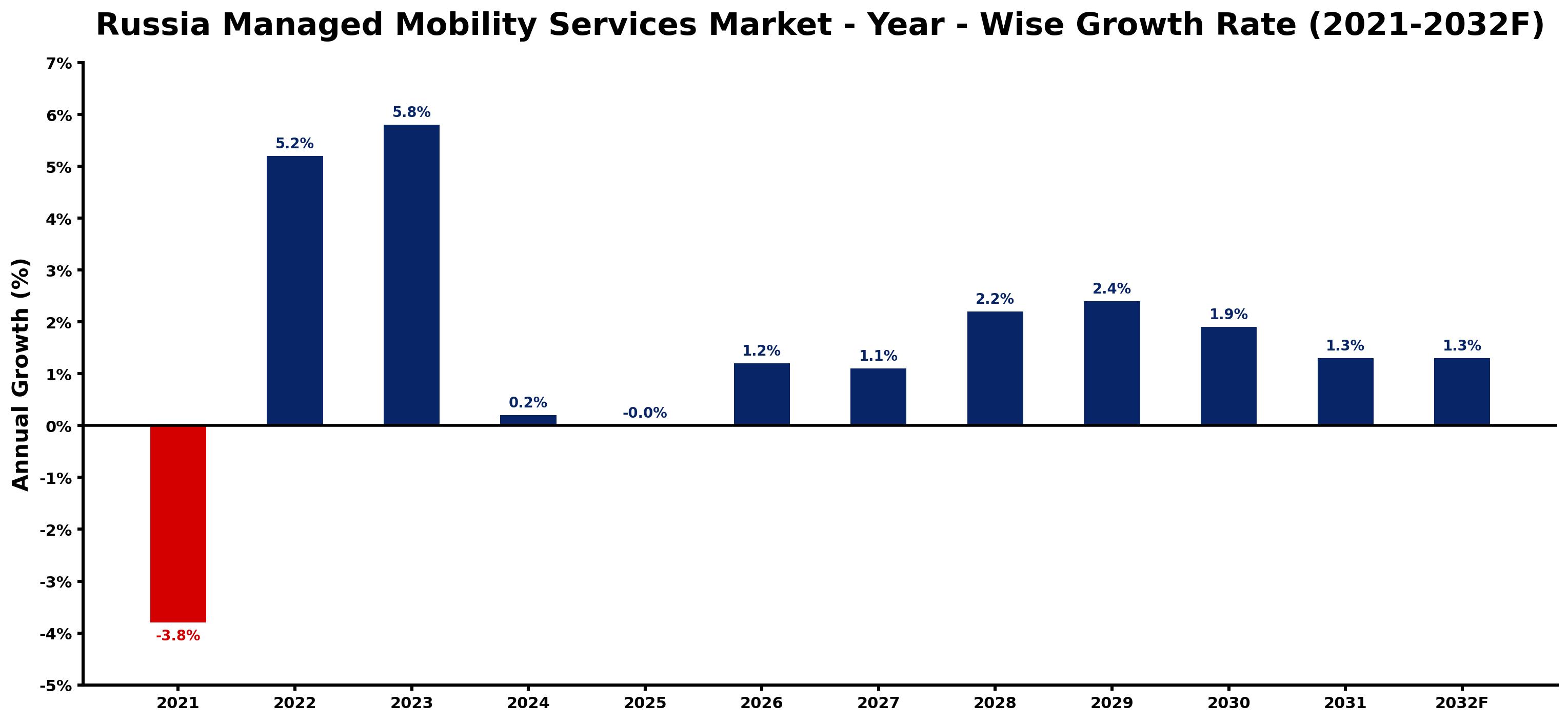
The table below presents the year‑wise growth rates along with the key drivers influencing the market
| Year | Growth Rate | Major Drivers |
| 2021 | -3.8% | Western sanctions limiting technological imports and services. |
| 2022 | 5.2% | Growth in state-sponsored digital economy initiatives boosting mobility. |
| 2023 | 5.8% | Rising adoption of IoT devices in enterprise sectors. |
| 2024 | 0.2% | Increased cybersecurity regulations driving managed mobility necessity. |
| 2025 | -0.0% | Expansion of transportation and logistics networks |
| 2026 | 1.2% | Government tax incentives for technology upgrades in business. |
| 2027 | 1.1% | Legislation supporting remote workforce mobility and security. |
| 2028 | 2.2% | Growing e-commerce sectors requiring efficient logistics solutions. |
| 2029 | 2.4% | Increased consumer demand for secure mobile transactions. |
| 2030 | 1.9% | Partnerships with local telecoms enhancing service offerings. |
| 2031 | 1.3% | Emergence of smart cities necessitating managed mobility services. |
| 2032 | 1.3% | Improving local tech talent pool fostering service innovations. |
Note: Market size estimations and growth projections presented in this report are based on 6Wresearch's proprietary forecasting methodology, utilizing the latest available industry data, government publications, and primary research inputs.
Russia Managed Mobility Services Market Key Takeaways
Below are some of the specific key takeaways from the market, including:
- The adoption of cloud-based solutions is reshaping managed mobility services.
- Mobile device management and application management services are experiencing increased demand.
- Data security and compliance with government regulations are central to service offerings.
- Remote work trends are driving businesses to invest more in mobility solutions.
- Integration of AI and machine learning is becoming common in managed mobility services.
Evaluation of Restraints in Russia Managed Mobility Services Market
The Russia Managed Mobility Services market faces distinct hurdles that affect growth potential. Data security remains a prime concern, particularly due to stringent regulations that require firms to safeguard sensitive information. The scarcity of skilled IT professionals limits the ability of providers to meet rising demand effectively. Additionally, economic sanctions have constrained access to advanced technologies, further complicating operations. Geographic diversity poses logistical challenges for service providers, especially when delivering support in remote regions of the country.
Russia Managed Mobility Services Market Trends
Several trends are currently shaping the Russia Managed Mobility Services market. Cloud-based solutions are gaining traction, enabling businesses to enhance their mobile operations while ensuring data security. There's also a noticeable shift towards comprehensive support for various mobile devices and operating systems, reflecting a growing sophistication in service needs.
Advanced technologies, including artificial intelligence and machine learning, are being integrated into mobility services to deliver personalized solutions and increase efficiency. As organizations adopt these technologies, the demand for managed mobility services continues to grow, signaling a transformation in how mobile management is approached in the region.
Russia Managed Mobility Services Market Opportunities
Investment opportunities abound within the Russia Managed Mobility Services market. As mobile technology adoption accelerates, companies that provide mobile device management, application management, and security solutions are positioned to thrive. The recent shift towards remote work has only amplified the necessity for efficient mobile workforce solutions.
As digital transformation initiatives unfold, there are increased opportunities for service providers to create tailored solutions catering to the unique requirements of businesses. This evolving market environment sets the stage for long-term growth and profitability in managed mobility services.
Government Initiatives in the Russia Managed Mobility Services Market
Government policies in Russia are increasingly focused on ensuring data security and compliance within the Managed Mobility Services market. Regulatory frameworks such as the Personal Data Law and the Data Localization Law mandate that personal data of Russian citizens be stored domestically. These regulations prioritize safeguarding customer information and pose implications for how businesses implement mobility solutions.
- A regulatory framework introduced in 2025 mandating data protection compliance has been established to bolster cybersecurity measures.
- The Federal Law on Information, Information Technologies, and Information Protection is currently enforced, requiring adherence to stringent data security standards.
- Ongoing government initiatives are focused on enhancing digital infrastructure to support mobility services across various sectors.
- There is a planned public-private partnership aimed at expanding telecom infrastructure access by 2028 to improve managed mobility services throughout the country.
Future Insights of the Russia Managed Mobility Services Market
Looking ahead to 2026-2032, the Russia Managed Mobility Services market is set for steady growth. Organizations will continue to prioritize the optimization of mobile operations to enhance productivity and streamline processes. The proliferation of mobile devices among the population will bolster demand for comprehensive mobility management solutions.
Companies will likely focus on innovating their service offerings to meet the diverse and evolving needs of businesses in Russia. However, firms must remain vigilant of regulatory changes and security concerns that could influence market dynamics in the coming years.
Russia Managed Mobility Services Market Latest Developments
In the last 12-14 months, the Russia Managed Mobility Services market has seen a range of developments. Providers are adapting to changes in technology while also responding to business needs for enhanced mobile management solutions.
- A leading regional operator launched an advanced mobile device management platform in early 2025, aimed at improving user experience and security.
- Ongoing initiatives to integrate machine learning into mobile application management services began in Q3 2025 and are expected to enhance automation.
- A service upgrade initiative focused on enhancing data protection measures is currently underway, anticipated to complete by mid-2026.
- Plans are in motion for a new partnership between technology vendors to develop innovative security solutions by late 2026.
Russia Managed Mobility Services Market - Key Attractiveness of the Report
- 10 Years of Market Numbers
- Historical Data Starting from 2022 to 2025
- Base Year: 2025
- Forecast Data until 2032
- Key Performance Indicators Impacting the Market
- Major Upcoming Developments and Projects
Key Highlights of the Report:
- Russia Managed Mobility Services Market Outlook
- Market Size of Russia Managed Mobility Services Market, 2025
- Forecast of Russia Managed Mobility Services Market, 2032
- Historical Data and Forecast of Russia Managed Mobility Services Revenues & Volume for the Period 2022-2032F
- Russia Managed Mobility Services Market Trend Evolution
- Russia Managed Mobility Services Market Drivers and Challenges
- Russia Managed Mobility Services Price Trends
- Russia Managed Mobility Services Porter's Five Forces
- Russia Managed Mobility Services Industry Life Cycle
- Historical Data and Forecast of Russia Managed Mobility Services Market Revenues & Volume By Function for the Period 2022-2032F
- Historical Data and Forecast of Russia Managed Mobility Services Market Revenues & Volume By Device Management for the Period 2022-2032F
- Historical Data and Forecast of Russia Managed Mobility Services Market Revenues & Volume By Application Management for the Period 2022-2032F
- Historical Data and Forecast of Russia Managed Mobility Services Market Revenues & Volume By Security Management for the Period 2022-2032F
- Historical Data and Forecast of Russia Managed Mobility Services Market Revenues & Volume By Maintenance & Support for the Period 2022-2032F
- Historical Data and Forecast of Russia Managed Mobility Services Market Revenues & Volume By Organization Size for the Period 2022-2032F
- Historical Data and Forecast of Russia Managed Mobility Services Market Revenues & Volume By SMEs for the Period 2022-2032F
- Historical Data and Forecast of Russia Managed Mobility Services Market Revenues & Volume By Large Enterprises for the Period 2022-2032F
- Historical Data and Forecast of Russia Managed Mobility Services Market Revenues & Volume By Industry Vertical for the Period 2022-2032F
- Historical Data and Forecast of Russia Managed Mobility Services Market Revenues & Volume By Healthcare for the Period 2022-2032F
- Historical Data and Forecast of Russia Managed Mobility Services Market Revenues & Volume By Manufacturing for the Period 2022-2032F
- Historical Data and Forecast of Russia Managed Mobility Services Market Revenues & Volume By Logistics and Transportation for the Period 2022-2032F
- Historical Data and Forecast of Russia Managed Mobility Services Market Revenues & Volume By Retail for the Period 2022-2032F
- Historical Data and Forecast of Russia Managed Mobility Services Market Revenues & Volume By Financial Services for the Period 2022-2032F
- Historical Data and Forecast of Russia Managed Mobility Services Market Revenues & Volume By Telecom and IT for the Period 2022-2032F
- Historical Data and Forecast of Russia Managed Mobility Services Market Revenues & Volume By Media and Entertainment for the Period 2022-2032F
- Historical Data and Forecast of Russia Managed Mobility Services Market Revenues & Volume By Travel and Hospitality for the Period 2022-2032F
- Russia Managed Mobility Services Import Export Trade Statistics
- Market Opportunity Assessment By Function
- Market Opportunity Assessment By Organization Size
- Market Opportunity Assessment By Industry Vertical
- Russia Managed Mobility Services Top Companies Market Share
- Russia Managed Mobility Services Competitive Benchmarking By Technical and Operational Parameters
- Russia Managed Mobility Services Company Profiles
- Russia Managed Mobility Services Key Strategic Recommendations






































