Russia Process Analytics Market Size & Growth Rate (2026-2032)
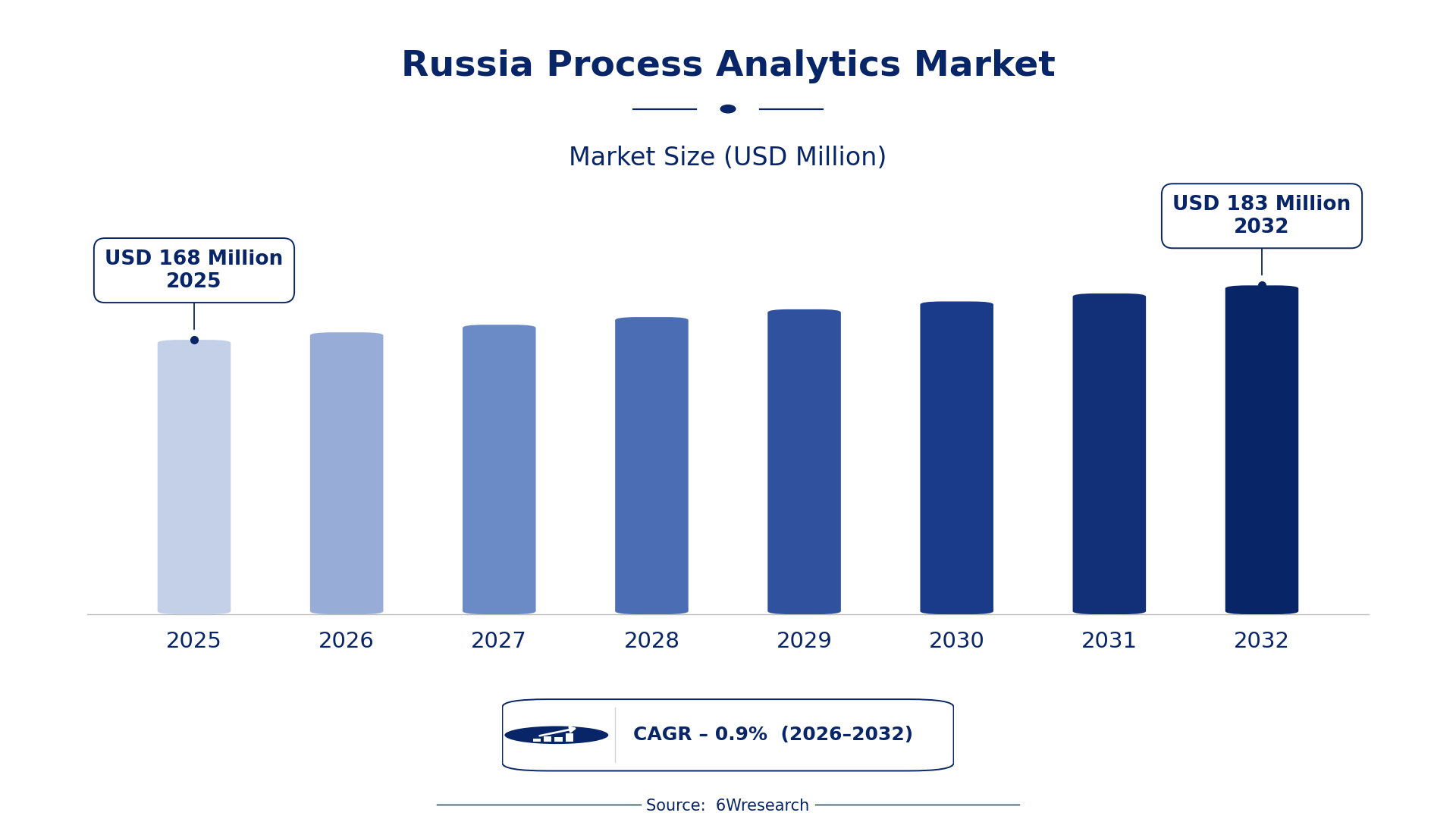
The Russia Process Analytics Market was estimated at USD 168 Million in 2025 and is projected to reach USD 183 Million by 2032, growing at a CAGR of 0.9% from 2026 to 2032.
Russia Process Analytics Market Synopsis
The Russia Process Analytics Market has recently gained momentum, driven by a surge in demand for process optimization across key sectors. Industries are increasingly recognizing the value of data-driven insights, which are essential for enhancing efficiency and reducing operational costs.
Looking ahead, the market is set to evolve as advanced analytics technologies and artificial intelligence become more integrated into business processes. This shift is likely to reshape how organizations approach decision-making and operational efficiency, creating a more dynamic environment for growth.
Russia Process Analytics Market Year-wise Growth Rate and Key Drivers
This graph illustrates the annual growth rates of the Russia Process Analytics Market from 2021 to 2032, highlighting a steady upward trajectory and projected expansion over the forecast period.
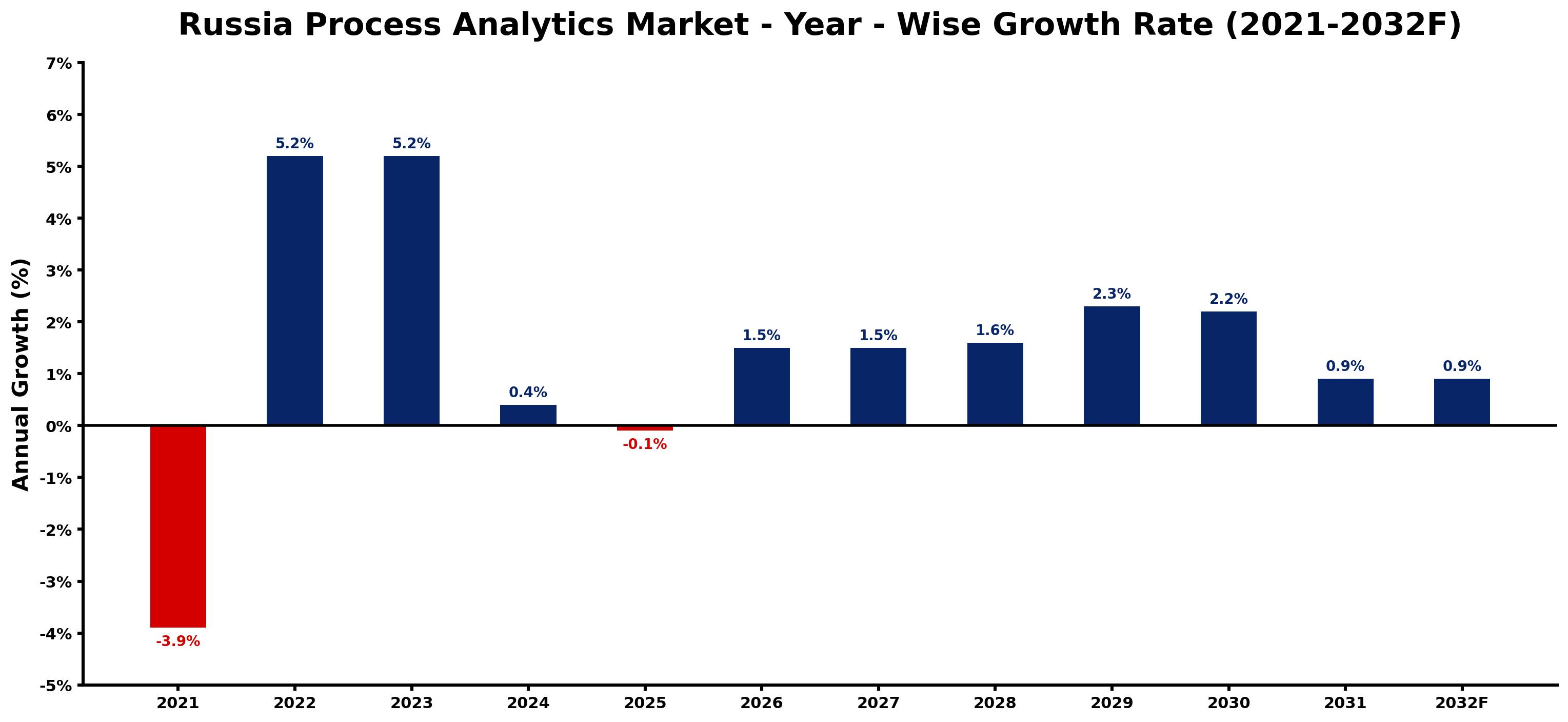
The table below presents the year‑wise growth rates along with the key drivers influencing the market
| Year | Growth Rate | Major Drivers |
| 2021 | -3.9% | Reduced spending on analytics by Russian tech firms |
| 2022 | 5.2% | Government's support for digital transformation initiatives |
| 2023 | 5.2% | Increase in manufacturing efficiency through process optimization tools |
| 2024 | 0.4% | Investment in local startups enhancing process data analysis |
| 2025 | -0.1% | Impact of Ukraine conflict on local investment strategies |
| 2026 | 1.5% | Adoption of AI technologies in industrial operations |
| 2027 | 1.5% | Growing need for compliance with Russian regulatory standards |
| 2028 | 1.6% | Surge in data collection tools among enterprises |
| 2029 | 2.3% | Rising interest in customized analytics solutions for sectors |
| 2030 | 2.2% | Focus on automating supply chain management processes |
| 2031 | 0.9% | Implementation of new technologies in oil and gas sector |
| 2032 | 0.9% | Development of advanced analytics platforms in Russia |
Note: Market size estimations and growth projections presented in this report are based on 6Wresearch's proprietary forecasting methodology, utilizing the latest available industry data, government publications, and primary research inputs.
Russia Process Analytics Market Key Takeaways
Below are some of the specific key takeaways from the market, including:
- Increasing adoption of cloud-based analytics solutions for scalability and flexibility.
- Heightened focus on real-time monitoring to preemptively address operational challenges.
- Emergence of artificial intelligence as a key driver for predictive analytics capabilities.
- Investment opportunities in sectors like oil & gas, manufacturing, and healthcare.
- Government initiatives aimed at promoting digital transformation in industrial processes.
Evaluation of Restraints in Russia Process Analytics Market
Several factors currently limit the growth of the Russia Process Analytics Market. One major issue is the lack of awareness regarding the benefits of process analytics, particularly among smaller enterprises. This knowledge gap prevents organizations from fully leveraging analytics tools that could significantly enhance their operations.
Additionally, concerns about data privacy and security are prominent. Strict regulations surrounding data protection can create barriers to the adoption of process analytics solutions, as companies grapple with compliance and integration challenges. Addressing these issues is crucial for unlocking the market's full potential.
Russia Process Analytics Market Trends
A notable trend in the Russia Process Analytics Market is the increasing use of advanced analytics and artificial intelligence technologies. Organizations are turning to these tools to gain deeper operational insights and streamline processes, resulting in improved efficiency and cost savings.
The demand for real-time data analytics is also growing, enabling companies to identify and address potential issues before they impact performance. This proactive approach is being complemented by a rise in cloud-based solutions, which offer businesses the flexibility and scalability necessary to adapt to changing market dynamics.
Russia Process Analytics Market Opportunities
The Russia Process Analytics Market is rich with investment opportunities. Industries such as oil and gas, manufacturing, and pharmaceuticals are particularly promising due to their pressing need for process optimization and operational efficiency.
Investors should focus on innovative software solutions that provide real-time monitoring and predictive maintenance capabilities. The increasing integration of AI and machine learning technologies presents another area ripe for growth, enabling companies to enhance their competitive edge through automation and data-driven decision-making.
Government Initiatives in the Russia Process Analytics Market
Government policy is actively shaping the Russia Process Analytics Market, with a clear focus on promoting advanced technologies within industrial sectors. Initiatives aimed at digitization and the implementation of Industry 4.0 principles are essential for enhancing efficiency and competitiveness in Russian industries.
- A national digital infrastructure upgrade programme launched in early 2023 is enhancing connectivity for analytics solutions.
- Current efforts include the Digital Economy program, which aims to integrate advanced technologies into various sectors, including manufacturing and energy.
- Upcoming initiatives planned for 2026 involve developing regulatory frameworks to support the secure use of process analytics tools.
- Ongoing government support for cybersecurity measures aims to bolster data protection in critical infrastructure sectors.
- A recent initiative focused on public-private partnerships is expected to foster innovation in process optimization technologies by 2025.
Future Insights of the Russia Process Analytics Market
The outlook for the Russia Process Analytics Market from 2026 to 2032 is optimistic. As industries continue to adopt process optimization technologies, the demand for advanced analytics solutions will increase. The government's commitment to digitization and Industry 4.0 will further accelerate this trend.
on top of that, advancements in artificial intelligence and big data analytics will play a crucial role in shaping the future of this market. Companies that invest in innovative analytics solutions are likely to gain a competitive advantage, paving the way for sustained growth and improved operational performance.
Russia Process Analytics Market Latest Developments
Recent activity in the Russia Process Analytics Market indicates a strong push towards modernization and efficiency. Over the last year, organizations have been focused on integrating advanced analytics tools to enhance operational performance and decision-making.
- A major technology vendor launched a new analytics platform in Q1 2025, aiming to improve predictive capabilities across various sectors.
- A partnership between regional operators began in mid-2025 to enhance data sharing initiatives and improve process efficiency.
- Currently ongoing is a pilot program aimed at implementing AI-driven analytics solutions in the healthcare sector, expected to yield results by late 2025.
- An upcoming rollout of a cloud-based analytics tool is planned for early 2026, designed to help companies scale their operations more effectively.
- Recent enhancements to an existing process analytics software suite were completed by the end of 2024, improving user experience and functionality.
Russia Process Analytics Market - Key Attractiveness of the Report
- 10 Years of Market Numbers
- Historical Data Starting from 2022 to 2025
- Base Year: 2025
- Forecast Data until 2032
- Key Performance Indicators Impacting the Market
- Major Upcoming Developments and Projects
Key investment opportunities lie in sectors like oil & gas, manufacturing, and pharmaceuticals, particularly in advanced analytics and predictive maintenance solutions.
Key Highlights of the Report:
- Russia Process Analytics Market Outlook
- Market Size of Russia Process Analytics Market, 2025
- Forecast of Russia Process Analytics Market, 2032
- Historical Data and Forecast of Russia Process Analytics Revenues & Volume for the Period 2022-2032F
- Russia Process Analytics Market Trend Evolution
- Russia Process Analytics Market Drivers and Challenges
- Russia Process Analytics Price Trends
- Russia Process Analytics Porter's Five Forces
- Russia Process Analytics Industry Life Cycle
- Historical Data and Forecast of Russia Process Analytics Market Revenues & Volume By Process Mining Type for the Period 2022-2032F
- Historical Data and Forecast of Russia Process Analytics Market Revenues & Volume By Process discovery for the Period 2022-2032F
- Historical Data and Forecast of Russia Process Analytics Market Revenues & Volume By Process conformance for the Period 2022-2032F
- Historical Data and Forecast of Russia Process Analytics Market Revenues & Volume By Process enhancement for the Period 2022-2032F
- Historical Data and Forecast of Russia Process Analytics Market Revenues & Volume By Deployment Type for the Period 2022-2032F
- Historical Data and Forecast of Russia Process Analytics Market Revenues & Volume By On-premises for the Period 2022-2032F
- Historical Data and Forecast of Russia Process Analytics Market Revenues & Volume By Cloud for the Period 2022-2032F
- Historical Data and Forecast of Russia Process Analytics Market Revenues & Volume By Organization Size for the Period 2022-2032F
- Historical Data and Forecast of Russia Process Analytics Market Revenues & Volume By SMEs for the Period 2022-2032F
- Historical Data and Forecast of Russia Process Analytics Market Revenues & Volume By Large enterprises for the Period 2022-2032F
- Historical Data and Forecast of Russia Process Analytics Market Revenues & Volume By Application for the Period 2022-2032F
- Historical Data and Forecast of Russia Process Analytics Market Revenues & Volume By Business process for the Period 2022-2032F
- Historical Data and Forecast of Russia Process Analytics Market Revenues & Volume By Information technology process for the Period 2022-2032F
- Historical Data and Forecast of Russia Process Analytics Market Revenues & Volume By Customer interaction for the Period 2022-2032F
- Russia Process Analytics Import Export Trade Statistics
- Market Opportunity Assessment By Process Mining Type
- Market Opportunity Assessment By Deployment Type
- Market Opportunity Assessment By Organization Size
- Market Opportunity Assessment By Application
- Russia Process Analytics Top Companies Market Share
- Russia Process Analytics Competitive Benchmarking By Technical and Operational Parameters
- Russia Process Analytics Company Profiles
- Russia Process Analytics Key Strategic Recommendations






































