Russia Risk Analytics Market Size & Growth Rate (2026-2032)
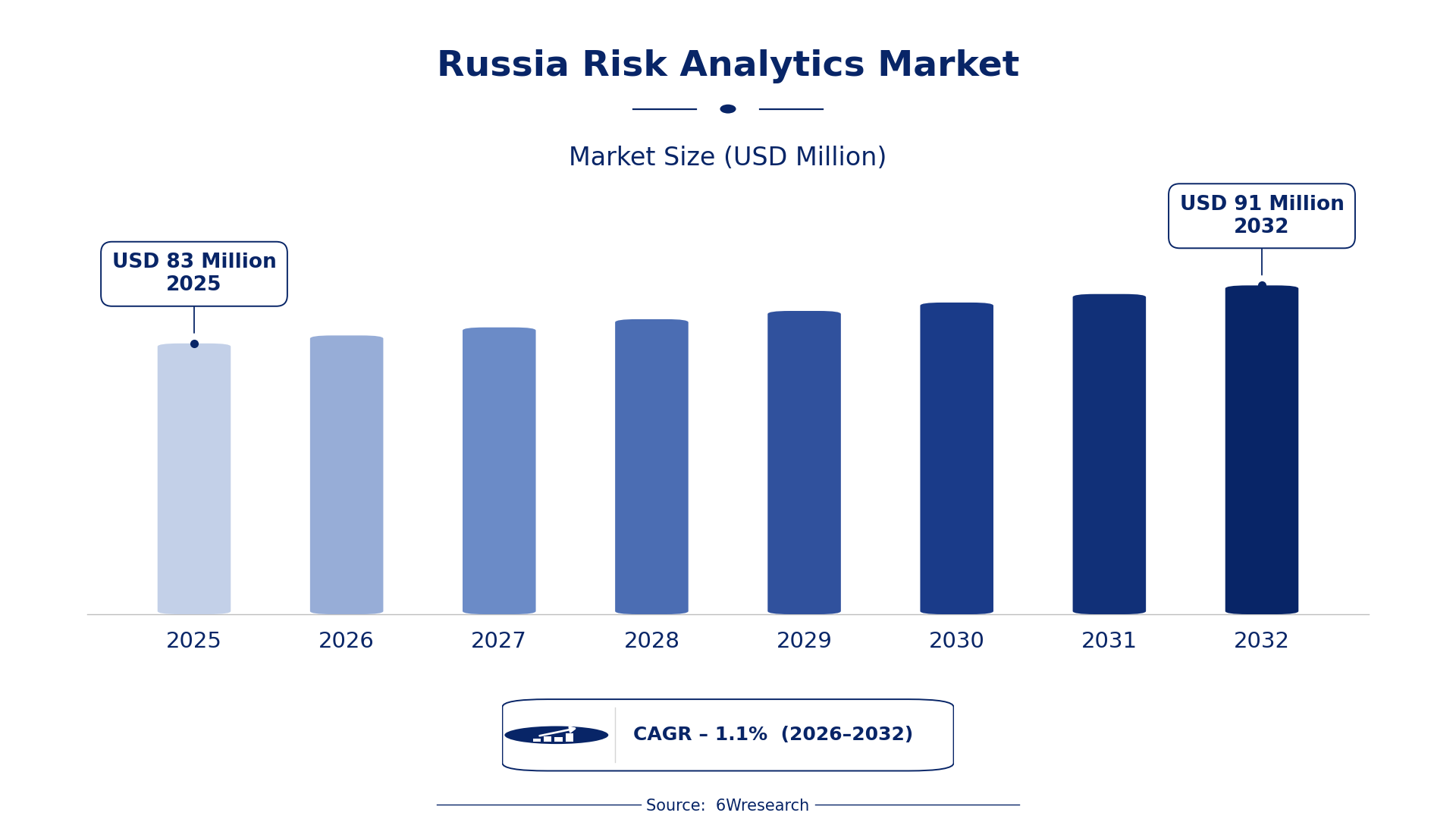
The Russia Risk Analytics Market was estimated at USD 83 Million in 2025 and is projected to reach USD 91 Million by 2032, growing at a CAGR of 1.1% from 2026 to 2032.
Russia Risk Analytics Market Synopsis
The current driving force behind the Russia Risk Analytics Market is the increasing demand for sophisticated risk management solutions across various sectors. Companies are compelled to adopt advanced analytics tools to effectively address the complexities arising from geopolitical tensions and regulatory shifts.
As organizations aim to bolster their resilience against financial, operational, and cyber risks, the market is seeing a notable shift toward real-time monitoring and predictive modeling capabilities. This transformation is vital for businesses striving to make informed decisions in an unpredictable environment.
Russia Risk Analytics Market Year-wise Growth Rate and Key Drivers
This graph illustrates the annual growth rates of the Russia Risk Analytics Market from 2021 to 2032, highlighting a steady upward trajectory and projected expansion over the forecast period.
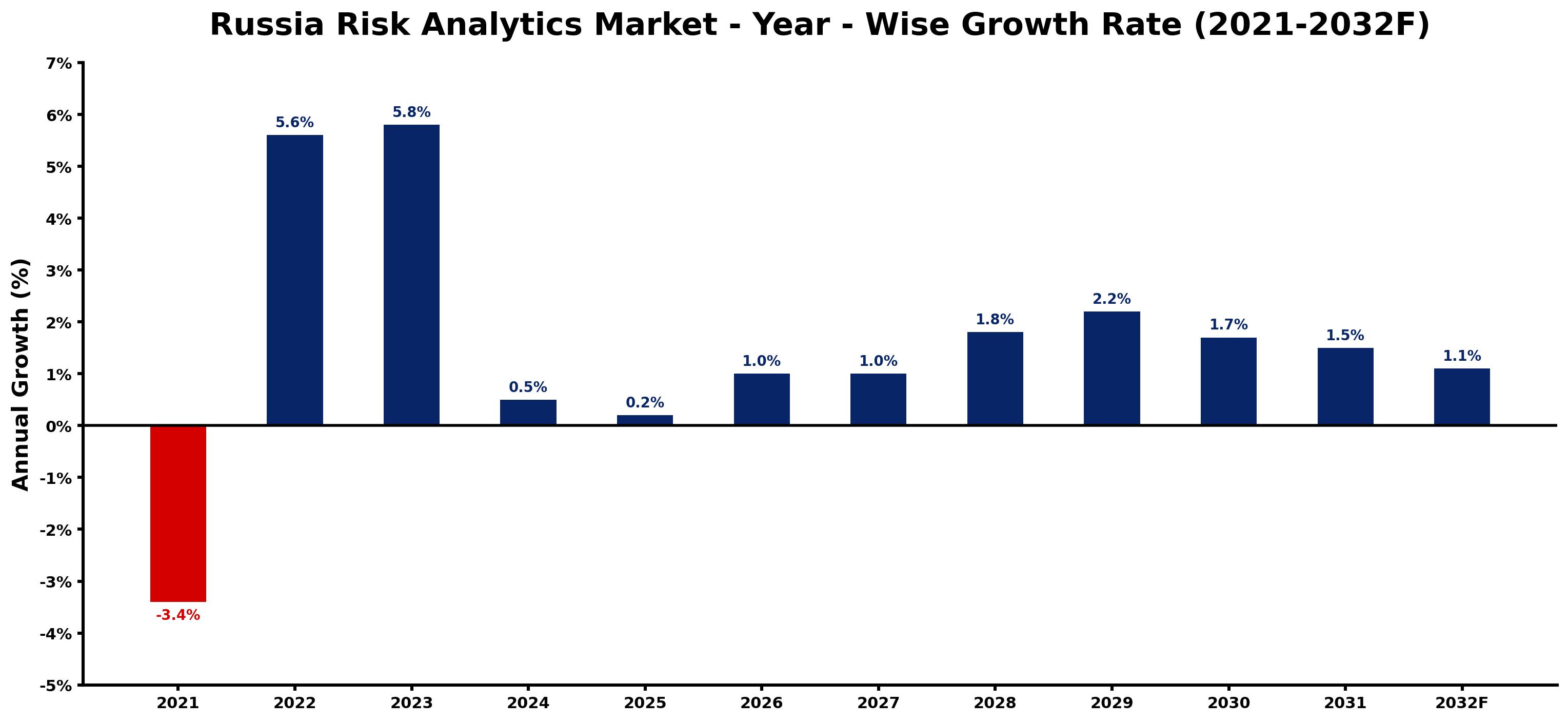
The table below presents the year‑wise growth rates along with the key drivers influencing the market
| Year | Growth Rate | Major Drivers |
| 2021 | -3.4% | Sanctions limiting technology imports into Russia's analytics sector |
| 2022 | 5.6% | Increased regulatory scrutiny on financial institutions' risk assessments. |
| 2023 | 5.8% | Rising cybersecurity threats driving demand for risk analytics solutions. |
| 2024 | 0.5% | Implementation of new anti-money laundering regulations by Rosfinmonitoring. |
| 2025 | 0.2% | Growing reliance on analytics for geopolitical risk evaluations. |
| 2026 | 1.0% | Higher adoption of advanced analytics in state-owned enterprises. |
| 2027 | 1.0% | Emerging fintech startups necessitating robust risk analysis tools. |
| 2028 | 1.8% | Government push for digital transformation in banking sector. |
| 2029 | 2.2% | Cloud-based risk analytics tools gaining traction among businesses. |
| 2030 | 1.7% | Increased investment in AI-driven predictive risk technologies. |
| 2031 | 1.5% | Focus on compliance with updated financial regulations. |
| 2032 | 1.1% | Shift toward integrated risk management solutions in corporations. |
Note: Market size estimations and growth projections presented in this report are based on 6Wresearch's proprietary forecasting methodology, utilizing the latest available industry data, government publications, and primary research inputs.
Russia Risk Analytics Market Key Takeaways
Below are some of the specific key takeaways from the market, including:
- Advanced analytics tools are becoming essential for effective risk management.
- Organizations increasingly prioritize real-time data insights to enhance decision-making.
- Geopolitical uncertainties continue to shape the demand for risk assessment solutions.
- Integration of AI and machine learning is on the rise in risk analytics platforms.
- Investment opportunities are emerging in cybersecurity and financial services sectors.
Evaluation of Restraints in Russia Risk Analytics Market
The Russia Risk Analytics Market faces several significant restraints that hinder its growth. The complex geopolitical landscape introduces uncertainties that can abruptly alter regulatory frameworks, making accurate risk prediction a daunting task. Additionally, data privacy and security concerns pose challenges, particularly as local regulations may not align with international standards. Limited access to reliable data sources further complicates the landscape, necessitating specialized analytical tools that many organizations may struggle to procure.
Russia Risk Analytics Market Trends
Presently, there is a marked increase in the demand for predictive analytics and data visualization tools tailored to assess risks in a volatile business climate. Companies are keen on harnessing artificial intelligence and machine learning to refine their risk assessment processes, ensuring greater predictive accuracy. The emphasis on big data analytics is also intensifying, enabling organizations to identify emerging risks and capitalize on opportunities proactively.
Russia Risk Analytics Market Opportunities
Investment opportunities in the Russia Risk Analytics Market are robust, particularly in sectors like cybersecurity and financial services. With digitalization on the rise, cybersecurity risk analytics solutions are increasingly attractive for investors. on top of that, as businesses navigate the complexities of the financial services sector, there is a growing need for specialized risk assessment tools. Geopolitical risk analytics also presents a fertile area for growth, as companies seek to mitigate the impacts of political instability.
Government Initiatives in the Russia Risk Analytics Market
Government policy plays a crucial role in shaping the Russia Risk Analytics Market, particularly through regulations that govern data management and risk assessment practices. The Russian government has enacted several laws aimed at data protection and privacy, which impact the way companies approach risk analytics. Understanding these policies is essential for businesses operating in the region.
- A recently completed initiative includes the enforcement of the Data Localization Law, requiring companies to store personal data on Russian soil.
- A current ongoing program involves the implementation of the Federal Law on Personal Data Protection, which governs data handling practices in the analytics sector.
- There are planned updates to the Federal Law on Information, Information Technologies, and Information Protection aimed at enhancing data security protocols by 2026.
- A public-private partnership is underway to develop a national cybersecurity framework, expected to be fully operational by 2025.
Future Insights of the Russia Risk Analytics Market
From 2026 to 2032, the Russia Risk Analytics Market is set to experience notable growth, primarily driven by the increasing integration of advanced analytics technologies. The need for companies to manage risks effectively amidst economic instability and regulatory changes will boost demand for innovative risk management tools. As organizations prioritize data-driven decision-making, there will be a marked shift towards tailored solutions that address specific industry challenges.
Russia Risk Analytics Market Latest Developments
In the last year, activity in the Russia Risk Analytics Market has been characterized by significant advancements in technology and partnerships aimed at enhancing risk management capabilities. Companies are focused on refining their analytics platforms to stay ahead of emerging risks and regulatory challenges.
- A leading technology vendor launched a new predictive analytics platform in early 2025, aimed at improving real-time risk assessment capabilities.
- An ongoing initiative by a major analytics firm focuses on integrating machine learning into their risk management solutions, expected to complete by mid-2026.
- A collaboration between regional businesses and cybersecurity experts is set to enhance data protection measures, with the rollout planned for late 2025.
- A comprehensive training program for risk management professionals was initiated in Q1 2025 to equip the workforce with necessary skills in advanced analytics.
Russia Risk Analytics Market - Key Attractiveness of the Report
- 10 Years of Market Numbers
- Historical Data Starting from 2022 to 2025
- Base Year: 2025
- Forecast Data until 2032
- Key Performance Indicators Impacting the Market
- Major Upcoming Developments and Projects
Key Highlights of the Report:
- Russia Risk Analytics Market Outlook
- Market Size of Russia Risk Analytics Market, 2025
- Forecast of Russia Risk Analytics Market, 2032
- Historical Data and Forecast of Russia Risk Analytics Revenues & Volume for the Period 2022-2032F
- Russia Risk Analytics Market Trend Evolution
- Russia Risk Analytics Market Drivers and Challenges
- Russia Risk Analytics Price Trends
- Russia Risk Analytics Porter's Five Forces
- Russia Risk Analytics Industry Life Cycle
- Historical Data and Forecast of Russia Risk Analytics Market Revenues & Volume By Component for the Period 2022-2032F
- Historical Data and Forecast of Russia Risk Analytics Market Revenues & Volume By Software (ETL Tools, Risk Calculation Engines, GRC Software) for the Period 2022-2032F
- Historical Data and Forecast of Russia Risk Analytics Market Revenues & Volume By Services for the Period 2022-2032F
- Historical Data and Forecast of Russia Risk Analytics Market Revenues & Volume By Risk Type for the Period 2022-2032F
- Historical Data and Forecast of Russia Risk Analytics Market Revenues & Volume By Strategic Risk for the Period 2022-2032F
- Historical Data and Forecast of Russia Risk Analytics Market Revenues & Volume By Operational Risk for the Period 2022-2032F
- Historical Data and Forecast of Russia Risk Analytics Market Revenues & Volume By Financial Risk for the Period 2022-2032F
- Historical Data and Forecast of Russia Risk Analytics Market Revenues & Volume By Deployment Mode for the Period 2022-2032F
- Historical Data and Forecast of Russia Risk Analytics Market Revenues & Volume By Cloud for the Period 2022-2032F
- Historical Data and Forecast of Russia Risk Analytics Market Revenues & Volume By On-premises for the Period 2022-2032F
- Historical Data and Forecast of Russia Risk Analytics Market Revenues & Volume By Organization Size for the Period 2022-2032F
- Historical Data and Forecast of Russia Risk Analytics Market Revenues & Volume By Large enterprises for the Period 2022-2032F
- Historical Data and Forecast of Russia Risk Analytics Market Revenues & Volume By Small and medium-sized enterprises (SMEs) for the Period 2022-2032F
- Historical Data and Forecast of Russia Risk Analytics Market Revenues & Volume By Vertical for the Period 2022-2032F
- Historical Data and Forecast of Russia Risk Analytics Market Revenues & Volume By Banking and Financial Services for the Period 2022-2032F
- Historical Data and Forecast of Russia Risk Analytics Market Revenues & Volume By Insurance for the Period 2022-2032F
- Historical Data and Forecast of Russia Risk Analytics Market Revenues & Volume By Manufacturing for the Period 2022-2032F
- Historical Data and Forecast of Russia Risk Analytics Market Revenues & Volume By Transportation and Logistics for the Period 2022-2032F
- Historical Data and Forecast of Russia Risk Analytics Market Revenues & Volume By Retail and Consumer Goods for the Period 2022-2032F
- Historical Data and Forecast of Russia Risk Analytics Market Revenues & Volume By IT and Telecom for the Period 2022-2032F
- Historical Data and Forecast of Russia Risk Analytics Market Revenues & Volume By Government and Defense for the Period 2022-2032F
- Historical Data and Forecast of Russia Risk Analytics Market Revenues & Volume By Healthcare and Life Sciences for the Period 2022-2032F
- Russia Risk Analytics Import Export Trade Statistics
- Market Opportunity Assessment By Component
- Market Opportunity Assessment By Risk Type
- Market Opportunity Assessment By Deployment Mode
- Market Opportunity Assessment By Organization Size
- Market Opportunity Assessment By Vertical
- Russia Risk Analytics Top Companies Market Share
- Russia Risk Analytics Competitive Benchmarking By Technical and Operational Parameters
- Russia Risk Analytics Company Profiles
- Russia Risk Analytics Key Strategic Recommendations






































