Russia Virtual Router Market Size & Growth Rate (2026-2032)
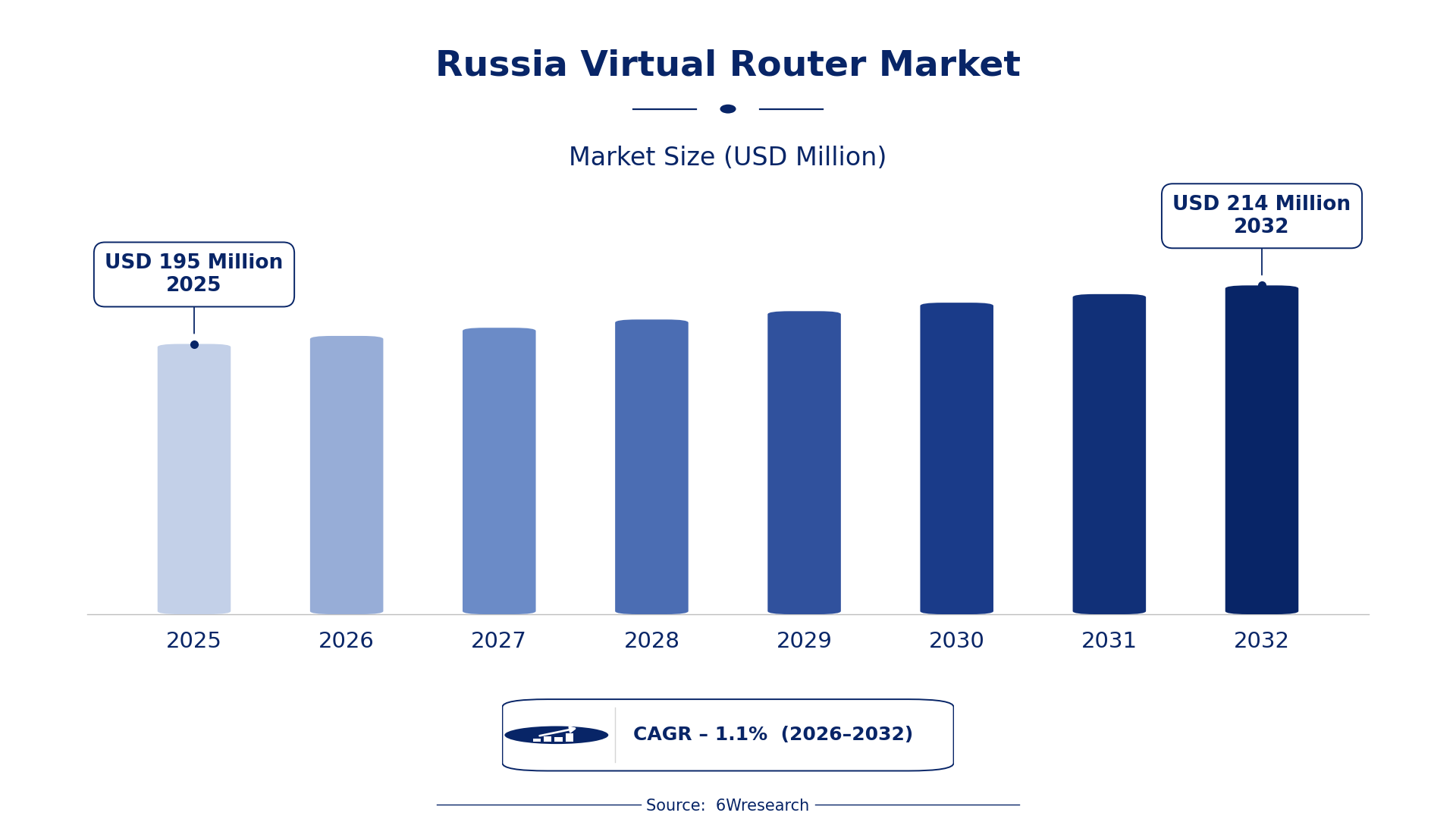
The Russia Virtual Router Market was estimated at USD 195 Million in 2025 and is projected to reach USD 214 Million by 2032, growing at a CAGR of 1.1% from 2026 to 2032.
Russia Virtual Router Market Synopsis
The demand for virtual routers in Russia is significantly influenced by the increasing necessity for scalable and cost-efficient networking solutions. As businesses across various sectors aim to modernize their infrastructure, the flexibility offered by virtual routers stands out as a compelling advantage, particularly in the face of rising cloud adoption.
Virtual routers enable organizations to enhance network performance without the constraints of physical hardware. This capability is crucial for managing the growing influx of IoT devices and cloud services, as companies seek more efficient ways to handle their network demands.
Russia Virtual Router Market Year-wise Growth Rate and Key Drivers
This graph illustrates the annual growth rates of the Russia Virtual Router Market from 2021 to 2032, highlighting a steady upward trajectory and projected expansion over the forecast period.
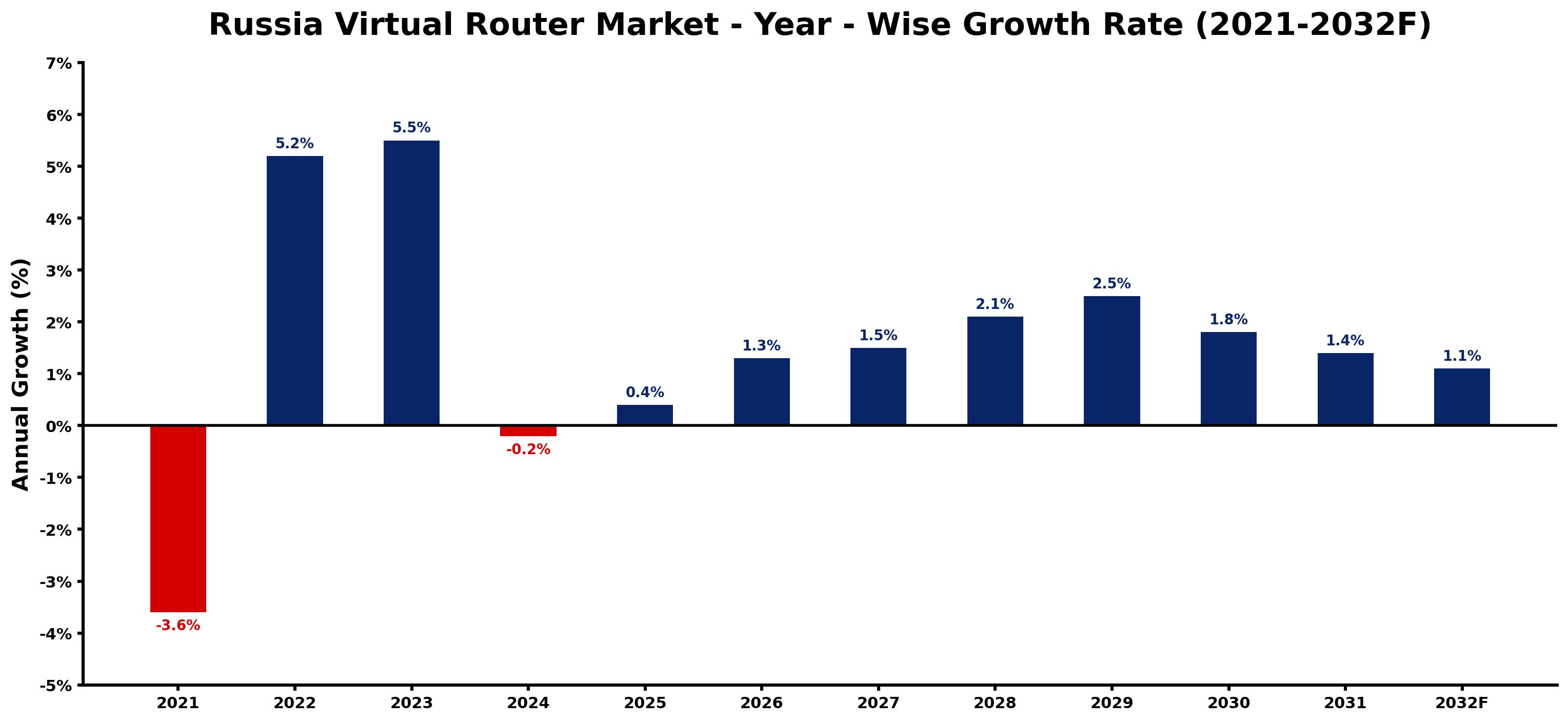
The table below presents the year‑wise growth rates along with the key drivers influencing the market
| Year | Growth Rate | Major Drivers |
| 2021 | -3.6% | Decreased investments due to Western sanctions impact. |
| 2022 | 5.2% | Increased demand for remote work solutions during sanctions. |
| 2023 | 5.5% | Growth in digital services push from local telecom providers. |
| 2024 | -0.2% | Evolving regulations limiting foreign technology adoption. |
| 2025 | 0.4% | Local tech firms adopting virtualization for network efficiency. |
| 2026 | 1.3% | Government support for digital infrastructure development projects. |
| 2027 | 1.5% | Rise in cybersecurity threats driving virtual router adoption. |
| 2028 | 2.1% | Small businesses transitioning to cloud-based networking solutions. |
| 2029 | 2.5% | Enhanced network virtualization through local technology partnerships. |
| 2030 | 1.8% | Focus on improving network resilience amid geopolitical tensions. |
| 2031 | 1.4% | Increased investment in domestic IT solutions during isolation. |
| 2032 | 1.1% | Growing interest in IoT solutions requiring advanced routing. |
Note: Market size estimations and growth projections presented in this report are based on 6Wresearch's proprietary forecasting methodology, utilizing the latest available industry data, government publications, and primary research inputs.
Russia Virtual Router Market Key Takeaways
Below are some of the specific key takeaways from the market, including:
- Virtual routers are gaining traction due to their ability to deliver software-based routing without hardware dependencies.
- Cloud computing and digital transformation initiatives are significant drivers of market growth.
- Investment in cybersecurity measures is essential to address increasing data privacy concerns.
- Government regulations pose both challenges and opportunities for market players.
- Emerging technologies like SD-WAN are shaping the future of virtual router solutions.
Evaluation of Restraints in Russia Virtual Router Market
The Russia Virtual Router Market faces considerable obstacles, primarily due to stringent government regulations and cybersecurity issues. The government's strict controls on internet traffic and data privacy create hurdles for businesses seeking to implement virtual router solutions. These regulatory measures often complicate the deployment of new technologies, as companies must navigate compliance requirements while ensuring robust cybersecurity to protect against potential threats. As a result, the market's growth is tempered by the need for vendors to prioritize security and regulatory adherence.
Russia Virtual Router Market Trends
A notable trend is the increasing shift toward virtualized networking solutions that offer businesses greater flexibility and scalability. The move towards software-defined networking (SDN) and network functions virtualization (NFV) is making virtual routers a preferred choice for many organizations. This trend is driven by the desire for more agile networking capabilities, allowing companies to adapt quickly to changing demands.
Another trend is the integration of advanced features such as automation and enhanced security protocols. As the digital landscape evolves, virtual router solutions are being developed with capabilities that address emerging challenges, making them indispensable in modern IT environments.
Russia Virtual Router Market Opportunities
Investment opportunities in the Russia Virtual Router Market are expanding, particularly as organizations embrace cloud services and digital transformation. Companies looking to capitalize on this growth can focus on developing innovative virtual router technologies that meet specific industry requirements. Collaborating with local businesses to tailor solutions will enhance market penetration and customer engagement.
on top of that, enhancing cybersecurity features will be crucial in gaining customer trust. As concerns over data security rise, vendors that can demonstrate high performance and reliability will have a competitive edge, positioning themselves favorably in a growing market.
Government Initiatives in the Russia Virtual Router Market
Government policy significantly influences the Russia Virtual Router Market, as regulatory frameworks shape the operational landscape for technology providers. The emphasis on data localization and strict internet traffic regulations creates both challenges and opportunities for businesses. Understanding these policies is crucial for market participants aiming to succeed in this environment.
- A regulatory framework established in 2023 mandates all internet traffic to pass through government-controlled points, impacting how virtual routers are deployed.
- Currently ongoing is an initiative to develop a national digital infrastructure program that aims to enhance connectivity and accessibility across the country.
- In 2024, a planned public-private partnership is expected to focus on upgrading telecom infrastructure to support the growing demand for virtualized networking solutions.
- Recent legislation introduced in 2025 requires technology companies to store user data within Russia, affecting the operational protocols for virtual router providers.
Future Insights of the Russia Virtual Router Market
Looking ahead to 2026-2032, the Russia Virtual Router Market is set to experience steady growth. The continued emphasis on digital transformation across industries will drive demand for advanced virtualized networking solutions. As organizations prioritize cost-effective and scalable options, the adoption of software-defined networking technologies will increase. on top of that, as awareness of the benefits of virtualization spreads, businesses will increasingly invest in modernizing their networking infrastructure, further propelling market expansion.
Russia Virtual Router Market Latest Developments
In the past year, the Russia Virtual Router Market has seen a surge in activity, driven by technological advancements and regulatory changes. Companies are increasingly focused on enhancing their offerings to meet the demands of a dynamic environment. This shift has led to a number of key initiatives aimed at fostering growth and innovation.
- A major technology vendor launched a new virtual router solution in Q1 2025, designed to improve integration with existing network infrastructures.
- Ongoing partnerships between local operators and cybersecurity firms are enhancing the security features of virtual router products, with initiatives that began in late 2024.
- In mid-2025, a leading regional operator announced a project to upgrade its virtual routing capabilities to support increased cloud service demands.
- Upcoming in early 2026 is the rollout of a new software update aimed at improving the automation capabilities of existing virtual routers.
Russia Virtual Router Market - Key Attractiveness of the Report
- 10 Years of Market Numbers
- Historical Data Starting from 2022 to 2025
- Base Year: 2025
- Forecast Data until 2032
- Key Performance Indicators Impacting the Market
- Major Upcoming Developments and Projects
Key Highlights of the Report:
- Russia Virtual Router Market Outlook
- Market Size of Russia Virtual Router Market, 2025
- Forecast of Russia Virtual Router Market, 2032
- Historical Data and Forecast of Russia Virtual Router Revenues & Volume for the Period 2022-2032F
- Russia Virtual Router Market Trend Evolution
- Russia Virtual Router Market Drivers and Challenges
- Russia Virtual Router Price Trends
- Russia Virtual Router Porter's Five Forces
- Russia Virtual Router Industry Life Cycle
- Historical Data and Forecast of Russia Virtual Router Market Revenues & Volume By Component for the Period 2022-2032F
- Historical Data and Forecast of Russia Virtual Router Market Revenues & Volume By Solution for the Period 2022-2032F
- Historical Data and Forecast of Russia Virtual Router Market Revenues & Volume By Service for the Period 2022-2032F
- Historical Data and Forecast of Russia Virtual Router Market Revenues & Volume By Type for the Period 2022-2032F
- Historical Data and Forecast of Russia Virtual Router Market Revenues & Volume By Pre-defined for the Period 2022-2032F
- Historical Data and Forecast of Russia Virtual Router Market Revenues & Volume By Custom for the Period 2022-2032F
- Historical Data and Forecast of Russia Virtual Router Market Revenues & Volume By End-User for the Period 2022-2032F
- Historical Data and Forecast of Russia Virtual Router Market Revenues & Volume By Service Provider for the Period 2022-2032F
- Historical Data and Forecast of Russia Virtual Router Market Revenues & Volume By Enterprises for the Period 2022-2032F
- Russia Virtual Router Import Export Trade Statistics
- Market Opportunity Assessment By Component
- Market Opportunity Assessment By Type
- Market Opportunity Assessment By End-User
- Russia Virtual Router Top Companies Market Share
- Russia Virtual Router Competitive Benchmarking By Technical and Operational Parameters
- Russia Virtual Router Company Profiles
- Russia Virtual Router Key Strategic Recommendations






































