Russia Water & Wastewater Treatment Market Summary
The russia water & wastewater treatment market was estimated at USD 95 Million in 2025 and is projected to reach USD 103 Million by 2032, growing at a CAGR of 1.1% from 2026 to 2032.
Russia Water & Wastewater Treatment Market Year-wise Growth Rate and Key Drivers
This graph highlights how the Russia Water & Wastewater Treatment Market has steadily grown over the past five years, supported by major growth factors.
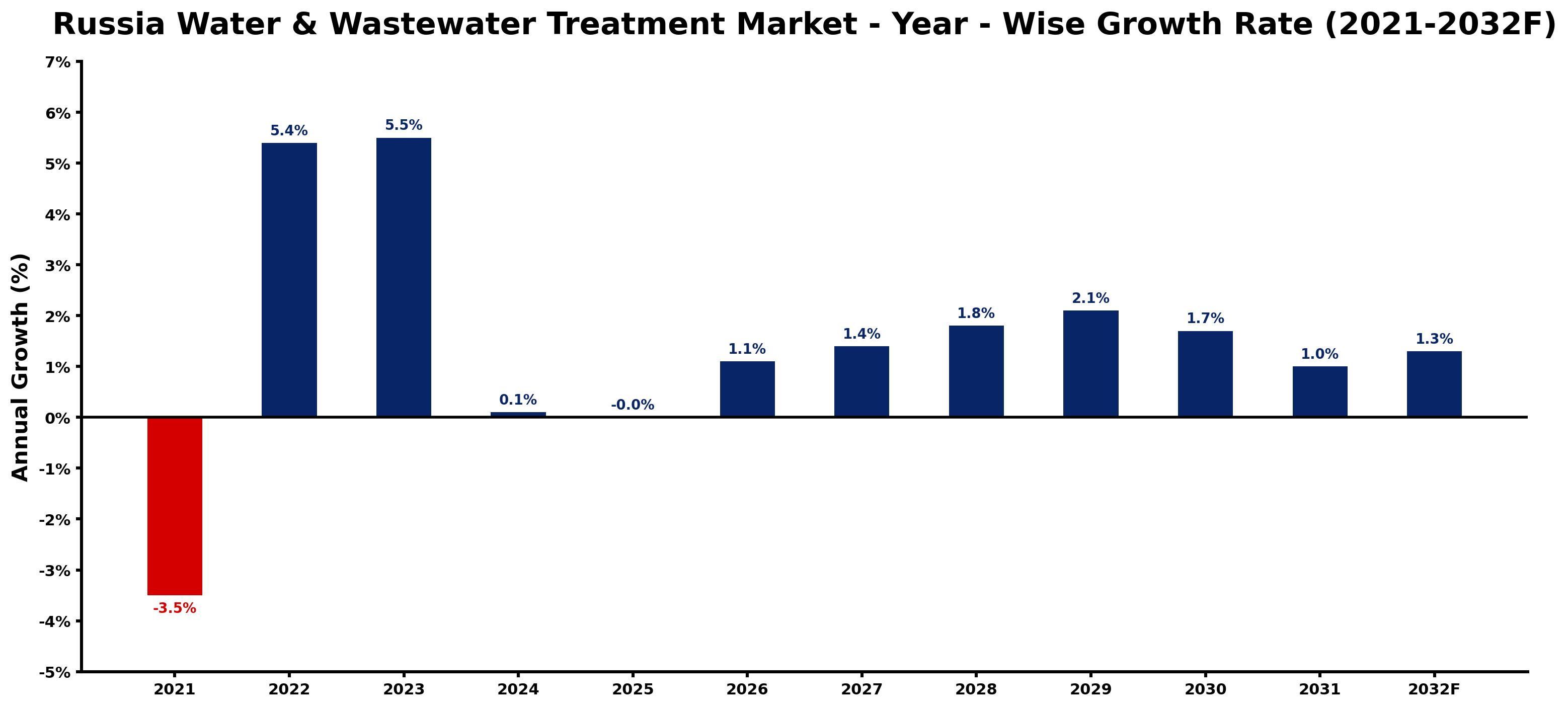
The table below presents the year wise growth rates along with the key drivers influencing the market
| Year | Growth Rate | Major Drivers |
| 2021 | -3.5% | Geopolitical tensions and sanctions hindered infrastructure investments, stalling advancements in water treatment technologies. |
| 2022 | 5.4% | Many municipalities prioritize upgrading treatment plants to meet modern environmental standards. |
| 2023 | 5.5% | Public-private partnerships emerge, advancing collaborative efforts in water management projects. |
| 2024 | 0.1% | Emerging technologies are reshaping water treatment processes, enhancing efficiency and sustainability. |
| 2025 | -0.0% | A focus on resource recovery within wastewater systems supports circular economy initiatives. |
| 2026 | 1.1% | Climate change impacts create urgency for resilient water infrastructure solutions. |
| 2027 | 1.4% | Increased industrial activity necessitates more robust water purification and reuse systems. |
| 2028 | 1.8% | Research and development investments yield innovative solutions tailored to local water challenges. |
| 2029 | 2.1% | Smart water management technologies gain traction, integrating IoT for real-time monitoring. |
| 2030 | 1.7% | Public awareness campaigns encourage community involvement in local water conservation efforts. |
| 2031 | 1.0% | International collaboration brings best practices to bolster Russian water treatment capabilities. |
| 2032 | 1.3% | Sustainable practices become integral to water management, influenced by global environmental trends. |
Note - Market size estimations and growth projections presented in this report are based on 6Wresearch's advanced forecasting approach, validated with industry datasets as of June 2026.
Russia Water & Wastewater Treatment Market Synopsis
The Russia Water Wastewater Treatment Market is projected to reach 1.1% and witness significant growth during the forecast period (2026-2032). The anticipated growth, estimated at a CAGR of 5.4%, is driven by a combination of factors including governmental initiatives aimed at enhancing water infrastructure, a growing population, and increasing urbanization. The industrial sectors, notably oil & gas, pharmaceuticals, and chemicals, are further elevating the demand for high-quality treated wastewater that meets stringent regulatory requirements.
Russia Water & Wastewater Treatment Market Growth Drivers
The Russia Water & Wastewater Treatment Market is experiencing growth due to several key drivers:
- The increased governmental focus on modernizing aging water infrastructure is paramount. Investment in this area not only improves service delivery but also enhances public health and environmental quality.
- The escalating population in urban areas significantly heightens water demand. This urban influx necessitates the expansion and upgrading of wastewater treatment facilities to handle larger volumes of waste efficiently.
- Rising urbanization activities create a pressing need for advanced water treatment solutions. As urban centers expand, the management of water resources becomes critical to sustaining growth.
- The proliferation of industries—especially in sectors such as pharmaceuticals and chemicals—demands stringent wastewater treatment solutions to abide by regulatory standards aimed at protecting ecosystems.
- Technological advancements in treatment processes, particularly in membrane bioreactor technology, are adding to the market's appeal by providing more efficient and effective solutions for wastewater management.
Russia Water & Wastewater Treatment Market Challenges and Restraints
While the Russia Water & Wastewater Treatment Market presents numerous opportunities, it is not without its challenges:
- The high cost associated with the installation and maintenance of advanced water treatment technologies can deter investment, especially among smaller municipalities.
- Inadequate funding and budget constraints at the local government level can impede progress on infrastructure improvements necessary for efficient wastewater management.
- Regulatory compliance can pose challenges, especially for industries that may struggle to meet the stringent standards for wastewater discharge.
- The geographical distribution of water resources creates logistical difficulties in treatment and distribution, making it hard for some regions to ensure consistent water quality.
- The lag in public awareness about the importance of wastewater treatment can hinder community support for initiatives aimed at improving water quality and infrastructure.
Russia Water & Wastewater Treatment Market Government Investment and Initiatives
The Russian Government has recognized the critical importance of water resource management, leading to a series of initiatives aimed at bolstering the water and wastewater treatment infrastructure:
- Programs such as the 'Clean Water' initiative highlight the government's commitment, with an estimated budget allocated to modernizing municipal sewage services, significantly impacting urban areas.
- Investment in large-scale infrastructure projects is being prioritized to improve treatment facilities, ensuring they can handle modern demands effectively.
- The government has initiated public-private partnerships to facilitate funding and technological support, allowing for improved implementation of wastewater solutions.
- Subsidies and incentives for eco-friendly technologies in water treatment have been introduced, promoting sustainable practices across industries.
- A focus on research and development is evident, with funding directed towards innovative technologies that enhance the efficiency of wastewater treatment processes.
Russia Water & Wastewater Treatment Market Latest Developments (May 2025 - June 2026)
Recent developments within the Russia Water & Wastewater Treatment Market indicate a progressive shift towards modernization and efficiency:
- The rollout of several pilot projects focusing on advanced filtration systems has garnered interest from multiple sectors looking to enhance wastewater management.
- Increased collaboration between government and local authorities has been noted, aiming to align municipal regulations with national standards for water quality.
- Technological innovations have surfaced, particularly in smart water management systems that utilize IoT for real-time monitoring and optimization of treatment processes.
- Consistent public engagement initiatives are being launched to raise awareness about the importance of wastewater treatment and conservation efforts.
- New funding schemes have been proposed to support ongoing infrastructure projects, ensuring that waste treatment facilities are equipped to handle future demands.
Russia Water & Wastewater Treatment Market - Key Attractiveness of the Report
- 10 Years of Market Numbers
- Historical Data Starting from 2022 to 2025
- Base Year: 2025
- Forecast Data until 2032
- Key Performance Indicators Impacting the Market
- Major Upcoming Developments and Projects
Key Highlights of the Report:
- Russia Water & Wastewater Treatment Market Outlook
- Market Size of Russia Water & Wastewater Treatment Market, 2025
- Forecast of Russia Water & Wastewater Treatment Market, 2032F
- Historical Data and Forecast of Russia Water & Wastewater Treatment Revenues & Volume for the Period 2022-2032F
- Russia Water & Wastewater Treatment Market Trend Evolution
- Russia Water & Wastewater Treatment Market Drivers and Challenges
- Russia Water & Wastewater Treatment Price Trends
- Russia Water & Wastewater Treatment Porter's Five Forces
- Russia Water & Wastewater Treatment Industry Life Cycle
- Historical Data and Forecast of Russia Water & Wastewater Treatment Market Revenues & Volume By Product Category????????????? for the Period 2022-2032F
- Historical Data and Forecast of Russia Water & Wastewater Treatment Market Revenues & Volume By Treatment Technologies for the Period 2022-2032F
- Historical Data and Forecast of Russia Water & Wastewater Treatment Market Revenues & Volume By Delivery Equipment for the Period 2022-2032F
- Historical Data and Forecast of Russia Water & Wastewater Treatment Market Revenues & Volume By Treatment Chemicals for the Period 2022-2032F
- Historical Data and Forecast of Russia Water & Wastewater Treatment Market Revenues & Volume By Instrumentation for the Period 2022-2032F
- Historical Data and Forecast of Russia Water & Wastewater Treatment Market Revenues & Volume By Applications for the Period 2022-2032F
- Historical Data and Forecast of Russia Water & Wastewater Treatment Market Revenues & Volume By Municipal for the Period 2022-2032F
- Historical Data and Forecast of Russia Water & Wastewater Treatment Market Revenues & Volume By Industrial for the Period 2022-2032F
- Russia Water & Wastewater Treatment Import Export Trade Statistics
- Market Opportunity Assessment By Product Category?????????????
- Market Opportunity Assessment By Applications
- Russia Water & Wastewater Treatment Top Companies Market Share
- Russia Water & Wastewater Treatment Competitive Benchmarking By Technical and Operational Parameters
- Russia Water & Wastewater Treatment Company Profiles
- Russia Water & Wastewater Treatment Key Strategic Recommendations






































