Russia Workflow Management System Market Size & Growth Rate (2026-2032)
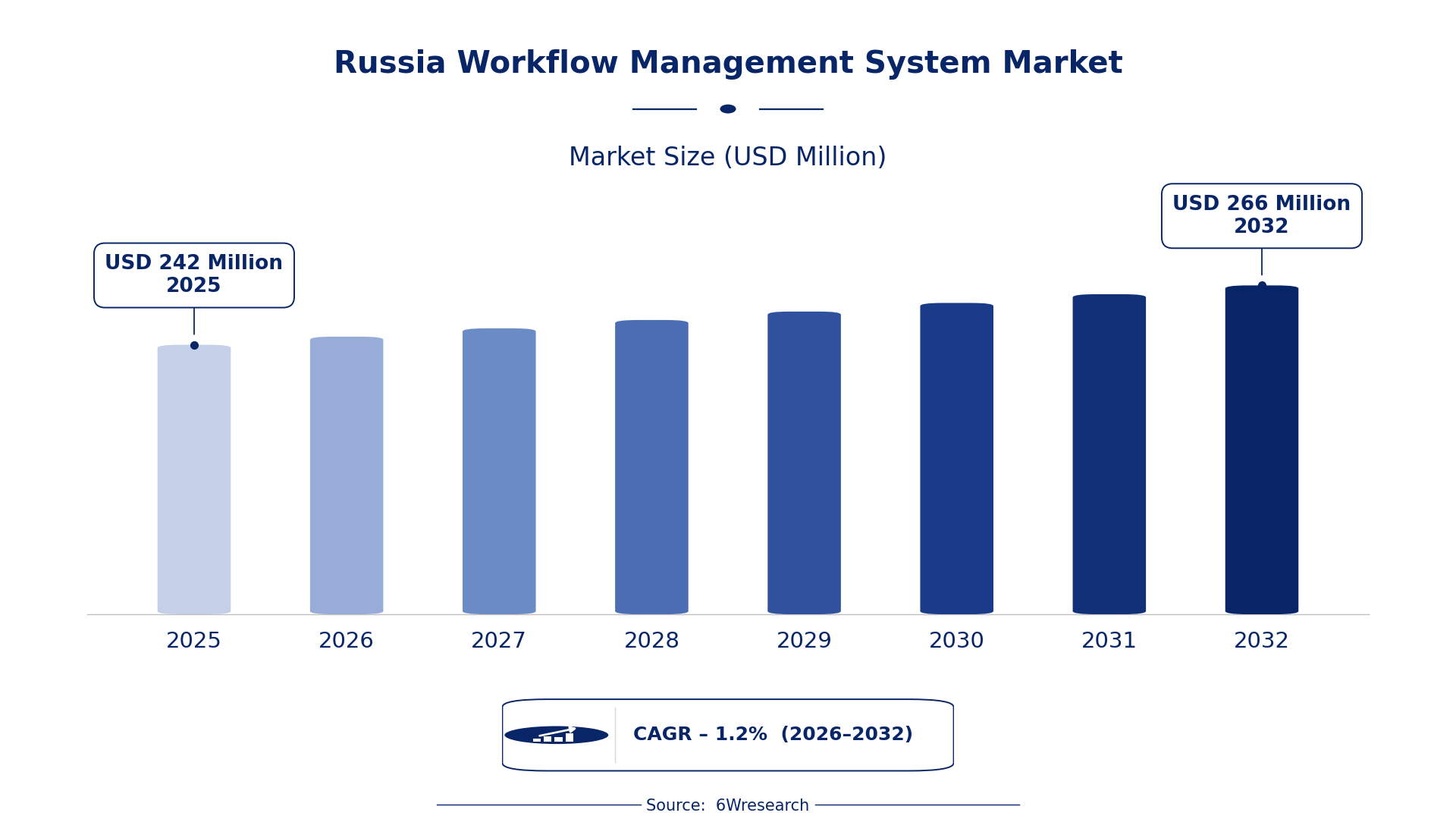
The Russia Workflow Management System Market was estimated at USD 242 Million in 2025 and is projected to reach USD 266 Million by 2032, growing at a CAGR of 1.2% from 2026 to 2032.
Russia Workflow Management System Market Synopsis
The demand for efficient workflow management solutions in Russia has surged as organizations strive to enhance productivity and reduce operational costs. Industries such as IT, healthcare, and banking are increasingly implementing digital solutions to streamline processes, illustrating a notable shift in operational strategies across sectors.
The rise of cloud-based solutions is particularly noteworthy, as companies seek scalable and cost-effective systems. These solutions not only support remote work but also cater to the evolving needs of a mobile workforce, driving the adoption of advanced features like automation and integration.
Russia Workflow Management System Market Year-wise Growth Rate and Key Drivers
This graph illustrates the annual growth rates of the Russia Workflow Management System Market from 2021 to 2032, highlighting a steady upward trajectory and projected expansion over the forecast period.
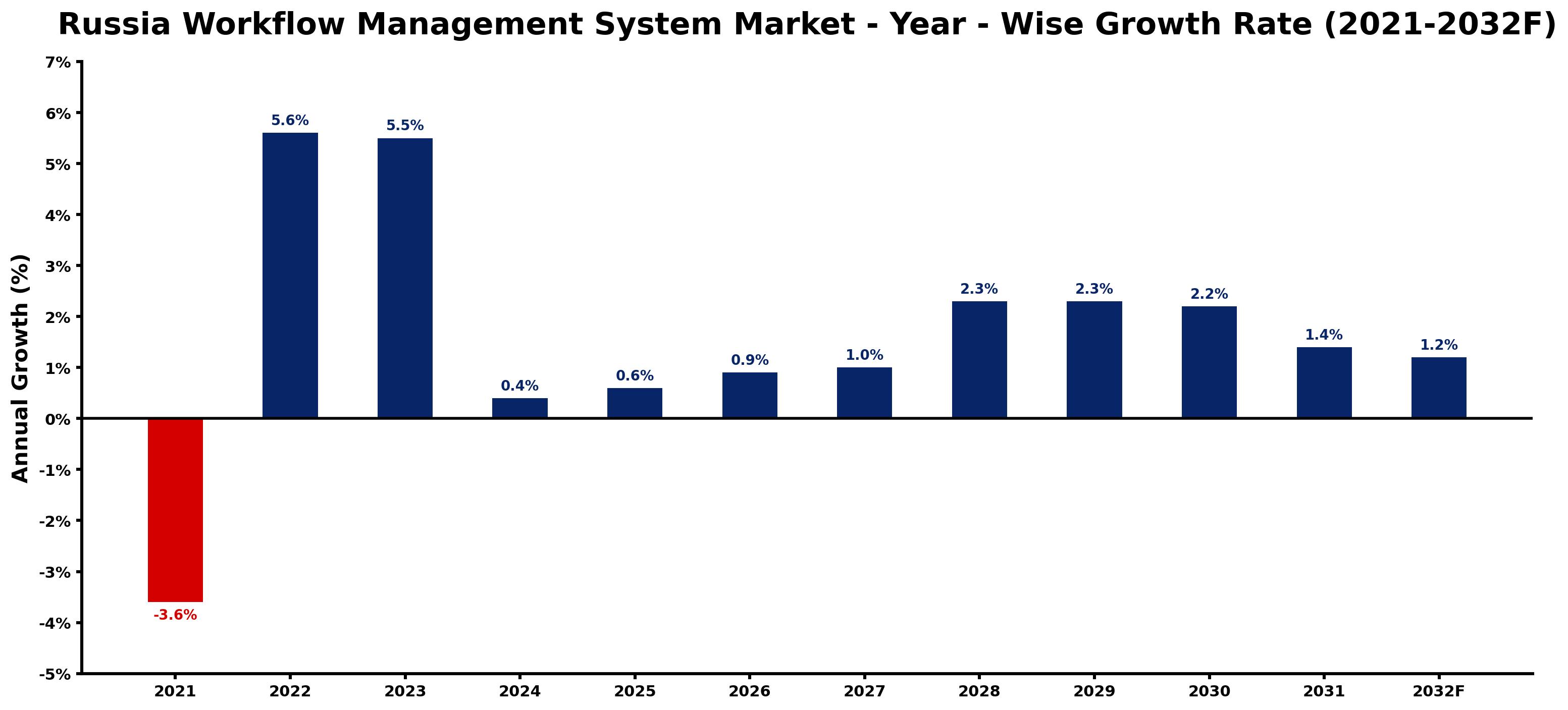
The table below presents the year‑wise growth rates along with the key drivers influencing the market
| Year | Growth Rate | Major Drivers |
| 2021 | -3.6% | Decreased spending from Russian state-owned enterprises. |
| 2022 | 5.6% | Increased digital transformation post-sanctions drive software adoption. |
| 2023 | 5.5% | Government incentives promote automation in various industries. |
| 2024 | 0.4% | Growing remote work culture boosts demand for workflow solutions. |
| 2025 | 0.6% | Local SMEs seeking cost-effective efficiency solutions expand market. |
| 2026 | 0.9% | Rise in digitization of public services encourages system integration. |
| 2027 | 1.0% | Evolving regulatory requirements drive compliance and process optimization. |
| 2028 | 2.3% | Increased focus on cybersecurity fuels demand for workflow management. |
| 2029 | 2.3% | Integration with AI technologies enhances operational capabilities. |
| 2030 | 2.2% | Market maturity leads to incremental improvements in existing systems. |
| 2031 | 1.4% | Focus on improving employee productivity and collaboration tools. |
| 2032 | 1.2% | Adoption of cloud solutions increases flexibility in workflows. |
Note: Market size estimations and growth projections presented in this report are based on 6Wresearch's proprietary forecasting methodology, utilizing the latest available industry data, government publications, and primary research inputs.
Russia Workflow Management System Market Key Takeaways
Below are some of the specific key takeaways from the market, including:
- Increasing demand for cloud-based workflow solutions reflects a shift towards more flexible operational frameworks.
- Adoption of AI and machine learning capabilities is enhancing automation and data analytics within workflow systems.
- Mobile accessibility is becoming a priority, driven by a growing remote workforce.
- Collaboration features are being enhanced to improve communication and task management among teams.
- Investment opportunities are expanding as businesses focus on digital transformation and process optimization.
Evaluation of Restraints in Russia Workflow Management System Market
While the market is on an upward trajectory, several restraints hinder its growth. Cultural barriers and a reluctance to change can stall the adoption of new technologies, particularly in traditional sectors. on top of that, the cybersecurity landscape poses significant risks, with data breaches threatening the integrity of sensitive information. Integration complexities with existing IT infrastructure further complicate the deployment of workflow management systems, requiring substantial resources and expertise for successful implementation.
Russia Workflow Management System Market Trends
Several trends are shaping the Russia Workflow Management System market. The migration towards cloud-based solutions continues to gain momentum, as organizations appreciate the flexibility and scalability offered. The integration of AI and machine learning is also on the rise, enabling predictive analytics and smarter automation.
There is a clear focus on enhancing user experience, with an increasing demand for mobile-friendly systems. Additionally, companies are prioritizing collaboration features to foster better communication and streamline task management, ensuring teams can work effectively regardless of location.
Russia Workflow Management System Market Opportunities
The market is ripe with investment opportunities, particularly in the wake of digital transformation initiatives. As businesses seek to automate workflows and optimize processes, the demand for tailored workflow management solutions will continue to rise. Companies that can offer innovative and localized solutions will find a favorable environment for growth.
on top of that, as the emphasis on process efficiency grows, opportunities will emerge for firms that integrate advanced technologies, making it essential for investors to stay attuned to emerging trends and technological advancements.
Government Initiatives in the Russia Workflow Management System Market
Government policy is playing a critical role in shaping the Russia Workflow Management System market. The Russian government has prioritized digitalization across various sectors, implementing initiatives aimed at reducing bureaucratic hurdles and enhancing efficiency through technology. Policies focused on data security and privacy are also gaining importance, particularly as workflow management systems become more integrated into public and private organizations.
- A recently completed initiative aimed at streamlining administrative processes through digital platforms has been successfully implemented.
- Current government efforts are underway to establish a regulatory framework that mandates compliance with data security protocols for WMS adoption.
- A planned public-private partnership is expected to boost the development of digital infrastructure, enhancing access to workflow management systems by 2028.
- Ongoing incentives for businesses adopting digital solutions are encouraging innovation and competitiveness in the market.
- Future policies will likely focus on expanding support for small and medium enterprises to implement workflow management solutions effectively.
Future Insights of the Russia Workflow Management System Market
Looking ahead to 2026-2032, the Russia Workflow Management System market is set for steady growth. The continued push for digitization across industries will fuel demand for advanced workflow solutions that enhance operational efficiency. As organizations increasingly embrace remote work and seek tools that promote collaboration, the market will likely expand further.
However, challenges such as cybersecurity threats and the need for compliance with evolving regulations will persist. Companies that can navigate these complexities while delivering innovative solutions will be well-positioned for success in the coming years.
Russia Workflow Management System Market Latest Developments
Recent industry activity in the Russia Workflow Management System market has highlighted a strong shift towards technological advancement and innovation. Organizations are increasingly investing in solutions that cater to their specific operational needs, reflecting a broader trend towards customization and efficiency.
- A major technology vendor launched a new cloud-based workflow solution in early 2025, aimed at enhancing collaboration among remote teams.
- An ongoing initiative started in mid-2025 focuses on integrating AI capabilities into existing workflow systems, aiming to boost automation and efficiency.
- In late 2025, a public-private partnership was formed to develop a national digital infrastructure upgrade program, enhancing access to workflow management technologies.
- A rollout expected to begin in Q2 2026 will introduce mobile-friendly features to existing workflow management systems, catering to a growing mobile workforce.
- By the end of 2026, a new regulatory framework is anticipated to be implemented, mandating enhanced data security measures for workflow management systems.
Russia Workflow Management System Market - Key Attractiveness of the Report
- 10 Years of Market Numbers
- Historical Data Starting from 2022 to 2025
- Base Year: 2025
- Forecast Data until 2032
- Key Performance Indicators Impacting the Market
- Major Upcoming Developments and Projects
Key Highlights of the Report:
- Russia Workflow Management System Market Outlook
- Market Size of Russia Workflow Management System Market, 2025
- Forecast of Russia Workflow Management System Market, 2032
- Historical Data and Forecast of Russia Workflow Management System Revenues & Volume for the Period 2022-2032F
- Russia Workflow Management System Market Trend Evolution
- Russia Workflow Management System Market Drivers and Challenges
- Russia Workflow Management System Price Trends
- Russia Workflow Management System Porter's Five Forces
- Russia Workflow Management System Industry Life Cycle
- Historical Data and Forecast of Russia Workflow Management System Market Revenues & Volume By Component for the Period 2022-2032F
- Historical Data and Forecast of Russia Workflow Management System Market Revenues & Volume By Software for the Period 2022-2032F
- Historical Data and Forecast of Russia Workflow Management System Market Revenues & Volume By Services for the Period 2022-2032F
- Historical Data and Forecast of Russia Workflow Management System Market Revenues & Volume By Service for the Period 2022-2032F
- Historical Data and Forecast of Russia Workflow Management System Market Revenues & Volume By IT consulting for the Period 2022-2032F
- Historical Data and Forecast of Russia Workflow Management System Market Revenues & Volume By Integration and implementation for the Period 2022-2032F
- Historical Data and Forecast of Russia Workflow Management System Market Revenues & Volume By Training and development for the Period 2022-2032F
- Historical Data and Forecast of Russia Workflow Management System Market Revenues & Volume By Software for the Period 2022-2032F
- Historical Data and Forecast of Russia Workflow Management System Market Revenues & Volume By Production workflow systems for the Period 2022-2032F
- Historical Data and Forecast of Russia Workflow Management System Market Revenues & Volume By Messaging-based workflow systems for the Period 2022-2032F
- Historical Data and Forecast of Russia Workflow Management System Market Revenues & Volume By Web-based workflow systems for the Period 2022-2032F
- Historical Data and Forecast of Russia Workflow Management System Market Revenues & Volume By Suite-based workflow systems for the Period 2022-2032F
- Historical Data and Forecast of Russia Workflow Management System Market Revenues & Volume By Other workflow systems for the Period 2022-2032F
- Historical Data and Forecast of Russia Workflow Management System Market Revenues & Volume By Deployment Type for the Period 2022-2032F
- Historical Data and Forecast of Russia Workflow Management System Market Revenues & Volume By Cloud for the Period 2022-2032F
- Historical Data and Forecast of Russia Workflow Management System Market Revenues & Volume By On-premises for the Period 2022-2032F
- Historical Data and Forecast of Russia Workflow Management System Market Revenues & Volume By Industry Verticals for the Period 2022-2032F
- Historical Data and Forecast of Russia Workflow Management System Market Revenues & Volume By Banking, financial services, and insurance for the Period 2022-2032F
- Historical Data and Forecast of Russia Workflow Management System Market Revenues & Volume By Public sector for the Period 2022-2032F
- Historical Data and Forecast of Russia Workflow Management System Market Revenues & Volume By Healthcare for the Period 2022-2032F
- Historical Data and Forecast of Russia Workflow Management System Market Revenues & Volume By Energy and utilities for the Period 2022-2032F
- Historical Data and Forecast of Russia Workflow Management System Market Revenues & Volume By Retail for the Period 2022-2032F
- Historical Data and Forecast of Russia Workflow Management System Market Revenues & Volume By IT and telecom for the Period 2022-2032F
- Historical Data and Forecast of Russia Workflow Management System Market Revenues & Volume By Travel and hospitality for the Period 2022-2032F
- Historical Data and Forecast of Russia Workflow Management System Market Revenues & Volume By Transportation and logistics for the Period 2022-2032F
- Russia Workflow Management System Import Export Trade Statistics
- Market Opportunity Assessment By Component
- Market Opportunity Assessment By Service
- Market Opportunity Assessment By Software
- Market Opportunity Assessment By Deployment Type
- Market Opportunity Assessment By Industry Verticals
- Russia Workflow Management System Top Companies Market Share
- Russia Workflow Management System Competitive Benchmarking By Technical and Operational Parameters
- Russia Workflow Management System Company Profiles
- Russia Workflow Management System Key Strategic Recommendations






































