Samoa Writing and Marking Instrument Market Growth Rate Analysis (2025 - 2031)
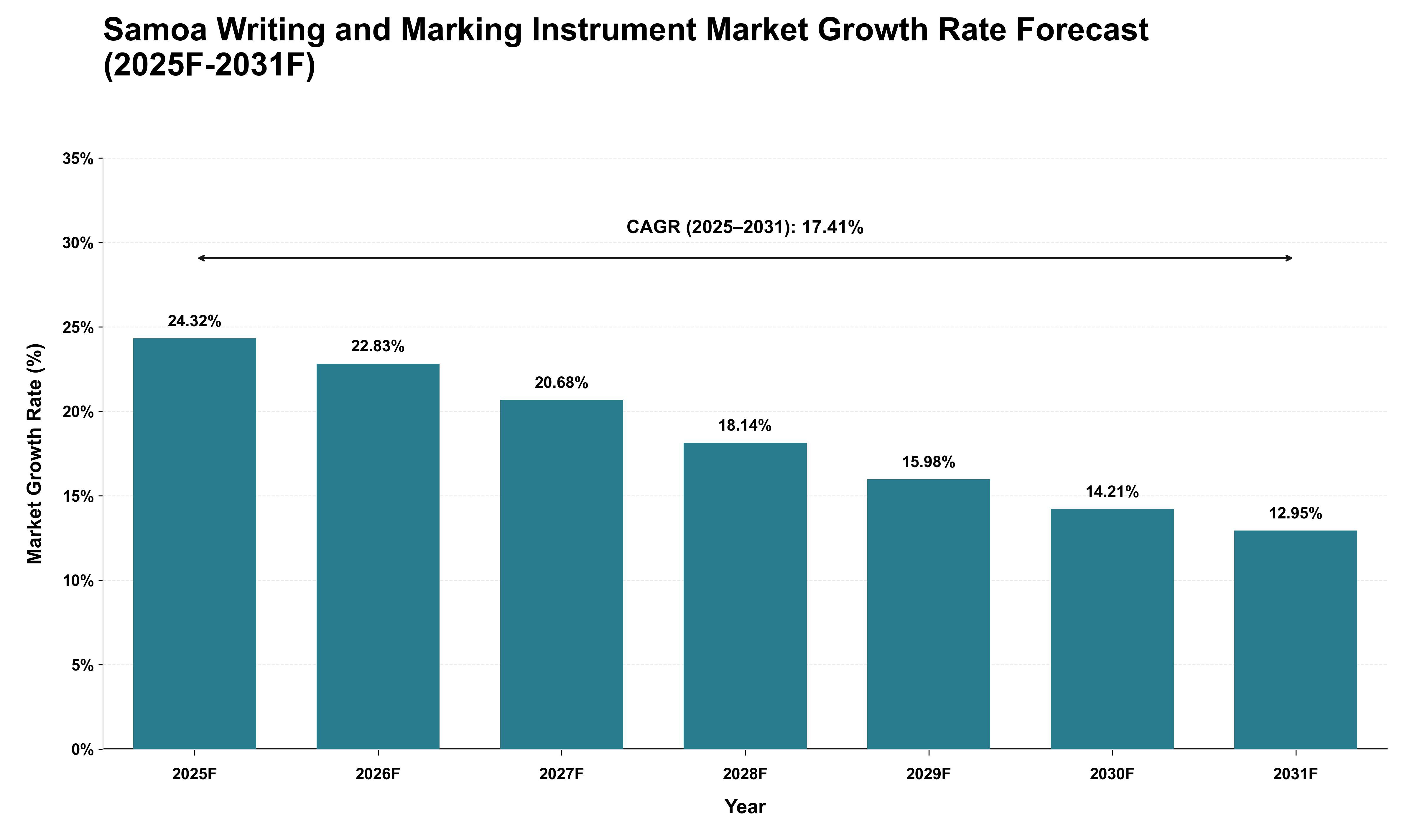
The Samoa writing and marking instrument market will experience robust growth driven by several macroeconomic factors, including increasing educational investments and a rising emphasis on literacy rates. The projected compound annual growth rate (CAGR) of 17.41% reflects a strong demand trajectory, particularly in the early years of the forecast period, with annual growth peaking at 24.32% in 2025. This surge will likely be supported by heightened import dependencies as local production may struggle to meet demand, necessitating increased imports from established manufacturing hubs. As the market evolves, cyclical trends will emerge, with growth rates gradually tapering to 12.95% by 2031; this deceleration may indicate a transition towards more stable consumption patterns as infrastructure develops and consumer preferences stabilize. Overall, the interplay of educational policy advancements and import dynamics will shape this market's future landscape significantly.
Key Highlights of the Report:
- Samoa Writing and Marking Instrument Market Outlook
- Market Size of Samoa Writing and Marking Instrument Market, 2024
- Forecast of Samoa Writing and Marking Instrument Market, 2031
- Historical Data and Forecast of Samoa Writing and Marking Instrument Revenues & Volume for the Period 2021-2031
- Samoa Writing and Marking Instrument Market Trend Evolution
- Samoa Writing and Marking Instrument Market Drivers and Challenges
- Samoa Writing and Marking Instrument Price Trends
- Samoa Writing and Marking Instrument Porter`s Five Forces
- Samoa Writing and Marking Instrument Industry Life Cycle
- Historical Data and Forecast of Samoa Writing and Marking Instrument Market Revenues & Volume By Type for the Period 2021-2031
- Historical Data and Forecast of Samoa Writing and Marking Instrument Market Revenues & Volume By Pen for the Period 2021-2031
- Historical Data and Forecast of Samoa Writing and Marking Instrument Market Revenues & Volume By Coloring and Writing Instrument for the Period 2021-2031
- Historical Data and Forecast of Samoa Writing and Marking Instrument Market Revenues & Volume By Pencil for the Period 2021-2031
- Historical Data and Forecast of Samoa Writing and Marking Instrument Market Revenues & Volume By Markers and Highlighters for the Period 2021-2031
- Historical Data and Forecast of Samoa Writing and Marking Instrument Market Revenues & Volume By Writing Accessories for the Period 2021-2031
- Historical Data and Forecast of Samoa Writing and Marking Instrument Market Revenues & Volume By Applications for the Period 2021-2031
- Historical Data and Forecast of Samoa Writing and Marking Instrument Market Revenues & Volume By Online Stores for the Period 2021-2031
- Historical Data and Forecast of Samoa Writing and Marking Instrument Market Revenues & Volume By Offline Stores for the Period 2021-2031
- Samoa Writing and Marking Instrument Import Export Trade Statistics
- Market Opportunity Assessment By Type
- Market Opportunity Assessment By Applications
- Samoa Writing and Marking Instrument Top Companies Market Share
- Samoa Writing and Marking Instrument Competitive Benchmarking By Technical and Operational Parameters
- Samoa Writing and Marking Instrument Company Profiles
- Samoa Writing and Marking Instrument Key Strategic Recommendations






































