Saudi Arabia AI in Education Market Size & Growth Rate (2026-2032)
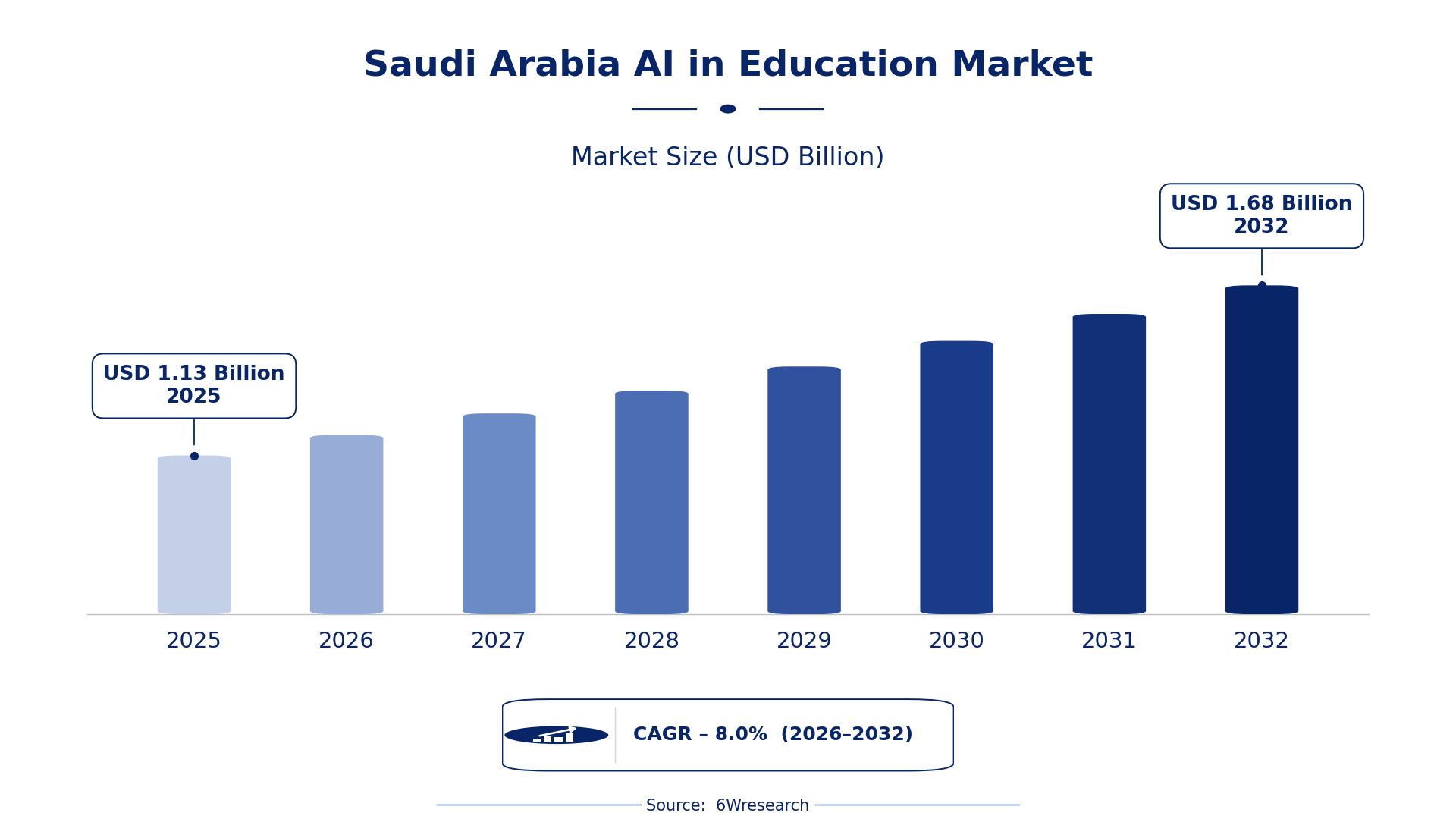
The Saudi Arabia AI in Education Market was estimated at USD 1134 Million in 2025 and is projected to reach USD 1680 Million by 2032, growing at a CAGR of 8.0% from 2026 to 2032.
Saudi Arabia AI in Education Market Synopsis
The driving force behind the Saudi Arabia AI in Education Market is the government’s strong commitment to enhancing educational quality through innovation. This initiative is not merely a trend; it reflects a strategic vision to integrate advanced technologies into the educational framework.
AI applications are transforming traditional learning methods by offering personalized experiences that cater to the individual needs of students. This shift is crucial for improving student outcomes and fostering an environment conducive to digital literacy, aligning with the nation’s goals for a knowledge-based economy.
Saudi Arabia AI in Education Market Year-wise Growth Rate and Key Drivers
This graph illustrates the annual growth rates of the Saudi Arabia AI in Education Market from 2021 to 2032, highlighting a steady upward trajectory and projected expansion over the forecast period.
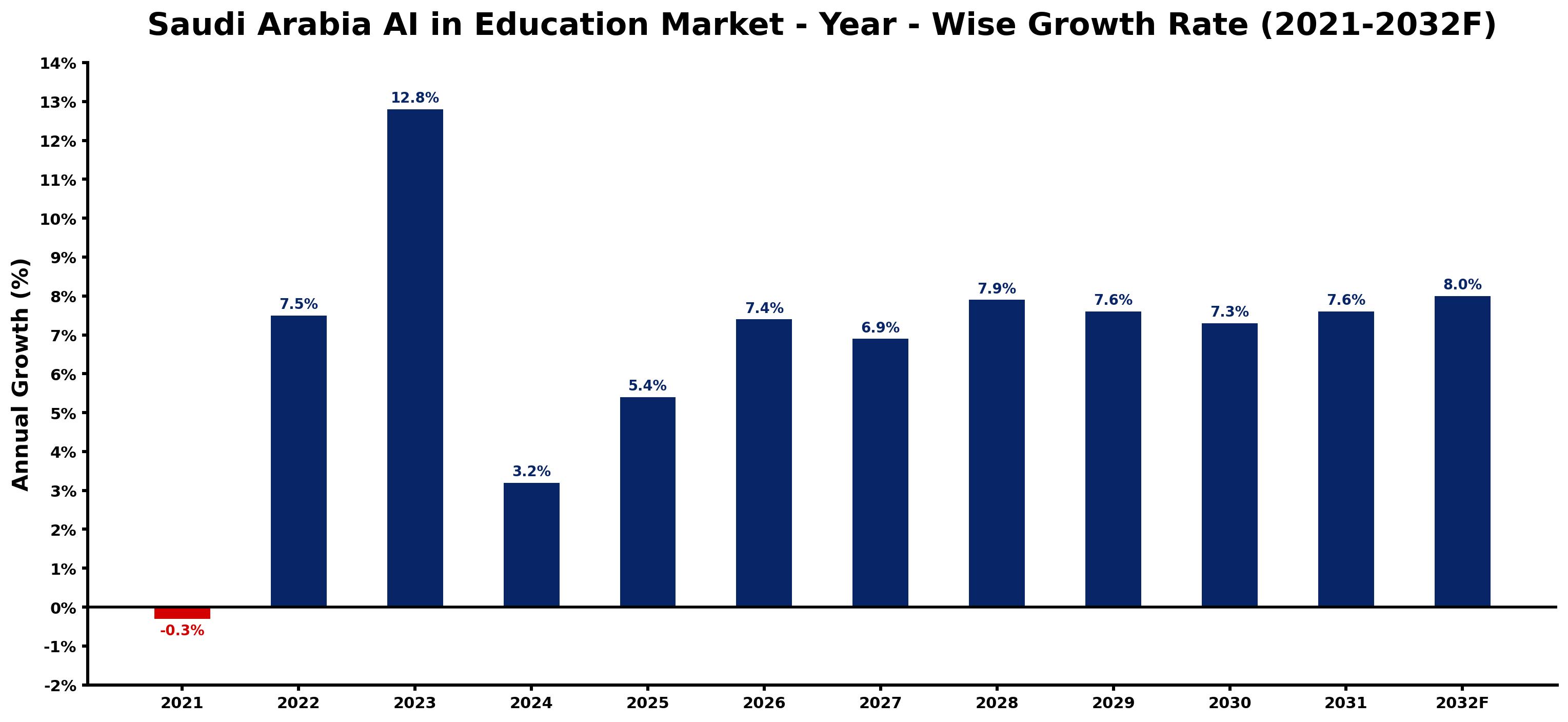
The table below presents the year‑wise growth rates along with the key drivers influencing the market
| Year | Growth Rate | Major Drivers |
| 2021 | -0.3% | Ministry of Education funding cuts for digital projects. |
| 2022 | 7.5% | Saudi Vision 2030 promoting technology in education |
| 2023 | 12.8% | Increased government funding for AI educational tools |
| 2024 | 3.2% | Growing interest in online learning platforms among universities |
| 2025 | 5.4% | Collaboration between schools and tech startups in EdTech |
| 2026 | 7.4% | Introduction of AI-driven student performance analytics tools |
| 2027 | 6.9% | Rise in demand for Arabic-language AI educational resources |
| 2028 | 7.9% | Implementation of AI-based tutoring systems in schools |
| 2029 | 7.6% | Government incentives for AI integration in educational institutions |
| 2030 | 7.3% | Surge in digital assessments and evaluation methods |
| 2031 | 7.6% | Increasing partnerships between industry leaders and educators |
| 2032 | 8.0% | Focus on STEM education boosted by AI advancements |
Note: Market size estimations and growth projections presented in this report are based on 6Wresearch's proprietary forecasting methodology, utilizing the latest available industry data, government publications, and primary research inputs.
Saudi Arabia AI in Education Market Key Takeaways
Below are some of the specific key takeaways from the market, including:
- The market is experiencing a significant uptick in investment driven by government initiatives.
- AI technologies are increasingly being adopted for personalized learning and administrative efficiency.
- Challenges regarding data privacy and ethical AI use remain a concern for stakeholders.
- The COVID-19 pandemic accelerated the adoption of AI in educational settings.
- Key players are focusing on enhancing student engagement through innovative AI solutions.
Evaluation of Restraints in Saudi Arabia AI in Education Market
Despite the promising growth, several restraints hinder market advancement. Concerns about data privacy and the ethical implications of AI use in education are paramount. Educational institutions must ensure compliance with privacy regulations while integrating AI technologies. Additionally, there's a need for more personalized and adaptive educational solutions to truly enhance the learning experience. These challenges require strategic planning and robust frameworks to be addressed effectively.
Saudi Arabia AI in Education Market Trends
A noticeable trend is the increasing incorporation of AI-driven analytics to monitor student performance and tailor educational content. Institutions are also embracing online platforms that utilize AI for real-time feedback and assessments, helping educators identify areas needing improvement. Another emerging trend is the collaboration between educational institutions and tech companies to develop customized AI tools that address specific curriculum needs.
Saudi Arabia AI in Education Market Opportunities
Opportunities for growth in this market are abundant. There is potential for investment in AI tools that facilitate remote learning, particularly as educational institutions adapt to hybrid models. on top of that, the demand for training educators in AI technologies presents a fertile ground for partnerships and programs. Expanding AI capabilities to cater to special education needs is another area ripe for development.
Government Initiatives in the Saudi Arabia AI in Education Market
The Saudi Arabian government is actively shaping the AI in Education Market through various initiatives aimed at promoting technological integration in schools. Public policy is focused on enhancing educational outcomes and equipping students with the necessary skills for a modern workforce. This proactive regulatory environment is crucial for encouraging investment and innovation within the sector.
- A national digital infrastructure upgrade programme was recently launched to enhance connectivity in educational institutions.
- Current initiatives include a pilot project focusing on AI-driven personalized learning tools for primary and secondary schools.
- Plans are underway to introduce a regulatory framework by 2026 that mandates the ethical use of AI in education.
- A public-private partnership has been established to develop AI training programs for educators, aiming for rollout by mid-2025.
- Upcoming initiatives include a comprehensive review of AI applications in education, scheduled for 2027, to assess their impact and effectiveness.
Future Insights of the Saudi Arabia AI in Education Market
Looking ahead to 2026-2032, the Saudi Arabia AI in Education Market is expected to continue its upward trajectory. The focus will likely remain on integrating advanced technologies into curricula, with a growing emphasis on personalized learning experiences. Stakeholders will need to address privacy concerns proactively, ensuring ethical standards are met as AI becomes more prevalent. As the market matures, partnerships between educational institutions and tech companies will be critical in driving innovation.
Saudi Arabia AI in Education Market Latest Developments
In the last 12-14 months, the Saudi Arabia AI in Education Market has witnessed considerable activity, reflecting a commitment to harnessing technology for educational advancement. Various initiatives have been launched, focusing on enhancing learning experiences and operational efficiencies.
- A major technology vendor launched an AI-based assessment tool in early 2025, aimed at improving student evaluation processes.
- An initiative began in Q3 2025 to implement AI-driven tutoring systems in universities, enhancing student support services.
- In late 2025, a partnership was formed between a leading regional operator and educational institutions to develop online learning platforms utilizing AI.
- A rollout expected to begin in early 2026 will introduce AI training workshops for teachers across the country.
- Plans for a pilot program in 2026 are underway to assess the impact of AI on student engagement in secondary education.
Saudi Arabia AI in Education Market - Key Attractiveness of the Report
- 10 Years of Market Numbers
- Historical Data Starting from 2022 to 2025
- Base Year: 2025
- Forecast Data until 2032
- Key Performance Indicators Impacting the Market
- Major Upcoming Developments and Projects
Key Highlights of the Report:
- Saudi Arabia AI in Education Market Outlook
- Market Size of Saudi Arabia AI in Education Market, 2025
- Forecast of Saudi Arabia AI in Education Market, 2032
- Historical Data and Forecast of Saudi Arabia AI in Education Revenues & Volume for the Period 2022-2032F
- Saudi Arabia AI in Education Market Trend Evolution
- Saudi Arabia AI in Education Market Drivers and Challenges
- Saudi Arabia AI in Education Price Trends
- Saudi Arabia AI in Education Porter's Five Forces
- Saudi Arabia AI in Education Industry Life Cycle
- Historical Data and Forecast of Saudi Arabia AI in Education Market Revenues & Volume By Technology for the Period 2022-2032F
- Historical Data and Forecast of Saudi Arabia AI in Education Market Revenues & Volume By Deep Learning and Machine Learning for the Period 2022-2032F
- Historical Data and Forecast of Saudi Arabia AI in Education Market Revenues & Volume By Natural Language Processing (NLP) for the Period 2022-2032F
- Historical Data and Forecast of Saudi Arabia AI in Education Market Revenues & Volume By Component for the Period 2022-2032F
- Historical Data and Forecast of Saudi Arabia AI in Education Market Revenues & Volume By Solutions for the Period 2022-2032F
- Historical Data and Forecast of Saudi Arabia AI in Education Market Revenues & Volume By Services for the Period 2022-2032F
- Historical Data and Forecast of Saudi Arabia AI in Education Market Revenues & Volume By Application for the Period 2022-2032F
- Historical Data and Forecast of Saudi Arabia AI in Education Market Revenues & Volume By Virtual Facilitators and Learning Environments for the Period 2022-2032F
- Historical Data and Forecast of Saudi Arabia AI in Education Market Revenues & Volume By Intelligent Tutoring Systems (ITS) for the Period 2022-2032F
- Historical Data and Forecast of Saudi Arabia AI in Education Market Revenues & Volume By Content Delivery Systems for the Period 2022-2032F
- Historical Data and Forecast of Saudi Arabia AI in Education Market Revenues & Volume By Fraud and Risk Management for the Period 2022-2032F
- Historical Data and Forecast of Saudi Arabia AI in Education Market Revenues & Volume By Student-initiated learning for the Period 2022-2032F
- Historical Data and Forecast of Saudi Arabia AI in Education Market Revenues & Volume By Others for the Period 2022-2032F
- Historical Data and Forecast of Saudi Arabia AI in Education Market Revenues & Volume By Deployment for the Period 2022-2032F
- Historical Data and Forecast of Saudi Arabia AI in Education Market Revenues & Volume By Cloud for the Period 2022-2032F
- Historical Data and Forecast of Saudi Arabia AI in Education Market Revenues & Volume By On-premises for the Period 2022-2032F
- Historical Data and Forecast of Saudi Arabia AI in Education Market Revenues & Volume By End for the Period 2022-2032F
- Historical Data and Forecast of Saudi Arabia AI in Education Market Revenues & Volume By Educational Institutes for the Period 2022-2032F
- Historical Data and Forecast of Saudi Arabia AI in Education Market Revenues & Volume By Educational Publishers for the Period 2022-2032F
- Historical Data and Forecast of Saudi Arabia AI in Education Market Revenues & Volume By Others for the Period 2022-2032F
- Saudi Arabia AI in Education Import Export Trade Statistics
- Market Opportunity Assessment By Technology
- Market Opportunity Assessment By Component
- Market Opportunity Assessment By Application
- Market Opportunity Assessment By Deployment
- Market Opportunity Assessment By End
- Saudi Arabia AI in Education Top Companies Market Share
- Saudi Arabia AI in Education Competitive Benchmarking By Technical and Operational Parameters
- Saudi Arabia AI in Education Company Profiles
- Saudi Arabia AI in Education Key Strategic Recommendations






































