Saudi Arabia AI in IoT Market Size & Growth Rate (2026-2032)
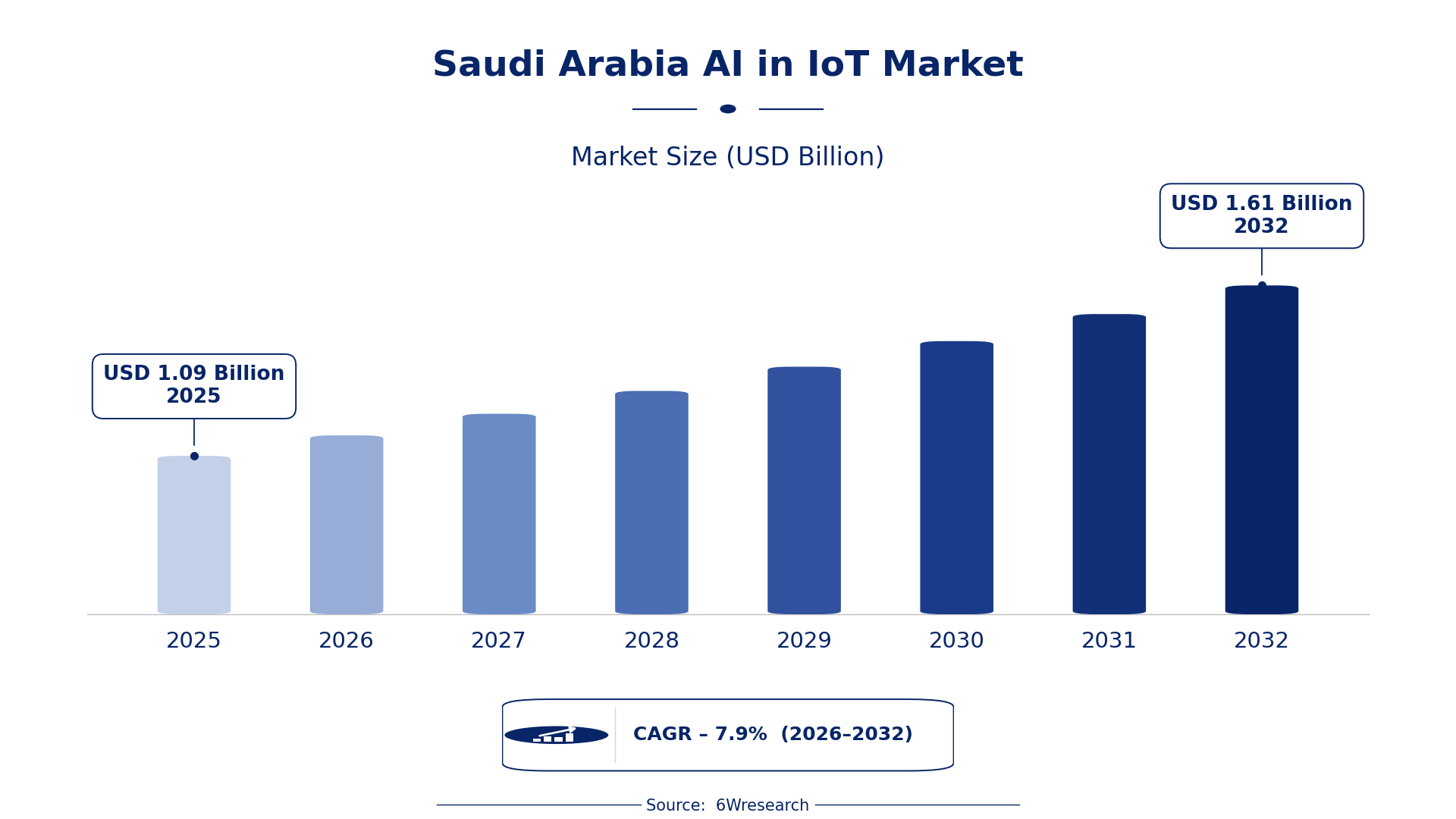
The Saudi Arabia AI in IoT Market was estimated at USD 1087 Million in 2025 and is projected to reach USD 1613 Million by 2032, growing at a CAGR of 7.9% from 2026 to 2032.
Saudi Arabia AI in IoT Market Synopsis
The Saudi Arabia AI in IoT market has experienced remarkable growth, driven by the increasing deployment of IoT devices across various sectors. The confluence of artificial intelligence with IoT technology is not just a trend; it has become an essential element for businesses looking to enhance operational efficiency and make data-driven decisions.
As we look ahead, the market is set for further expansion. Companies are realizing that AI is no longer an optional add-on but a necessity for effective data management and predictive analytics. This shift indicates that the market's momentum is not merely a phase but a long-term trajectory toward smarter, more connected ecosystems.
Saudi Arabia AI in IoT Market Year-wise Growth Rate and Key Drivers
This graph illustrates the annual growth rates of the Saudi Arabia AI in IoT Market from 2021 to 2032, highlighting a steady upward trajectory and projected expansion over the forecast period.
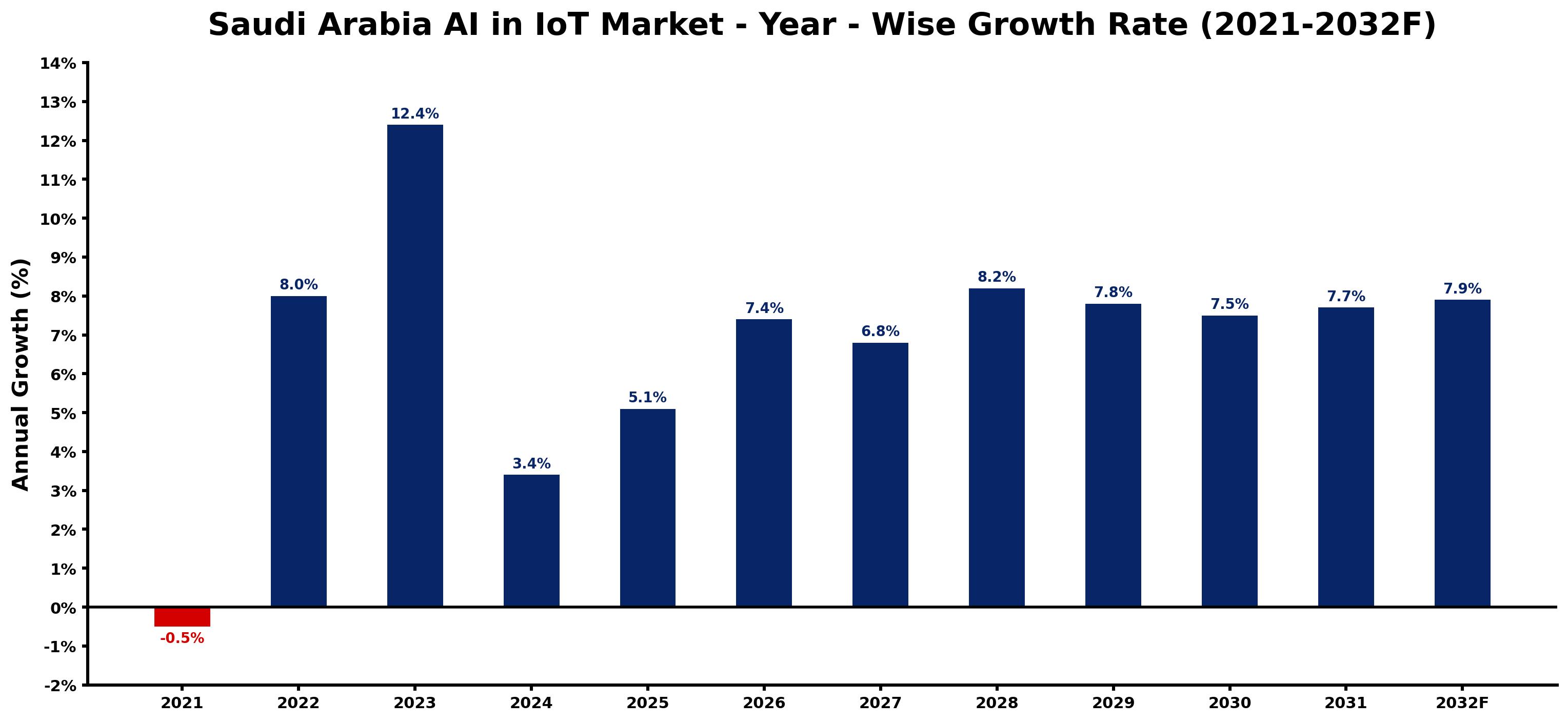
The table below presents the year‑wise growth rates along with the key drivers influencing the market
| Year | Growth Rate | Major Drivers |
| 2021 | -0.5% | Delays in Saudi Vision 2030 implementation affecting investments. |
| 2022 | 8.0% | Saudi Vision 2030 promoting IoT solutions adoption |
| 2023 | 12.4% | Demand for predictive maintenance in oil & gas sector |
| 2024 | 3.4% | Government initiatives boosting AI research funding nationwide |
| 2025 | 5.1% | Increased population driving smart home technology adoption |
| 2026 | 7.4% | Emerging cybersecurity regulations enhancing IoT security standards |
| 2027 | 6.8% | RISE initiative fostering AI startups in the region |
| 2028 | 8.2% | Growing need for real-time data analytics in retail |
| 2029 | 7.8% | Sustainable initiatives leading to smart energy management systems |
| 2030 | 7.5% | Collaboration between universities and tech firms accelerating innovation |
| 2031 | 7.7% | Regulatory frameworks encouraging IoT interoperability standards |
| 2032 | 7.9% | Healthcare sector leveraging IoT for patient monitoring systems |
Note: Market size estimations and growth projections presented in this report are based on 6Wresearch's proprietary forecasting methodology, utilizing the latest available industry data, government publications, and primary research inputs.
Saudi Arabia AI in IoT Market Key Takeaways
Below are some of the specific key takeaways from the market, including:
- The integration of AI and IoT is redefining operational standards across various industries.
- Investment in smart city projects is accelerating demand for AI in IoT solutions.
- Data security and privacy remain critical challenges that need addressing.
- Predictive maintenance capabilities are becoming a key selling point for AI-driven IoT systems.
- Major players are focusing on innovative solutions to enhance data analysis and automation.
Evaluation of Restraints in Saudi Arabia AI in IoT Market
Despite its growth potential, the Saudi Arabia AI in IoT market faces several constraints. A major hurdle lies in the integration of AI technologies within existing IoT frameworks, which can be complex and resource-intensive. Additionally, concerns surrounding data security and privacy are paramount, as businesses must navigate regulatory requirements while protecting sensitive information. These challenges create a cautious approach among companies looking to adopt AI-enhanced IoT solutions, potentially slowing down the pace of market adoption.
Saudi Arabia AI in IoT Market Trends
Several trends are shaping the Saudi Arabia AI in IoT market. The rise of smart city initiatives is driving the demand for integrated IoT solutions powered by AI, focusing on public safety, energy management, and transportation efficiency. Additionally, industries are increasingly adopting AI for predictive maintenance, which reduces downtime and operational costs. on top of that, partnerships between technology firms and local businesses are on the rise, enhancing innovation and market penetration.
Saudi Arabia AI in IoT Market Opportunities
Genuine growth opportunities are emerging in sectors like healthcare, where AI can optimize patient care through real-time data analysis. The manufacturing industry is also ripe for investment, as AI-driven IoT solutions can streamline operations and improve productivity. on top of that, the agricultural sector is beginning to explore AI applications for precision farming, leading to more sustainable practices. These areas present significant avenues for stakeholders looking to capitalize on the market's potential.
Government Initiatives in the Saudi Arabia AI in IoT Market
The Saudi government plays a crucial role in fostering the AI in IoT market, demonstrating a commitment to innovation and technological advancement. Public policy is increasingly focused on developing a regulatory framework that supports AI integration into IoT ecosystems, highlighting its importance for economic diversification. This proactive stance ensures that both private and public sectors are aligned in their objectives to enhance digital infrastructure.
- A national digital infrastructure upgrade programme now in its rollout phase aims to enhance connectivity across urban and rural areas.
- Current initiatives focus on establishing data protection regulations to ensure the security and privacy of IoT devices.
- Planned public-private partnerships expected to boost investments in smart city projects by 2028.
- A recently completed initiative introduced a framework for AI standardization to streamline IoT solutions across industries.
Future Insights of the Saudi Arabia AI in IoT Market
Looking ahead to 2026-2032, the Saudi Arabia AI in IoT market is likely to witness substantial advancements. As technology continues to mature, businesses will increasingly rely on AI to unlock the full potential of their IoT devices. The demand for real-time analytics and predictive capabilities will drive further innovation, making AI an indispensable element of IoT strategies. This trajectory suggests a continuously expanding market with increased opportunities for both established players and new entrants.
Saudi Arabia AI in IoT Market Latest Developments
Over the past 12-14 months, the Saudi Arabia AI in IoT market has seen notable developments as organizations adapt to evolving technological demands. The focus has shifted towards enhancing data processing capabilities and integrating AI into existing IoT frameworks. This trend signals a growing recognition of AI's essential role in maximizing the effectiveness of IoT systems.
- A major technology vendor launched a new AI-driven analytics platform aimed at improving IoT data management, officially rolled out in early 2025.
- An ongoing initiative that began in late 2025 focuses on upgrading IoT devices in public infrastructure to enhance smart city capabilities.
- A partnership between regional tech firms is currently underway to develop advanced AI algorithms tailored for industrial IoT applications.
- A planned expansion of cloud-based AI services targeting IoT analytics is expected to commence in Q2 2026.
Saudi Arabia AI in IoT Market - Key Attractiveness of the Report
- 10 Years of Market Numbers
- Historical Data Starting from 2022 to 2025
- Base Year: 2025
- Forecast Data until 2032
- Key Performance Indicators Impacting the Market
- Major Upcoming Developments and Projects
Key Highlights of the Report:
- Saudi Arabia AI in IoT Market Outlook
- Market Size of Saudi Arabia AI in IoT Market, 2025
- Forecast of Saudi Arabia AI in IoT Market, 2032
- Historical Data and Forecast of Saudi Arabia AI in IoT Revenues & Volume for the Period 2022-2032F
- Saudi Arabia AI in IoT Market Trend Evolution
- Saudi Arabia AI in IoT Market Drivers and Challenges
- Saudi Arabia AI in IoT Price Trends
- Saudi Arabia AI in IoT Porter's Five Forces
- Saudi Arabia AI in IoT Industry Life Cycle
- Historical Data and Forecast of Saudi Arabia AI in IoT Market Revenues & Volume By Component for the Period 2022-2032F
- Historical Data and Forecast of Saudi Arabia AI in IoT Market Revenues & Volume By Platforms for the Period 2022-2032F
- Historical Data and Forecast of Saudi Arabia AI in IoT Market Revenues & Volume By Software Solutions for the Period 2022-2032F
- Historical Data and Forecast of Saudi Arabia AI in IoT Market Revenues & Volume By Services for the Period 2022-2032F
- Historical Data and Forecast of Saudi Arabia AI in IoT Market Revenues & Volume By Vertical for the Period 2022-2032F
- Historical Data and Forecast of Saudi Arabia AI in IoT Market Revenues & Volume By Manufacturing for the Period 2022-2032F
- Historical Data and Forecast of Saudi Arabia AI in IoT Market Revenues & Volume By Energy and Utilities for the Period 2022-2032F
- Historical Data and Forecast of Saudi Arabia AI in IoT Market Revenues & Volume By Transportation and Mobility for the Period 2022-2032F
- Historical Data and Forecast of Saudi Arabia AI in IoT Market Revenues & Volume By BFSI for the Period 2022-2032F
- Historical Data and Forecast of Saudi Arabia AI in IoT Market Revenues & Volume By Government and Defense for the Period 2022-2032F
- Historical Data and Forecast of Saudi Arabia AI in IoT Market Revenues & Volume By Retail for the Period 2022-2032F
- Historical Data and Forecast of Saudi Arabia AI in IoT Market Revenues & Volume By Healthcare and Life Sciences for the Period 2022-2032F
- Historical Data and Forecast of Saudi Arabia AI in IoT Market Revenues & Volume By Telecom for the Period 2022-2032F
- Historical Data and Forecast of Saudi Arabia AI in IoT Market Revenues & Volume By Technology for the Period 2022-2032F
- Historical Data and Forecast of Saudi Arabia AI in IoT Market Revenues & Volume By ML and Deep Learning for the Period 2022-2032F
- Historical Data and Forecast of Saudi Arabia AI in IoT Market Revenues & Volume By NLP for the Period 2022-2032F
- Saudi Arabia AI in IoT Import Export Trade Statistics
- Market Opportunity Assessment By Component
- Market Opportunity Assessment By Vertical
- Market Opportunity Assessment By Technology
- Saudi Arabia AI in IoT Top Companies Market Share
- Saudi Arabia AI in IoT Competitive Benchmarking By Technical and Operational Parameters
- Saudi Arabia AI in IoT Company Profiles
- Saudi Arabia AI in IoT Key Strategic Recommendations






































