Saudi Arabia Analog Timer Market Size, Share & Growth Rate
The Saudi Arabia Analog Timer Market was estimated at USD 341 Million in 2025 and is projected to reach USD 439 Million by 2032, growing at a CAGR of 3.7% from 2026 to 2032. This steady growth trajectory is propelled by an increasing adoption of analog timers across various industries, including manufacturing, energy, and agriculture. The ongoing construction boom and expansive infrastructure projects are key contributors, fueling demand for reliable timing solutions that enhance energy efficiency in residential and commercial settings.
Saudi Arabia Analog Timer Market Year-wise Growth Rate and Key Drivers
This graph highlights how the Saudi Arabia Analog Timer Market has steadily grown over the years, supported by major growth factors.
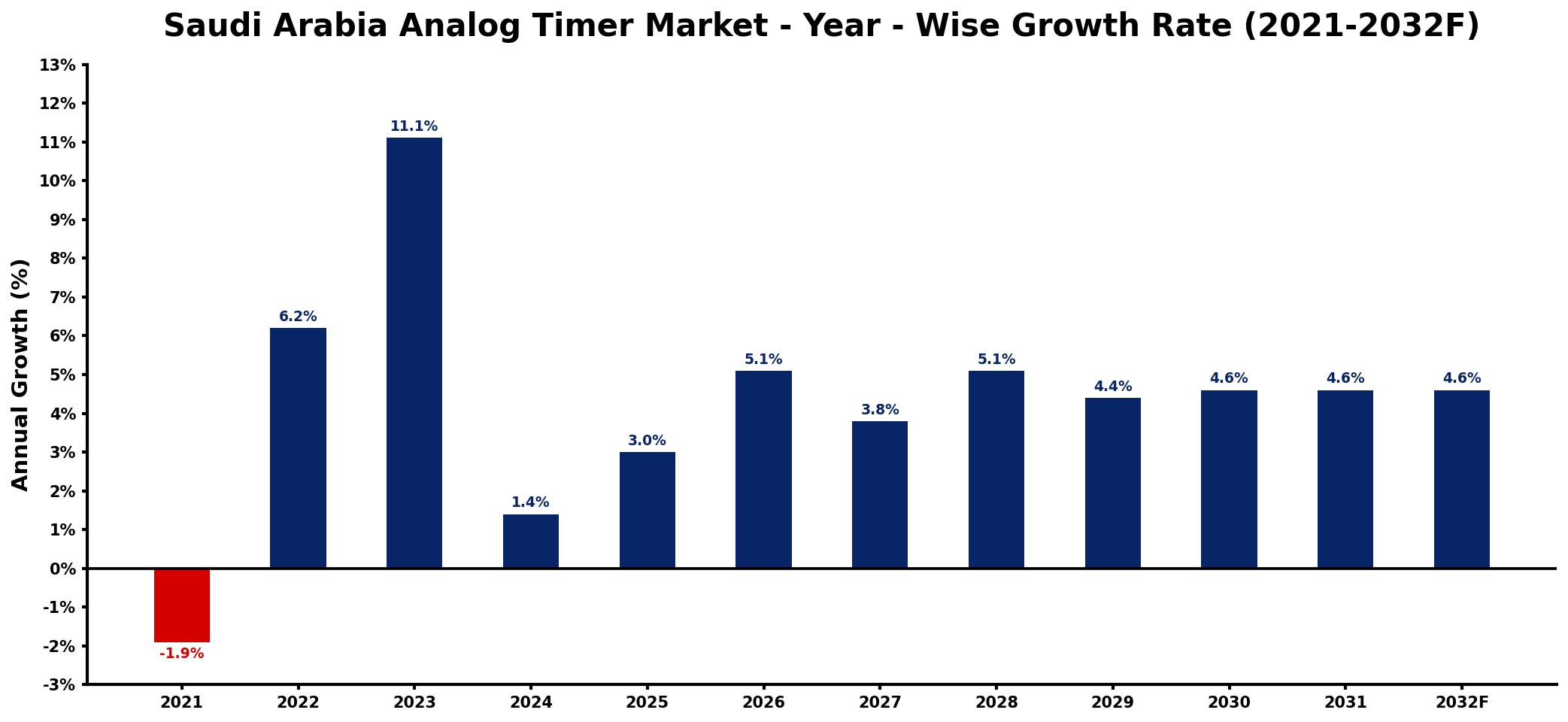
The table below presents the year‑wise growth rates along with the key drivers influencing the market
| Year | Growth Rate | Major Drivers |
| 2021 | -1.9% | decrease in consumer spending power |
| 2022 | 6.2% | increased residential construction projects |
| 2023 | 11.1% | growth in smart home technologies |
| 2024 | 1.4% | expansion of renewable energy initiatives |
| 2025 | 3.0% | rise in automated manufacturing processes |
| 2026 | 5.1% | increased demand for energy efficiency |
| 2027 | 3.8% | growing regional consumption patterns |
| 2028 | 5.1% | improved processing technologies adoption |
| 2029 | 4.4% | increased focus on home security |
| 2030 | 4.6% | growing commercial sector adoption |
| 2031 | 4.6% | rising interest in DIY projects |
| 2032 | 4.6% | increased capital investment inflows |
Note: Market size estimations and growth projections presented in this report are based on 6Wresearch's proprietary forecasting methodology, utilizing the latest available industry data, government publications, and primary research inputs.
Saudi Arabia Analog Timer Market Synopsis
In recent years, the Saudi Arabia analog timer market has shown robust growth, attributed to its applications in diverse sectors. The reliability and simplicity of these devices make them an essential component in manufacturing, HVAC systems, and home automation, aligning with the national push for energy conservation. As Saudi Arabia continues to invest in its infrastructure, the market for analog timers is poised for continued expansion.
The shift toward automation across various industries further underscores the relevance of analog timers. Companies are increasingly leveraging these timers to manage processes efficiently, reducing energy consumption while maintaining operational simplicity. With technological advancements on the horizon, the market anticipates innovations that will enhance the functionality and appeal of analog timers.
Saudi Arabia Analog Timer Market Key Takeaways
- The analog timer market is experiencing steady growth driven by demand from manufacturing, agriculture, and energy sectors.
- Infrastructure development projects are significantly boosting the demand for analog timers in various applications.
- Technological advancements are expected to lead to product innovations that cater to evolving customer needs.
- The simplicity and reliability of analog timers continue to make them appealing amidst the rise of digital alternatives.
- Economic recovery post-COVID-19 is revitalizing demand for analog timers in commercial settings.
Evaluation of Restraints in Saudi Arabia Analog Timer Market
Despite its positive trajectory, the Saudi Arabia analog timer market encounters limitations primarily due to the increasing popularity of digital timers and smart devices. These alternatives often provide enhanced precision and customizable features that appeal to a tech-savvy consumer base. Traditional analog timers may struggle to compete unless they are positioned strategically within niches where reliability and straightforward operation are prioritized. This challenge necessitates a targeted approach by manufacturers to maintain relevance and capture specific segments of the market.
Saudi Arabia Analog Timer Market Trends
A notable trend in the Saudi Arabia analog timer market is the increasing emphasis on energy-efficient solutions. As companies and households aim to reduce their carbon footprint, the demand for timers that facilitate energy conservation is on the rise. Additionally, the integration of analog timers with smart home systems is emerging, allowing for greater control and automation. These trends are shaping the future of the market, driving the need for product innovations that align with modern consumer expectations.
Saudi Arabia Analog Timer Market Opportunities
The market presents genuine growth opportunities, particularly as industries focus on sustainable practices and energy efficiency. With the ongoing construction and renovation projects, demand for analog timers in new residential and commercial spaces will likely surge. Additionally, targeting specific applications in agriculture and irrigation systems presents an avenue for market players to reinforce their presence and leverage the simplicity and cost-effectiveness of analog solutions.
Government Initiatives in the Saudi Arabia Analog Timer Market
The Saudi government is actively investing in infrastructure development as part of its Vision 2030 initiative, which includes enhancing energy efficiency across sectors. Policies promoting sustainable practices create a conducive environment for the analog timer market, encouraging businesses to adopt solutions that support energy conservation. Public spending on modernization and automation in both commercial and residential projects further strengthens the market landscape.
Future Insights of the Saudi Arabia Analog Timer Market
Looking ahead to 2026-2032, the Saudi Arabia analog timer market is expected to evolve significantly. As traditional industries modernize, there will be an increased need for reliable and efficient timing solutions. The anticipated technological advancements may also rejuvenate interest in analog products, particularly as they blend with smart technology. The market's resilience, driven by energy-conscious applications, suggests a promising outlook, fueled by the country's robust infrastructural ambitions.
Saudi Arabia Analog Timer Market Latest Developments (2025 - 2026)
Recent developments in the analog timer market indicate a push towards innovation, with companies focusing on enhancing product reliability and energy-saving features. Market players are increasingly collaborating with technology firms to integrate analog timers with automation systems, providing a bridge between traditional reliability and modern conveniences. The resurgence of demand post-COVID-19 has encouraged many suppliers to streamline their operations to better serve the recovering market landscape.
Saudi Arabia Analog Timer Market - Key Attractiveness of the Report
- 10 Years of Market Numbers
- Historical Data Starting from 2022 to 2025
- Base Year: 2025
- Forecast Data until 2032
- Key Performance Indicators Impacting the Market
- Major Upcoming Developments and Projects
Key Highlights of the Report:
- Saudi Arabia Analog Timer Market Outlook
- Market Size of Saudi Arabia Analog Timer Market, 2025
- Forecast of Saudi Arabia Analog Timer Market, 2032
- Historical Data and Forecast of Saudi Arabia Analog Timer Revenues & Volume for the Period 2022-2032F
- Saudi Arabia Analog Timer Market Trend Evolution
- Saudi Arabia Analog Timer Market Drivers and Challenges
- Saudi Arabia Analog Timer Price Trends
- Saudi Arabia Analog Timer Porter's Five Forces
- Saudi Arabia Analog Timer Industry Life Cycle
- Historical Data and Forecast of Saudi Arabia Analog Timer Market Revenues & Volume By Type for the Period 2022-2032F
- Historical Data and Forecast of Saudi Arabia Analog Timer Market Revenues & Volume By DIN Rail Mount for the Period 2022-2032F
- Historical Data and Forecast of Saudi Arabia Analog Timer Market Revenues & Volume By Panel Mount for the Period 2022-2032F
- Historical Data and Forecast of Saudi Arabia Analog Timer Market Revenues & Volume By Plug-in Mount for the Period 2022-2032F
- Historical Data and Forecast of Saudi Arabia Analog Timer Market Revenues & Volume By Application for the Period 2022-2032F
- Historical Data and Forecast of Saudi Arabia Analog Timer Market Revenues & Volume By Industrial Devices for the Period 2022-2032F
- Historical Data and Forecast of Saudi Arabia Analog Timer Market Revenues & Volume By Lighting Systems for the Period 2022-2032F
- Historical Data and Forecast of Saudi Arabia Analog Timer Market Revenues & Volume By Others for the Period 2022-2032F
- Saudi Arabia Analog Timer Import Export Trade Statistics
- Market Opportunity Assessment By Type
- Market Opportunity Assessment By Application
- Saudi Arabia Analog Timer Top Companies Market Share
- Saudi Arabia Analog Timer Competitive Benchmarking By Technical and Operational Parameters
- Saudi Arabia Analog Timer Company Profiles
- Saudi Arabia Analog Timer Key Strategic Recommendations






































