Saudi Arabia Artificial Intelligence in Retail Market Size & Growth Rate (2026-2032)
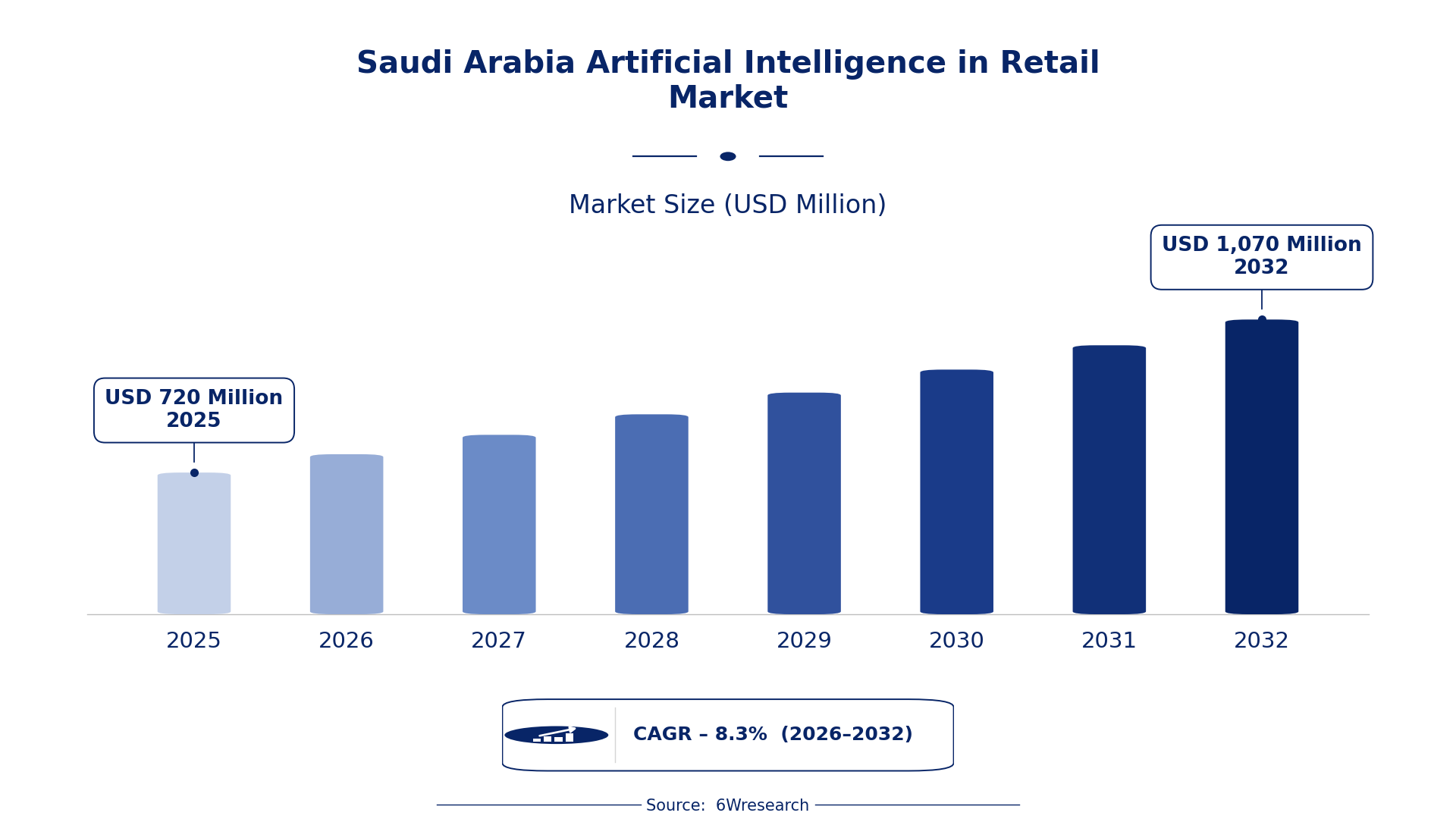
The Saudi Arabia Artificial Intelligence in Retail Market was estimated at USD 720 Million in 2025 and is projected to reach USD 1070 Million by 2032, growing at a CAGR of 8.3% from 2026 to 2032.
Saudi Arabia Artificial Intelligence in Retail Market Synopsis
The Saudi Arabia Artificial Intelligence in Retail market is currently being shaped by an urgent demand for personalized customer experiences. Retailers in the Kingdom are increasingly turning to AI technologies to create tailored shopping interactions that enhance customer loyalty and satisfaction.
This push for personalization is driving the adoption of AI solutions across various retail functions, from inventory management to automated customer service. As companies strive to remain competitive, the integration of AI is becoming a necessity rather than a luxury.
Saudi Arabia Artificial Intelligence in Retail Market Year-wise Growth Rate and Key Drivers
This graph illustrates the annual growth rates of the Saudi Arabia Artificial Intelligence in Retail Market from 2021 to 2032, highlighting a steady upward trajectory and projected expansion over the forecast period.
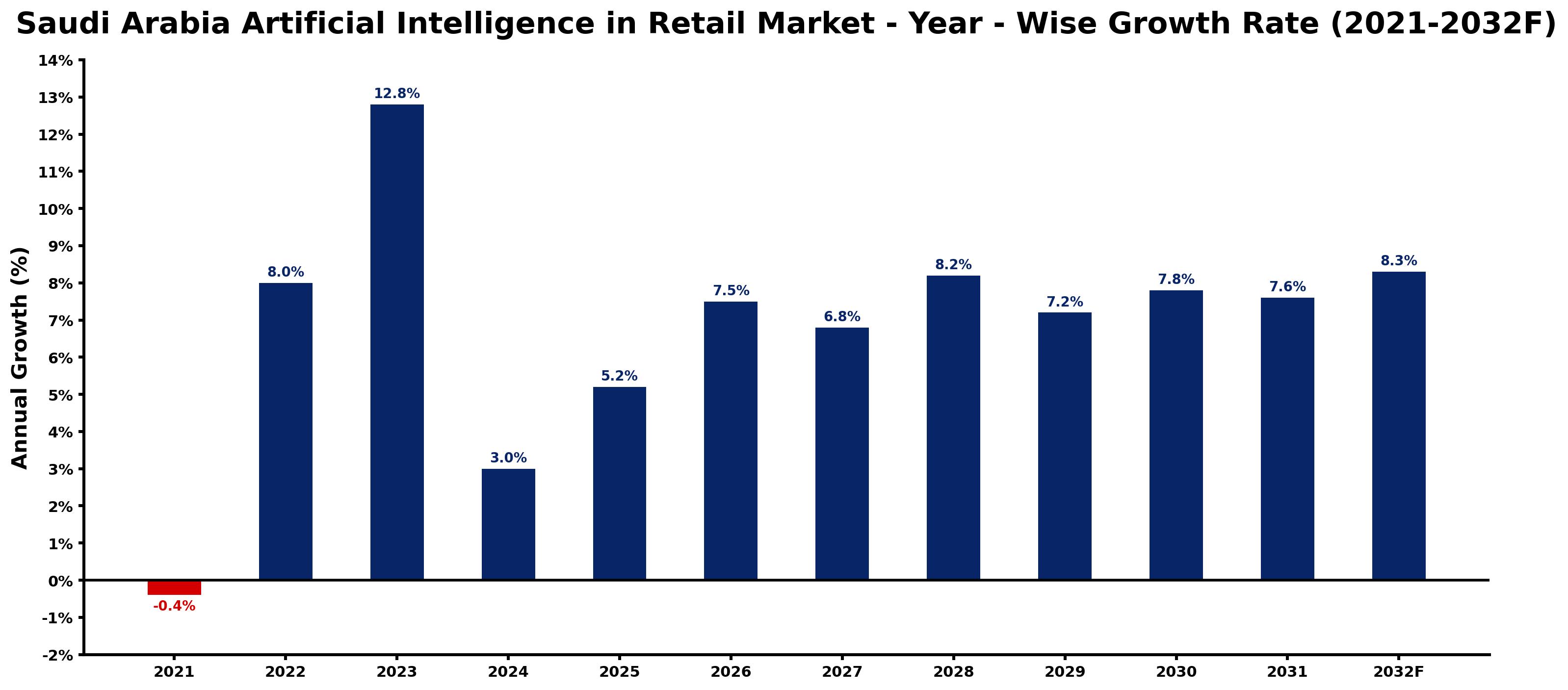
The table below presents the year‑wise growth rates along with the key drivers influencing the market
| Year | Growth Rate | Major Drivers |
| 2021 | -0.4% | Delayed AI regulations by Saudi Arabian Monetary Authority |
| 2022 | 8.0% | Retail Vision 2030 initiative promoting AI adoption |
| 2023 | 12.8% | Increased smartphone penetration enhancing mobile shopping experiences |
| 2024 | 3.0% | Local investment in AI startups boosting retail innovations |
| 2025 | 5.2% | Regulatory support for AI application in retail sector |
| 2026 | 7.5% | Rising youth population driving tech-savvy consumer behavior |
| 2027 | 6.8% | E-commerce growth accelerating AI integration in retail |
| 2028 | 8.2% | Collaboration with global tech firms advancing retail AI |
| 2029 | 7.2% | Government funding programs for smart retail technologies |
| 2030 | 7.8% | Enhancements in logistics AI improving retail efficiency |
| 2031 | 7.6% | Consumer demand for seamless omnichannel shopping experiences |
| 2032 | 8.3% | National AI Strategy fostering retail technology advancements |
Note: Market size estimations and growth projections presented in this report are based on 6Wresearch's proprietary forecasting methodology, utilizing the latest available industry data, government publications, and primary research inputs.
Saudi Arabia Artificial Intelligence in Retail Market Key Takeaways
Below are some of the specific key takeaways from the market, including:
- The demand for AI-driven personalized marketing strategies is rising significantly among retailers.
- Inventory management solutions utilizing AI are improving supply chain efficiencies and reducing costs.
- Consumer data protection is a growing concern, requiring retailers to balance AI application with ethical considerations.
- The COVID-19 pandemic accelerated the adoption of AI technologies, emphasizing the need for data security.
- Innovations in customer service automation through AI chatbots are reshaping customer interactions.
Evaluation of Restraints in Saudi Arabia Artificial Intelligence in Retail Market
Despite the impressive growth trajectory, several constraints are impacting the Saudi Arabia Artificial Intelligence in Retail market. A major limitation is the challenge of maintaining consumer trust in data privacy. Retailers face scrutiny over how they collect and utilize consumer data, especially with evolving regulations in the region. Additionally, many retailers struggle to integrate AI smoothly into their existing operations, which can lead to disruptions and inefficiencies. The digital divide also complicates matters, as varying levels of tech adoption among consumers can hinder the widespread effectiveness of AI solutions.
Saudi Arabia Artificial Intelligence in Retail Market Trends
Current trends indicate a growing reliance on AI for inventory optimization and demand forecasting. Retailers are increasingly investing in AI technologies to analyze consumer behavior and predict purchasing patterns, which in turn informs stock management. The use of AI-driven chatbots for customer service is becoming a standard practice, enhancing customer interaction while reducing operational costs. on top of that, retailers are experimenting with augmented reality (AR) and virtual reality (VR) solutions powered by AI to create engaging shopping experiences.
Saudi Arabia Artificial Intelligence in Retail Market Opportunities
The opportunities in the Saudi Arabia Artificial Intelligence in Retail market are vast. Retailers can capitalize on the growing demand for personalized shopping experiences by utilizing AI to analyze consumer data more effectively. Investing in predictive analytics tools will enable businesses to anticipate market trends and adjust their strategies accordingly. on top of that, the integration of AI solutions can streamline operations, leading to cost reductions and improved margins. Retailers that prioritize ethical data use will also be well-positioned to build consumer trust and loyalty.
Government Initiatives in the Saudi Arabia Artificial Intelligence in Retail Market
Government initiatives are playing a crucial role in shaping the Saudi Arabia Artificial Intelligence in Retail market. The Kingdom's Vision 2030 emphasizes the importance of digital transformation across various sectors, including retail. This regulatory focus aims to foster innovation and ensure that AI technologies are adopted responsibly and ethically.
- A recently completed initiative focused on establishing a national AI strategy, which aims to enhance the use of AI technologies across all sectors, including retail.
- Currently, the government is rolling out a public-private partnership program to support AI research and development in retail applications.
- A planned regulatory framework expected to be introduced by 2026 will establish guidelines for data privacy and the ethical use of AI in retail.
- The Saudi government is investing in AI training programs aimed at equipping retail employees with the necessary skills to implement AI solutions effectively.
Future Insights of the Saudi Arabia Artificial Intelligence in Retail Market
Looking ahead to 2026-2032, the Saudi Arabia Artificial Intelligence in Retail market is set to experience transformative changes. Retailers will likely increase their investments in AI to enhance customer experiences and streamline operations. The focus on ethical data use will also grow, with companies needing to demonstrate transparency in their AI applications. As technology advances, we can expect more sophisticated AI tools that will provide deeper insights into consumer behavior and trends, further driving retail innovation.
Saudi Arabia Artificial Intelligence in Retail Market Latest Developments
In the past year, the Saudi Arabia Artificial Intelligence in Retail market has seen a flurry of activity as retailers strive to enhance their offerings through technology. Companies are rapidly adopting AI solutions to improve both customer engagement and operational efficiency, reflecting an upward trend in digital transformation within the sector.
- A major technology vendor launched a new AI-driven inventory management system in Q3 2025, aimed at optimizing stock levels for retailers.
- An ongoing initiative started in early 2025 is enhancing customer service capabilities through the implementation of AI chatbots across various retail platforms.
- Upcoming in early 2026, a national conference is planned to discuss AI innovations in retail, focusing on knowledge sharing and partnership opportunities.
- In mid-2025, a leading regional operator announced a collaboration with local universities to develop AI training programs tailored for the retail sector.
Saudi Arabia Artificial Intelligence in Retail Market - Key Attractiveness of the Report
- 10 Years of Market Numbers
- Historical Data Starting from 2022 to 2025
- Base Year: 2025
- Forecast Data until 2032
- Key Performance Indicators Impacting the Market
- Major Upcoming Developments and Projects
Key Highlights of the Report:
- Saudi Arabia Artificial Intelligence in Retail Market Outlook
- Market Size of Saudi Arabia Artificial Intelligence in Retail Market, 2025
- Forecast of Saudi Arabia Artificial Intelligence in Retail Market, 2032
- Historical Data and Forecast of Saudi Arabia Artificial Intelligence in Retail Revenues & Volume for the Period 2022-2032F
- Saudi Arabia Artificial Intelligence in Retail Market Trend Evolution
- Saudi Arabia Artificial Intelligence in Retail Market Drivers and Challenges
- Saudi Arabia Artificial Intelligence in Retail Price Trends
- Saudi Arabia Artificial Intelligence in Retail Porter's Five Forces
- Saudi Arabia Artificial Intelligence in Retail Industry Life Cycle
- Historical Data and Forecast of Saudi Arabia Artificial Intelligence in Retail Market Revenues & Volume By Type for the Period 2022-2032F
- Historical Data and Forecast of Saudi Arabia Artificial Intelligence in Retail Market Revenues & Volume By Online for the Period 2022-2032F
- Historical Data and Forecast of Saudi Arabia Artificial Intelligence in Retail Market Revenues & Volume By Offline for the Period 2022-2032F
- Historical Data and Forecast of Saudi Arabia Artificial Intelligence in Retail Market Revenues & Volume By Service for the Period 2022-2032F
- Historical Data and Forecast of Saudi Arabia Artificial Intelligence in Retail Market Revenues & Volume By Professional for the Period 2022-2032F
- Historical Data and Forecast of Saudi Arabia Artificial Intelligence in Retail Market Revenues & Volume By Managed for the Period 2022-2032F
- Historical Data and Forecast of Saudi Arabia Artificial Intelligence in Retail Market Revenues & Volume By Technology for the Period 2022-2032F
- Historical Data and Forecast of Saudi Arabia Artificial Intelligence in Retail Market Revenues & Volume By Machine Learning for the Period 2022-2032F
- Historical Data and Forecast of Saudi Arabia Artificial Intelligence in Retail Market Revenues & Volume By Deep Learning for the Period 2022-2032F
- Historical Data and Forecast of Saudi Arabia Artificial Intelligence in Retail Market Revenues & Volume By NLP for the Period 2022-2032F
- Saudi Arabia Artificial Intelligence in Retail Import Export Trade Statistics
- Market Opportunity Assessment By Type
- Market Opportunity Assessment By Service
- Market Opportunity Assessment By Technology
- Saudi Arabia Artificial Intelligence in Retail Top Companies Market Share
- Saudi Arabia Artificial Intelligence in Retail Competitive Benchmarking By Technical and Operational Parameters
- Saudi Arabia Artificial Intelligence in Retail Company Profiles
- Saudi Arabia Artificial Intelligence in Retail Key Strategic Recommendations






































