Saudi Arabia Auto Parts And Accessories Market Size, Share & Growth Rate
The Saudi Arabia Auto Parts And Accessories Market was estimated at USD 233 Million in 2025 and is projected to reach USD 298 Million by 2032, growing at a CAGR of 3.6% from 2026 to 2032. This robust growth trajectory is fueled by the rising number of vehicles on the roads and the subsequent demand for both maintenance and aftermarket products. Moreover, the increasing inclination towards vehicle customization and enhancement, along with government initiatives supporting the automotive sector, are key factors underpinning this market growth.
Saudi Arabia Auto Parts And Accessories Market Year-wise Growth Rate and Key Drivers
This graph highlights how the Saudi Arabia Auto Parts And Accessories Market has steadily grown over the years, supported by major growth factors.
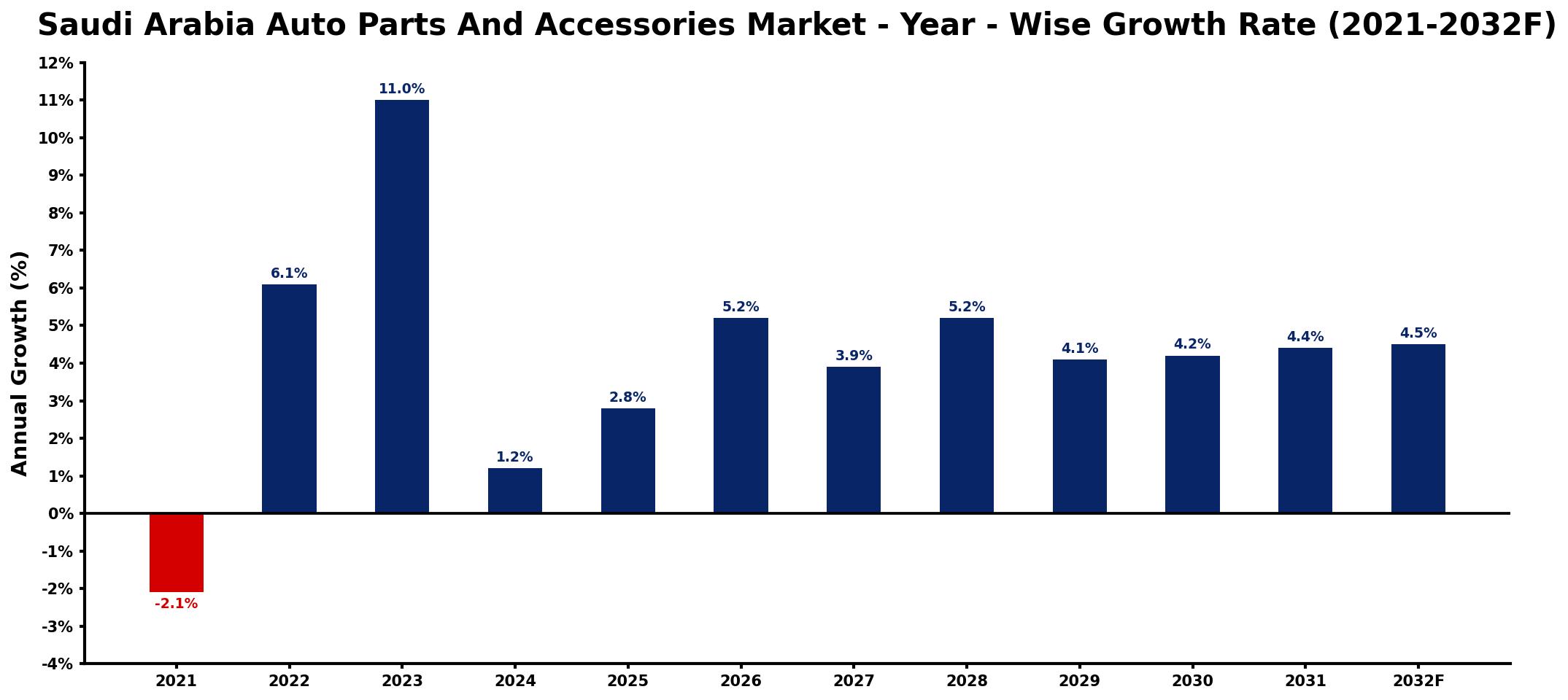
The table below presents the year‑wise growth rates along with the key drivers influencing the market
| Year | Growth Rate | Major Drivers |
| 2021 | -2.1% | Supply chain disruptions affect availability |
| 2022 | 6.1% | Rising consumer demand for vehicles |
| 2023 | 11.0% | Increased investments in manufacturing |
| 2024 | 1.2% | Growing focus on sustainability initiatives |
| 2025 | 2.8% | Expansion of e-commerce platforms |
| 2026 | 5.2% | Technological advancements in production |
| 2027 | 3.9% | Rising popularity of electric vehicles |
| 2028 | 5.2% | Government incentives for vehicle upgrades |
| 2029 | 4.1% | strengthening underlying market demand |
| 2030 | 4.2% | Emerging trends in smart technologies |
| 2031 | 4.4% | Increased consumer spending on enhancements |
| 2032 | 4.5% | Strengthened regional trade partnerships |
Note: Market size estimations and growth projections presented in this report are based on 6Wresearch's proprietary forecasting methodology, utilizing the latest available industry data, government publications, and primary research inputs.
Saudi Arabia Auto Parts And Accessories Market Synopsis
The strongest force shaping the Saudi Arabia Auto Parts and Accessories Market today is the significant growth in vehicle ownership. As more consumers opt for personal vehicles, the need for reliable auto parts and performance accessories intensifies, driving market expansion.
In addition, advancements in automotive technology and a shift in consumer preferences toward customization are fostering a competitive landscape. Both local and international brands are rising to meet the diverse demands of consumers, enhancing their offerings in terms of quality and variety.
Saudi Arabia Auto Parts And Accessories Market Key Takeaways
- The market is expected to reach USD 298 Million by 2032, demonstrating a steady growth pattern.
- Increased vehicle ownership and demand for maintenance are central to market dynamics.
- Customization trends are prompting innovation in product offerings across the industry.
- Government support for local manufacturing enhances the availability of quality auto parts.
- Both OEM and aftermarket segments are key contributors to overall market performance.
Evaluation of Restraints in Saudi Arabia Auto Parts And Accessories Market
Despite the positive market outlook, several restraints hinder growth. The prevalence of counterfeit parts remains a significant concern, as it compromises quality and consumer safety. Additionally, modern vehicles' complex systems require advanced parts, making it challenging for some local manufacturers to meet the demand for genuine, high-quality components. The market also faces pressure to provide affordable options without sacrificing quality, a balancing act that proves difficult amid rising material costs.
Saudi Arabia Auto Parts And Accessories Market Trends
Current trends in the Saudi Arabia Auto Parts and Accessories Market highlight a shift towards digitalization and e-commerce. With the increasing prevalence of online shopping, consumers are more frequently seeking parts and accessories via digital platforms. Furthermore, sustainability is becoming a focal point, as manufacturers are exploring eco-friendly materials and production processes. Technological advancements, such as the integration of smart features in auto components, are also gaining traction, enhancing user experience and vehicle performance.
Saudi Arabia Auto Parts And Accessories Market Opportunities
There are considerable growth and investment opportunities within the Saudi Arabia Auto Parts and Accessories Market. The government's initiatives to bolster local manufacturing create a fertile ground for companies looking to establish or expand their operations in the region. Furthermore, the rising demand for electric vehicles presents an opportunity for players to innovate and cater to this evolving segment. As consumers increasingly seek advanced technology and customization, brands that can adapt quickly will find themselves at a significant advantage.
Government Initiatives in the Saudi Arabia Auto Parts And Accessories Market
The Saudi government is actively promoting the growth of the automotive sector through various initiatives, including support for local manufacturing and investment in infrastructure. Programs aimed at enhancing vehicle safety and emissions standards are also shaping the market landscape. These efforts are geared towards positioning Saudi Arabia as a hub for automotive production and innovation, further driving the demand for quality auto parts and accessories.
Future Insights of the Saudi Arabia Auto Parts And Accessories Market
Looking forward to the years 2026-2032, the Saudi Arabia Auto Parts and Accessories Market is poised for steady growth. The emphasis on vehicle safety, sustainability, and technological advancements will shape the future landscape. As consumers continue to favor personalized vehicle experiences, the demand for innovative products will be crucial. Additionally, the burgeoning electric vehicle market is expected to open up new avenues for manufacturers and suppliers, setting the stage for a transformative era in the automotive sector.
Saudi Arabia Auto Parts And Accessories Market Latest Developments (2025 - 2026)
Recent developments in the Saudi Arabia Auto Parts and Accessories Market indicate a growing focus on sustainability and technological integration. Numerous companies are exploring partnerships to enhance their product offerings, particularly in the realm of electric and hybrid vehicles. E-commerce platforms for auto parts are gaining traction, significantly influencing consumer purchasing habits and preferences. Overall, the industry is adapting quickly to changing market dynamics, setting the stage for a promising future.
Saudi Arabia Auto Parts And Accessories Market - Key Attractiveness of the Report
- 10 Years of Market Numbers
- Historical Data Starting from 2022 to 2025
- Base Year: 2025
- Forecast Data until 2032
- Key Performance Indicators Impacting the Market
- Major Upcoming Developments and Projects
Key Highlights of the Report:
- Saudi Arabia Auto Parts And Accessories Market Outlook
- Market Size of Saudi Arabia Auto Parts And Accessories Market, 2025
- Forecast of Saudi Arabia Auto Parts And Accessories Market, 2032
- Historical Data and Forecast of Saudi Arabia Auto Parts And Accessories Revenues & Volume for the Period 2022-2032F
- Saudi Arabia Auto Parts And Accessories Market Trend Evolution
- Saudi Arabia Auto Parts And Accessories Market Drivers and Challenges
- Saudi Arabia Auto Parts And Accessories Price Trends
- Saudi Arabia Auto Parts And Accessories Porter's Five Forces
- Saudi Arabia Auto Parts And Accessories Industry Life Cycle
- Historical Data and Forecast of Saudi Arabia Auto Parts And Accessories Market Revenues & Volume By Product for the Period 2022-2032F
- Historical Data and Forecast of Saudi Arabia Auto Parts And Accessories Market Revenues & Volume By Driveline & Powertrain for the Period 2022-2032F
- Historical Data and Forecast of Saudi Arabia Auto Parts And Accessories Market Revenues & Volume By Interiors & Exteriors for the Period 2022-2032F
- Historical Data and Forecast of Saudi Arabia Auto Parts And Accessories Market Revenues & Volume By Electronics for the Period 2022-2032F
- Historical Data and Forecast of Saudi Arabia Auto Parts And Accessories Market Revenues & Volume By Bodies & Chassis for the Period 2022-2032F
- Historical Data and Forecast of Saudi Arabia Auto Parts And Accessories Market Revenues & Volume By Wheel & Tires for the Period 2022-2032F
- Historical Data and Forecast of Saudi Arabia Auto Parts And Accessories Market Revenues & Volume By Others for the Period 2022-2032F
- Historical Data and Forecast of Saudi Arabia Auto Parts And Accessories Market Revenues & Volume By Application for the Period 2022-2032F
- Historical Data and Forecast of Saudi Arabia Auto Parts And Accessories Market Revenues & Volume By OEMs for the Period 2022-2032F
- Historical Data and Forecast of Saudi Arabia Auto Parts And Accessories Market Revenues & Volume By Aftermarket for the Period 2022-2032F
- Saudi Arabia Auto Parts And Accessories Import Export Trade Statistics
- Market Opportunity Assessment By Product
- Market Opportunity Assessment By Application
- Saudi Arabia Auto Parts And Accessories Top Companies Market Share
- Saudi Arabia Auto Parts And Accessories Competitive Benchmarking By Technical and Operational Parameters
- Saudi Arabia Auto Parts And Accessories Company Profiles
- Saudi Arabia Auto Parts And Accessories Key Strategic Recommendations






































