Saudi Arabia Automotive Drive Shaft Market Size, Share & Growth Rate
The Saudi Arabia Automotive Drive Shaft Market was estimated at USD 275 Million in 2025 and is projected to reach USD 351 Million by 2032, growing at a CAGR of 3.5% from 2026 to 2032. This growth trajectory is primarily driven by the robust expansion of the automotive sector in Saudi Arabia, which is experiencing heightened vehicle production and sales. Moreover, the increasing demand for advanced transmission systems is leading manufacturers to innovate and enhance drive shaft technologies, making them more efficient and lightweight.
Saudi Arabia Automotive Drive Shaft Market Year-wise Growth Rate and Key Drivers
This graph highlights how the Saudi Arabia Automotive Drive Shaft Market has steadily grown over the years, supported by major growth factors.
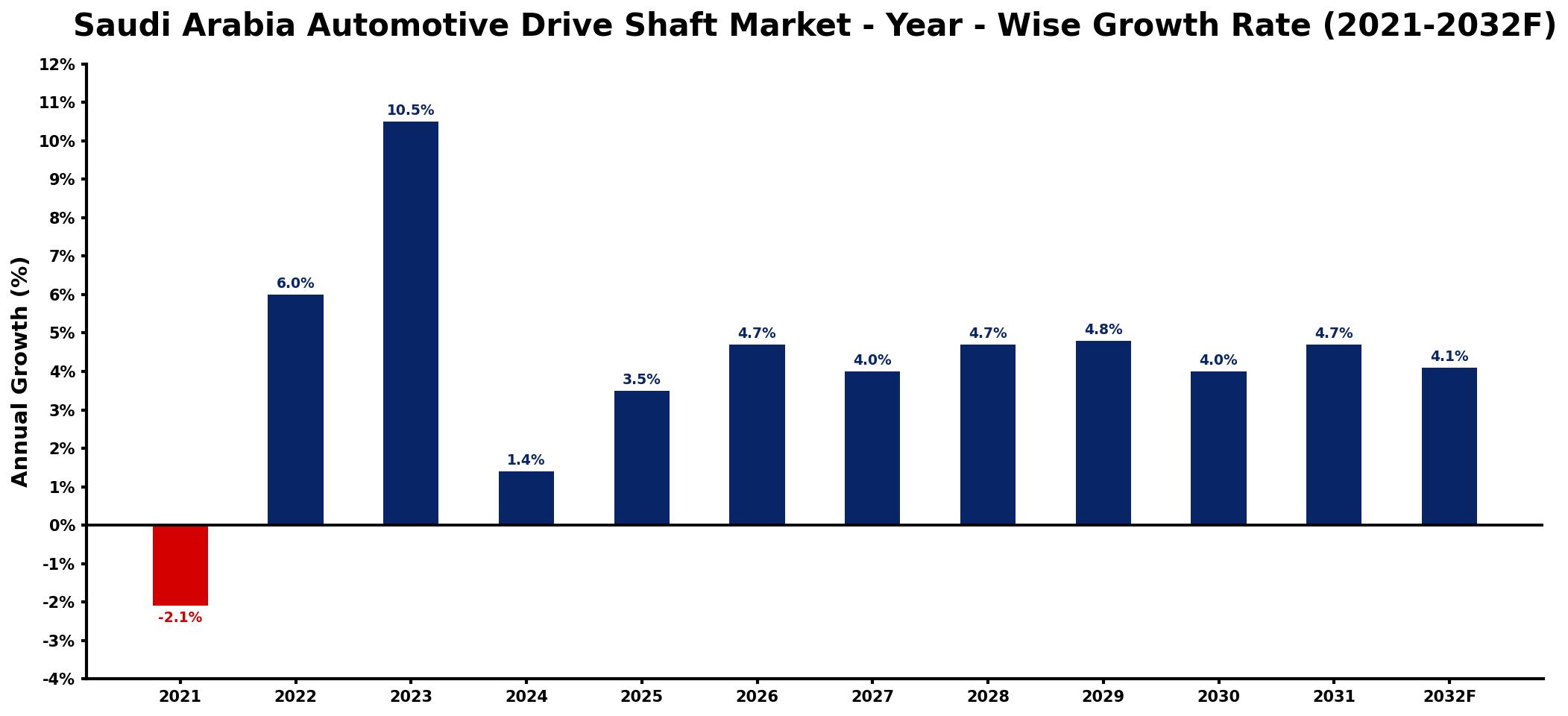
The table below presents the year‑wise growth rates along with the key drivers influencing the market
| Year | Growth Rate | Major Drivers |
| 2021 | -2.1% | Supply chain disruptions affecting production |
| 2022 | 6.0% | Rising consumer demand for vehicles |
| 2023 | 10.5% | Increased investments in manufacturing |
| 2024 | 1.4% | Expansion of local production facilities |
| 2025 | 3.5% | Growth in electric vehicle market |
| 2026 | 4.7% | Technological advancements in manufacturing |
| 2027 | 4.0% | Rising exports to neighboring markets |
| 2028 | 4.7% | Improved infrastructure supporting logistics |
| 2029 | 4.8% | Increased focus on sustainability initiatives |
| 2030 | 4.0% | Development of new market segments |
| 2031 | 4.7% | Growing popularity of hybrid vehicles |
| 2032 | 4.1% | Strengthening partnerships with suppliers |
Note: Market size estimations and growth projections presented in this report are based on 6Wresearch's proprietary forecasting methodology, utilizing the latest available industry data, government publications, and primary research inputs.
Saudi Arabia Automotive Drive Shaft Market Synopsis
The most influential factor currently shaping the Saudi Arabia Automotive Drive Shaft Market is the growing demand for vehicles as consumer preferences shift towards more advanced and efficient models. As the automotive sector evolves, so does the necessity for high-performance drive shafts capable of transmitting power effectively while adhering to stringent regulatory standards.
In addition, domestic manufacturing is gaining traction, bolstered by investments aimed at enhancing local production capabilities. This shift not only reduces dependency on imports but also facilitates better alignment with the unique requirements of the Saudi Arabian automotive market, paving the way for innovations in drive shaft designs and materials.
Saudi Arabia Automotive Drive Shaft Market Key Takeaways
- The market is poised for steady growth, driven by increasing vehicle production and consumer demand.
- Technological advancements are enhancing the performance and efficiency of automotive drive shafts.
- Domestic manufacturing initiatives are expected to foster innovation and reduce reliance on imports.
- Regulatory standards are prompting manufacturers to prioritize lightweight and durable designs.
- The market is influenced by the growing trend towards electric and hybrid vehicles, necessitating advanced drive shaft solutions.
Evaluation of Restraints in Saudi Arabia Automotive Drive Shaft Market
Despite its potential, the Saudi Arabia Automotive Drive Shaft Market faces several constraints. One key limitation is the challenge of developing drive shafts that balance performance with fuel efficiency, as rising fuel costs and environmental concerns grow. Manufacturers are also grappling with the need to minimize vibrations and enhance overall vehicle dynamics, which requires significant investment in research and development. Furthermore, the lingering effects of the COVID-19 pandemic have also introduced uncertainties in consumer behavior, affecting demand forecasts.
Saudi Arabia Automotive Drive Shaft Market Trends
Several trends are emerging within the Saudi Arabia Automotive Drive Shaft Market. Notably, there is a marked shift towards lightweight materials to improve fuel efficiency and performance. The introduction of electric and hybrid vehicles is also reshaping consumer expectations regarding drive shaft technology, leading to innovations aimed at optimizing torque transfer. Additionally, the adoption of advanced manufacturing processes, including automation and 3D printing, is facilitating the production of more complex designs at reduced costs.
Saudi Arabia Automotive Drive Shaft Market Opportunities
The landscape of the Saudi Arabia Automotive Drive Shaft Market is ripe with opportunities for growth and investment. The continued expansion of electric vehicles presents a significant opening for manufacturers to develop specialized drive shafts tailored to meet the unique requirements of these models. Moreover, the government's push for economic diversification under Vision 2030 encourages investments in local manufacturing and R&D, paving the way for innovative solutions and enhanced market competitiveness.
Government Initiatives in the Saudi Arabia Automotive Drive Shaft Market
The Saudi government has introduced several initiatives aimed at bolstering the automotive sector, which directly impacts the automotive drive shaft market. Public spending on infrastructure improvements and transportation networks is fostering a more robust automotive ecosystem. Moreover, programs promoting local manufacturing capabilities and technological innovation are encouraging foreign investment, which is vital for the sector's growth. These government efforts reflect a strategic commitment to developing a sustainable automotive industry.
Future Insights of the Saudi Arabia Automotive Drive Shaft Market
Looking ahead to 2026-2032, the Saudi Arabia Automotive Drive Shaft Market is anticipated to experience continued growth driven by the ongoing expansion of the automotive industry. As consumer preferences evolve towards energy-efficient and technologically advanced vehicles, manufacturers will need to adapt rapidly, focusing on innovations that enhance performance and reduce environmental impact. Additionally, the collaboration between local manufacturers and international players will likely intensify, fostering knowledge transfer and further enhancing market dynamics.
Saudi Arabia Automotive Drive Shaft Market Latest Developments (2025 - 2026)
Recent developments in the Saudi Arabia Automotive Drive Shaft Market indicate a shift towards integrating smart technology within automotive components. Companies are exploring partnerships to enhance their technological capabilities, focusing on the development of drive shafts that can support electric vehicle platforms. Additionally, there is an increased emphasis on research initiatives aimed at material innovations that improve durability and weight reduction, essential for meeting evolving consumer demands.
Saudi Arabia Automotive Drive Shaft Market - Key Attractiveness of the Report
- 10 Years of Market Numbers
- Historical Data Starting from 2022 to 2025
- Base Year: 2025
- Forecast Data until 2032
- Key Performance Indicators Impacting the Market
- Major Upcoming Developments and Projects
Key Highlights of the Report:
- Saudi Arabia Automotive Drive Shaft Market Outlook
- Market Size of Saudi Arabia Automotive Drive Shaft Market, 2025
- Forecast of Saudi Arabia Automotive Drive Shaft Market, 2032
- Historical Data and Forecast of Saudi Arabia Automotive Drive Shaft Revenues & Volume for the Period 2022-2032F
- Saudi Arabia Automotive Drive Shaft Market Trend Evolution
- Saudi Arabia Automotive Drive Shaft Market Drivers and Challenges
- Saudi Arabia Automotive Drive Shaft Price Trends
- Saudi Arabia Automotive Drive Shaft Porter's Five Forces
- Saudi Arabia Automotive Drive Shaft Industry Life Cycle
- Historical Data and Forecast of Saudi Arabia Automotive Drive Shaft Market Revenues & Volume By Design Type for the Period 2022-2032F
- Historical Data and Forecast of Saudi Arabia Automotive Drive Shaft Market Revenues & Volume By Hollow Shaft for the Period 2022-2032F
- Historical Data and Forecast of Saudi Arabia Automotive Drive Shaft Market Revenues & Volume By Solid Shaft for the Period 2022-2032F
- Historical Data and Forecast of Saudi Arabia Automotive Drive Shaft Market Revenues & Volume By Position Type for the Period 2022-2032F
- Historical Data and Forecast of Saudi Arabia Automotive Drive Shaft Market Revenues & Volume By Rear Axle for the Period 2022-2032F
- Historical Data and Forecast of Saudi Arabia Automotive Drive Shaft Market Revenues & Volume By Front Axle for the Period 2022-2032F
- Historical Data and Forecast of Saudi Arabia Automotive Drive Shaft Market Revenues & Volume By Vehicle Type for the Period 2022-2032F
- Historical Data and Forecast of Saudi Arabia Automotive Drive Shaft Market Revenues & Volume By Passenger Cars for the Period 2022-2032F
- Historical Data and Forecast of Saudi Arabia Automotive Drive Shaft Market Revenues & Volume By Commercial Vehicles for the Period 2022-2032F
- Saudi Arabia Automotive Drive Shaft Import Export Trade Statistics
- Market Opportunity Assessment By Design Type
- Market Opportunity Assessment By Position Type
- Market Opportunity Assessment By Vehicle Type
- Saudi Arabia Automotive Drive Shaft Top Companies Market Share
- Saudi Arabia Automotive Drive Shaft Competitive Benchmarking By Technical and Operational Parameters
- Saudi Arabia Automotive Drive Shaft Company Profiles
- Saudi Arabia Automotive Drive Shaft Key Strategic Recommendations






































