Saudi Arabia Autonomous Vehicle Simulation Solution Market Size, Share & Growth Rate
The Saudi Arabia Autonomous Vehicle Simulation Solution Market was estimated at USD 373 Million in 2025 and is projected to reach USD 473 Million by 2032, growing at a CAGR of 3.5% from 2026 to 2032. This upward trajectory is driven by the increasing demand for advanced testing environments that ensure the safety and efficacy of autonomous driving technologies. As the nation accelerates its push toward smart transportation solutions, the role of simulation solutions in refining autonomous vehicle algorithms cannot be overstated.
Saudi Arabia Autonomous Vehicle Simulation Solution Market Year-wise Growth Rate and Key Drivers
This graph highlights how the Saudi Arabia Autonomous Vehicle Simulation Solution Market has steadily grown over the years, supported by major growth factors.
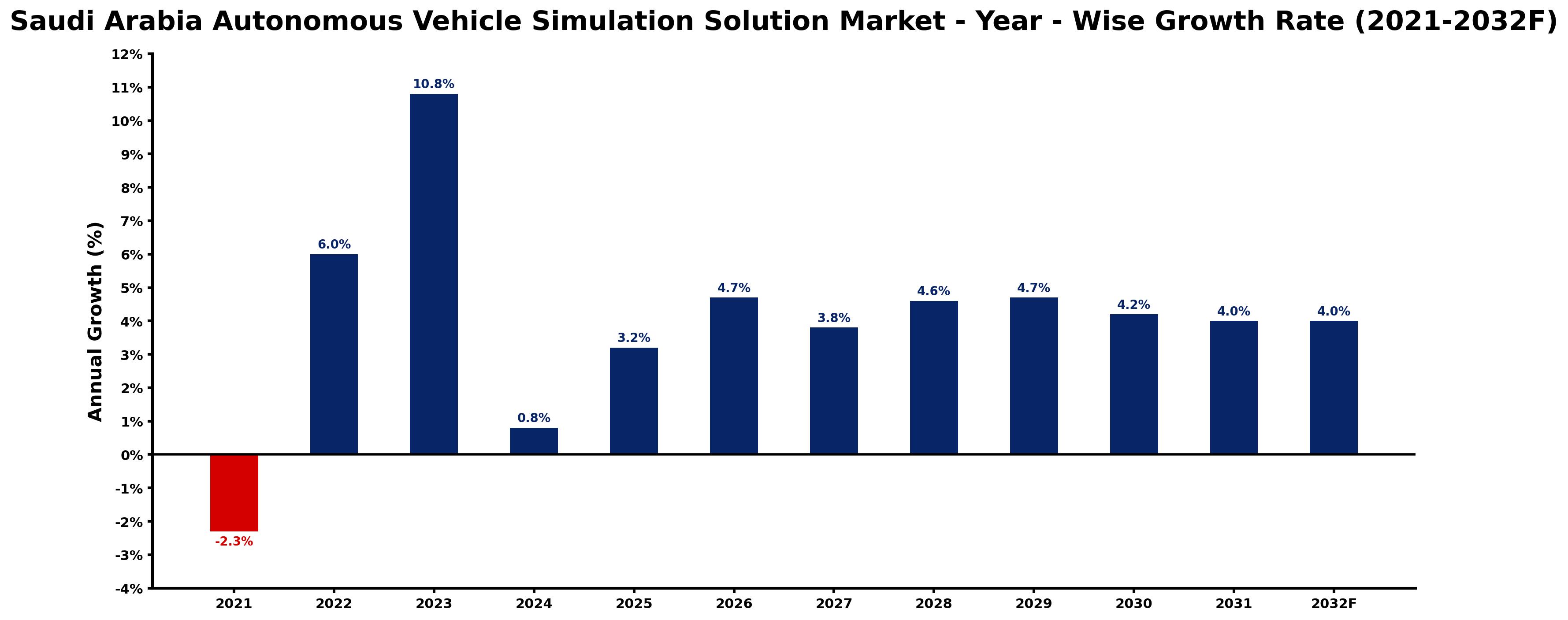
The table below presents the year‑wise growth rates along with the key drivers influencing the market
| Year | Growth Rate | Major Drivers |
| 2021 | -2.3% | Government infrastructure modernization initiatives |
| 2022 | 6.0% | Expansion of manufacturing activities |
| 2023 | 10.8% | Increasing smart city development projects |
| 2024 | 0.8% | Government infrastructure modernization initiatives |
| 2025 | 3.2% | Increasing industrial automation investments |
| 2026 | 4.7% | Expansion of transportation and logistics networks |
| 2027 | 3.8% | Increasing smart city development projects |
| 2028 | 4.6% | Growing renewable energy integration projects |
| 2029 | 4.7% | Increasing smart city development projects |
| 2030 | 4.2% | Government infrastructure modernization initiatives |
| 2031 | 4.0% | Growing renewable energy integration projects |
| 2032 | 4.0% | Increasing industrial infrastructure investments |
Note - Market size estimations and growth projections presented in this report are based on 6Wresearch's advanced forecasting approach, validated with industry datasets as of June 2026.
Saudi Arabia Autonomous Vehicle Simulation Solution Market Synopsis
The Saudi Arabia autonomous vehicle simulation solution market is on an impressive growth path, fueled by significant technological advancements and regulatory support. While recent momentum in autonomous technologies reflects a commitment to innovation, the market is poised for an even more transformative phase as investment increases and infrastructures adapt to support these changes.
Currently, simulation solutions are critical for fine-tuning vehicle performance and ensuring the safety of autonomous systems under various conditions. With a regulatory landscape increasingly focused on safety standards and risk assessment, these solutions will be integral in shaping the future of transportation in Saudi Arabia.
Saudi Arabia Autonomous Vehicle Simulation Solution Market Key Takeaways
- The market is driven by the rapid advancement of technologies, including AI and connectivity.
- Safety validation remains a top priority, making simulation solutions vital for regulatory compliance.
- Access to accurate data continues to challenge the development of high-fidelity simulations.
- Government initiatives are fostering innovation and investment in autonomous vehicle technologies.
- COVID-19 highlighted the importance of autonomous technologies in enabling efficient transportation.
Evaluation of Restraints in Saudi Arabia Autonomous Vehicle Simulation Solution Market
Despite the market's robust growth prospects, several restraints hinder its progress. One notable limitation is the challenge of developing simulation solutions that can accurately replicate the complexities of real-world driving environments. Factors such as unpredictable traffic patterns, diverse geographical landscapes, and varying weather conditions complicate the simulation development process. Furthermore, the reliance on extensive and accurate data inputs poses challenges, as many regions may lack the necessary infrastructure to gather real-time traffic and environmental data.
Saudi Arabia Autonomous Vehicle Simulation Solution Market Trends
A number of emerging trends are shaping the demand and technological landscape of the Saudi Arabia autonomous vehicle simulation solution market. The integration of artificial intelligence into simulation platforms is on the rise, enhancing their ability to predict and analyze complex driving scenarios. Additionally, there is a growing emphasis on partnerships between tech firms and automotive manufacturers to co-develop simulation tools that are aligned with real-world testing requirements. As regulatory frameworks evolve, there is also a shift toward creating more standardized simulation environments that facilitate compliance and risk assessment.
Saudi Arabia Autonomous Vehicle Simulation Solution Market Opportunities
Genuine growth opportunities lie within the burgeoning demand for high-fidelity simulation solutions that can cater to the unique challenges posed by Saudi Arabia's urban environments. Investment in research and development is crucial, particularly in areas that enhance the safety and reliability of autonomous driving systems. Furthermore, collaborations with local universities and research institutions present avenues for innovation, paving the way for tailored simulation solutions that address specific market needs.
Government Initiatives in the Saudi Arabia Autonomous Vehicle Simulation Solution Market
The Saudi government is actively promoting the development of autonomous vehicle technologies through various initiatives, regulatory frameworks, and public spending programs. These efforts include formulating policies that incentivize research and development in simulation solutions while ensuring compliance with safety standards. The government's commitment to enhancing the transportation landscape aligns with the increasing adoption of autonomous vehicle technologies, creating a conducive environment for market growth.
Future Insights of the Saudi Arabia Autonomous Vehicle Simulation Solution Market
Looking ahead to 2026-2032, the Saudi Arabia autonomous vehicle simulation solution market is expected to evolve significantly as technological advancements continue to reshape the landscape. With a focus on enhancing safety and optimizing vehicle performance, simulation solutions will play a crucial role in the integration of autonomous vehicles into existing transportation systems. The ongoing support from the government and private sector investment will drive innovation, making the market an exciting space for stakeholders aiming to capitalize on the future of mobility.
Saudi Arabia Autonomous Vehicle Simulation Solution Market Latest Developments (May 2025 - June 2026)
In recent months, the market has seen a flurry of activity with companies focusing on refining their simulation technologies to better serve the unique conditions present in Saudi Arabia. There have been advancements in AI-driven simulation platforms aimed at improving safety measures and performance validations for autonomous vehicles. Moreover, collaborations between technology providers and automotive manufacturers have intensified, with joint efforts directed toward creating a more robust testing ecosystem for autonomous solutions.
Saudi Arabia Autonomous Vehicle Simulation Solution Market - Key Attractiveness of the Report
- 10 Years of Market Numbers
- Historical Data Starting from 2022 to 2025
- Base Year: 2025
- Forecast Data until 2032
- Key Performance Indicators Impacting the Market
- Major Upcoming Developments and Projects
Key Highlights of the Report:
- Saudi Arabia Autonomous Vehicle Simulation Solution Market Outlook
- Market Size of Saudi Arabia Autonomous Vehicle Simulation Solution Market, 2025
- Forecast of Saudi Arabia Autonomous Vehicle Simulation Solution Market, 2032
- Historical Data and Forecast of Saudi Arabia Autonomous Vehicle Simulation Solution Revenues & Volume for the Period 2022-2032F
- Saudi Arabia Autonomous Vehicle Simulation Solution Market Trend Evolution
- Saudi Arabia Autonomous Vehicle Simulation Solution Market Drivers and Challenges
- Saudi Arabia Autonomous Vehicle Simulation Solution Price Trends
- Saudi Arabia Autonomous Vehicle Simulation Solution Porter's Five Forces
- Saudi Arabia Autonomous Vehicle Simulation Solution Industry Life Cycle
- Historical Data and Forecast of Saudi Arabia Autonomous Vehicle Simulation Solution Market Revenues & Volume By Application for the Period 2022-2032F
- Historical Data and Forecast of Saudi Arabia Autonomous Vehicle Simulation Solution Market Revenues & Volume By Research & Testing for the Period 2022-2032F
- Historical Data and Forecast of Saudi Arabia Autonomous Vehicle Simulation Solution Market Revenues & Volume By Training for the Period 2022-2032F
- Historical Data and Forecast of Saudi Arabia Autonomous Vehicle Simulation Solution Market Revenues & Volume By Simulator for the Period 2022-2032F
- Historical Data and Forecast of Saudi Arabia Autonomous Vehicle Simulation Solution Market Revenues & Volume By Compact for the Period 2022-2032F
- Historical Data and Forecast of Saudi Arabia Autonomous Vehicle Simulation Solution Market Revenues & Volume By Full-scale for the Period 2022-2032F
- Saudi Arabia Autonomous Vehicle Simulation Solution Import Export Trade Statistics
- Market Opportunity Assessment By Application
- Market Opportunity Assessment By Simulator
- Saudi Arabia Autonomous Vehicle Simulation Solution Top Companies Market Share
- Saudi Arabia Autonomous Vehicle Simulation Solution Competitive Benchmarking By Technical and Operational Parameters
- Saudi Arabia Autonomous Vehicle Simulation Solution Company Profiles
- Saudi Arabia Autonomous Vehicle Simulation Solution Key Strategic Recommendations






































