Saudi Arabia Beef and Veal Market: Import Trend Analysis
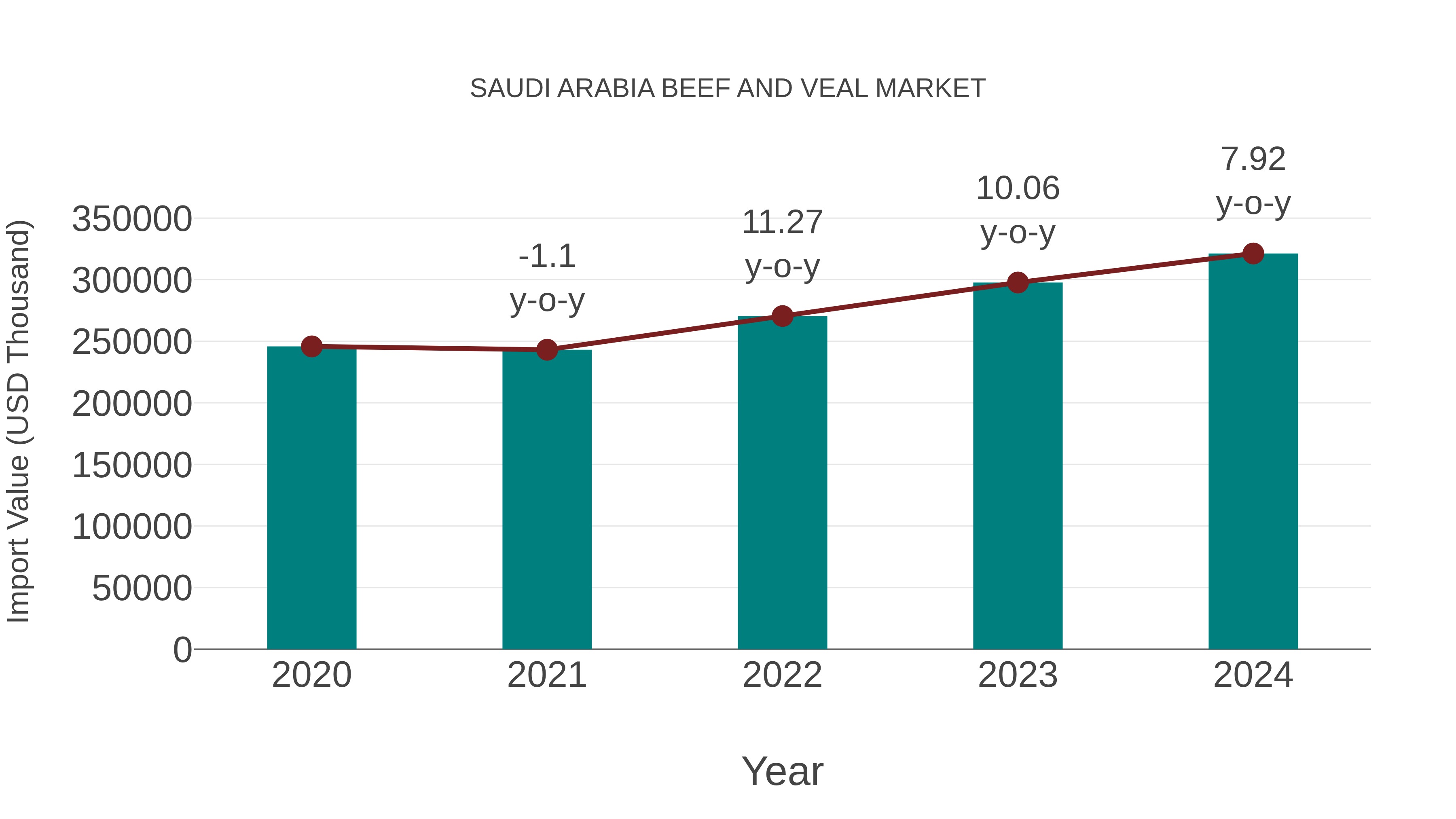
In the Saudi Arabia beef and veal market, import momentum saw a notable increase from 2023 to 2024, with a growth rate of 7.92%. The compound annual growth rate (CAGR) for the period 2020-2024 stood at 6.92%. This growth can be attributed to evolving consumer preferences towards high-quality meat products and an increase in disposable income, indicating a positive demand shift for imported beef and veal in the Saudi market.
Saudi Arabia Beef and Veal Market Synopsis
The beef and veal market in Saudi Arabia reflects the country`s evolving dietary habits and demographic shifts. As the population grows and becomes more urbanized, there is an increasing demand for animal protein sources, including beef and veal. The market comprises various segments, including fresh and processed products, and serves both domestic consumption and potential export opportunities. Efforts are being made to ensure the quality and safety of these products through regulations and quality control measures. The beef and veal market is closely monitored to align with Islamic dietary requirements, further shaping its dynamics within the Saudi Arabia food industry.
Drivers of the Market
The Saudi Arabia beef and veal market`s growth is primarily driven by factors such as increasing meat consumption, a growing population, and rising disposable incomes. Beef and veal remain staple sources of protein in the Saudi diet, and the demand for these meats has risen as consumers` dietary preferences evolve. Moreover, the expansion of the hospitality and foodservice sectors has bolstered the demand for beef and veal products, contributing to the market`s expansion.
Challenges of the Market
The Saudi Arabia beef and veal market encounters challenges linked to meeting the growing demand for high-quality meat products. Ensuring a steady supply of fresh and hygienic meat while complying with rigorous food safety standards is a complex task. Maintaining an efficient supply chain that spans from livestock production to retail requires coordination and investment. Cultural preferences and consumption habits also influence market dynamics, making it necessary to balance domestic production with imports. Striking this balance while meeting quality and safety expectations presents ongoing challenges.
COVID-19 Impact on the Market
The beef and veal market in Saudi Arabia faced disruptions during the COVID-19 pandemic due to supply chain challenges, changing consumer behavior, and economic uncertainties. The closure of restaurants and reduced consumer spending impacted the demand for beef and veal products. Additionally, logistical challenges and restrictions on movement affected the distribution and availability of meat products. As the economy gradually reopened and consumer confidence improved, the market started recovering, although it took time for the foodservice sector to fully rebound. The recovery of the market was closely tied to the revival of the foodservice industry and overall economic conditions.
Key Players in the Market
The Saudi Arabia beef and veal market is dominated by a few major players, namely Almarai, Savola Group, Jazan Development Company (JDC), Lifestyles Food Processing Co., and Agthia Group PJSC. Almarai is the largest player in the country`s beef and veal sector with its substantial presence across multiple product categories.
Key Highlights of the Report:
- Saudi Arabia Beef And Veal Market Outlook
- Market Size of Saudi Arabia Beef And Veal Market, 2025
- Forecast of Saudi Arabia Beef And Veal Market, 2032
- Historical Data and Forecast of Saudi Arabia Beef And Veal Revenues & Volume for the Period 2022-2032F
- Saudi Arabia Beef And Veal Market Trend Evolution
- Saudi Arabia Beef And Veal Market Drivers and Challenges
- Saudi Arabia Beef And Veal Price Trends
- Saudi Arabia Beef And Veal Porter's Five Forces
- Saudi Arabia Beef And Veal Industry Life Cycle
- Historical Data and Forecast of Saudi Arabia Beef And Veal Market Revenues & Volume By Type for the Period 2022-2032F
- Historical Data and Forecast of Saudi Arabia Beef And Veal Market Revenues & Volume By Beef for the Period 2022-2032F
- Historical Data and Forecast of Saudi Arabia Beef And Veal Market Revenues & Volume By Veal for the Period 2022-2032F
- Historical Data and Forecast of Saudi Arabia Beef And Veal Market Revenues & Volume By Distribution Channel for the Period 2022-2032F
- Historical Data and Forecast of Saudi Arabia Beef And Veal Market Revenues & Volume By Supermarkets for the Period 2022-2032F
- Historical Data and Forecast of Saudi Arabia Beef And Veal Market Revenues & Volume By Convenient Store for the Period 2022-2032F
- Historical Data and Forecast of Saudi Arabia Beef And Veal Market Revenues & Volume By Speciality Stores for the Period 2022-2032F
- Historical Data and Forecast of Saudi Arabia Beef And Veal Market Revenues & Volume By Online Retail for the Period 2022-2032F
- Saudi Arabia Beef And Veal Import Export Trade Statistics
- Market Opportunity Assessment By Type
- Market Opportunity Assessment By Distribution Channel
- Saudi Arabia Beef And Veal Top Companies Market Share
- Saudi Arabia Beef And Veal Competitive Benchmarking By Technical and Operational Parameters
- Saudi Arabia Beef And Veal Company Profiles
- Saudi Arabia Beef And Veal Key Strategic Recommendations






































