Saudi Arabia Biosimilars Market Size, Share & Growth Rate
The Saudi Arabia Biosimilars Market was estimated at USD 469 Million in 2025 and is projected to reach USD 603 Million by 2032, growing at a CAGR of 3.7% from 2026 to 2032. This growth trajectory is primarily driven by the increasing prevalence of chronic diseases such as diabetes and cancer, which necessitate more affordable treatment options. Furthermore, governmental initiatives aimed at bolstering local biosimilar production are further fueling market expansion.
Saudi Arabia Biosimilars Market Year-wise Growth Rate and Key Drivers
This graph highlights how the Saudi Arabia Biosimilars Market has steadily grown over the years, supported by major growth factors.
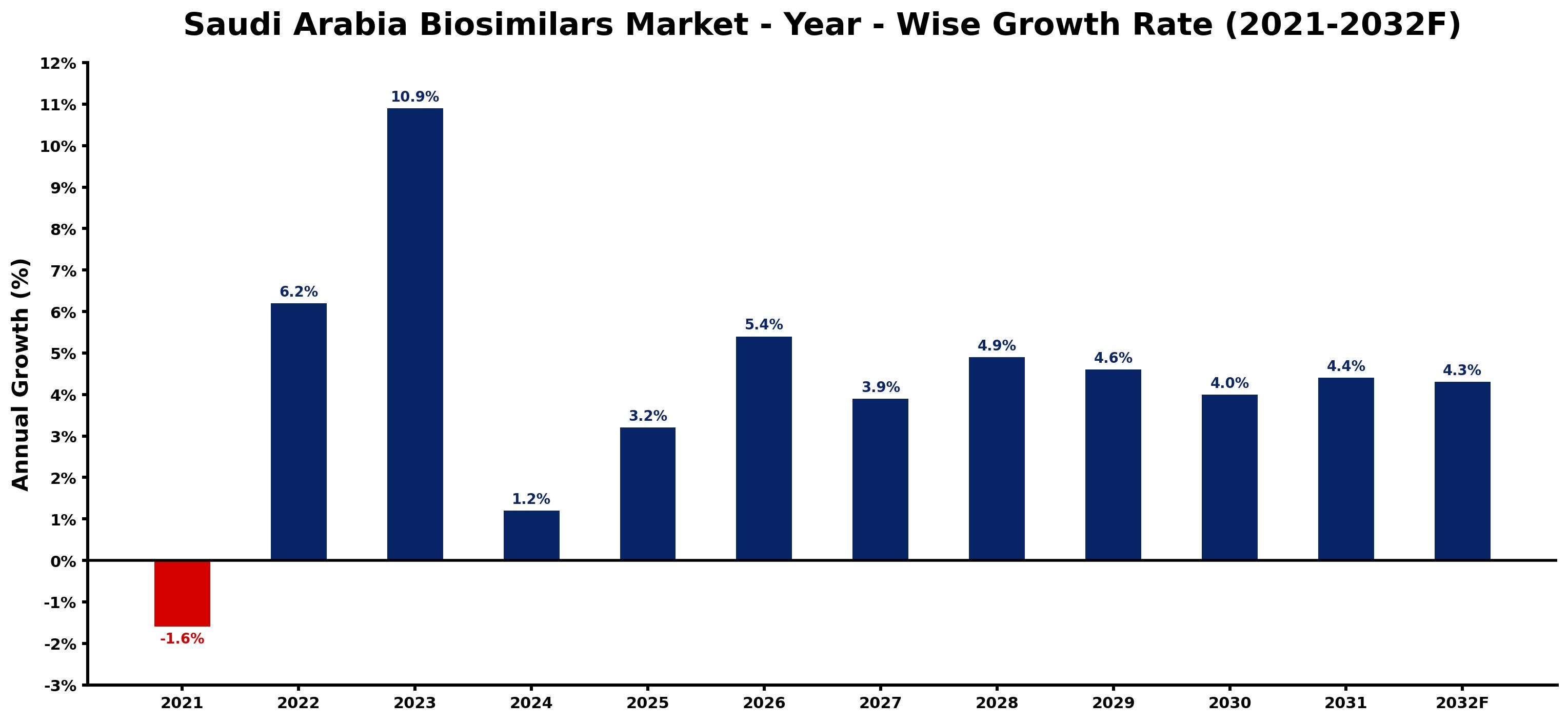
The table below presents the year‑wise growth rates along with the key drivers influencing the market
| Year | Growth Rate | Major Drivers |
| 2021 | -1.6% | Increasing smart city development projects |
| 2022 | 6.2% | Rising electricity demand across industries |
| 2023 | 10.9% | Increasing smart city development projects |
| 2024 | 1.2% | Government infrastructure modernization initiatives |
| 2025 | 3.2% | Expansion of transportation and logistics networks |
| 2026 | 5.4% | Expansion of transportation and logistics networks |
| 2027 | 3.9% | Rapid growth in telecom and data center sectors |
| 2028 | 4.9% | Growing urbanization and commercial development |
| 2029 | 4.6% | Increasing smart city development projects |
| 2030 | 4.0% | Government infrastructure modernization initiatives |
| 2031 | 4.4% | Growing renewable energy integration projects |
| 2032 | 4.3% | Rising electricity demand across industries |
Note - Market size estimations and growth projections presented in this report are based on 6Wresearch's advanced forecasting approach, validated with industry datasets as of June 2026.
Saudi Arabia Biosimilars Market Synopsis
The Saudi Arabia biosimilars market is currently navigating a period of notable momentum, supported by a rising demand for cost-effective healthcare solutions. As healthcare costs continue to escalate, the emphasis on biosimilars as viable alternatives to traditional biologics is becoming more pronounced.
Looking ahead, the market is poised for sustained growth, spurred by enhanced regulatory frameworks and increased public awareness of biosimilars' benefits. As the healthcare ecosystem evolves, the integration of biosimilars into treatment protocols will likely expand, aligning with broader efforts to improve patient access and affordability.
Saudi Arabia Biosimilars Market Key Takeaways
- Increasing chronic disease prevalence drives demand for cost-effective biosimilars.
- Government initiatives support domestic production and regulatory improvements.
- Biosimilars present significant cost-saving potential for patients and healthcare systems.
- Ongoing efforts to build physician and patient trust in biosimilars are essential for market growth.
- The market is expected to grow steadily, reflecting a shift in healthcare spending priorities.
Evaluation of Restraints in Saudi Arabia Biosimilars Market
Despite the promising prospects, several challenges persist that may hinder the market's growth. The complexity of obtaining regulatory approvals for new biosimilars remains a significant hurdle for manufacturers, leading to delays that can stifle innovation. Moreover, there exists a level of skepticism among healthcare professionals and patients regarding the safety and efficacy of biosimilars compared to their reference biologics. This skepticism can impede acceptance and usage, thereby limiting the potential market reach of biosimilars.
Saudi Arabia Biosimilars Market Trends
Several key trends are currently shaping the Saudi Arabia biosimilars market. One significant trend is the increasing collaboration between biotechnology firms and healthcare providers to promote the development and adoption of biosimilars. Additionally, advancements in manufacturing processes are enabling more cost-effective production methods, which are vital for enhancing market accessibility. Moreover, the growing focus on patient-centered care is driving a shift towards more affordable treatment alternatives, including biosimilars.
Saudi Arabia Biosimilars Market Opportunities
Investment opportunities in the Saudi Arabia biosimilars market are on the rise. With increasing emphasis on healthcare cost optimization, stakeholders can capitalize on the growing need for affordable biologic alternatives. The government's push for local biosimilar production presents further avenues for investment, particularly for companies looking to establish a presence in the region. Additionally, as awareness of biosimilars grows among healthcare professionals, the potential for market penetration and expansion becomes more pronounced.
Government Initiatives in the Saudi Arabia Biosimilars Market
The Saudi Arabian government is actively promoting the biosimilars market through various initiatives aimed at enhancing local production and facilitating regulatory approvals. Public spending is being directed towards programs that educate healthcare providers and patients on the benefits of biosimilars, aiming to build confidence in these products. By fostering an environment conducive to innovation and growth, the government is positioning the biosimilars sector as a key component of its broader healthcare strategy.
Future Insights of the Saudi Arabia Biosimilars Market
Looking towards 2026 and beyond, the Saudi Arabia biosimilars market is expected to continue its upward trajectory. The convergence of increasing chronic disease rates, heightened governmental support, and evolving perceptions of biosimilars will likely create a robust ecosystem for growth. As healthcare stakeholders increasingly prioritize affordability and access, biosimilars will play a pivotal role in reshaping the treatment landscape in Saudi Arabia.
Saudi Arabia Biosimilars Market Latest Developments (May 2025 - June 2026)
Recent developments within the Saudi Arabia biosimilars market have centered on strengthening regulatory frameworks to expedite approvals for new products. Additionally, partnerships between international biosimilar manufacturers and local firms are gaining traction, aiming to leverage local knowledge and distribution networks. These collaborative efforts are geared towards enhancing the availability and accessibility of biosimilars across the healthcare system.
Saudi Arabia Biosimilars Market - Key Attractiveness of the Report
- 10 Years of Market Numbers
- Historical Data Starting from 2022 to 2025
- Base Year: 2025
- Forecast Data until 2032
- Key Performance Indicators Impacting the Market
- Major Upcoming Developments and Projects
Key Highlights of the Report:
- Saudi Arabia Biosimilars Market Outlook
- Market Size of Saudi Arabia Biosimilars Market, 2025
- Forecast of Saudi Arabia Biosimilars Market, 2032
- Historical Data and Forecast of Saudi Arabia Biosimilars Revenues & Volume for the Period 2022-2032F
- Saudi Arabia Biosimilars Market Trend Evolution
- Saudi Arabia Biosimilars Market Drivers and Challenges
- Saudi Arabia Biosimilars Price Trends
- Saudi Arabia Biosimilars Porter's Five Forces
- Saudi Arabia Biosimilars Industry Life Cycle
- Historical Data and Forecast of Saudi Arabia Biosimilars Market Revenues & Volume By Product for the Period 2022-2032F
- Historical Data and Forecast of Saudi Arabia Biosimilars Market Revenues & Volume By Insulin for the Period 2022-2032F
- Historical Data and Forecast of Saudi Arabia Biosimilars Market Revenues & Volume By Follitropin for the Period 2022-2032F
- Historical Data and Forecast of Saudi Arabia Biosimilars Market Revenues & Volume By Calcitonin for the Period 2022-2032F
- Historical Data and Forecast of Saudi Arabia Biosimilars Market Revenues & Volume By Glucagon for the Period 2022-2032F
- Historical Data and Forecast of Saudi Arabia Biosimilars Market Revenues & Volume By Teriparatide for the Period 2022-2032F
- Historical Data and Forecast of Saudi Arabia Biosimilars Market Revenues & Volume By Others for the Period 2022-2032F
- Historical Data and Forecast of Saudi Arabia Biosimilars Market Revenues & Volume By Indication for the Period 2022-2032F
- Historical Data and Forecast of Saudi Arabia Biosimilars Market Revenues & Volume By Oncology for the Period 2022-2032F
- Historical Data and Forecast of Saudi Arabia Biosimilars Market Revenues & Volume By Offsite Treatment for the Period 2022-2032F
- Historical Data and Forecast of Saudi Arabia Biosimilars Market Revenues & Volume By Chronic Disorders for the Period 2022-2032F
- Historical Data and Forecast of Saudi Arabia Biosimilars Market Revenues & Volume By Blood Disorders for the Period 2022-2032F
- Historical Data and Forecast of Saudi Arabia Biosimilars Market Revenues & Volume By Infectious Diseases for the Period 2022-2032F
- Historical Data and Forecast of Saudi Arabia Biosimilars Market Revenues & Volume By Others for the Period 2022-2032F
- Historical Data and Forecast of Saudi Arabia Biosimilars Market Revenues & Volume By Manufacturing for the Period 2022-2032F
- Historical Data and Forecast of Saudi Arabia Biosimilars Market Revenues & Volume By Outsourced for the Period 2022-2032F
- Historical Data and Forecast of Saudi Arabia Biosimilars Market Revenues & Volume By In-house for the Period 2022-2032F
- Saudi Arabia Biosimilars Import Export Trade Statistics
- Market Opportunity Assessment By Product
- Market Opportunity Assessment By Indication
- Market Opportunity Assessment By Manufacturing
- Saudi Arabia Biosimilars Top Companies Market Share
- Saudi Arabia Biosimilars Competitive Benchmarking By Technical and Operational Parameters
- Saudi Arabia Biosimilars Company Profiles
- Saudi Arabia Biosimilars Key Strategic Recommendations






































