Saudi Arabia Borosilicate Glass Market Size, Share & Growth Rate
The Saudi Arabia Borosilicate Glass Market was estimated at USD 410 Million in 2025 and is projected to reach USD 524 Million by 2032, growing at a CAGR of 3.6% from 2026 to 2032. This growth trajectory is driven primarily by increasing demand across multiple sectors, particularly pharmaceuticals and laboratory applications, where high-performance glass is crucial. Furthermore, the ongoing push for technological innovation and improvements in manufacturing processes are expected to further bolster this market.
Saudi Arabia Borosilicate Glass Market Year-wise Growth Rate and Key Drivers
This graph highlights how the Saudi Arabia Borosilicate Glass Market has steadily grown over the years, supported by major growth factors.
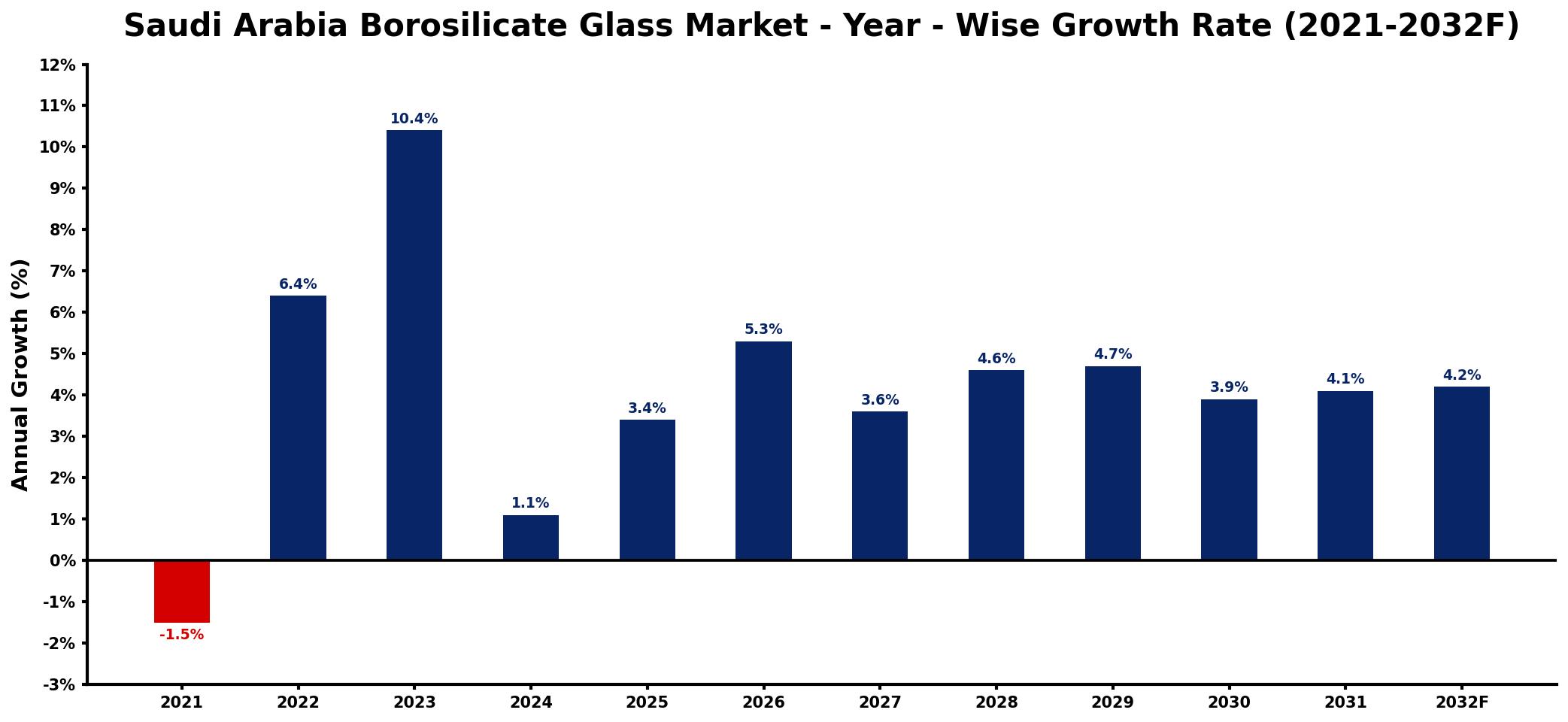
The table below presents the year‑wise growth rates along with the key drivers influencing the market
| Year | Growth Rate | Major Drivers |
| 2021 | -1.5% | decreased industrial manufacturing activities |
| 2022 | 6.4% | revitalization of construction projects |
| 2023 | 10.4% | expansion of healthcare facilities |
| 2024 | 1.1% | growth in scientific research funding |
| 2025 | 3.4% | increased consumer electronics demand |
| 2026 | 5.3% | rising popularity of eco-friendly materials |
| 2027 | 3.6% | enhanced investments in renewable energy |
| 2028 | 4.6% | development of advanced packaging solutions |
| 2029 | 4.7% | surge in food service industry |
| 2030 | 3.9% | growing trend in home decor |
| 2031 | 4.1% | increased adoption in education sector |
| 2032 | 4.2% | emergence of innovative manufacturing techniques |
Note: Market size estimations and growth projections presented in this report are based on 6Wresearch's proprietary forecasting methodology, utilizing the latest available industry data, government publications, and primary research inputs.
Saudi Arabia Borosilicate Glass Market Synopsis
The demand for high-performance glass solutions is the strongest force currently shaping the Saudi Arabia borosilicate glass market. Industries requiring materials that can endure extreme temperatures and harsh chemicals are increasingly turning to borosilicate glass, thanks to its durability and thermal resistance. This shift is particularly evident in the pharmaceutical and laboratory sectors, where the need for precision and safety is paramount.
As the country progresses towards industrial diversification, the borosilicate glass market benefits from heightened focus on innovation and sustainability. Technological advancements are leading to better quality products, further driving the adoption of borosilicate glass in various applications such as consumer goods and electronics, ultimately ensuring robust market growth.
Saudi Arabia Borosilicate Glass Market Key Takeaways
- The market is poised for steady growth, with key sectors such as pharmaceuticals and lab equipment leading demand.
- Technological advancements are enhancing the quality and applications of borosilicate glass.
- Awareness campaigns are needed to educate consumers and industries about the advantages of borosilicate over conventional glass.
- Investment in local manufacturing could help stabilize supply chains and enhance product availability.
- Global supply chain disruptions during COVID-19 highlighted the need for resilient manufacturing solutions in the market.
Evaluation of Restraints in Saudi Arabia Borosilicate Glass Market
Despite its strengths, the Saudi Arabia borosilicate glass market faces several restraints. One significant limitation is the lack of awareness among consumers regarding the benefits of borosilicate glass compared to conventional glass. This gap can hinder market penetration as industries may remain hesitant to switch. Additionally, the establishment of a robust local manufacturing base remains a challenge, as current reliance on imports complicates quality consistency and increases costs. These factors collectively pose risks to the market's potential growth.
Saudi Arabia Borosilicate Glass Market Trends
Currently, there is a notable trend towards sustainability and eco-friendliness in the materials used across various industries. Borosilicate glass is increasingly being recognized for its recyclability and longevity, aligning with global sustainability goals. Furthermore, innovations in production techniques are enabling manufacturers to create thinner, lighter, and more durable glass products, thus expanding the application scope. The rise in laboratory automation and the growing preference for high-quality laboratory equipment are also contributing to the heightened demand for borosilicate glass.
Saudi Arabia Borosilicate Glass Market Opportunities
The current landscape presents a multitude of opportunities for growth within the Saudi Arabia borosilicate glass market. Investment in local manufacturing can reduce dependency on imports, enhancing supply chain resilience. Moreover, expanding applications of borosilicate glass in high-tech sectors, such as electronics and renewable energy, promise substantial market potential. The increasing shift towards research and development initiatives in the pharmaceutical sector further exemplifies the avenues available for market expansion.
Government Initiatives in the Saudi Arabia Borosilicate Glass Market
The Saudi government is actively promoting initiatives aimed at enhancing local manufacturing capabilities and fostering research and innovation within the glass production sector. Public spending on infrastructure and technology development is expected to bolster industries reliant on borosilicate glass. Additionally, programs encouraging sustainable practices within manufacturing processes align with global environmental goals, creating a favorable regulatory environment for borosilicate glass products.
Future Insights of the Saudi Arabia Borosilicate Glass Market
Looking ahead to the period from 2026 to 2032, the Saudi Arabia borosilicate glass market is expected to experience dynamic changes influenced by technological advancements and increasing industrial diversification. The trend towards high-quality materials will continue, with more industries recognizing the long-term benefits of investing in borosilicate glass. As awareness and demand grow, market participants are likely to innovate and expand their offerings, thus positioning themselves favorably within this evolving landscape.
Saudi Arabia Borosilicate Glass Market Latest Developments (2025 - 2026)
Recent developments in the Saudi Arabia borosilicate glass market indicate a shift towards advanced manufacturing techniques aimed at improving product performance. Companies are increasingly focusing on R&D efforts to develop new applications that meet the rising demands of the pharmaceutical and electronics sectors. Collaborations among local manufacturers and research institutions have also emerged as a trend, aimed at fostering innovation and enhancing product offerings in the market.
Saudi Arabia Borosilicate Glass Market - Key Attractiveness of the Report
- 10 Years of Market Numbers
- Historical Data Starting from 2022 to 2025
- Base Year: 2025
- Forecast Data until 2032
- Key Performance Indicators Impacting the Market
- Major Upcoming Developments and Projects
Key Highlights of the Report:
- Saudi Arabia Borosilicate Glass Market Outlook
- Market Size of Saudi Arabia Borosilicate Glass Market, 2025
- Forecast of Saudi Arabia Borosilicate Glass Market, 2032
- Historical Data and Forecast of Saudi Arabia Borosilicate Glass Revenues & Volume for the Period 2022-2032F
- Saudi Arabia Borosilicate Glass Market Trend Evolution
- Saudi Arabia Borosilicate Glass Market Drivers and Challenges
- Saudi Arabia Borosilicate Glass Price Trends
- Saudi Arabia Borosilicate Glass Porter's Five Forces
- Saudi Arabia Borosilicate Glass Industry Life Cycle
- Historical Data and Forecast of Saudi Arabia Borosilicate Glass Market Revenues & Volume By Type for the Period 2022-2032F
- Historical Data and Forecast of Saudi Arabia Borosilicate Glass Market Revenues & Volume By High Borosilicate Glass for the Period 2022-2032F
- Historical Data and Forecast of Saudi Arabia Borosilicate Glass Market Revenues & Volume By Medium Borosilicate Glass for the Period 2022-2032F
- Historical Data and Forecast of Saudi Arabia Borosilicate Glass Market Revenues & Volume By Application for the Period 2022-2032F
- Historical Data and Forecast of Saudi Arabia Borosilicate Glass Market Revenues & Volume By Solar Energy Tubes for the Period 2022-2032F
- Historical Data and Forecast of Saudi Arabia Borosilicate Glass Market Revenues & Volume By Heat Glassware for the Period 2022-2032F
- Historical Data and Forecast of Saudi Arabia Borosilicate Glass Market Revenues & Volume By Laboratory Glassware for the Period 2022-2032F
- Historical Data and Forecast of Saudi Arabia Borosilicate Glass Market Revenues & Volume By Pharmaceutical Packaging for the Period 2022-2032F
- Historical Data and Forecast of Saudi Arabia Borosilicate Glass Market Revenues & Volume By Chemical Tubes for the Period 2022-2032F
- Historical Data and Forecast of Saudi Arabia Borosilicate Glass Market Revenues & Volume By Others for the Period 2022-2032F
- Saudi Arabia Borosilicate Glass Import Export Trade Statistics
- Market Opportunity Assessment By Type
- Market Opportunity Assessment By Application
- Saudi Arabia Borosilicate Glass Top Companies Market Share
- Saudi Arabia Borosilicate Glass Competitive Benchmarking By Technical and Operational Parameters
- Saudi Arabia Borosilicate Glass Company Profiles
- Saudi Arabia Borosilicate Glass Key Strategic Recommendations






































