Saudi Arabia Building Construction Market Size, Share & Growth Rate
The Saudi Arabia Building Construction Market was estimated at USD 480 Million in 2025 and is projected to reach USD 624 Million by 2032, growing at a CAGR of 3.8% from 2026 to 2032. This growth trajectory is largely driven by the ambitious Vision 2031 plan, which aims to diversify the economy through extensive investment in infrastructure development. Furthermore, the rapid urbanization and increasing demand for modern residential and commercial spaces fuel ongoing construction activities, establishing the sector as a fundamental pillar of economic transformation.
Saudi Arabia Building Construction Market Year-wise Growth Rate and Key Drivers
This graph highlights how the Saudi Arabia Building Construction Market has steadily grown over the years, supported by major growth factors.
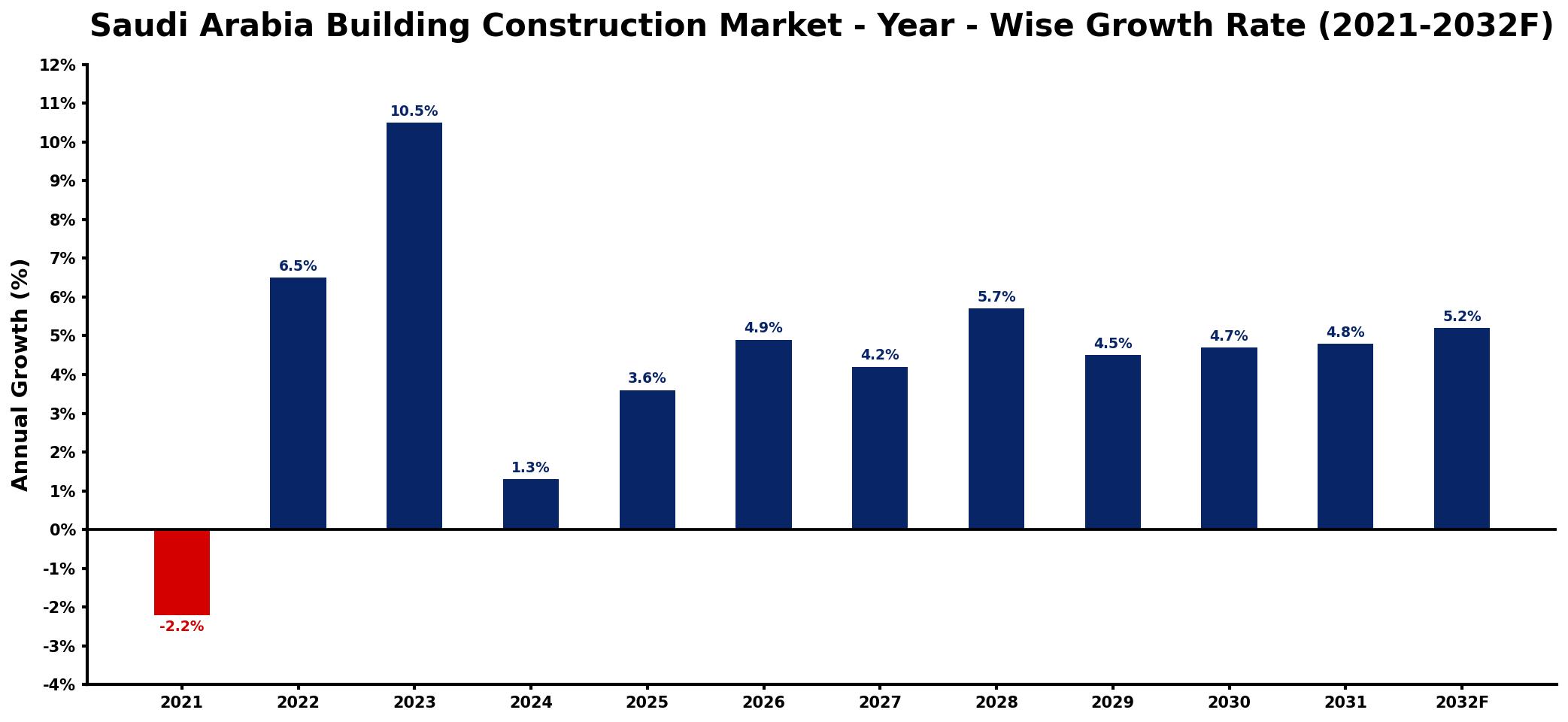
The table below presents the year‑wise growth rates along with the key drivers influencing the market
| Year | Growth Rate | Major Drivers |
| 2021 | -2.2% | decreased investment in infrastructure projects |
| 2022 | 6.5% | increased residential housing demand |
| 2023 | 10.5% | expansion of renewable energy projects |
| 2024 | 1.3% | growth in public sector projects |
| 2025 | 3.6% | rise in commercial real estate |
| 2026 | 4.9% | development of smart city initiatives |
| 2027 | 4.2% | enhanced foreign direct investments |
| 2028 | 5.7% | growing emerging market penetration |
| 2029 | 4.5% | increased urbanization and migration |
| 2030 | 4.7% | growing regional consumption patterns |
| 2031 | 4.8% | rising export shipment volumes |
| 2032 | 5.2% | enhanced product quality standards |
Note: Market size estimations and growth projections presented in this report are based on 6Wresearch's proprietary forecasting methodology, utilizing the latest available industry data, government publications, and primary research inputs.
Saudi Arabia Building Construction Market Synopsis
In recent years, the Saudi Arabia building construction market has witnessed a surge in activity, marked by various large-scale projects that reflect the kingdoms evolving urban landscape. Urbanization continues to rise, supported by government initiatives and a growing population that necessitates innovative housing and commercial solutions.
With a strong emphasis on sustainability and modern construction practices, companies are increasingly adopting advanced technologies to meet market demands. The ongoing push for high-quality standards and safety compliance further enriches the competitive landscape, stimulating innovations that align with global trends.
Saudi Arabia Building Construction Market Key Takeaways
- The market is projected to see steady growth driven by Vision 2031 and urbanization trends.
- Government investments are pivotal in promoting infrastructure and residential projects.
- Technological integration is enhancing project management and construction efficiency.
- Environmental sustainability remains a core focus among construction firms.
- The market's future will be shaped by continuous innovation and government support.
Evaluation of Restraints in Saudi Arabia Building Construction Market
Despite the promising outlook, the Saudi Arabia building construction market grapples with notable constraints that could impede growth. The cyclical nature of the industry, heavily reliant on government spending, can lead to fluctuations in construction activity. Economic downturns may stall projects and impact profitability, highlighting the necessity for contingency strategies. Additionally, bureaucratic processes often prolong project timelines, while labor shortages and rising costs create additional complexity in maintaining project schedules and budgets.
Saudi Arabia Building Construction Market Trends
Emerging trends within the Saudi Arabia building construction market underscore a shift towards sustainable and smart building solutions. The integration of digital technologies such as Building Information Modeling (BIM) and modular construction is becoming more prevalent, enhancing efficiency and reducing waste. Moreover, there is a growing emphasis on sustainable materials and construction practices as stakeholders aim to align with global environmental standards and consumer expectations.
Saudi Arabia Building Construction Market Opportunities
Significant growth opportunities abound in the Saudi Arabia building construction market, particularly in the residential and hospitality sectors. The increasing population and urbanization present a pressing demand for affordable housing and commercial spaces. Additionally, investments in tourism and entertainment projects align with the nation's diversification strategy, creating a robust environment for construction firms to thrive. Furthermore, the anticipated improvements in regulatory frameworks are likely to enhance market accessibility for local and international investors.
Government Initiatives in the Saudi Arabia Building Construction Market
The Saudi government is actively investing in infrastructure as part of its Vision 2031 initiative, which aims to foster economic diversification away from oil dependency. Recent policies focus on improving construction permit processes, thereby increasing transparency and efficiency within the sector. Additional incentives for sustainable building practices and technology adoption are being introduced, as part of a broader commitment to enhancing the country's infrastructure and urban spaces.
Future Insights of the Saudi Arabia Building Construction Market
Looking ahead to 2026-2032, the Saudi Arabia building construction market is poised for continued growth, driven by the governments strategic vision and ongoing urbanization efforts. As population dynamics evolve, the demand for innovative, resilient, and sustainable construction solutions is expected to rise. Investment in advanced construction methodologies and technology will likely become a cornerstone of project execution, thereby setting the stage for a more competitive and sustainable market environment.
Saudi Arabia Building Construction Market Latest Developments (2025 - 2026)
During this period, the industry has seen a renewed focus on digital transformation, with several firms adopting advanced project management software and collaborative tools to enhance efficiency and reduce costs. Additionally, the government has rolled out initiatives aimed at expediting project approvals and supporting sustainable development. These efforts are indicative of the sector's resilience and adaptability in the face of emerging challenges and opportunities.
Saudi Arabia Building Construction Market - Key Attractiveness of the Report
- 10 Years of Market Numbers
- Historical Data Starting from 2022 to 2025
- Base Year: 2025
- Forecast Data until 2032
- Key Performance Indicators Impacting the Market
- Major Upcoming Developments and Projects
Key Highlights of the Report:
- Saudi Arabia Building Construction Market Outlook
- Market Size of Saudi Arabia Building Construction Market, 2025
- Forecast of Saudi Arabia Building Construction Market, 2032
- Historical Data and Forecast of Saudi Arabia Building Construction Revenues & Volume for the Period 2022-2032F
- Saudi Arabia Building Construction Market Trend Evolution
- Saudi Arabia Building Construction Market Drivers and Challenges
- Saudi Arabia Building Construction Price Trends
- Saudi Arabia Building Construction Porter's Five Forces
- Saudi Arabia Building Construction Industry Life Cycle
- Historical Data and Forecast of Saudi Arabia Building Construction Market Revenues & Volume By Type for the Period 2022-2032F
- Historical Data and Forecast of Saudi Arabia Building Construction Market Revenues & Volume By Residential for the Period 2022-2032F
- Historical Data and Forecast of Saudi Arabia Building Construction Market Revenues & Volume By Non-residential for the Period 2022-2032F
- Historical Data and Forecast of Saudi Arabia Building Construction Market Revenues & Volume By Construction Type for the Period 2022-2032F
- Historical Data and Forecast of Saudi Arabia Building Construction Market Revenues & Volume By New Construction for the Period 2022-2032F
- Historical Data and Forecast of Saudi Arabia Building Construction Market Revenues & Volume By Renovation for the Period 2022-2032F
- Historical Data and Forecast of Saudi Arabia Building Construction Market Revenues & Volume By Application for the Period 2022-2032F
- Historical Data and Forecast of Saudi Arabia Building Construction Market Revenues & Volume By Owned for the Period 2022-2032F
- Historical Data and Forecast of Saudi Arabia Building Construction Market Revenues & Volume By Rental for the Period 2022-2032F
- Historical Data and Forecast of Saudi Arabia Building Construction Market Revenues & Volume By End User for the Period 2022-2032F
- Historical Data and Forecast of Saudi Arabia Building Construction Market Revenues & Volume By Private for the Period 2022-2032F
- Historical Data and Forecast of Saudi Arabia Building Construction Market Revenues & Volume By Public for the Period 2022-2032F
- Saudi Arabia Building Construction Import Export Trade Statistics
- Market Opportunity Assessment By Type
- Market Opportunity Assessment By Construction Type
- Market Opportunity Assessment By Application
- Market Opportunity Assessment By End User
- Saudi Arabia Building Construction Top Companies Market Share
- Saudi Arabia Building Construction Competitive Benchmarking By Technical and Operational Parameters
- Saudi Arabia Building Construction Company Profiles
- Saudi Arabia Building Construction Key Strategic Recommendations






































