Saudi Arabia Bulletproof Glass Market Size, Share & Growth Rate
The Saudi Arabia Bulletproof Glass Market was estimated at USD 438 Million in 2025 and is projected to reach USD 560 Million by 2032, growing at a CAGR of 3.6% from 2026 to 2032. This growth trajectory is significantly influenced by increasing security concerns across various sectors, including finance and defense, and the ongoing integration of advanced materials that enhance both protection and clarity. The evolving landscape, marked by rapid urbanization and heightened public safety initiatives, further bolsters the demand for robust security solutions like bulletproof glass.
Saudi Arabia Bulletproof Glass Market Year-wise Growth Rate and Key Drivers
This graph highlights how the Saudi Arabia Bulletproof Glass Market has steadily grown over the years, supported by major growth factors.
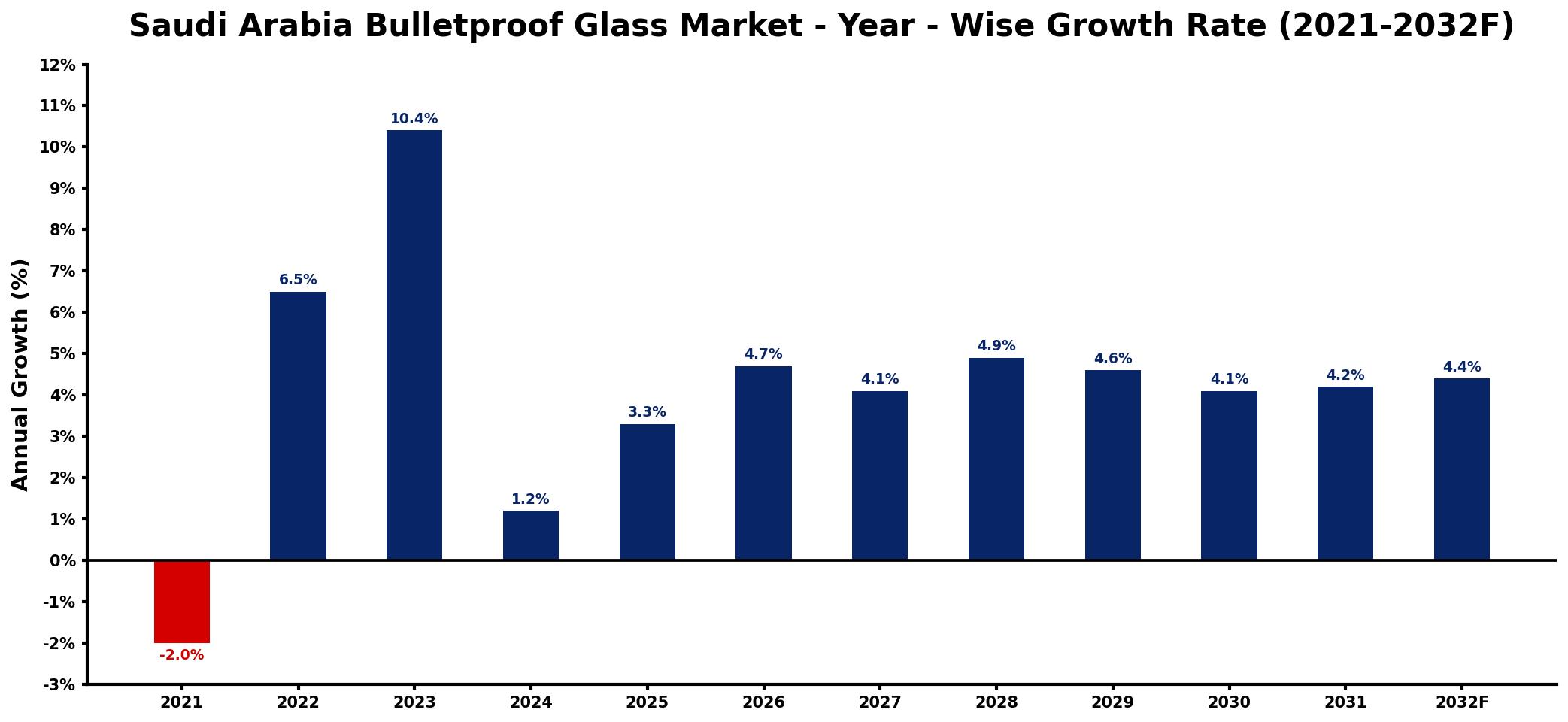
The table below presents the year‑wise growth rates along with the key drivers influencing the market
| Year | Growth Rate | Major Drivers |
| 2021 | -2.0% | decreased investments in security systems |
| 2022 | 6.5% | increased demand from construction sector |
| 2023 | 10.4% | expansion of automotive safety regulations |
| 2024 | 1.2% | growth in defense sector investments |
| 2025 | 3.3% | rising consumer awareness of safety |
| 2026 | 4.7% | enhanced infrastructure development projects |
| 2027 | 4.1% | surge in private security services |
| 2028 | 4.9% | advancements in safety technology applications |
| 2029 | 4.6% | increased urbanization and development |
| 2030 | 4.1% | growing demand for luxury vehicles |
| 2031 | 4.2% | growing downstream application demand |
| 2032 | 4.4% | heightened focus on public safety |
Note: Market size estimations and growth projections presented in this report are based on 6Wresearch's proprietary forecasting methodology, utilizing the latest available industry data, government publications, and primary research inputs.
Saudi Arabia Bulletproof Glass Market Synopsis
The most compelling force currently shaping the Saudi Arabia Bulletproof Glass Market is the escalating emphasis on security and asset protection. As government and private entities prioritize the safeguarding of personnel and critical infrastructure, the adoption of bulletproof glass has become increasingly prevalent.
In addition, industries such as banking and automotive are pioneering the integration of advanced bulletproof solutions. This trend not only reflects a proactive stance towards risk management but also aligns with global innovations aimed at enhancing ballistic resistance while retaining aesthetic appeal.
Saudi Arabia Bulletproof Glass Market Key Takeaways
- Heightened security concerns are propelling demand for bulletproof glass across multiple sectors.
- Technological advancements are driving the development of lighter and more effective bulletproof glass solutions.
- The automotive industry is witnessing a notable surge in the use of bulletproof glass for luxury and high-profile vehicles.
- Strategic partnerships between manufacturers and architects can enhance market penetration and product offerings.
- Education regarding the benefits and limitations of bulletproof glass remains critical for driving adoption.
Evaluation of Restraints in Saudi Arabia Bulletproof Glass Market
Despite the promising outlook for the bulletproof glass market in Saudi Arabia, certain constraints impede its growth. A primary challenge is achieving an optimal balance between transparency and ballistic protection. Developing products that can withstand various threats while meeting aesthetic standards presents a continuous engineering hurdle. Furthermore, there is a pressing need to inform potential clients about the technological advancements and real-world applications of bulletproof glass, as misconceptions may hinder market acceptance.
Saudi Arabia Bulletproof Glass Market Trends
One of the prominent trends in the Saudi Arabia Bulletproof Glass Market is the increasing incorporation of smart technologies, such as sensors and integrated communication systems, into glass applications. Additionally, a growing preference for customization, where clients seek tailor-made solutions that blend seamlessly with architectural designs, is influencing product offerings. Finally, sustainability is gaining traction as manufacturers explore eco-friendly materials to meet both safety standards and environmental regulations.
Saudi Arabia Bulletproof Glass Market Opportunities
The market presents significant opportunities, particularly within the automotive sector, where the integration of bulletproof glass can serve as a compelling selling point for security-conscious consumers. Moreover, ongoing government investments in security infrastructure are expected to further elevate demand. Manufacturers are encouraged to engage in research and development to innovate products that maintain optical clarity while enhancing ballistic resistance. Collaborations with security agencies and architects can also pave the way for new applications and market expansion.
Government Initiatives in the Saudi Arabia Bulletproof Glass Market
The Saudi government has intensified its focus on security infrastructure, implementing policies that promote the adoption of advanced protective solutions across various sectors. Public spending on safety and security measures, particularly in urban areas and critical facilities, reflects a strategic commitment to enhancing national safety standards. Moreover, initiatives encouraging collaboration between public and private sectors aim to bolster innovation within security technology, including bulletproof glass.
Future Insights of the Saudi Arabia Bulletproof Glass Market
Looking ahead to the period between 2026 and 2032, the Saudi Arabia Bulletproof Glass Market is poised for substantial growth, largely driven by continuous advancements in material technology and the persistent focus on security. Increasing urbanization and ongoing infrastructural developments will necessitate enhanced protective measures. Additionally, as security concerns evolve, the demand for high-performance bulletproof solutions will likely gain momentum, further shaping the future landscape of the market.
Saudi Arabia Bulletproof Glass Market Latest Developments (2025 - 2026)
The bulletproof glass market in Saudi Arabia is witnessing a shift towards innovation, with manufacturers exploring new technologies and materials to enhance product offerings. Industry players are increasingly focusing on collaborations and partnerships to expand their market presence. Moreover, there has been an uptick in projects related to governmental infrastructure that necessitate enhanced security measures, paving the way for increased adoption of bulletproof glass solutions.
Saudi Arabia Bulletproof Glass Market - Key Attractiveness of the Report
- 10 Years of Market Numbers
- Historical Data Starting from 2022 to 2025
- Base Year: 2025
- Forecast Data until 2032
- Key Performance Indicators Impacting the Market
- Major Upcoming Developments and Projects
Key Highlights of the Report:
- Saudi Arabia Bulletproof Glass Market Outlook
- Market Size of Saudi Arabia Bulletproof Glass Market, 2025
- Forecast of Saudi Arabia Bulletproof Glass Market, 2032
- Historical Data and Forecast of Saudi Arabia Bulletproof Glass Revenues & Volume for the Period 2022-2032F
- Saudi Arabia Bulletproof Glass Market Trend Evolution
- Saudi Arabia Bulletproof Glass Market Drivers and Challenges
- Saudi Arabia Bulletproof Glass Price Trends
- Saudi Arabia Bulletproof Glass Porter's Five Forces
- Saudi Arabia Bulletproof Glass Industry Life Cycle
- Historical Data and Forecast of Saudi Arabia Bulletproof Glass Market Revenues & Volume By Type for the Period 2022-2032F
- Historical Data and Forecast of Saudi Arabia Bulletproof Glass Market Revenues & Volume By Solid Acrylic for the Period 2022-2032F
- Historical Data and Forecast of Saudi Arabia Bulletproof Glass Market Revenues & Volume By Traditional Laminated for the Period 2022-2032F
- Historical Data and Forecast of Saudi Arabia Bulletproof Glass Market Revenues & Volume By Polycarbonate for the Period 2022-2032F
- Historical Data and Forecast of Saudi Arabia Bulletproof Glass Market Revenues & Volume By Glass-clad Polycarbonate for the Period 2022-2032F
- Historical Data and Forecast of Saudi Arabia Bulletproof Glass Market Revenues & Volume By Other Types for the Period 2022-2032F
- Historical Data and Forecast of Saudi Arabia Bulletproof Glass Market Revenues & Volume By End-user Industry for the Period 2022-2032F
- Historical Data and Forecast of Saudi Arabia Bulletproof Glass Market Revenues & Volume By Automotive for the Period 2022-2032F
- Historical Data and Forecast of Saudi Arabia Bulletproof Glass Market Revenues & Volume By Buildings and Construction for the Period 2022-2032F
- Historical Data and Forecast of Saudi Arabia Bulletproof Glass Market Revenues & Volume By Defense for the Period 2022-2032F
- Historical Data and Forecast of Saudi Arabia Bulletproof Glass Market Revenues & Volume By Other End-user Industries for the Period 2022-2032F
- Saudi Arabia Bulletproof Glass Import Export Trade Statistics
- Market Opportunity Assessment By Type
- Market Opportunity Assessment By End-user Industry
- Saudi Arabia Bulletproof Glass Top Companies Market Share
- Saudi Arabia Bulletproof Glass Competitive Benchmarking By Technical and Operational Parameters
- Saudi Arabia Bulletproof Glass Company Profiles
- Saudi Arabia Bulletproof Glass Key Strategic Recommendations






































