Saudi Arabia Cellulose Acetate Fiber Market Size, Share & Growth Rate
The Saudi Arabia Cellulose Acetate Fiber Market was estimated at USD 203 Million in 2025 and is projected to reach USD 259 Million by 2032, growing at a CAGR of 3.5% from 2026 to 2032. This growth trajectory is driven by an increasing consumer preference for sustainable textiles and eco-friendly materials. Furthermore, as Saudi Arabias fashion and textile sectors expand, the demand for cellulose acetate fibers, known for their biodegradability and soft texture, is expected to rise, aligning with global sustainability trends.
Saudi Arabia Cellulose Acetate Fiber Market Year-wise Growth Rate and Key Drivers
This graph highlights how the Saudi Arabia Cellulose Acetate Fiber Market has steadily grown over the years, supported by major growth factors.
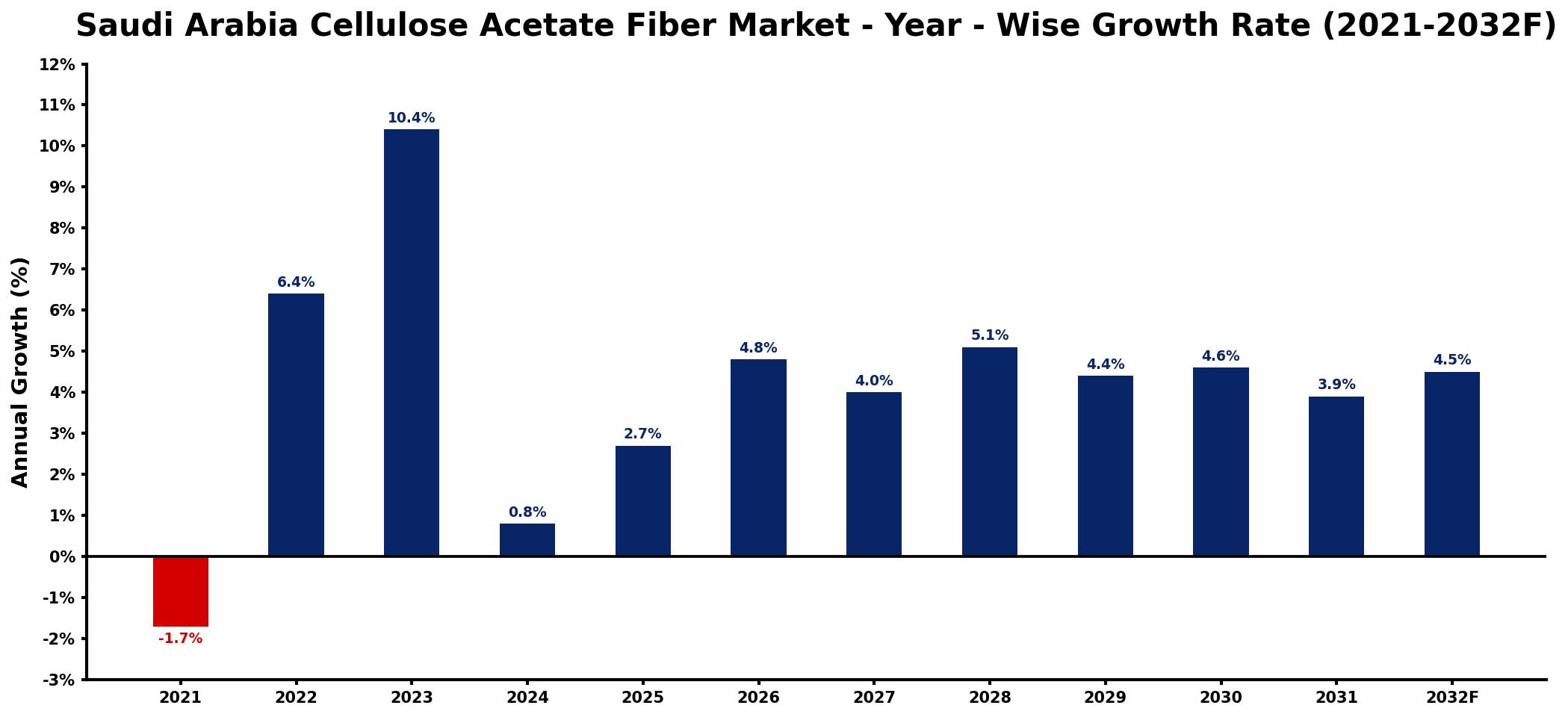
The table below presents the year‑wise growth rates along with the key drivers influencing the market
| Year | Growth Rate | Major Drivers |
| 2021 | -1.7% | Reduced demand from textile industry |
| 2022 | 6.4% | Increased investment in manufacturing |
| 2023 | 10.4% | Growing popularity in fashion sector |
| 2024 | 0.8% | Expansion of sustainable materials market |
| 2025 | 2.7% | expanding healthcare application demand |
| 2026 | 4.8% | Technological advancements in production processes |
| 2027 | 4.0% | Increase in export opportunities regionally |
| 2028 | 5.1% | Emergence of new application sectors |
| 2029 | 4.4% | Strengthening partnerships with local manufacturers |
| 2030 | 4.6% | Growth in automotive interior applications |
| 2031 | 3.9% | Rising demand from packaging industry |
| 2032 | 4.5% | increased production capacity utilization |
Note: Market size estimations and growth projections presented in this report are based on 6Wresearch's proprietary forecasting methodology, utilizing the latest available industry data, government publications, and primary research inputs.
Saudi Arabia Cellulose Acetate Fiber Market Synopsis
The Saudi Arabian cellulose acetate fiber market is witnessing a significant transformation as sustainability becomes a core focus for both consumers and manufacturers. Derived from renewable wood pulp, cellulose acetate fibers not only provide a soft, breathable alternative to traditional fibers but also help address pressing environmental concerns.
As fashion brands increasingly shift towards eco-conscious production methods, cellulose acetate is carving a niche for itself in various applications, from apparel to home textiles. The confluence of consumer demand and regulatory pressures is driving manufacturers to invest in more efficient and sustainable production processes, ensuring the market's robust evolution.
Saudi Arabia Cellulose Acetate Fiber Market Key Takeaways
- Growing awareness of sustainable materials is propelling market demand.
- Cellulose acetate fibers are gaining traction in the textile and apparel sectors.
- Manufacturers are innovating to enhance production efficiency and sustainability.
- Regulatory standards favor eco-friendly products, further stimulating market growth.
- Consumer preference is shifting towards biodegradable materials, impacting purchasing decisions.
Evaluation of Restraints in Saudi Arabia Cellulose Acetate Fiber Market
Despite the promising growth trajectory, the Saudi Arabia cellulose acetate fiber market faces several restraints that can impede progress. The primary concern is the chemical processing involved in the production of cellulose acetate fibers, which raises questions regarding sustainability. Although these fibers originate from renewable resources, the environmental impact of their manufacturing processes can deter eco-conscious consumers. Additionally, competition from alternative natural fibers, which may be perceived as more sustainable, poses a challenge for cellulose acetate's market positioning. Addressing these perceptions and ensuring transparency in production processes will be crucial for the industrys advancement.
Saudi Arabia Cellulose Acetate Fiber Market Trends
Several trends are shaping the Saudi Arabia cellulose acetate fiber market. One significant trend is the growing integration of sustainable practices within supply chains, as manufacturers adopt more environmentally friendly processes. Moreover, collaborations between fiber producers and fashion brands are becoming more common, aiming to create innovative products that appeal to eco-conscious consumers. Additionally, the rise of digital retail platforms is facilitating broader access to sustainable textile options, increasing consumer awareness and interest in cellulose acetate fibers.
Saudi Arabia Cellulose Acetate Fiber Market Opportunities
The Saudi Arabia cellulose acetate fiber market presents several growth and investment opportunities. With a heightened focus on sustainability, companies can explore new applications of cellulose acetate in diverse sectors, including packaging and home furnishings. Expanding R&D efforts to develop advanced cellulose acetate products that leverage its biodegradability could attract environmentally conscious consumers. Additionally, investment in local production capabilities may reduce reliance on imports and enhance market competitiveness, aligning with national objectives to boost local industries.
Government Initiatives in the Saudi Arabia Cellulose Acetate Fiber Market
The Saudi government is actively promoting sustainability across various sectors, including textiles. Initiatives aimed at diversifying the economy encourage investments in eco-friendly materials and production methods. Public spending on infrastructure and technology development is also facilitating advancements in the cellulose acetate fiber market. Furthermore, regulatory frameworks are increasingly favorable towards businesses that prioritize environmental responsibility, thus creating a conducive environment for market growth.
Future Insights of the Saudi Arabia Cellulose Acetate Fiber Market
Looking ahead to 2026-2032, the Saudi Arabia cellulose acetate fiber market is set to flourish in an environment that increasingly prioritizes sustainability. As consumer awareness grows and regulatory pressures mount, the shift towards biodegradable and eco-friendly materials will only gain momentum. Companies that adapt quickly to these changes and invest in innovative production methods are likely to capture significant market share. The ongoing collaboration between manufacturers and fashion brands will further enhance product offerings, driving demand and contributing to the market's robust growth.
Saudi Arabia Cellulose Acetate Fiber Market Latest Developments (2025 - 2026)
Recent developments in the Saudi Arabia cellulose acetate fiber market indicate a strong trend towards innovation and sustainability. Manufacturers are exploring new processing techniques to enhance the eco-friendliness of cellulose acetate production. Moreover, collaborations between textile producers and eco-conscious brands are on the rise, reflecting a mutual commitment to sustainable practices. The market is also seeing increased efforts to promote cellulose acetate fibers at trade shows and exhibitions, highlighting their benefits in addressing environmental concerns.
Saudi Arabia Cellulose Acetate Fiber Market - Key Attractiveness of the Report
- 10 Years of Market Numbers
- Historical Data Starting from 2022 to 2025
- Base Year: 2025
- Forecast Data until 2032
- Key Performance Indicators Impacting the Market
- Major Upcoming Developments and Projects
Key Highlights of the Report:
- Saudi Arabia Cellulose Acetate Fiber Market Outlook
- Market Size of Saudi Arabia Cellulose Acetate Fiber Market, 2025
- Forecast of Saudi Arabia Cellulose Acetate Fiber Market, 2032
- Historical Data and Forecast of Saudi Arabia Cellulose Acetate Fiber Revenues & Volume for the Period 2022-2032F
- Saudi Arabia Cellulose Acetate Fiber Market Trend Evolution
- Saudi Arabia Cellulose Acetate Fiber Market Drivers and Challenges
- Saudi Arabia Cellulose Acetate Fiber Price Trends
- Saudi Arabia Cellulose Acetate Fiber Porter's Five Forces
- Saudi Arabia Cellulose Acetate Fiber Industry Life Cycle
- Historical Data and Forecast of Saudi Arabia Cellulose Acetate Fiber Market Revenues & Volume By Type for the Period 2022-2032F
- Historical Data and Forecast of Saudi Arabia Cellulose Acetate Fiber Market Revenues & Volume By Plastic for the Period 2022-2032F
- Historical Data and Forecast of Saudi Arabia Cellulose Acetate Fiber Market Revenues & Volume By Fiber for the Period 2022-2032F
- Historical Data and Forecast of Saudi Arabia Cellulose Acetate Fiber Market Revenues & Volume By Application for the Period 2022-2032F
- Historical Data and Forecast of Saudi Arabia Cellulose Acetate Fiber Market Revenues & Volume By Photographic Films for the Period 2022-2032F
- Historical Data and Forecast of Saudi Arabia Cellulose Acetate Fiber Market Revenues & Volume By Cigarette Filters for the Period 2022-2032F
- Historical Data and Forecast of Saudi Arabia Cellulose Acetate Fiber Market Revenues & Volume By Tapes & Labels for the Period 2022-2032F
- Historical Data and Forecast of Saudi Arabia Cellulose Acetate Fiber Market Revenues & Volume By Textiles & Apparel for the Period 2022-2032F
- Saudi Arabia Cellulose Acetate Fiber Import Export Trade Statistics
- Market Opportunity Assessment By Type
- Market Opportunity Assessment By Application
- Saudi Arabia Cellulose Acetate Fiber Top Companies Market Share
- Saudi Arabia Cellulose Acetate Fiber Competitive Benchmarking By Technical and Operational Parameters
- Saudi Arabia Cellulose Acetate Fiber Company Profiles
- Saudi Arabia Cellulose Acetate Fiber Key Strategic Recommendations






































