Saudi Arabia Cement and Concrete Market Summary
The saudi arabia cement and concrete market was estimated at USD 171 Million in 2025 and is projected to reach USD 218 Million by 2032, growing at a CAGR of 4.9% from 2026 to 2032.
Saudi Arabia Cement and Concrete Market Year-wise Growth Rate and Key Drivers
This graph highlights how the Saudi Arabia Cement and Concrete Market has steadily grown over the past five years, supported by major growth factors.
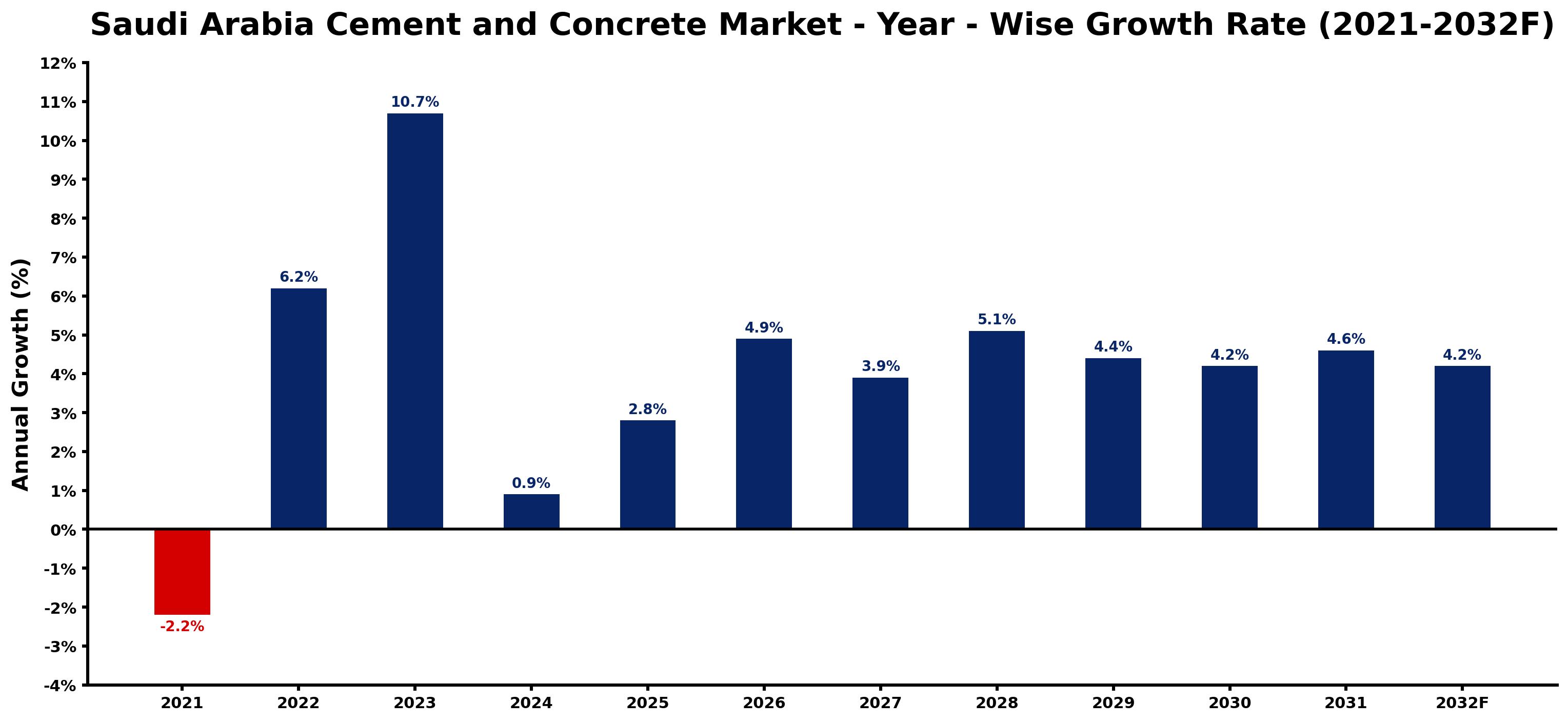
The table below presents the year wise growth rates along with the key drivers influencing the market
| Year | Growth Rate | Major Drivers |
| 2021 | -2.2% | Unanticipated construction project delays, exacerbated by pandemicrelated restrictions, led to decreased cement demand in 2021. |
| 2022 | 6.2% | Expansion of infrastructure projects within Vision 2030 fueled significant market investments. |
| 2023 | 10.7% | Emerging urban projects, including NEOM, bolstered demand for high-performance concrete solutions. |
| 2024 | 0.9% | Sustainability concerns prompted the industry to explore eco-friendly cement alternatives. |
| 2025 | 2.8% | Regional geopolitical stability encouraged foreign investment in construction and material supply chains. |
| 2026 | 4.9% | Technological advancements in concrete production improved efficiency and reduced operational costs. |
| 2027 | 3.9% | The residential sector's growth resulted in increased demand for quality concrete products. |
| 2028 | 5.1% | Public-private partnerships provided significant funding for large-scale infrastructure developments. |
| 2029 | 4.4% | Evolving architectural trends prioritized innovative concrete designs and customized solutions. |
| 2030 | 4.2% | Localizing production facilities minimized logistics costs and improved market responsiveness. |
| 2031 | 4.6% | Increased focus on green building practices emphasized sustainable materials usage. |
| 2032 | 4.2% | Digital transformation within construction sectors streamlined project management and delivery processes. |
Note - Market size estimations and growth projections presented in this report are based on 6Wresearch's advanced forecasting approach, validated with industry datasets as of June 2026.
Saudi Arabia Cement and Concrete Market Synopsis
The Saudi Arabia Cement and Concrete Market is projected to reach 4.9% and witness significant growth during the forecast period (2026-2032). The expansion of infrastructure projects across the nation, including roads, highways, and residential buildings, is anticipated to drive the demand for cement and concrete. A combination of rapid urbanization and increasing disposable income among citizens is fuelling greater investment in construction activities, further stimulating market growth. Furthermore, government efforts to enhance healthcare infrastructure, along with an increasing inclination towards non-residential constructions such as educational institutes and high-tech offices, are poised to augment the cement and concrete industry.
Saudi Arabia Cement and Concrete Market Growth Drivers
The growth trajectory of the Saudi Arabia Cement and Concrete Market can be largely attributed to several key drivers:
- The Saudi Arabian government has committed substantial investments towards national development initiatives under its Vision 2031 program. This vision includes significant construction projects such as Neom City, which demand extensive quantities of cement and concrete.
- An increase in foreign investments in the real estate sector, stimulated by favorable economic conditions, is leading to a heightened demand for residential properties. This trend is facilitating more construction and renovation activities, which rely heavily on cement and concrete materials.
- Incentives provided by the government to local manufacturers are fostering healthy competition and ensuring adherence to quality standards, thereby enhancing profitability without compromising safety measures.
- The influx of foreign personnel seeking opportunities in the domestic market is contributing to higher home-buying activities, subsequently driving the demand for construction materials.
- The ongoing trend of urbanization and rising living standards are also important factors that are pushing the demand for enhanced infrastructure development across urban centers in Saudi Arabia.
Saudi Arabia Cement and Concrete Market Challenges and Restraints
Despite the promising growth potential, the Saudi Arabia Cement and Concrete Market does encounter several challenges which could impact its dynamics:
- The volatility of raw material prices, particularly oil, poses a significant challenge for manufacturing units. Fluctuations in commodity prices can hinder the affordability of inputs necessary for production, disrupting operational stability.
- Stringent environmental regulations imposed by the government could also act as a restraint, requiring producers to adopt more sustainable practices while maintaining productivity.
- The market could be negatively impacted by potential economic uncertainties or shifts in governmental policies that affect construction spending.
- Competition from alternative building materials may also create pressure on traditional cement and concrete segments, necessitating innovation within the industry.
- Lastly, supply chain disruptions, particularly in the wake of global economic upheavals, could further challenge the market's ability to maintain steady growth.
Saudi Arabia Cement and Concrete Market Government Investment and Initiatives
Governmental investment in the Saudi Arabia Cement and Concrete Market is crucial for facilitating sector growth and meeting infrastructure demands. Through its Vision 2031 program, the Saudi government is channeling substantial funds into various national projects. These initiatives are aimed not only at bolstering the economy but also at fostering sustainable urban development. The government is implementing policies to provide incentives for local manufacturers, ensuring that they can compete effectively with international entities while maintaining stringent quality standards.
Moreover, ongoing initiatives to enhance public infrastructure, such as healthcare facilities, educational institutions, and commercial complexes are generating significant demand for cement and concrete. The government's commitment to expanding the country's urban and rural infrastructure is an essential aspect of its development strategy. By focusing on sustainable growth and reducing regulatory bottlenecks, the government aims to create an environment conducive to investments, subsequently increasing the market's attractiveness for construction materials.
Saudi Arabia Cement and Concrete Market Latest Developments (May 2025 - June 2026)
In the period spanning from May 2025 to June 2026, the Saudi Arabia Cement and Concrete Market has seen noteworthy developments aligning with the country's ambitious infrastructure goals. Major investments in production capacities and the establishment of new facilities are being observed as companies prepare to meet the rising demand associated with large-scale construction projects.
Additionally, innovative practices and technologies are being adopted within the sector to enhance efficiency and sustainability in production. Many companies are focusing on environmentally friendly manufacturing processes, adhering to the stringent regulations set forth by the government. These advancements are expected to contribute positively to overall market growth.
Saudi Arabia Cement and Concrete Market - Key Attractiveness of the Report
- 10 Years of Market Numbers
- Historical Data Starting from 2022 to 2025
- Base Year: 2025
- Forecast Data until 2032
- Key Performance Indicators Impacting the Market
- Major Upcoming Developments and Projects
Key Highlights of the Report:
- Saudi Arabia Cement and Concrete Market Outlook
- Market Size of Saudi Arabia Cement and Concrete Market, 2025
- Forecast of Saudi Arabia Cement and Concrete Market, 2032
- Historical Data and Forecast of Saudi Arabia Cement and Concrete Revenues & Volume for the Period 2022-2032F
- Saudi Arabia Cement and Concrete Market Trend Evolution
- Saudi Arabia Cement and Concrete Market Drivers and Challenges
- Saudi Arabia Cement and Concrete Price Trends
- Saudi Arabia Cement and Concrete Porter's Five Forces
- Saudi Arabia Cement and Concrete Industry Life Cycle
- Historical Data and Forecast of Saudi Arabia Cement and Concrete Market Revenues & Volume By Type for the Period 2022-2032F
- Historical Data and Forecast of Saudi Arabia Cement and Concrete Market Revenues & Volume By Cement for the Period 2022-2032F
- Historical Data and Forecast of Saudi Arabia Cement and Concrete Market Revenues & Volume By Ready-Mix Concrete for the Period 2022-2032F
- Historical Data and Forecast of Saudi Arabia Cement and Concrete Market Revenues & Volume By Concrete PipeBrickand Block for the Period 2022-2032F
- Historical Data and Forecast of Saudi Arabia Cement and Concrete Market Revenues & Volume By Others for the Period 2022-2032F
- Historical Data and Forecast of Saudi Arabia Cement and Concrete Market Revenues & Volume By Applications for the Period 2022-2032F
- Historical Data and Forecast of Saudi Arabia Cement and Concrete Market Revenues & Volume By Residential for the Period 2022-2032F
- Historical Data and Forecast of Saudi Arabia Cement and Concrete Market Revenues & Volume By Nonresidential for the Period 2022-2032F
- Saudi Arabia Cement and Concrete Import Export Trade Statistics
- Market Opportunity Assessment By Type
- Market Opportunity Assessment By Applications
- Saudi Arabia Cement and Concrete Top Companies Market Share
- Saudi Arabia Cement and Concrete Competitive Benchmarking By Technical and Operational Parameters
- Saudi Arabia Cement and Concrete Company Profiles
- Saudi Arabia Cement and Concrete Key Strategic Recommendations






































