Saudi Arabia Cloud Compliance Market Size & Growth Rate (2026-2032)
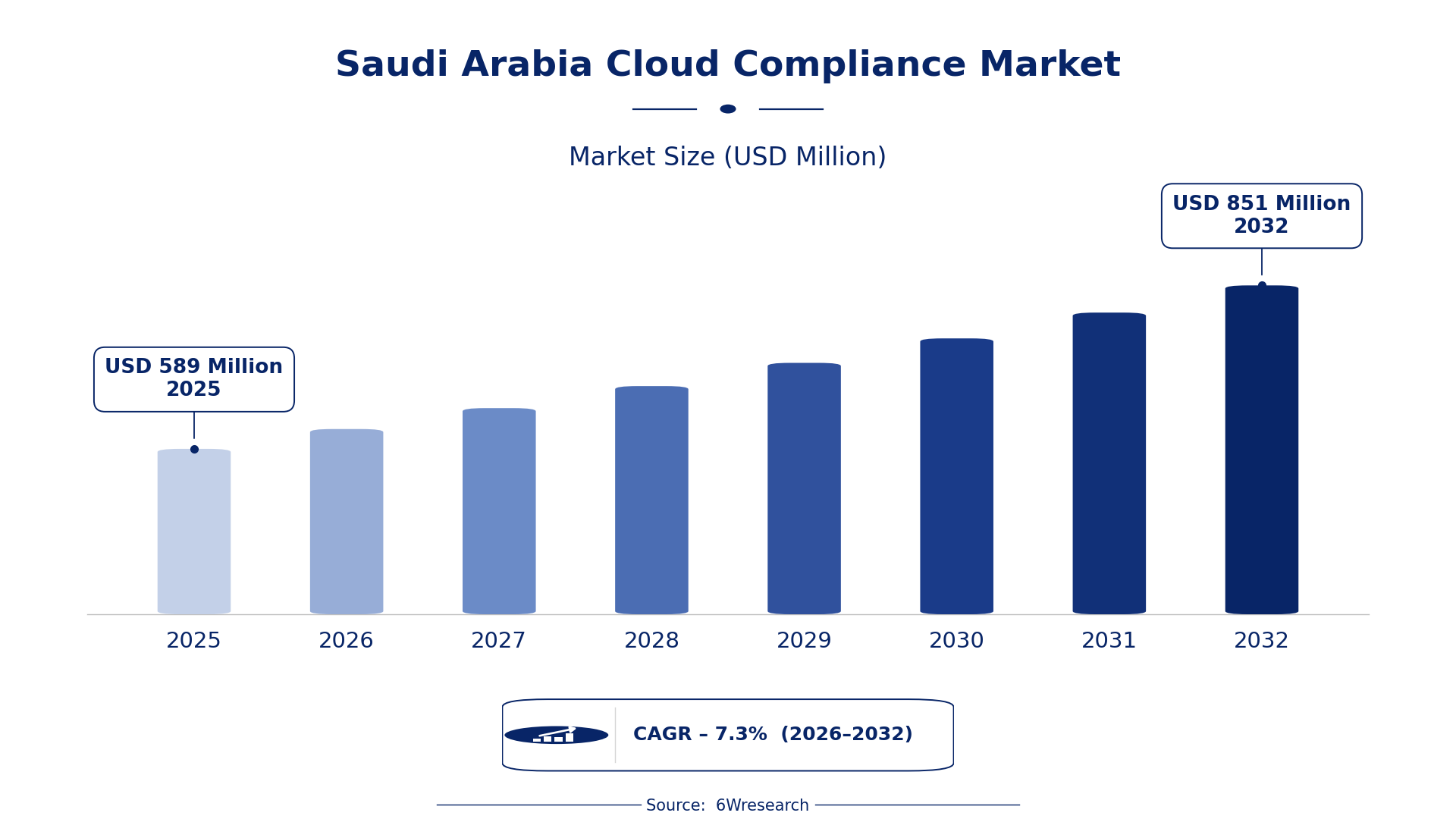
The Saudi Arabia Cloud Compliance Market was estimated at USD 589 Million in 2025 and is projected to reach USD 851 Million by 2032, growing at a CAGR of 7.3% from 2026 to 2032.
Saudi Arabia Cloud Compliance Market Synopsis
The increasing reliance on cloud solutions by businesses in Saudi Arabia is driving the demand for cloud compliance services. Organizations are prioritizing compliance to protect sensitive data and meet regulatory requirements, making cloud compliance a critical aspect of their operations.
As enterprises navigate complex regulatory frameworks, the need for effective cloud compliance solutions becomes more pronounced. This market not only addresses data security but also offers tools for auditing and compliance reporting, essential for maintaining organizational integrity in a digital-first environment.
Saudi Arabia Cloud Compliance Market Year-wise Growth Rate and Key Drivers
This graph illustrates the annual growth rates of the Saudi Arabia Cloud Compliance Market from 2021 to 2032, highlighting a steady upward trajectory and projected expansion over the forecast period.
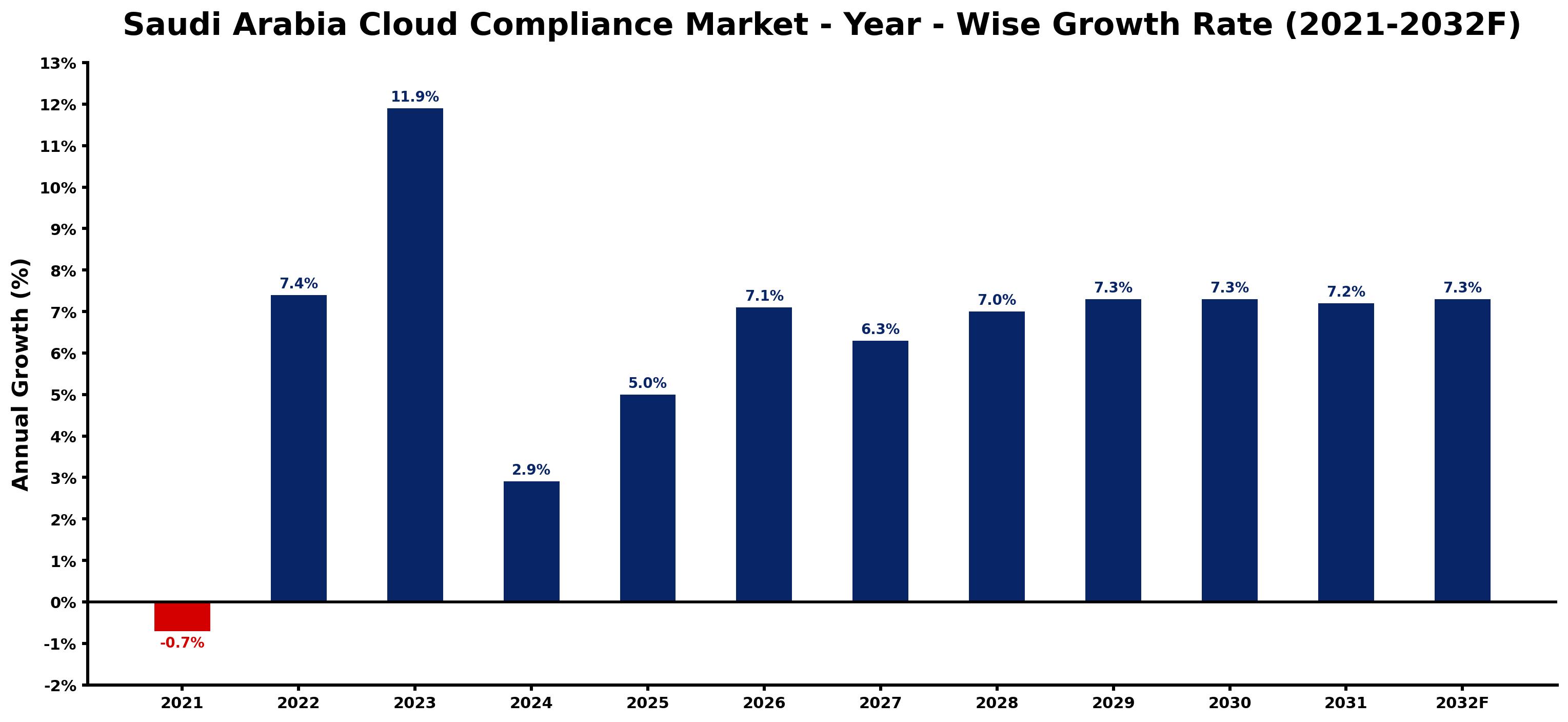
The table below presents the year‑wise growth rates along with the key drivers influencing the market
| Year | Growth Rate | Major Drivers |
| 2021 | -0.7% | SAMA tightening regulations on data residency requirements. |
| 2022 | 7.4% | New cloud compliance regulations by Saudi Telecom Authority |
| 2023 | 11.9% | Growth in local startups requiring cloud security frameworks |
| 2024 | 2.9% | Increased demand for cloud services amongst SMEs |
| 2025 | 5.0% | Adoption of Vision 2030 promoting digital transformation |
| 2026 | 7.1% | Government mandates for data privacy in cloud systems |
| 2027 | 6.3% | Rising awareness of cybersecurity threats in enterprises |
| 2028 | 7.0% | Enhanced compliance frameworks for financial institutions |
| 2029 | 7.3% | Growing e-commerce sector increasing cloud service needs |
| 2030 | 7.3% | Public awareness campaigns on cloud data protection |
| 2031 | 7.2% | Investment in national cloud infrastructure by government |
| 2032 | 7.3% | Emergence of local compliance consultancies supporting businesses |
Note: Market size estimations and growth projections presented in this report are based on 6Wresearch's proprietary forecasting methodology, utilizing the latest available industry data, government publications, and primary research inputs.
Saudi Arabia Cloud Compliance Market Key Takeaways
Below are some of the specific key takeaways from the market, including:
- Organizations are increasingly adopting cloud compliance solutions to safeguard sensitive data.
- Regulatory requirements and data protection laws are significant drivers of market growth.
- The need for effective auditing and compliance reporting is shaping service offerings.
- Cloud compliance technology is becoming essential for legal adherence and operational security.
- Challenges around data localization and sovereignty are critical considerations for providers.
Evaluation of Restraints in Saudi Arabia Cloud Compliance Market
The Saudi Arabia Cloud Compliance market faces several restraints that can hinder its growth trajectory. One of the primary challenges is ensuring adherence to the specific regulatory requirements unique to the Kingdom. Issues related to data localization and sovereignty complicate compliance efforts, as organizations must navigate a complex web of laws governing data storage and access. Additionally, the lack of standardized regulations across different sectors may lead to inconsistencies, further complicating compliance efforts for businesses. As organizations strive to meet these challenges, they often encounter hurdles in aligning their cloud solutions with local regulatory expectations.
Saudi Arabia Cloud Compliance Market Trends
Several trends are currently shaping the Saudi Arabia Cloud Compliance market. Firstly, organizations are increasingly seeking solutions that offer automated compliance monitoring to enhance efficiency and reduce manual oversight. The growing focus on data privacy is also influencing demand, as businesses aim to align with both local and international standards. on top of that, the shift towards hybrid cloud environments is prompting providers to develop compliant solutions that can operate across diverse platforms, ensuring that data remains secure and compliant regardless of its location. Lastly, the integration of advanced analytics and AI technologies in compliance tools is becoming more prevalent, enabling organizations to gain deeper insights into their compliance status.
Saudi Arabia Cloud Compliance Market Opportunities
With the rise in regulatory scrutiny, opportunities abound for businesses in the cloud compliance sector. Companies that can provide innovative compliance solutions tailored to specific industries stand to gain a competitive edge. Additionally, as more organizations transition to cloud infrastructures, there is a pressing need for tailored compliance frameworks that address unique operational requirements. Partnerships between technology providers and regulatory bodies can also create pathways for developing solutions that enhance compliance while fostering innovation in cloud services.
Government Initiatives in the Saudi Arabia Cloud Compliance Market
The Saudi government is actively shaping the Cloud Compliance market through various initiatives aimed at strengthening data protection and regulatory adherence. By prioritizing digital transformation, the government is establishing a framework that encourages businesses to adopt compliant cloud solutions while ensuring data security and privacy. This proactive stance is crucial for fostering trust in cloud technologies across sectors.
- A national digital infrastructure upgrade programme was launched in early 2025 to enhance data security and compliance capabilities across cloud services.
- Currently underway is a comprehensive review of existing data protection regulations, aimed at aligning them with international standards.
- A public-private partnership initiative is planned for 2026, focused on developing innovative cloud compliance technologies for local enterprises.
- The establishment of a new regulatory body in mid-2025 is set to oversee cloud compliance and data protection standards across various sectors.
- Ongoing workshops and training sessions are being organized to educate businesses on compliance best practices and regulatory updates.
Future Insights of the Saudi Arabia Cloud Compliance Market
Looking ahead to 2026-2032, the Saudi Arabia Cloud Compliance market is expected to evolve significantly as organizations increasingly embrace cloud technologies. As the regulatory environment continues to mature, businesses will demand more sophisticated compliance solutions that integrate seamlessly with their operations. The interplay between emerging technologies and compliance will drive innovation, leading to the development of advanced tools designed to ensure adherence to local regulations while enhancing operational efficiency. This trajectory indicates a market ripe with opportunities for forward-thinking providers.
Saudi Arabia Cloud Compliance Market Latest Developments
Recent developments in the Saudi Arabia Cloud Compliance market highlight the industry's dynamic nature as organizations adapt to evolving regulatory demands. As businesses prioritize compliance, several initiatives have emerged to enhance data protection and operational efficiency.
- A major technology vendor launched a new compliance automation tool in Q1 2025, aimed at simplifying regulatory reporting for enterprises.
- An initiative that began in late 2024 is currently underway, focusing on developing training programs for compliance officers in various sectors.
- A planned rollout of an advanced analytics platform is expected to begin in early 2026, designed to provide real-time compliance monitoring.
- A regional operator is currently collaborating with government agencies to create a compliance framework tailored to the healthcare sector, which remains a priority area.
- A recent partnership between local firms was announced in Q3 2025, aimed at enhancing cloud compliance solutions through shared resources and expertise.
Saudi Arabia Cloud Compliance Market - Key Attractiveness of the Report
- 10 Years of Market Numbers
- Historical Data Starting from 2022 to 2025
- Base Year: 2025
- Forecast Data until 2032
- Key Performance Indicators Impacting the Market
- Major Upcoming Developments and Projects
Key Highlights of the Report:
- Saudi Arabia Cloud Compliance Market Outlook
- Market Size of Saudi Arabia Cloud Compliance Market, 2025
- Forecast of Saudi Arabia Cloud Compliance Market, 2032
- Historical Data and Forecast of Saudi Arabia Cloud Compliance Revenues & Volume for the Period 2022-2032F
- Saudi Arabia Cloud Compliance Market Trend Evolution
- Saudi Arabia Cloud Compliance Market Drivers and Challenges
- Saudi Arabia Cloud Compliance Price Trends
- Saudi Arabia Cloud Compliance Porter's Five Forces
- Saudi Arabia Cloud Compliance Industry Life Cycle
- Historical Data and Forecast of Saudi Arabia Cloud Compliance Market Revenues & Volume By Component for the Period 2022-2032F
- Historical Data and Forecast of Saudi Arabia Cloud Compliance Market Revenues & Volume By Software for the Period 2022-2032F
- Historical Data and Forecast of Saudi Arabia Cloud Compliance Market Revenues & Volume By Services for the Period 2022-2032F
- Historical Data and Forecast of Saudi Arabia Cloud Compliance Market Revenues & Volume By Cloud Model for the Period 2022-2032F
- Historical Data and Forecast of Saudi Arabia Cloud Compliance Market Revenues & Volume By Infrastructure-as-a-Service (IaaS) for the Period 2022-2032F
- Historical Data and Forecast of Saudi Arabia Cloud Compliance Market Revenues & Volume By Platform-as-a-Service (PaaS) for the Period 2022-2032F
- Historical Data and Forecast of Saudi Arabia Cloud Compliance Market Revenues & Volume By Software-as-a-Service (SaaS) for the Period 2022-2032F
- Historical Data and Forecast of Saudi Arabia Cloud Compliance Market Revenues & Volume By Application for the Period 2022-2032F
- Historical Data and Forecast of Saudi Arabia Cloud Compliance Market Revenues & Volume By Audit and Compliance Management for the Period 2022-2032F
- Historical Data and Forecast of Saudi Arabia Cloud Compliance Market Revenues & Volume By Threat Detection and Remediation for the Period 2022-2032F
- Historical Data and Forecast of Saudi Arabia Cloud Compliance Market Revenues & Volume By Activity Monitoring and Analytics for the Period 2022-2032F
- Historical Data and Forecast of Saudi Arabia Cloud Compliance Market Revenues & Volume By Visibility and Risk Assessment for the Period 2022-2032F
- Historical Data and Forecast of Saudi Arabia Cloud Compliance Market Revenues & Volume By Other Applications for the Period 2022-2032F
- Historical Data and Forecast of Saudi Arabia Cloud Compliance Market Revenues & Volume By Organization Size for the Period 2022-2032F
- Historical Data and Forecast of Saudi Arabia Cloud Compliance Market Revenues & Volume By Large Enterprises for the Period 2022-2032F
- Historical Data and Forecast of Saudi Arabia Cloud Compliance Market Revenues & Volume By Small and Medium-sized Enterprises (SMEs) for the Period 2022-2032F
- Historical Data and Forecast of Saudi Arabia Cloud Compliance Market Revenues & Volume By Vertical for the Period 2022-2032F
- Historical Data and Forecast of Saudi Arabia Cloud Compliance Market Revenues & Volume By Banking, Financial Services, and Insurance (BFSI) for the Period 2022-2032F
- Historical Data and Forecast of Saudi Arabia Cloud Compliance Market Revenues & Volume By Government for the Period 2022-2032F
- Historical Data and Forecast of Saudi Arabia Cloud Compliance Market Revenues & Volume By Healthcare for the Period 2022-2032F
- Historical Data and Forecast of Saudi Arabia Cloud Compliance Market Revenues & Volume By IT and ITeS for the Period 2022-2032F
- Historical Data and Forecast of Saudi Arabia Cloud Compliance Market Revenues & Volume By Retail and eCommerce for the Period 2022-2032F
- Historical Data and Forecast of Saudi Arabia Cloud Compliance Market Revenues & Volume By Manufacturing for the Period 2022-2032F
- Saudi Arabia Cloud Compliance Import Export Trade Statistics
- Market Opportunity Assessment By Component
- Market Opportunity Assessment By Cloud Model
- Market Opportunity Assessment By Application
- Market Opportunity Assessment By Organization Size
- Market Opportunity Assessment By Vertical
- Saudi Arabia Cloud Compliance Top Companies Market Share
- Saudi Arabia Cloud Compliance Competitive Benchmarking By Technical and Operational Parameters
- Saudi Arabia Cloud Compliance Company Profiles
- Saudi Arabia Cloud Compliance Key Strategic Recommendations






































