Saudi Arabia Coated Fabric Market Size, Share & Growth Rate
The Saudi Arabia Coated Fabric Market was estimated at USD 455 Million in 2025 and is projected to reach USD 583 Million by 2032, growing at a CAGR of 3.6% from 2026 to 2032. This growth trajectory is primarily driven by expanding automotive production, increased infrastructure development, and a rising demand for durable, high-performance materials across various sectors. As these industries continue to flourish, the coated fabric market is expected to play a pivotal role in meeting diverse application needs.
Saudi Arabia Coated Fabric Market Growth Rate Analysis (2021-2032)
The Saudi Arabia coated fabric market has displayed notable fluctuations over recent years, beginning with a contraction of 2.3% in 2021 due to pandemic-related disruptions and reduced industrial activity. However, recovery began in 2022 with a robust growth of 6.6%, fueled by increased demand from sectors such as automotive and construction, along with enhanced investments in infrastructure projects. This positive trajectory accelerated to 11.1% in 2023, reflecting favorable policy shifts supporting industrial diversification and energy transition initiatives. As consumer demand stabilizes, subsequent years, including 2024-2032, foresee a steady expansion, averaging around 4% annually, driven by technological advancements and a growing emphasis on sustainable materials in the marketplace.
Saudi Arabia Coated Fabric Market Year-wise Growth Rate and Key Drivers
This graph highlights how the Saudi Arabia Coated Fabric Market has steadily grown over the past five years, supported by major growth factors.
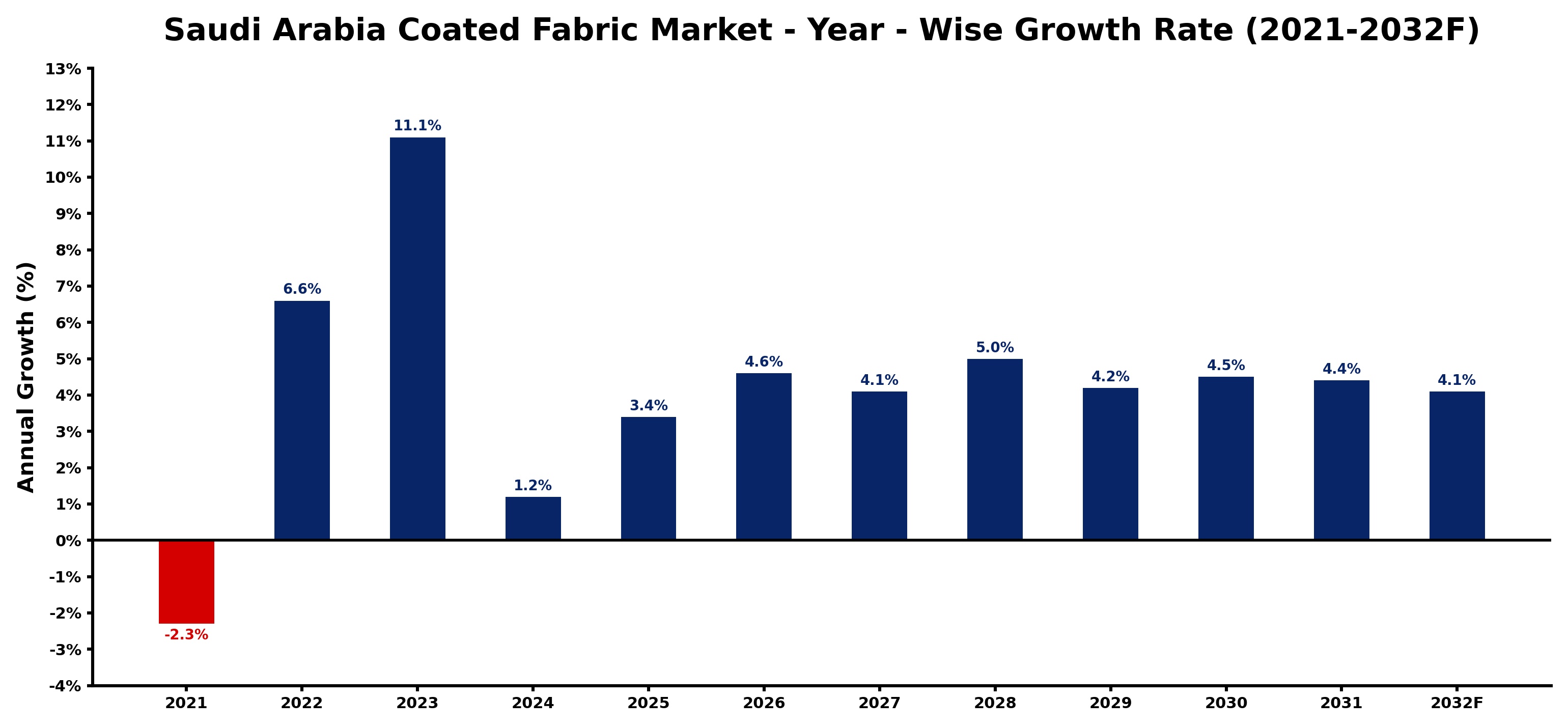
The table below presents the year‑wise growth rates along with the key drivers influencing the market
| Year | Growth Rate | Major Drivers |
| 2021 | -2.3% | Rapid growth in telecom and data center sectors |
| 2022 | 6.6% | Growing renewable energy integration projects |
| 2023 | 11.1% | Government infrastructure modernization initiatives |
| 2024 | 1.2% | Rising electricity demand across industries |
| 2025 | 3.4% | Growing urbanization and commercial development |
| 2026 | 4.6% | Expansion of transportation and logistics networks |
| 2027 | 4.1% | Growing urbanization and commercial development |
| 2028 | 5.0% | Rapid growth in telecom and data center sectors |
| 2029 | 4.2% | Increasing smart city development projects |
| 2030 | 4.5% | Increasing smart city development projects |
| 2031 | 4.4% | Rapid growth in telecom and data center sectors |
| 2032 | 4.1% | Expansion of manufacturing activities |
Note - Market size estimations and growth projections presented in this report are based on 6Wresearch’s advanced forecasting approach, validated with industry datasets as of June 2026.
Saudi Arabia Coated Fabric Market Synopsis
The current strongest force shaping the Saudi Arabia Coated Fabric Market is the country's industrial growth, particularly in automotive and infrastructure sectors. As urbanization accelerates, the demand for coated fabrics, which provide essential qualities such as weather resistance and durability, is increasing exponentially.
In addition, coated fabrics are witnessing heightened usage in furniture and protective clothing, further amplifying their appeal across multiple industries. Key players in the market are actively working to enhance their product offerings to cater to the evolving needs of manufacturers and consumers alike.
Saudi Arabia Coated Fabric Market Key Takeaways
- The coated fabric market is projected to grow steadily due to increasing demand from the automotive and industrial sectors.
- Coated fabrics are favored for their durability, weather resistance, and aesthetic appeal.
- Post-COVID recovery has led to stabilization in demand across various applications.
- Investment in R&D is essential to improve coating technologies and meet industry standards.
- Competitive pressures from alternative materials and international suppliers are influencing market dynamics.
Evaluation of Restraints in Saudi Arabia Coated Fabric Market
Despite its promising outlook, the Saudi Arabia Coated Fabric Market faces significant restraints. Strict quality control measures and performance specifications are critical, especially in high-demand sectors such as automotive and marine applications. The need for durable, weather-resistant products intensifies competition, not just from local manufacturers but also from international suppliers offering alternative materials. Furthermore, the market must navigate the challenges posed by ever-evolving industrial standards and the necessity for customized solutions, which could impede growth and profitability in the short term.
Saudi Arabia Coated Fabric Market Trends
Several current and emerging trends are shaping the Saudi Arabia Coated Fabric Market. A significant shift towards sustainable practices is driving the development of eco-friendly coated fabrics. Moreover, innovations in coating technologies aim to improve the performance and versatility of products. The integration of smart fabrics, with embedded technologies for enhanced functionality, is also gaining traction. These trends reflect a broader industry push towards higher efficiency, greater safety, and sustainability.
Saudi Arabia Coated Fabric Market Opportunities
There are substantial opportunities for growth within the Saudi Arabia Coated Fabric Market. As the nation continues to invest in infrastructure and urban development projects, the demand for high-quality coated fabrics is set to rise. Additionally, the healthcare sector's growing need for medical textiles presents an avenue for innovation and expansion. Companies focusing on R&D to create specialized, high-performance materials can capture significant market share and cater to evolving customer needs.
Government Initiatives in the Saudi Arabia Coated Fabric Market
The Saudi government has implemented various initiatives to promote industrial growth and diversification, which indirectly support the coated fabric market. Policies aimed at enhancing local manufacturing capabilities and reducing dependency on imports are particularly relevant. Public spending on infrastructure projects, coupled with incentives for businesses investing in technology and innovation, further create a conducive environment for the coated fabric sector to thrive.
Future Insights of the Saudi Arabia Coated Fabric Market
Looking ahead to 2026-2032, the Saudi Arabia Coated Fabric Market is poised for remarkable evolution. With continued industrial growth, particularly in automotive and construction, demand for coated fabrics will rise. Additionally, the market is likely to see a greater emphasis on sustainability, leading to innovations in eco-friendly coating technologies. As companies adapt to changing consumer preferences and regulatory requirements, the landscape will shift, offering ample growth potential and investment opportunities.
Saudi Arabia Coated Fabric Market Latest Developments (May 2025 - June 2026)
Recent developments in the Saudi Arabia Coated Fabric Market indicate a proactive shift toward integrating advanced technologies into manufacturing processes. Innovations are being pursued to enhance product resilience and performance. Additionally, stakeholders are focusing on partnerships and collaborations to leverage shared knowledge and expertise, thereby responding more effectively to market demands and challenges.
Saudi Arabia Coated Fabric Market - Key Attractiveness of the Report
- 10 Years of Market Numbers
- Historical Data Starting from 2022 to 2025
- Base Year: 2025
- Forecast Data until 2032
- Key Performance Indicators Impacting the Market
- Major Upcoming Developments and Projects
Key Highlights of the Report:
- Saudi Arabia Coated Fabric Market Outlook
- Market Size of Saudi Arabia Coated Fabric Market, 2025
- Forecast of Saudi Arabia Coated Fabric Market, 2032F
- Historical Data and Forecast of Saudi Arabia Coated Fabric Revenues & Volume for the Period 2022-2032F
- Saudi Arabia Coated Fabric Market Trend Evolution
- Saudi Arabia Coated Fabric Market Drivers and Challenges
- Saudi Arabia Coated Fabric Price Trends
- Saudi Arabia Coated Fabric Porter's Five Forces
- Saudi Arabia Coated Fabric Industry Life Cycle
- Historical Data and Forecast of Saudi Arabia Coated Fabric Market Revenues & Volume By Product for the Period 2022-2032F
- Historical Data and Forecast of Saudi Arabia Coated Fabric Market Revenues & Volume By Polymer-coated Fabric for the Period 2022-2032F
- Historical Data and Forecast of Saudi Arabia Coated Fabric Market Revenues & Volume By Rubber-coated Fabric for the Period 2022-2032F
- Historical Data and Forecast of Saudi Arabia Coated Fabric Market Revenues & Volume By Fabric-backed Wall Coverings for the Period 2022-2032F
- Historical Data and Forecast of Saudi Arabia Coated Fabric Market Revenues & Volume By Application for the Period 2022-2032F
- Historical Data and Forecast of Saudi Arabia Coated Fabric Market Revenues & Volume By Transportation for the Period 2022-2032F
- Historical Data and Forecast of Saudi Arabia Coated Fabric Market Revenues & Volume By Protective Clothing for the Period 2022-2032F
- Historical Data and Forecast of Saudi Arabia Coated Fabric Market Revenues & Volume By Industrial for the Period 2022-2032F
- Historical Data and Forecast of Saudi Arabia Coated Fabric Market Revenues & Volume By Roofing, Awnings & Canopies for the Period 2022-2032F
- Historical Data and Forecast of Saudi Arabia Coated Fabric Market Revenues & Volume By Furniture & Seating for the Period 2022-2032F
- Historical Data and Forecast of Saudi Arabia Coated Fabric Market Revenues & Volume By Others for the Period 2022-2032F
- Saudi Arabia Coated Fabric Import Export Trade Statistics
- Market Opportunity Assessment By Product
- Market Opportunity Assessment By Application
- Saudi Arabia Coated Fabric Top Companies Market Share
- Saudi Arabia Coated Fabric Competitive Benchmarking By Technical and Operational Parameters
- Saudi Arabia Coated Fabric Company Profiles
- Saudi Arabia Coated Fabric Key Strategic Recommendations






































