Saudi Arabia Computer-Aided Manufacturing Market Size & Growth Rate (2026-2032)
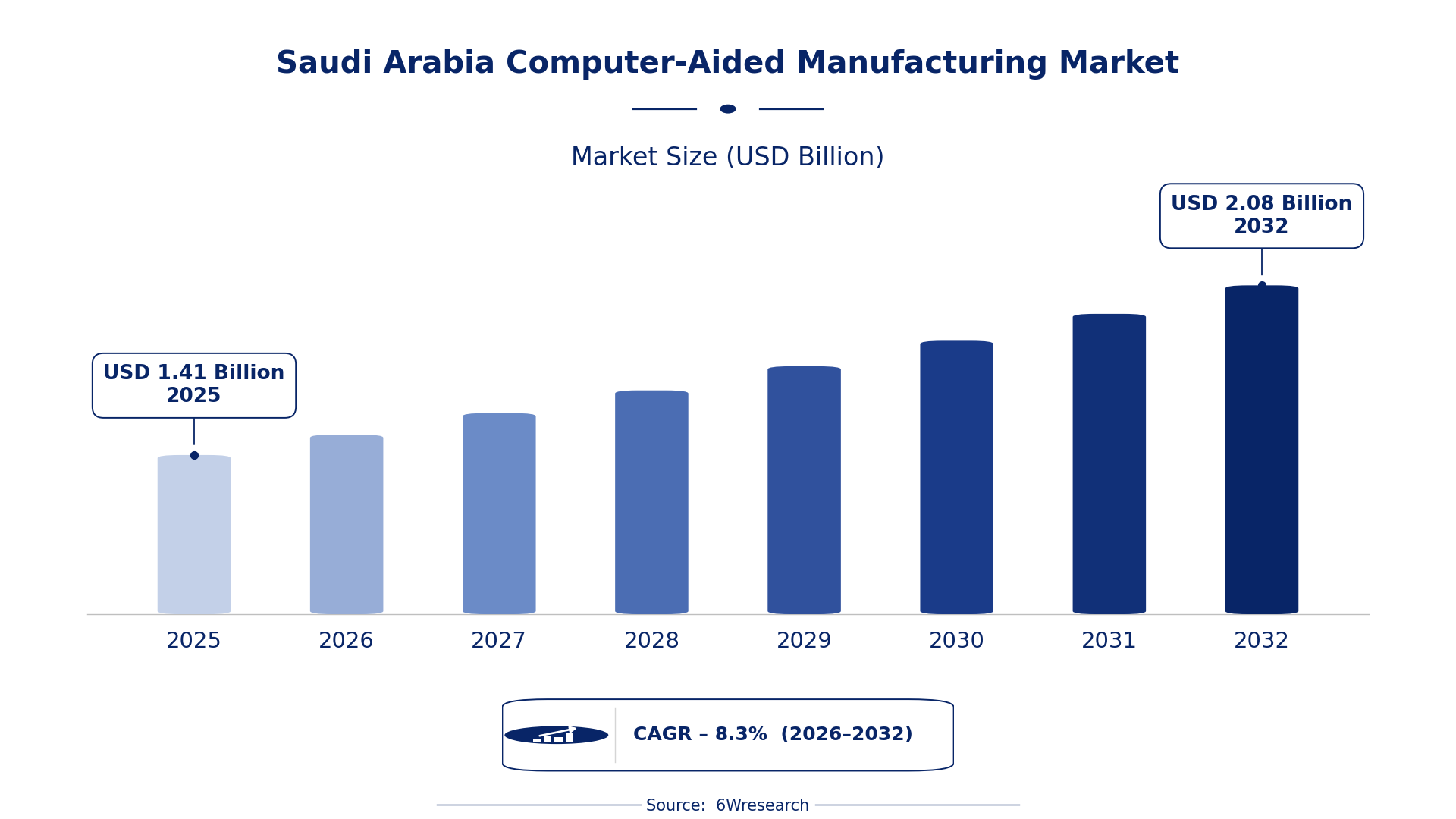
The Saudi Arabia Computer-Aided Manufacturing Market was estimated at USD 1405 Million in 2025 and is projected to reach USD 2078 Million by 2032, growing at a CAGR of 8.3% from 2026 to 2032.
Saudi Arabia Computer-Aided Manufacturing Market Synopsis
In recent years, the Saudi Arabia Computer-Aided Manufacturing market has gained momentum as industries increasingly adopt automation to streamline production. This shift reflects a significant transition towards advanced manufacturing technologies, which are vital for enhancing productivity and quality.
Looking ahead, the market is expected to experience sustained growth, driven by the ongoing demand for precision engineering and cost-effective solutions. As sectors such as aerospace and manufacturing embrace these technologies, the role of computer-aided manufacturing will become increasingly central to operational success.
Saudi Arabia Computer-Aided Manufacturing Market Year-wise Growth Rate and Key Drivers
This graph illustrates the annual growth rates of the Saudi Arabia Computer-Aided Manufacturing Market from 2021 to 2032, highlighting a steady upward trajectory and projected expansion over the forecast period.
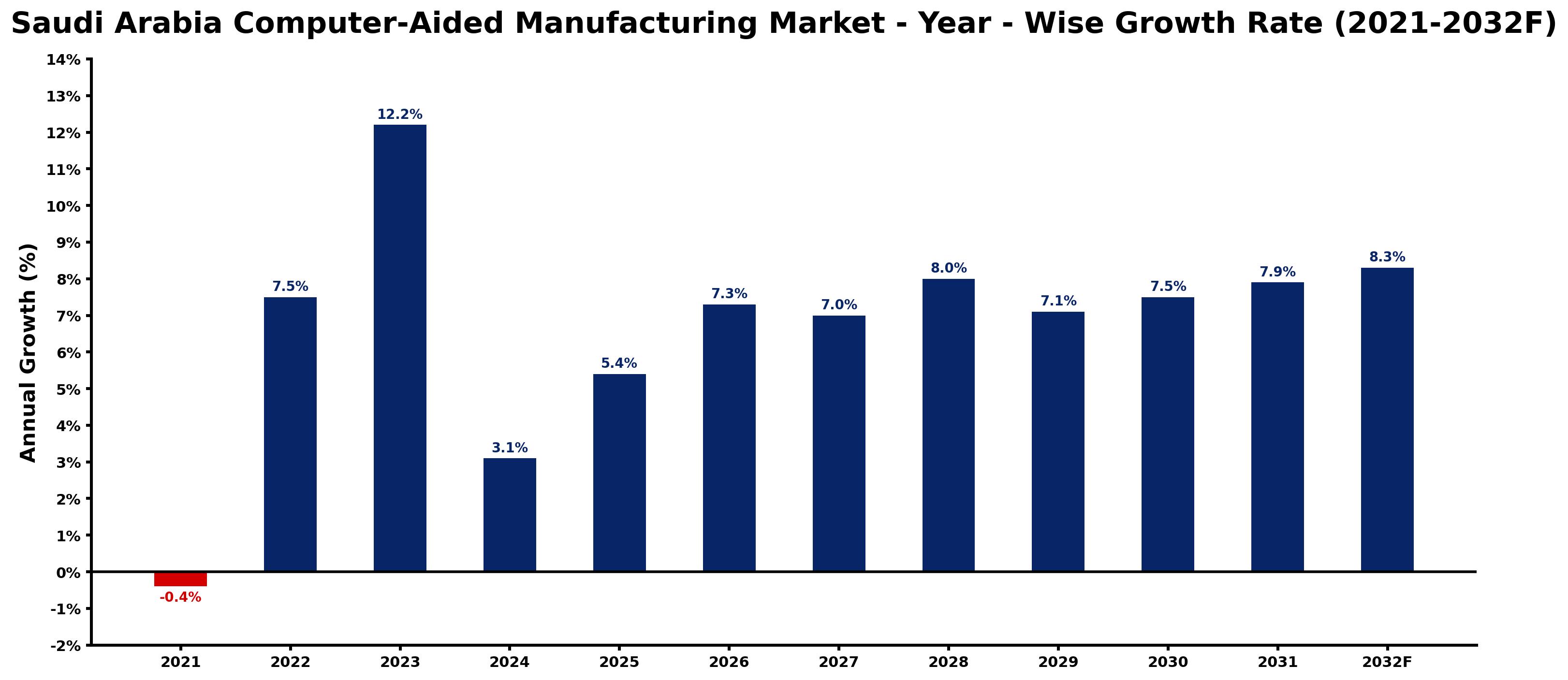
The table below presents the year‑wise growth rates along with the key drivers influencing the market
| Year | Growth Rate | Major Drivers |
| 2021 | -0.4% | Decreased investment due to Vision 2030 budget cuts. |
| 2022 | 7.5% | Vision 2030 drives automation in local manufacturing sector |
| 2023 | 12.2% | Increased foreign investment in Saudi manufacturing initiatives |
| 2024 | 3.1% | Government incentives for digital transformation in industry |
| 2025 | 5.4% | Rise in skilled workforce supporting advanced manufacturing technologies |
| 2026 | 7.3% | Local demand for precision engineering in automotive sector |
| 2027 | 7.0% | Adoption of IoT solutions enhancing manufacturing efficiency |
| 2028 | 8.0% | Need for localized production reducing import dependency |
| 2029 | 7.1% | Emergence of smart factories in industrial zones |
| 2030 | 7.5% | Support from the Saudi Industrial Development Fund |
| 2031 | 7.9% | Collaboration with international tech firms for innovation |
| 2032 | 8.3% | Development of manufacturing hubs in NEOM project |
Note: Market size estimations and growth projections presented in this report are based on 6Wresearch's proprietary forecasting methodology, utilizing the latest available industry data, government publications, and primary research inputs.
Saudi Arabia Computer-Aided Manufacturing Market Key Takeaways
Below are some of the specific key takeaways from the market, including:
- Increasing adoption of CAM solutions is enhancing production efficiency across various industries.
- The push for automation is critical for reducing production costs and minimizing errors.
- Ongoing developments in software capabilities are driving demand for advanced CAM technologies.
- Strategic government initiatives are facilitating the growth of the manufacturing sector.
- Investment in workforce training is essential to maximize the benefits of CAM technologies.
Evaluation of Restraints in Saudi Arabia Computer-Aided Manufacturing Market
Despite its growth trajectory, the Saudi Arabia Computer-Aided Manufacturing market faces several challenges. Key among them is the need for compatibility between CAM software and existing CNC machinery, which can hinder seamless integration. on top of that, many industries still rely on outdated systems, making the transition to more advanced CAM solutions a daunting task. The high costs associated with implementing state-of-the-art CAM technologies can also be a barrier for smaller enterprises, limiting their ability to compete effectively.
Saudi Arabia Computer-Aided Manufacturing Market Trends
Several trends are shaping the Saudi Arabia Computer-Aided Manufacturing market. One notable trend is the increasing emphasis on Industry 4.0 practices, which integrate IoT and AI with traditional manufacturing processes. This shift enables real-time monitoring and optimization of production lines, enhancing overall efficiency.
Another trend is the growing demand for customized manufacturing solutions. As consumer preferences become more diverse, manufacturers are seeking agile CAM systems that can quickly adapt to changing market needs. This flexibility is becoming a key differentiator in a competitive landscape.
Saudi Arabia Computer-Aided Manufacturing Market Opportunities
The Saudi Arabia Computer-Aided Manufacturing market presents several lucrative opportunities for growth and investment. The ongoing modernization of manufacturing facilities creates a demand for advanced CAM solutions that enhance productivity and reduce waste. Additionally, the government's focus on diversifying the economy and fostering innovation in manufacturing opens avenues for partnerships and collaborations in the CAM space.
on top of that, as industries increasingly prioritize sustainability, there is a rising demand for CAM technologies that minimize environmental impact. Companies that can develop eco-friendly manufacturing processes stand to gain a competitive edge.
Government Initiatives in the Saudi Arabia Computer-Aided Manufacturing Market
Government policies are playing a crucial role in shaping the Saudi Arabia Computer-Aided Manufacturing market. The focus on enhancing the manufacturing sector aligns with national goals of economic diversification and technological advancement. Regulatory frameworks are being introduced to promote investment in advanced manufacturing technologies, thereby positioning Saudi Arabia as a competitive player on the global stage.
- A recently launched initiative supports digital transformation across the manufacturing sector, aiming to integrate advanced technologies into traditional practices.
- Current programs are underway to enhance vocational training and education in CAM technologies, ensuring a skilled workforce for the future.
- A planned public-private partnership is expected to develop a state-of-the-art manufacturing innovation center to foster R&D in CAM solutions.
- The government is currently revising regulatory standards to encourage compliance with international manufacturing best practices.
- Future initiatives aim to provide financial incentives for companies investing in green manufacturing technologies.
Future Insights of the Saudi Arabia Computer-Aided Manufacturing Market
From 2026 to 2032, the Saudi Arabia Computer-Aided Manufacturing market is projected to evolve significantly. As industries embrace automation and advanced technologies, the demand for CAM solutions will likely surge. Companies that can adapt to rapid technological changes and focus on innovation will lead the market.
Investment in research and development will be critical, particularly in creating software that integrates seamlessly with existing systems. As the market matures, a focus on sustainability will also drive the adoption of eco-friendly manufacturing practices, further shaping the future of CAM in the Kingdom.
Saudi Arabia Computer-Aided Manufacturing Market Latest Developments
Over the past year, the Saudi Arabia Computer-Aided Manufacturing market has seen notable activity, reflecting an ongoing commitment to modernization and technological adoption. Companies are increasingly investing in advanced CAM solutions to enhance operational efficiency and meet rising consumer demands.
- A leading technology vendor launched a comprehensive CAM software suite in early 2025, designed to improve user experience and streamline production processes.
- An ongoing initiative focuses on developing a network of smart manufacturing facilities across the Kingdom, incorporating cutting-edge CAM technologies.
- A major regional operator is currently upgrading its manufacturing capabilities with advanced CAM tools, aiming to reduce cycle times and improve product quality.
- A planned rollout of an innovative training program for manufacturing professionals is expected to begin in the second half of 2026, aimed at enhancing skills in CAM technologies.
Saudi Arabia Computer-Aided Manufacturing Market - Key Attractiveness of the Report
- 10 Years of Market Numbers
- Historical Data Starting from 2022 to 2025
- Base Year: 2025
- Forecast Data until 2032
- Key Performance Indicators Impacting the Market
- Major Upcoming Developments and Projects
Key Highlights of the Report:
- Saudi Arabia Computer-Aided Manufacturing Market Outlook
- Market Size of Saudi Arabia Computer-Aided Manufacturing Market, 2025
- Forecast of Saudi Arabia Computer-Aided Manufacturing Market, 2032
- Historical Data and Forecast of Saudi Arabia Computer-Aided Manufacturing Revenues & Volume for the Period 2022-2032F
- Saudi Arabia Computer-Aided Manufacturing Market Trend Evolution
- Saudi Arabia Computer-Aided Manufacturing Market Drivers and Challenges
- Saudi Arabia Computer-Aided Manufacturing Price Trends
- Saudi Arabia Computer-Aided Manufacturing Porter's Five Forces
- Saudi Arabia Computer-Aided Manufacturing Industry Life Cycle
- Historical Data and Forecast of Saudi Arabia Computer-Aided Manufacturing Market Revenues & Volume By Component for the Period 2022-2032F
- Historical Data and Forecast of Saudi Arabia Computer-Aided Manufacturing Market Revenues & Volume By Solution for the Period 2022-2032F
- Historical Data and Forecast of Saudi Arabia Computer-Aided Manufacturing Market Revenues & Volume By Services for the Period 2022-2032F
- Historical Data and Forecast of Saudi Arabia Computer-Aided Manufacturing Market Revenues & Volume By Training and education for the Period 2022-2032F
- Historical Data and Forecast of Saudi Arabia Computer-Aided Manufacturing Market Revenues & Volume By Support and maintenance for the Period 2022-2032F
- Historical Data and Forecast of Saudi Arabia Computer-Aided Manufacturing Market Revenues & Volume By Industry Vertical for the Period 2022-2032F
- Historical Data and Forecast of Saudi Arabia Computer-Aided Manufacturing Market Revenues & Volume By Automotive for the Period 2022-2032F
- Historical Data and Forecast of Saudi Arabia Computer-Aided Manufacturing Market Revenues & Volume By Aerospace and Defense for the Period 2022-2032F
- Historical Data and Forecast of Saudi Arabia Computer-Aided Manufacturing Market Revenues & Volume By Industrial Equipment for the Period 2022-2032F
- Historical Data and Forecast of Saudi Arabia Computer-Aided Manufacturing Market Revenues & Volume By High Tech for the Period 2022-2032F
- Historical Data and Forecast of Saudi Arabia Computer-Aided Manufacturing Market Revenues & Volume By Medical Devices and Component for the Period 2022-2032F
- Historical Data and Forecast of Saudi Arabia Computer-Aided Manufacturing Market Revenues & Volume By Energy and Utilities for the Period 2022-2032F
- Historical Data and Forecast of Saudi Arabia Computer-Aided Manufacturing Market Revenues & Volume By Others for the Period 2022-2032F
- Historical Data and Forecast of Saudi Arabia Computer-Aided Manufacturing Market Revenues & Volume By Deployment Type for the Period 2022-2032F
- Historical Data and Forecast of Saudi Arabia Computer-Aided Manufacturing Market Revenues & Volume By On-Premises for the Period 2022-2032F
- Historical Data and Forecast of Saudi Arabia Computer-Aided Manufacturing Market Revenues & Volume By Cloud for the Period 2022-2032F
- Historical Data and Forecast of Saudi Arabia Computer-Aided Manufacturing Market Revenues & Volume By Organization Size for the Period 2022-2032F
- Historical Data and Forecast of Saudi Arabia Computer-Aided Manufacturing Market Revenues & Volume By Large enterprises for the Period 2022-2032F
- Historical Data and Forecast of Saudi Arabia Computer-Aided Manufacturing Market Revenues & Volume By SMEs for the Period 2022-2032F
- Saudi Arabia Computer-Aided Manufacturing Import Export Trade Statistics
- Market Opportunity Assessment By Component
- Market Opportunity Assessment By Industry Vertical
- Market Opportunity Assessment By Deployment Type
- Market Opportunity Assessment By Organization Size
- Saudi Arabia Computer-Aided Manufacturing Top Companies Market Share
- Saudi Arabia Computer-Aided Manufacturing Competitive Benchmarking By Technical and Operational Parameters
- Saudi Arabia Computer-Aided Manufacturing Company Profiles
- Saudi Arabia Computer-Aided Manufacturing Key Strategic Recommendations






































