Saudi Arabia Cultured Meat Market Size, Share & Growth Rate
The Saudi Arabia Cultured Meat Market was estimated at USD 270 Million in 2025 and is projected to reach USD 346 Million by 2032, growing at a CAGR of 3.6% from 2026 to 2032. This promising growth trajectory is fueled by the country's increasing focus on food security and sustainability, as well as a rising consumer demand for ethical and environmentally friendly protein sources. As technological advancements in cellular agriculture continue to progress, the market is expected to gain further momentum, capturing the interest of consumers and investors alike.
Saudi Arabia Cultured Meat Market Year-wise Growth Rate and Key Drivers
This graph highlights how the Saudi Arabia Cultured Meat Market has steadily grown over the years, supported by major growth factors.
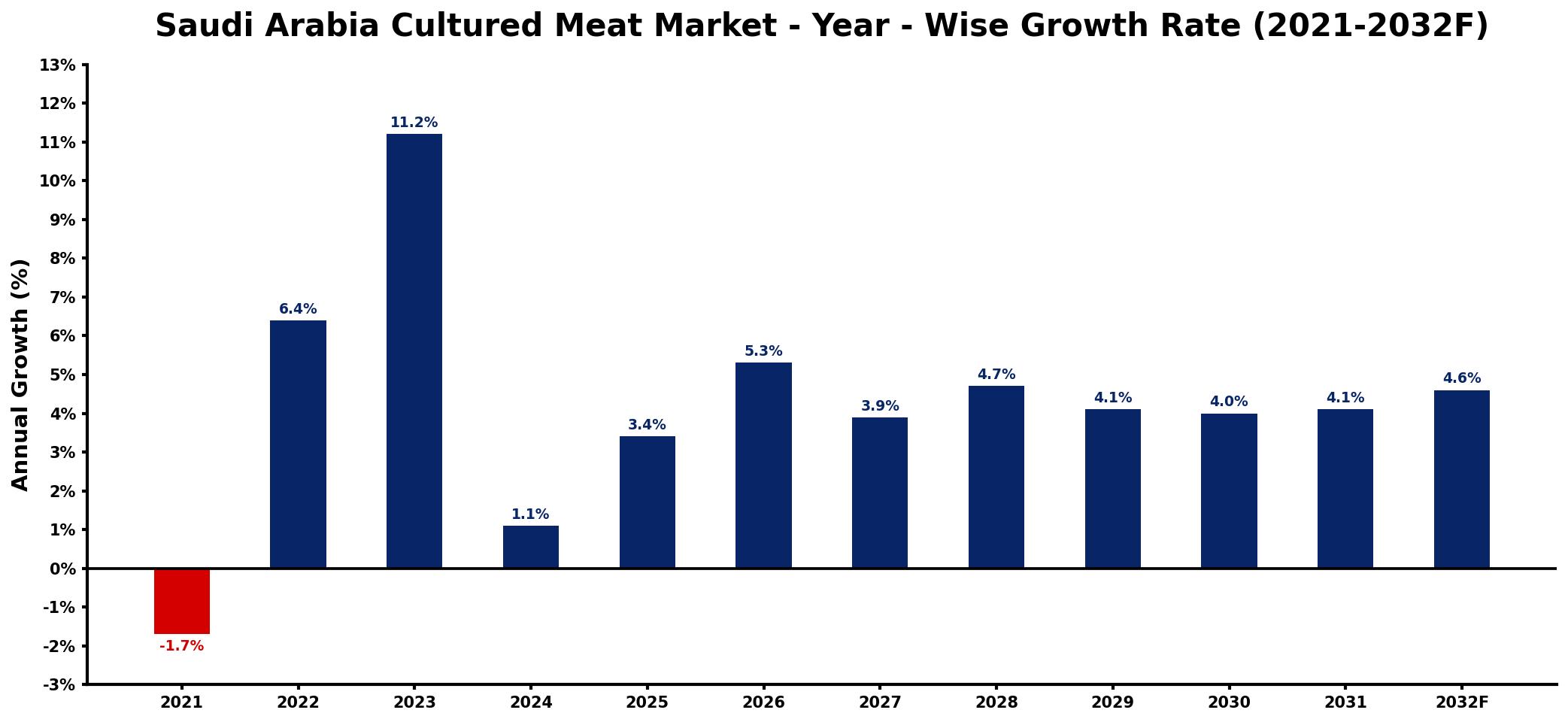
The table below presents the year‑wise growth rates along with the key drivers influencing the market
| Year | Growth Rate | Major Drivers |
| 2021 | -1.7% | Consumer interest in alternatives waned |
| 2022 | 6.4% | Investment in sustainable food systems |
| 2023 | 11.2% | Growing awareness of health benefits |
| 2024 | 1.1% | Increase in production technologies |
| 2025 | 3.4% | Expansion of distribution networks |
| 2026 | 5.3% | Rising demand for innovative proteins |
| 2027 | 3.9% | Consumer acceptance of novel foods |
| 2028 | 4.7% | Increased government support initiatives |
| 2029 | 4.1% | Partnerships with food service providers |
| 2030 | 4.0% | Advancements in regulatory frameworks |
| 2031 | 4.1% | Focus on environmental sustainability practices |
| 2032 | 4.6% | Emergence of new market players |
Note: Market size estimations and growth projections presented in this report are based on 6Wresearch's proprietary forecasting methodology, utilizing the latest available industry data, government publications, and primary research inputs.
Saudi Arabia Cultured Meat Market Synopsis
While the Saudi Arabia cultured meat market is still in its infancy, recent developments indicate a significant shift towards alternative protein sources. The intersection of technology and food production presents new opportunities to redefine meat consumption in the country, which is vital given its rich cultural ties to traditional meat dishes.
As awareness grows about the environmental and ethical challenges posed by conventional meat production, consumers in Saudi Arabia are beginning to embrace lab-grown alternatives. This momentum aligns with national priorities surrounding sustainability, potentially paving the way for a transformative impact on the local food landscape.
Saudi Arabia Cultured Meat Market Key Takeaways
- The market is expected to grow steadily due to increasing consumer awareness about sustainability and animal welfare.
- Technological advancements in cellular agriculture are crucial to enhancing production efficiency and reducing costs.
- Regulatory frameworks will play a vital role in shaping consumer acceptance and safety perceptions of cultured meat.
- The COVID-19 pandemic highlighted the need for resilient food systems, further driving interest in alternative proteins.
- Investor confidence in this emerging sector continues to rise, fostering innovation and new market entrants.
Evaluation of Restraints in Saudi Arabia Cultured Meat Market
Despite its potential, the Saudi Arabia cultured meat market faces several barriers that may impede its growth. One of the significant challenges is consumer skepticism regarding the safety and nutritional profiles of lab-grown meat products. As the concept is still relatively novel, many consumers may harbor concerns about its authenticity and ethical implications. Furthermore, establishing scalable and cost-effective production methods poses technical hurdles that require substantial investment in research and development. It is imperative for stakeholders to focus on transparent communication and robust scientific validation to build trust and drive adoption in the market.
Saudi Arabia Cultured Meat Market Trends
Several current and emerging trends are shaping the Saudi Arabia cultured meat market. The increasing focus on health and nutrition is pushing consumers to seek out alternatives that not only satisfy their dietary needs but also align with their ethical values. Additionally, advancements in biotechnology are enabling more efficient production processes, which may lower costs and improve accessibility. There is also a growing emphasis on food transparency and traceability, with consumers desiring clearer information about where their food comes from and how it is produced. This trend is likely to strengthen the demand for cultured meat as producers work to meet these expectations.
Saudi Arabia Cultured Meat Market Opportunities
The Saudi Arabia cultured meat market presents numerous growth and investment opportunities. As the demand for sustainable food options rises, there is a significant scope for innovation in production technologies and methods. Strategic partnerships between technology firms and food producers can accelerate advancements in cellular agriculture. Additionally, there is potential for the development of local supply chains, which can not only reduce production costs but also enhance food security in the region. Furthermore, educational initiatives aimed at raising awareness about the benefits of cultured meat can foster consumer acceptance and drive market penetration.
Government Initiatives in the Saudi Arabia Cultured Meat Market
The Saudi Arabian government is increasingly recognizing the importance of food security and sustainability, and this is reflected in its policy frameworks and initiatives aimed at promoting alternative protein sources. Public investments in research and development are being directed towards innovative agricultural technologies, including cultured meat. Additionally, regulatory bodies are likely to establish guidelines that support the safe introduction of lab-grown products into the market, fostering consumer trust and acceptance. Overall, governmental support will be crucial in facilitating the growth of the cultured meat sector.
Future Insights of the Saudi Arabia Cultured Meat Market
Looking ahead to the period from 2026 to 2032, the Saudi Arabia cultured meat market is poised for significant evolution. As consumer awareness and acceptance continue to grow, the market is expected to attract more investment, leading to increased innovation and product diversification. Furthermore, advancements in production technologies will likely drive costs down, making cultured meat more competitive with traditional meat. The alignment of market growth with national sustainability goals will create a conducive environment for the establishment of robust supply chains and a flourishing ecosystem around cultured meat.
Saudi Arabia Cultured Meat Market Latest Developments (2025 - 2026)
In recent months, the Saudi Arabia cultured meat market has witnessed notable developments, including collaborations between local startups and international research institutions aimed at accelerating technological advancements in cellular agriculture. Initiatives promoting consumer education and awareness about lab-grown meat are gaining traction, with various campaigns launched to highlight its benefits. Additionally, there have been discussions around regulatory frameworks to facilitate the safe introduction of cultured meat products into the market, reflecting a proactive approach by governmental bodies to embrace this innovative sector.
Saudi Arabia Cultured Meat Market - Key Attractiveness of the Report
- 10 Years of Market Numbers
- Historical Data Starting from 2022 to 2025
- Base Year: 2025
- Forecast Data until 2032
- Key Performance Indicators Impacting the Market
- Major Upcoming Developments and Projects
Key Highlights of the Report:
- Saudi Arabia Cultured Meat Market Outlook
- Market Size of Saudi Arabia Cultured Meat Market, 2025
- Forecast of Saudi Arabia Cultured Meat Market, 2032
- Historical Data and Forecast of Saudi Arabia Cultured Meat Revenues & Volume for the Period 2022-2032F
- Saudi Arabia Cultured Meat Market Trend Evolution
- Saudi Arabia Cultured Meat Market Drivers and Challenges
- Saudi Arabia Cultured Meat Price Trends
- Saudi Arabia Cultured Meat Porter's Five Forces
- Saudi Arabia Cultured Meat Industry Life Cycle
- Historical Data and Forecast of Saudi Arabia Cultured Meat Market Revenues & Volume By Product Type for the Period 2022-2032F
- Historical Data and Forecast of Saudi Arabia Cultured Meat Market Revenues & Volume By Poultry for the Period 2022-2032F
- Historical Data and Forecast of Saudi Arabia Cultured Meat Market Revenues & Volume By Beef for the Period 2022-2032F
- Historical Data and Forecast of Saudi Arabia Cultured Meat Market Revenues & Volume By Seafood for the Period 2022-2032F
- Historical Data and Forecast of Saudi Arabia Cultured Meat Market Revenues & Volume By Pork for the Period 2022-2032F
- Historical Data and Forecast of Saudi Arabia Cultured Meat Market Revenues & Volume By Duck for the Period 2022-2032F
- Historical Data and Forecast of Saudi Arabia Cultured Meat Market Revenues & Volume By End-Use for the Period 2022-2032F
- Historical Data and Forecast of Saudi Arabia Cultured Meat Market Revenues & Volume By Nuggets for the Period 2022-2032F
- Historical Data and Forecast of Saudi Arabia Cultured Meat Market Revenues & Volume By Burgers for the Period 2022-2032F
- Historical Data and Forecast of Saudi Arabia Cultured Meat Market Revenues & Volume By Meatballs for the Period 2022-2032F
- Historical Data and Forecast of Saudi Arabia Cultured Meat Market Revenues & Volume By Sausage for the Period 2022-2032F
- Historical Data and Forecast of Saudi Arabia Cultured Meat Market Revenues & Volume By Hot dogs for the Period 2022-2032F
- Historical Data and Forecast of Saudi Arabia Cultured Meat Market Revenues & Volume By Others for the Period 2022-2032F
- Saudi Arabia Cultured Meat Import Export Trade Statistics
- Market Opportunity Assessment By Product Type
- Market Opportunity Assessment By End-Use
- Saudi Arabia Cultured Meat Top Companies Market Share
- Saudi Arabia Cultured Meat Competitive Benchmarking By Technical and Operational Parameters
- Saudi Arabia Cultured Meat Company Profiles
- Saudi Arabia Cultured Meat Key Strategic Recommendations






































