Saudi Arabia Curtains and Window Blinds Market Size, Share & Growth Rate
The Saudi Arabia Curtains and Window Blinds Market was estimated at USD 433 Million in 2025 and is projected to reach USD 643 Million by 2032, growing at a CAGR of 5.8% from 2026 to 2032. This positive trajectory can be attributed to rapid urbanization, a burgeoning construction sector, and an increasing consumer focus on aesthetic home and office environments. With a growing interest in personalized interior solutions, demand for various styles and materials is expected to flourish.
Saudi Arabia Curtains and Window Blinds Market Year-wise Growth Rate and Key Drivers
This graph highlights how the Saudi Arabia Curtains and Window Blinds Market has steadily grown over the years, supported by major growth factors.
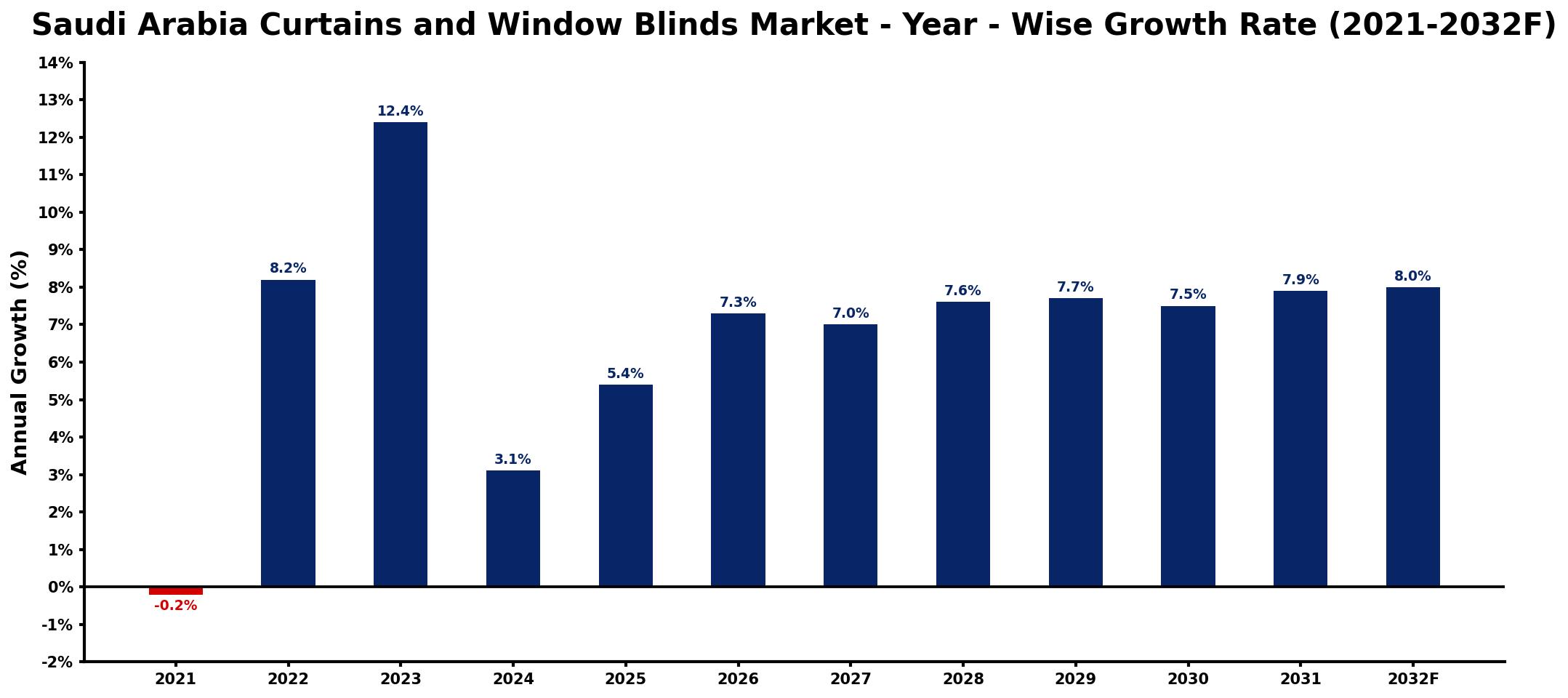
The table below presents the year‑wise growth rates along with the key drivers influencing the market
| Year | Growth Rate | Major Drivers |
| 2021 | -0.2% | Reduced construction project investments |
| 2022 | 8.2% | Increased residential renovation projects |
| 2023 | 12.4% | Rising disposable income levels |
| 2024 | 3.1% | Growth in interior design sector |
| 2025 | 5.4% | Expansion of real estate developments |
| 2026 | 7.3% | Surge in hospitality sector demand |
| 2027 | 7.0% | Enhanced focus on energy efficiency |
| 2028 | 7.6% | Growing trend of smart homes |
| 2029 | 7.7% | Increased urbanization and population |
| 2030 | 7.5% | Rising demand for aesthetic solutions |
| 2031 | 7.9% | increased domestic production output |
| 2032 | 8.0% | Emergence of sustainable materials market |
Note: Market size estimations and growth projections presented in this report are based on 6Wresearch's proprietary forecasting methodology, utilizing the latest available industry data, government publications, and primary research inputs.
Saudi Arabia Curtains and Window Blinds Market Synopsis
In recent years, the Saudi Arabia curtains and window blinds market has experienced notable momentum, driven by shifts in consumer preferences towards home and office aesthetics. Looking ahead, the market is poised for significant growth, propelled by urbanization trends and rising disposable incomes, which enable consumers to invest more in interior décor.
As the market evolves, it showcases an extensive range of offerings catering to diverse consumer demands. The interplay between traditional designs and modern innovation presents both challenges and opportunities, as manufacturers strive to create products that align with contemporary lifestyles while enhancing energy efficiency.
Saudi Arabia Curtains and Window Blinds Market Key Takeaways
- The market is driven by urbanization, increased construction activities, and heightened interest in personalized home aesthetics.
- Demand is influenced by consumer preferences for both functionality and decorative appeal in window treatments.
- Technological advancements are shaping product offerings, particularly concerning energy efficiency and light control.
- COVID-19 led to an initial decline but subsequently boosted interest in home improvement projects, including curtains and window blinds.
- Key players are focusing on innovation and quality to maintain competitive advantage and satisfy market needs.
Evaluation of Restraints in Saudi Arabia Curtains and Window Blinds Market
Despite its growth potential, the Saudi Arabia curtains and window blinds market faces significant restraints. One major concern is the need for products that effectively balance aesthetics and energy efficiency. Many consumers remain unaware of the benefits of energy-efficient designs, which can lead to hesitance in adopting advanced window treatment solutions. Additionally, fluctuating raw material costs and supply chain challenges may impact product availability and pricing, further complicating market dynamics.
Saudi Arabia Curtains and Window Blinds Market Trends
Current trends in the Saudi Arabia curtains and window blinds market reflect a growing inclination towards sustainable and smart window treatment solutions. Consumers are increasingly seeking options that integrate technology, enabling remote control and enhanced light management. Furthermore, a preference for natural materials and eco-friendly products is influencing design choices, steering the market toward more environmentally conscious offerings. Artistic customization is also gaining traction, as consumers strive to reflect personal style within their spaces.
Saudi Arabia Curtains and Window Blinds Market Opportunities
Opportunities for growth within the Saudi Arabia curtains and window blinds market lie in product innovation and the expansion of distribution channels. The increasing focus on smart home technologies presents a significant avenue for manufacturers to differentiate their offerings. Additionally, tapping into the commercial sector, including offices and hospitality venues, can drive substantial revenue growth. The burgeoning interest in bespoke designs also provides fertile ground for businesses willing to invest in customization capabilities.
Government Initiatives in the Saudi Arabia Curtains and Window Blinds Market
Government initiatives aimed at stimulating economic growth, particularly in construction and real estate, indirectly benefit the curtains and window blinds market. Public spending on infrastructure and housing projects creates a favorable environment for product demand. Moreover, programs encouraging sustainable development can bolster interest in energy-efficient window treatments, aligning with broader national goals for environmental responsibility.
Future Insights of the Saudi Arabia Curtains and Window Blinds Market
Looking forward to 2026-2032, the Saudi Arabia curtains and window blinds market is expected to flourish, driven by ongoing urbanization and a robust real estate sector. The rising demand for smart home products will likely lead to innovations that enhance energy efficiency and user convenience. Additionally, as consumers become increasingly design-conscious, the focus on customization will intensify, pushing manufacturers to adapt to evolving preferences while maintaining high standards of quality and sustainability.
Saudi Arabia Curtains and Window Blinds Market Latest Developments (2025 - 2026)
Recent developments in the Saudi Arabia curtains and window blinds market highlight a shift towards eco-friendly materials and smart technologies. Innovations in product design are emerging, responding to consumer demand for sustainable options. Additionally, manufacturers are expanding their online presence to cater to a growing segment of tech-savvy consumers seeking convenience in purchasing. Collaborative efforts to enhance supply chain resilience are also underway, aiming to mitigate previous disruptions and improve product availability.
Saudi Arabia Curtains and Window Blinds Market - Key Attractiveness of the Report
- 10 Years of Market Numbers
- Historical Data Starting from 2022 to 2025
- Base Year: 2025
- Forecast Data until 2032
- Key Performance Indicators Impacting the Market
- Major Upcoming Developments and Projects
Key Highlights of the Report:
- Saudi Arabia Curtains and Window Blinds Market Outlook
- Market Size of Saudi Arabia Curtains and Window Blinds Market, 2025
- Forecast of Saudi Arabia Curtains and Window Blinds Market, 2032
- Historical Data and Forecast of Saudi Arabia Curtains and Window Blinds Revenues & Volume for the Period 2022-2032F
- Saudi Arabia Curtains and Window Blinds Market Trend Evolution
- Saudi Arabia Curtains and Window Blinds Market Drivers and Challenges
- Saudi Arabia Curtains and Window Blinds Price Trends
- Saudi Arabia Curtains and Window Blinds Porter's Five Forces
- Saudi Arabia Curtains and Window Blinds Industry Life Cycle
- Historical Data and Forecast of Saudi Arabia Curtains and Window Blinds Market Revenues & Volume By Materials for the Period 2022-2032F
- Historical Data and Forecast of Saudi Arabia Curtains and Window Blinds Market Revenues & Volume By Curtains (Cotton, Linen, Polyester) for the Period 2022-2032F
- Historical Data and Forecast of Saudi Arabia Curtains and Window Blinds Market Revenues & Volume By Window Blinds (Cotton, Linen, Wood, PVC, Metal) for the Period 2022-2032F
- Historical Data and Forecast of Saudi Arabia Curtains and Window Blinds Market Revenues & Volume By Product for the Period 2022-2032F
- Historical Data and Forecast of Saudi Arabia Curtains and Window Blinds Market Revenues & Volume By Curtains (Box pleat curtains, Pinch pleat curtains & drapery, Goblet pleat curtains & drapery, Eyelet curtains & drapery) for the Period 2022-2032F
- Historical Data and Forecast of Saudi Arabia Curtains and Window Blinds Market Revenues & Volume By Window Blinds (Window Shades,, Window Screens, Connected) for the Period 2022-2032F
- Historical Data and Forecast of Saudi Arabia Curtains and Window Blinds Market Revenues & Volume By Distribution Channel for the Period 2022-2032F
- Historical Data and Forecast of Saudi Arabia Curtains and Window Blinds Market Revenues & Volume By B2B for the Period 2022-2032F
- Historical Data and Forecast of Saudi Arabia Curtains and Window Blinds Market Revenues & Volume By B2C for the Period 2022-2032F
- Historical Data and Forecast of Saudi Arabia Curtains and Window Blinds Market Revenues & Volume By E-commerce for the Period 2022-2032F
- Historical Data and Forecast of Saudi Arabia Curtains and Window Blinds Market Revenues & Volume By Price Range for the Period 2022-2032F
- Historical Data and Forecast of Saudi Arabia Curtains and Window Blinds Market Revenues & Volume By High for the Period 2022-2032F
- Historical Data and Forecast of Saudi Arabia Curtains and Window Blinds Market Revenues & Volume By Medium for the Period 2022-2032F
- Historical Data and Forecast of Saudi Arabia Curtains and Window Blinds Market Revenues & Volume By Low for the Period 2022-2032F
- Saudi Arabia Curtains and Window Blinds Import Export Trade Statistics
- Market Opportunity Assessment By Materials
- Market Opportunity Assessment By Product
- Market Opportunity Assessment By Distribution Channel
- Market Opportunity Assessment By Price Range
- Saudi Arabia Curtains and Window Blinds Top Companies Market Share
- Saudi Arabia Curtains and Window Blinds Competitive Benchmarking By Technical and Operational Parameters
- Saudi Arabia Curtains and Window Blinds Company Profiles
- Saudi Arabia Curtains and Window Blinds Key Strategic Recommendations






































