Saudi Arabia Digital Signature Market Size & Growth Rate (2026-2032)
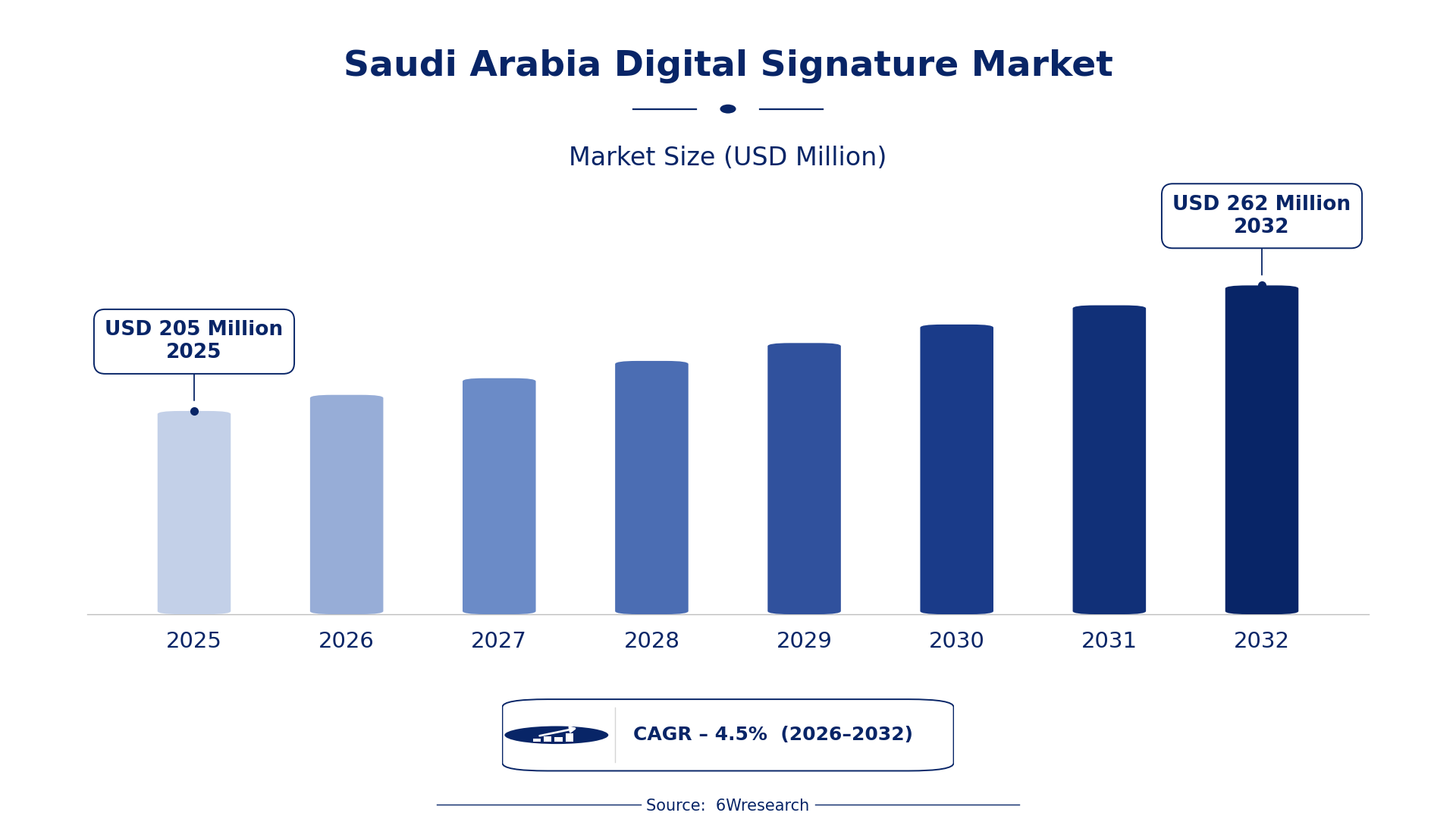
The Saudi Arabia Digital Signature Market was estimated at USD 205 Million in 2025 and is projected to reach USD 262 Million by 2032, growing at a CAGR of 4.5% from 2026 to 2032.
Saudi Arabia Digital Signature Market Synopsis
The strongest force currently shaping the Saudi Arabia Digital Signature Market is the push towards digital transformation across public and private sectors. Organizations are increasingly recognizing the need for secure electronic transactions to enhance operational efficiency and reduce reliance on paper-based processes.
As remote working becomes the norm, the adoption of digital signatures is becoming critical for facilitating secure communications. This growth is further supported by government initiatives aimed at promoting e-government services, indicating a shift in how digital signatures are viewed within the context of national digital infrastructure.
Saudi Arabia Digital Signature Market Year-wise Growth Rate and Key Drivers
This graph illustrates the annual growth rates of the Saudi Arabia Digital Signature Market from 2021 to 2032, highlighting a steady upward trajectory and projected expansion over the forecast period.
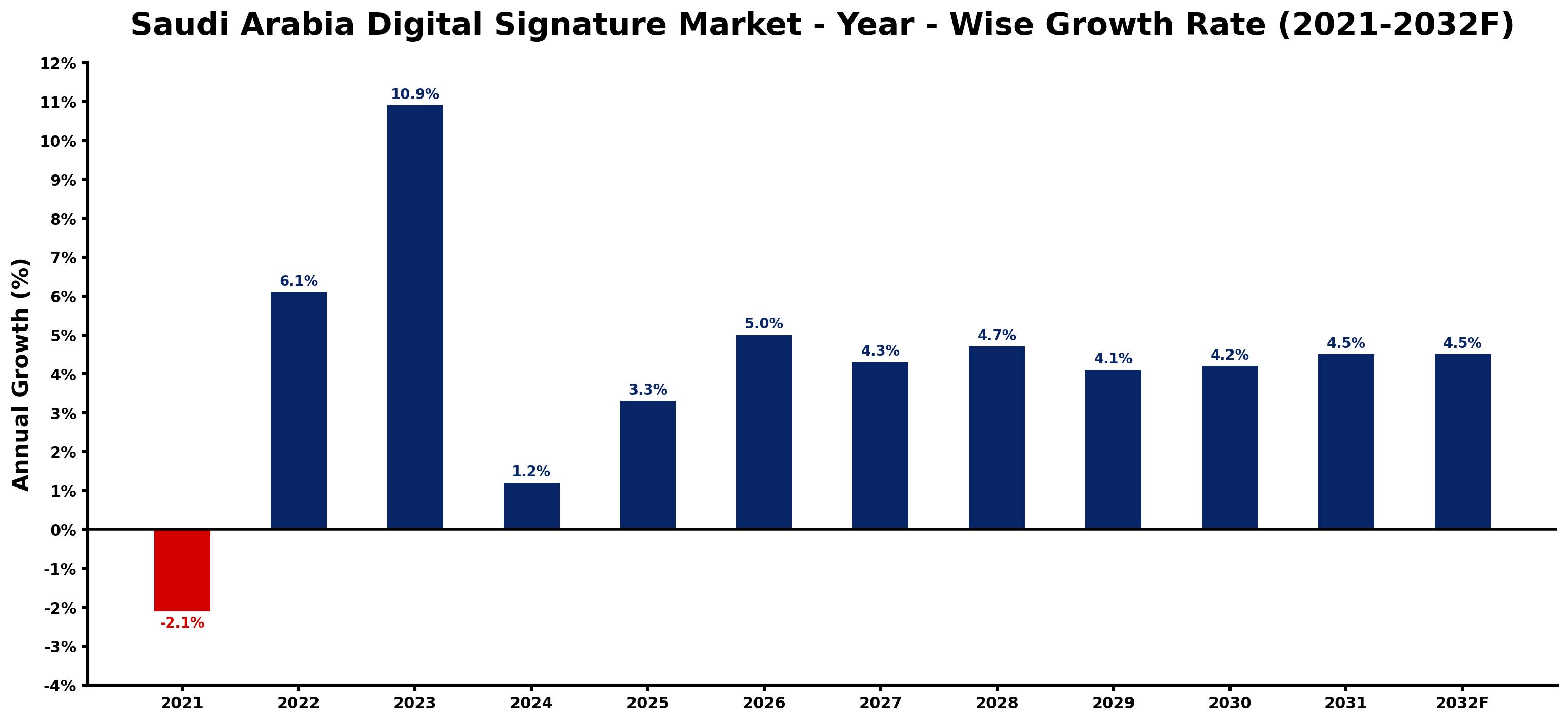
The table below presents the year‑wise growth rates along with the key drivers influencing the market
| Year | Growth Rate | Major Drivers |
| 2021 | -2.1% | Delayed adoption due to strict cybersecurity regulations in Saudi Arabia. |
| 2022 | 6.1% | National Digital Transformation Strategy boosts digital document use |
| 2023 | 10.9% | Increased e-government services drive demand for secure signatures |
| 2024 | 1.2% | Cybersecurity regulations enforce e-signature compliance standards |
| 2025 | 3.3% | Enhanced mobile access to digital signing applications emerging |
| 2026 | 5.0% | Growth in fintech sector requires robust digital transaction tools |
| 2027 | 4.3% | Rising adoption of cloud services supports digital signature growth |
| 2028 | 4.7% | Local businesses digitalizing to align with Vision 2030 goals |
| 2029 | 4.1% | Regulatory push for electronic contracts enhances market traction |
| 2030 | 4.2% | Increased consumer trust in digital interactions fuels adoption |
| 2031 | 4.5% | Collaboration platforms demand seamless digital authentication solutions |
| 2032 | 4.5% | Regulatory framework solidifies standards for digital signatures |
Note: Market size estimations and growth projections presented in this report are based on 6Wresearch's proprietary forecasting methodology, utilizing the latest available industry data, government publications, and primary research inputs.
Saudi Arabia Digital Signature Market Key Takeaways
Below are some of the specific key takeaways from the market, including:
- The market is expanding due to the increasing demand for remote and contactless transactions.
- Government initiatives are crucial in promoting digital transformation and e-government services.
- Businesses are seeking to streamline operations and enhance security through digital signatures.
- Trust and regulatory compliance remain central issues affecting market growth.
- Post-COVID, the reliance on digital signatures has increased significantly among organizations.
Evaluation of Restraints in Saudi Arabia Digital Signature Market
Despite the promising growth trajectory, the Saudi Arabia Digital Signature Market faces several notable restraints. One of the primary challenges is the relatively slow adoption rate among smaller organizations, which often lack the resources or technical know-how to implement these solutions. Additionally, regulatory compliance can be a complex barrier, as organizations must navigate various legal frameworks to ensure their digital signatures are recognized and enforceable. Trust and security concerns also linger, with potential users often wary of fully transitioning to digital solutions without clear guarantees of safety and authenticity.
Saudi Arabia Digital Signature Market Trends
A key trend in the Saudi Arabia Digital Signature Market is the integration of advanced technologies such as artificial intelligence and blockchain to enhance security and streamline the signing process. Many organizations are exploring how these technologies can automate document verification and improve audit trails. Additionally, there is a notable shift towards user-friendly platforms that simplify the signing process for individuals and businesses alike. With a heightened focus on regulatory compliance, digital signatures are increasingly being embedded within broader digital transformation initiatives.
Saudi Arabia Digital Signature Market Opportunities
The demand for digital signatures presents numerous growth opportunities, particularly in sectors such as finance, healthcare, and legal services, where secure document handling is essential. Investment in educational programs to raise awareness about digital signature technologies can also foster greater adoption, particularly among small and medium-sized enterprises. Furthermore, collaborations between private sector players and government entities could pave the way for innovative solutions tailored to the unique needs of the Saudi market, enhancing both accessibility and reliability of digital signature solutions.
Government Initiatives in the Saudi Arabia Digital Signature Market
The Saudi government is actively fostering a conducive environment for the Digital Signature Market through a range of strategic initiatives. With a strong emphasis on digital transformation, the government is keen on establishing a regulatory framework that supports the adoption of digital signatures across various sectors. This focus on modernization is crucial for ensuring that digital signatures are recognized as valid, trustworthy, and integral to the Kingdom’s e-government services.
- A recently completed initiative involved the introduction of a regulatory framework in 2025 that mandates electronic signatures in specific government processes.
- Current ongoing efforts include the rollout of a national digital infrastructure upgrade program aimed at enhancing the security of electronic transactions.
- A planned public-private partnership is expected to launch by 2028, focusing on creating tailored solutions for small businesses to utilize digital signatures effectively.
- In 2026, the government is set to evaluate the impact of digital signature technologies on public sector efficiency as part of a broader e-government strategy.
- Workshops and training sessions are currently being conducted to raise awareness and understanding of digital signatures among enterprises.
Future Insights of the Saudi Arabia Digital Signature Market
Looking ahead to 2026-2032, the Saudi Arabia Digital Signature Market is expected to witness steady growth as more organizations adopt digital solutions. The increasing regulatory push towards paperless operations will likely create a favorable environment for digital signatures. Enhanced cybersecurity measures and advancements in technology will also contribute to building trust in these solutions, encouraging wider acceptance. As businesses and government agencies increasingly prioritize secure electronic transactions, the role of digital signatures will become more prominent in facilitating secure operations.
Saudi Arabia Digital Signature Market Latest Developments
In the past year, the Saudi Arabia Digital Signature Market has experienced a surge in activity driven by the demand for secure electronic solutions. Organizations are rapidly deploying digital signature technologies to accommodate the evolving needs of remote work and secure transactions. This trend reflects a broader shift towards digitalization across sectors, underscoring the growing recognition of the importance of secure electronic communications.
- A major technology vendor launched an upgraded digital signature solution in Q1 2025, enhancing security features and user experience.
- In mid-2025, an initiative to partner with leading financial institutions to offer integrated digital signature services was announced and remains underway.
- A regional operator is currently expanding its digital signature platform, with a rollout expected to begin in late 2026.
- A new collaborative project aimed at developing a standardized digital signature protocol across government departments was initiated in early 2025.
- By mid-2026, a major tech firm plans to release a cloud-based digital signature service designed to enhance accessibility for small businesses.
Saudi Arabia Digital Signature Market - Key Attractiveness of the Report
- 10 Years of Market Numbers
- Historical Data Starting from 2022 to 2025
- Base Year: 2025
- Forecast Data until 2032
- Key Performance Indicators Impacting the Market
- Major Upcoming Developments and Projects
Key Highlights of the Report:
- Saudi Arabia Digital Signature Market Outlook
- Market Size of Saudi Arabia Digital Signature Market, 2025
- Forecast of Saudi Arabia Digital Signature Market, 2032
- Historical Data and Forecast of Saudi Arabia Digital Signature Revenues & Volume for the Period 2022-2032F
- Saudi Arabia Digital Signature Market Trend Evolution
- Saudi Arabia Digital Signature Market Drivers and Challenges
- Saudi Arabia Digital Signature Price Trends
- Saudi Arabia Digital Signature Porter's Five Forces
- Saudi Arabia Digital Signature Industry Life Cycle
- Historical Data and Forecast of Saudi Arabia Digital Signature Market Revenues & Volume By Component for the Period 2022-2032F
- Historical Data and Forecast of Saudi Arabia Digital Signature Market Revenues & Volume By Solutions for the Period 2022-2032F
- Historical Data and Forecast of Saudi Arabia Digital Signature Market Revenues & Volume By Services for the Period 2022-2032F
- Historical Data and Forecast of Saudi Arabia Digital Signature Market Revenues & Volume By Solution for the Period 2022-2032F
- Historical Data and Forecast of Saudi Arabia Digital Signature Market Revenues & Volume By Software for the Period 2022-2032F
- Historical Data and Forecast of Saudi Arabia Digital Signature Market Revenues & Volume By Hardware for the Period 2022-2032F
- Historical Data and Forecast of Saudi Arabia Digital Signature Market Revenues & Volume By Vertical for the Period 2022-2032F
- Historical Data and Forecast of Saudi Arabia Digital Signature Market Revenues & Volume By BFSI for the Period 2022-2032F
- Historical Data and Forecast of Saudi Arabia Digital Signature Market Revenues & Volume By Government for the Period 2022-2032F
- Historical Data and Forecast of Saudi Arabia Digital Signature Market Revenues & Volume By Defense for the Period 2022-2032F
- Historical Data and Forecast of Saudi Arabia Digital Signature Market Revenues & Volume By Legal for the Period 2022-2032F
- Historical Data and Forecast of Saudi Arabia Digital Signature Market Revenues & Volume By Real Estate for the Period 2022-2032F
- Historical Data and Forecast of Saudi Arabia Digital Signature Market Revenues & Volume By Organization Size for the Period 2022-2032F
- Historical Data and Forecast of Saudi Arabia Digital Signature Market Revenues & Volume By Large Enterprises for the Period 2022-2032F
- Historical Data and Forecast of Saudi Arabia Digital Signature Market Revenues & Volume By Small and Medium-Sized Enterprises (SMEs) for the Period 2022-2032F
- Historical Data and Forecast of Saudi Arabia Digital Signature Market Revenues & Volume By Deployment Mode for the Period 2022-2032F
- Historical Data and Forecast of Saudi Arabia Digital Signature Market Revenues & Volume By Cloud for the Period 2022-2032F
- Historical Data and Forecast of Saudi Arabia Digital Signature Market Revenues & Volume By On-Premises for the Period 2022-2032F
- Saudi Arabia Digital Signature Import Export Trade Statistics
- Market Opportunity Assessment By Component
- Market Opportunity Assessment By Solution
- Market Opportunity Assessment By Vertical
- Market Opportunity Assessment By Organization Size
- Market Opportunity Assessment By Deployment Mode
- Saudi Arabia Digital Signature Top Companies Market Share
- Saudi Arabia Digital Signature Competitive Benchmarking By Technical and Operational Parameters
- Saudi Arabia Digital Signature Company Profiles
- Saudi Arabia Digital Signature Key Strategic Recommendations






































