Saudi Arabia Dill Seed Oil Market Size, Share & Growth Rate
The Saudi Arabia Dill Seed Oil Market was estimated at USD 159 Million in 2025 and is projected to reach USD 202 Million by 2032, growing at a CAGR of 3.5% from 2026 to 2032. This upward trajectory reflects a growing demand, driven by increasing applications across culinary and wellness sectors. The shift towards natural and functional ingredients in food products and beverages underpins this growth, coupled with a rising consumer interest in aromatherapy and herbal medicine.
Saudi Arabia Dill Seed Oil Market Year-wise Growth Rate and Key Drivers
This graph highlights how the Saudi Arabia Dill Seed Oil Market has steadily grown over the years, supported by major growth factors.
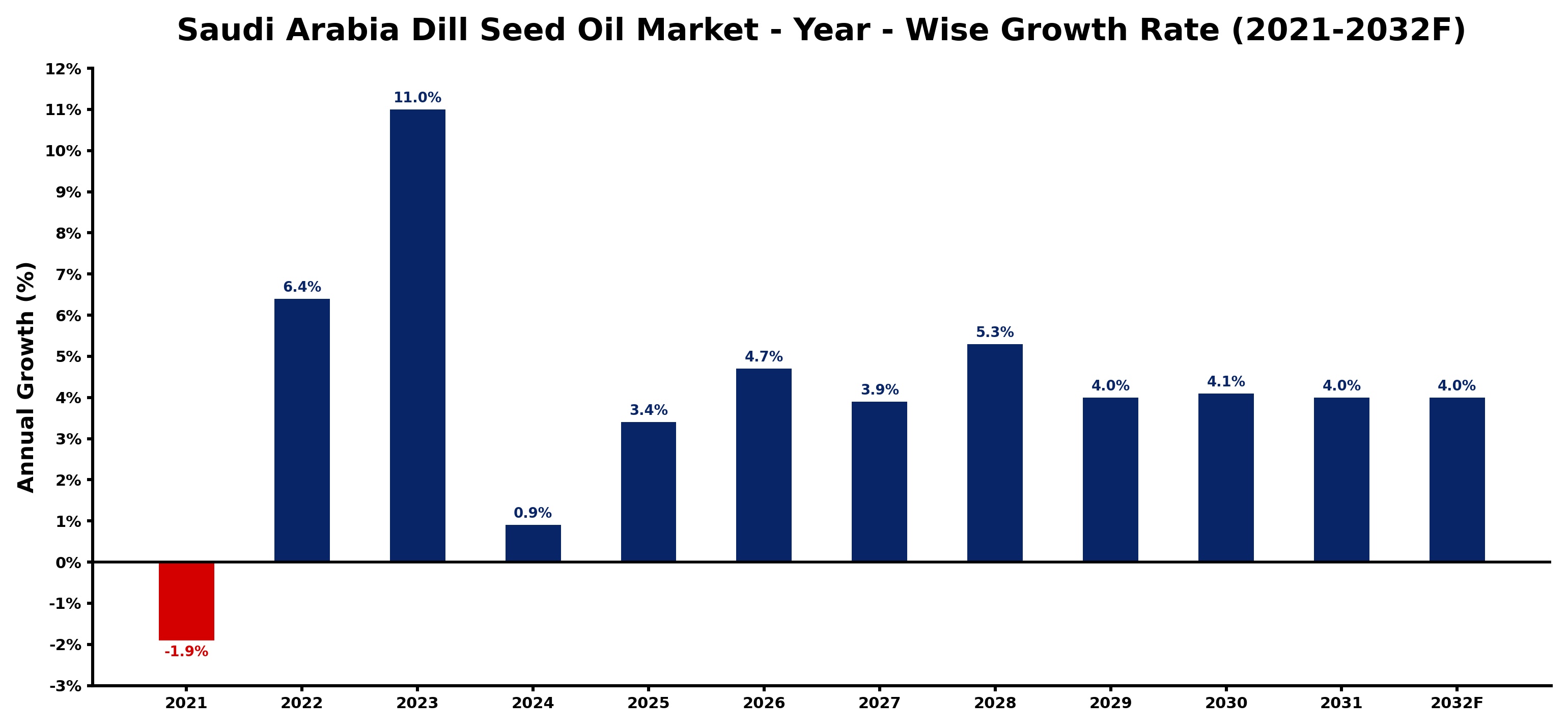
The table below presents the year‑wise growth rates along with the key drivers influencing the market
| Year | Growth Rate | Major Drivers |
| 2021 | -1.9% | Expansion of manufacturing activities |
| 2022 | 6.4% | Increasing industrial infrastructure investments |
| 2023 | 11.0% | Government infrastructure modernization initiatives |
| 2024 | 0.9% | Government infrastructure modernization initiatives |
| 2025 | 3.4% | Rising electricity demand across industries |
| 2026 | 4.7% | Expansion of transportation and logistics networks |
| 2027 | 3.9% | Increasing smart city development projects |
| 2028 | 5.3% | Government infrastructure modernization initiatives |
| 2029 | 4.0% | Increasing industrial automation investments |
| 2030 | 4.1% | Increasing smart city development projects |
| 2031 | 4.0% | Increasing adoption of advanced technologies |
| 2032 | 4.0% | Increasing industrial automation investments |
Note - Market size estimations and growth projections presented in this report are based on 6Wresearch’s advanced forecasting approach, validated with industry datasets as of June 2026.
Saudi Arabia Dill Seed Oil Market Synopsis
In recent years, the Saudi Arabia dill seed oil market has experienced notable growth, propelled by the culinary and wellness industries' demand for high-quality natural ingredients. Looking ahead, this market is poised for further expansion as culinary trends lean toward authentic flavors and consumers increasingly seek health-oriented products.
As the population becomes more health-conscious, the need for functional ingredients in food and beverages will continue to shape the market landscape. Furthermore, the rise of the aromatherapy trend suggests that dill seed oil's aromatic properties will remain in demand, ensuring a robust market environment.
Saudi Arabia Dill Seed Oil Market Key Takeaways
- The Saudi Arabia dill seed oil market is driven by applications in culinary, flavoring, and pharmaceuticals.
- Increasing health awareness among consumers boosts demand for natural flavoring agents.
- High-purity and responsibly sourced dill seed oil is essential for market growth.
- Aromatherapy and herbal medicine sectors are significant contributors to market demand.
- Logistical challenges and quality assurance are key considerations for market players.
Evaluation of Restraints in Saudi Arabia Dill Seed Oil Market
Despite the potential for growth, the Saudi Arabia dill seed oil market faces several restraints that could impede its expansion. The strict quality and safety standards set by regulatory bodies necessitate that manufacturers ensure their products meet high purity levels. As consumers become increasingly discerning, concerns around authenticity and the sourcing of dill seed oil must be addressed to maintain trust and credibility. Additionally, competition from alternative flavoring agents complicates the market landscape, potentially impacting market share for dill seed oil.
Saudi Arabia Dill Seed Oil Market Trends
Current trends indicate a strong inclination towards organic and sustainably sourced dill seed oil, driven by a consumer preference for transparency and quality. The expansion of the health and wellness sector in Saudi Arabia further enhances the appeal of herbal and natural products. Moreover, innovations in extraction methods and packaging are likely to improve product offerings, making them more attractive to both manufacturers and consumers. The integration of dill seed oil into various wellness products, including dietary supplements and cosmetics, is gaining momentum, further broadening its market footprint.
Saudi Arabia Dill Seed Oil Market Opportunities
The Saudi Arabia dill seed oil market presents numerous growth opportunities for stakeholders. As the demand for natural and organic ingredients continues to escalate, businesses can invest in the cultivation of dill seeds under controlled conditions to ensure high-quality oil production. Additionally, partnerships with food and beverage companies can facilitate broader distribution channels, enhancing market accessibility. Furthermore, increasing consumer interest in DIY wellness products opens avenues for innovative product development that leverages dill seed oil's health benefits.
Government Initiatives in the Saudi Arabia Dill Seed Oil Market
The Saudi Arabian government actively promotes initiatives aimed at bolstering the agriculture and food sectors. Policies focused on enhancing local production capabilities and ensuring quality standards align with market requirements. Additionally, programs encouraging the use of natural ingredients in food and wellness products support the growth of the dill seed oil market. These initiatives are designed to foster innovation and sustainability, ultimately benefiting both producers and consumers.
Future Insights of the Saudi Arabia Dill Seed Oil Market
Looking ahead to the 2026-2032 period, the Saudi Arabia dill seed oil market is expected to sustain its growth momentum, fueled by the ongoing trends in health and wellness. As consumers continue to prioritize natural flavoring agents in their diets, the market for dill seed oil will likely expand, supported by the development of new applications across various sectors. Enhanced distribution networks will be crucial in ensuring product availability, while ongoing efforts to promote sustainable practices will resonate well with the increasingly eco-conscious consumer base.
Saudi Arabia Dill Seed Oil Market Latest Developments (May 2025 - June 2026)
Recent developments within the Saudi Arabia dill seed oil market indicate a shift towards more sustainable production practices and an emphasis on product quality. Various industry players are beginning to adopt advanced extraction techniques that preserve the oil's integrity while ensuring higher purity levels. In addition, strategic collaborations among manufacturers and health product companies are emerging, focusing on innovative applications of dill seed oil in dietary supplements and health foods. The market is also witnessing a surge in consumer education initiatives aimed at increasing awareness of the benefits associated with dill seed oil.
Saudi Arabia Dill Seed Oil Market - Key Attractiveness of the Report
- 10 Years of Market Numbers
- Historical Data Starting from 2022 to 2025
- Base Year: 2025
- Forecast Data until 2032
- Key Performance Indicators Impacting the Market
- Major Upcoming Developments and Projects
Key Highlights of the Report:
- Saudi Arabia Dill Seed Oil Market Outlook
- Market Size of Saudi Arabia Dill Seed Oil Market, 2025
- Forecast of Saudi Arabia Dill Seed Oil Market, 2032
- Historical Data and Forecast of Saudi Arabia Dill Seed Oil Revenues & Volume for the Period 2022-2032F
- Saudi Arabia Dill Seed Oil Market Trend Evolution
- Saudi Arabia Dill Seed Oil Market Drivers and Challenges
- Saudi Arabia Dill Seed Oil Price Trends
- Saudi Arabia Dill Seed Oil Porter's Five Forces
- Saudi Arabia Dill Seed Oil Industry Life Cycle
- Historical Data and Forecast of Saudi Arabia Dill Seed Oil Market Revenues & Volume By Type for the Period 2022-2032F
- Historical Data and Forecast of Saudi Arabia Dill Seed Oil Market Revenues & Volume By Anethum Graveolens Seed Oil for the Period 2022-2032F
- Historical Data and Forecast of Saudi Arabia Dill Seed Oil Market Revenues & Volume By Anethum Sowa Seed Oil for the Period 2022-2032F
- Historical Data and Forecast of Saudi Arabia Dill Seed Oil Market Revenues & Volume By Application for the Period 2022-2032F
- Historical Data and Forecast of Saudi Arabia Dill Seed Oil Market Revenues & Volume By Flavor for the Period 2022-2032F
- Historical Data and Forecast of Saudi Arabia Dill Seed Oil Market Revenues & Volume By Fragrance for the Period 2022-2032F
- Historical Data and Forecast of Saudi Arabia Dill Seed Oil Market Revenues & Volume By Pharmaceutical for the Period 2022-2032F
- Historical Data and Forecast of Saudi Arabia Dill Seed Oil Market Revenues & Volume By Skincare for the Period 2022-2032F
- Historical Data and Forecast of Saudi Arabia Dill Seed Oil Market Revenues & Volume By Aromatherapy for the Period 2022-2032F
- Saudi Arabia Dill Seed Oil Import Export Trade Statistics
- Market Opportunity Assessment By Type
- Market Opportunity Assessment By Application
- Saudi Arabia Dill Seed Oil Top Companies Market Share
- Saudi Arabia Dill Seed Oil Competitive Benchmarking By Technical and Operational Parameters
- Saudi Arabia Dill Seed Oil Company Profiles
- Saudi Arabia Dill Seed Oil Key Strategic Recommendations






































