Saudi Arabia Electric lighting equipment Market Summary
The saudi arabia electric lighting equipment market was estimated at USD 303 Million in 2025 and is projected to reach USD 390 Million by 2032, growing at a CAGR of 5.0% from 2026 to 2032.
Saudi Arabia Electric lighting equipment Market Year-wise Growth Rate and Key Drivers
This graph highlights how the Saudi Arabia Electric lighting equipment Market has steadily grown over the past five years, supported by major growth factors.
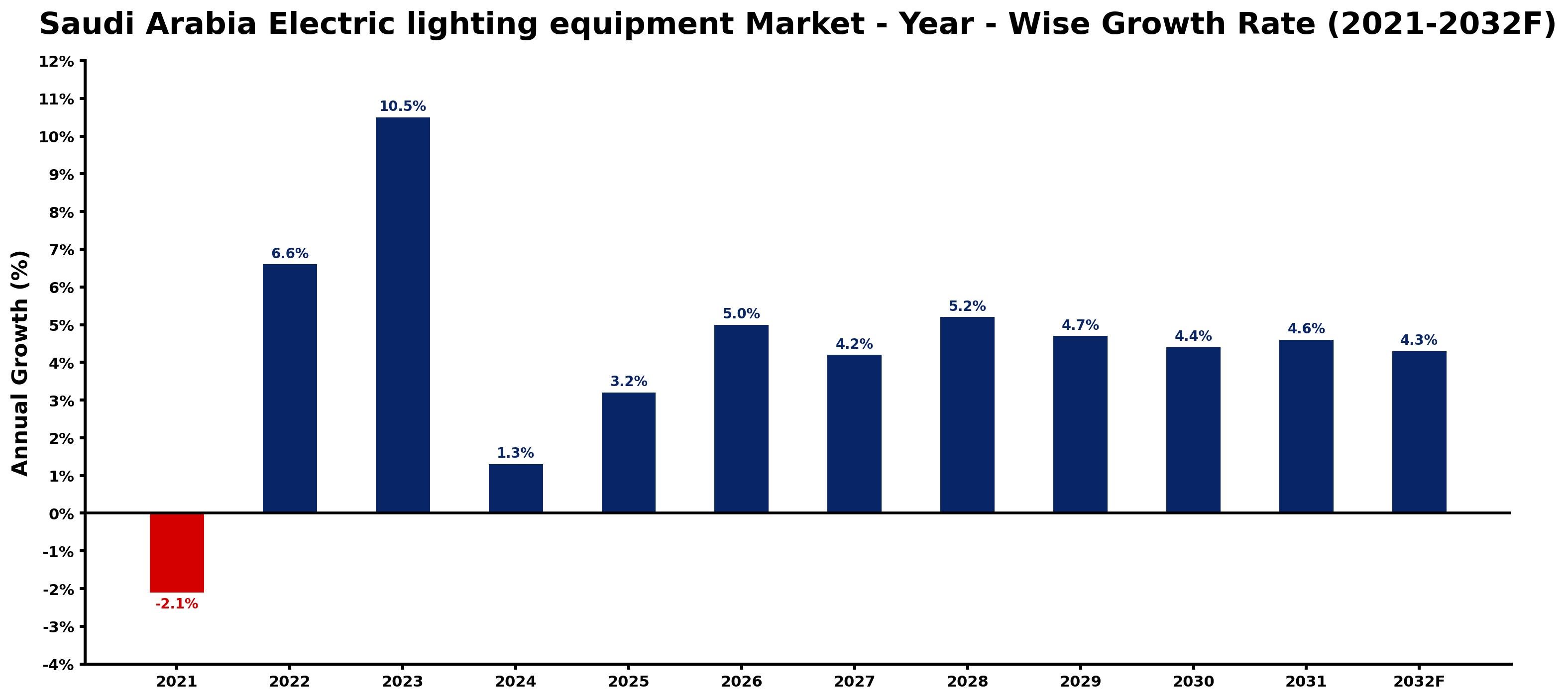
The table below presents the year wise growth rates along with the key drivers influencing the market
| Year | Growth Rate | Major Drivers |
| 2021 | -2.1% | Shifts toward energyefficient alternatives diminished demand for traditional electric lighting products. |
| 2022 | 6.6% | Local manufacturing of lighting components gained momentum, reducing import dependencies significantly. |
| 2023 | 10.5% | Construction pipelines associated with Neom provided opportunities for innovative lighting solutions. |
| 2024 | 1.3% | Technological advancements in LED efficiency began influencing consumer preferences and purchasing behavior. |
| 2025 | 3.2% | Smart city initiatives drove demand for integrated lighting systems in urban development projects. |
| 2026 | 5.0% | Energy efficiency goals in commercial buildings prompted retrofitting of older lighting systems. |
| 2027 | 4.2% | Residential projects expanded, creating a robust market for decorative and functional lighting fixtures. |
| 2028 | 5.2% | Collaboration between local and international firms brought diverse lighting technologies to the market. |
| 2029 | 4.7% | Inventive designs catering to hot climate requirements attracted both domestic and international buyers. |
| 2030 | 4.4% | Public awareness campaigns highlighted benefits of energy-efficient lighting, shaping consumer choices. |
| 2031 | 4.6% | The hospitality sector's expansion necessitated advanced lighting solutions for enhanced guest experiences. |
| 2032 | 4.3% | Sustainability trends encouraged businesses to invest in eco-friendly lighting technologies and practices. |
Note - Market size estimations and growth projections presented in this report are based on 6Wresearch's advanced forecasting approach, validated with industry datasets as of June 2026.
Saudi Arabia Electric lighting equipment Market Synopsis
The Saudi Arabia Electric lighting equipment Market is projected to reach 5.0% and witness significant growth during the forecast period (2026-2032). Driven by a combination of factors, this market is expected to thrive amid the Kingdom's ongoing urbanization, rising population, and increased electricity consumption. The shift towards more energy-efficient lighting solutions, particularly LED technologies, is anticipated to further bolster market growth. As the country invests in infrastructure and energy conservation initiatives, the demand for electric lighting equipment is set to escalate across various applications.
Saudi Arabia Electric lighting equipment Market Growth Drivers
The growth of the Saudi Arabia Electric lighting equipment Market can be attributed to several key drivers:
- The increasing population of Saudi Arabia is leading to a higher demand for electricity, directly influencing the sales of electric lighting equipment such as bulbs and tubes.
- Rapid urbanization is contributing to the expansion of residential and commercial developments, necessitating a significant need for lighting solutions.
- Government initiatives focused on energy conservation are encouraging consumers to transition from traditional incandescent lamps to more efficient LED lights, thus driving market demand.
- Increased construction activities in both the public and private sectors are creating opportunities for electric lighting equipment manufacturers to expand their market presence.
- The push for sustainable and environmentally friendly solutions is further promoting the adoption of energy-efficient lighting technologies in various applications.
Saudi Arabia Electric lighting equipment Market Challenges and Restraints
Despite the promising growth trajectory, the Saudi Arabia Electric lighting equipment Market faces several challenges:
- The high initial costs associated with the installation of advanced lighting systems can deter consumers from adopting newer technologies.
- Maintenance costs related to replacing parts can act as a barrier to widespread usage, limiting the market growth potential.
- Consumer reluctance to move away from traditional lighting solutions due to perceived reliability issues can hinder growth.
- Limited awareness about the advantages of energy-efficient lighting among certain demographics may restrict adoption rates.
- Supply chain disruptions can impede the availability of lighting products, impacting overall market performance.
Saudi Arabia Electric lighting equipment Market Trends and Opportunities
The Saudi Arabia Electric lighting equipment Market is characterized by several trends that present lucrative opportunities:
- The growing trend of smart city developments is likely to enhance the demand for innovative electric lighting solutions, integrating smart technologies.
- As businesses and households become more energy-conscious, demand for advanced energy management systems integrated with lighting equipment will increase.
- The rising focus on sustainability is prompting both consumers and businesses to seek out lighting products that reduce carbon footprints and enhance energy efficiency.
- Opportunities for partnerships between manufacturers and construction firms are emerging, driven by the increased construction of energy-efficient buildings.
- Technological advancements in lighting designs and functionalities provide avenues for companies to differentiate their offerings in the competitive market.
Saudi Arabia Electric lighting equipment Market Government Investment and Initiatives
The government of Saudi Arabia is actively investing in the electric lighting equipment sector as part of its broader vision for sustainable development. Initiatives aimed at energy conservation and efficiency are being implemented across various levels:
- The government is incentivizing the adoption of energy-efficient lighting solutions through subsidies and rebates, promoting the use of LED technology.
- Long-term development plans aim to enhance the infrastructure for public spaces, thereby increasing the demand for advanced lighting solutions.
- Regulations mandating energy efficiency standards for lighting products are being enforced, significantly impacting product offerings in the market.
- Public awareness campaigns are being launched to educate consumers on the benefits of energy-efficient lighting and encourage their adoption.
- Investment in research and development initiatives aims to foster innovation within the electric lighting sector, ensuring that Saudi Arabia remains at the forefront of lighting technology advancements.
Saudi Arabia Electric lighting equipment Market Latest Developments (May 2025 - June 2026)
Recent developments within the Saudi Arabia Electric lighting equipment Market indicate dynamic shifts as the industry adapts to emerging trends:
- Increased collaboration among industry players to explore sustainable lighting solutions has been observed, aiming to accelerate the shift towards LED technology.
- New product launches featuring advanced lighting systems, including smart lighting solutions, have begun to gain traction among consumers and businesses alike.
- Companies are increasingly focusing on developing products that align with governmental energy efficiency goals, enhancing their market competitiveness.
- There has been a marked rise in investments targeting R&D for innovative lighting technologies, reflecting the industry's commitment to sustainability.
- Public and private partnerships are becoming more common, facilitating larger-scale projects that prioritize energy efficiency and modern lighting infrastructure.
Saudi Arabia Electric lighting equipment Market - Key Attractiveness of the Report
- 10 Years of Market Numbers
- Historical Data Starting from 2022 to 2025
- Base Year: 2025
- Forecast Data until 2032
- Key Performance Indicators Impacting the Market
- Major Upcoming Developments and Projects
Key Highlights of the Report:
- Saudi Arabia Electric lighting equipment Market Outlook
- Market Size of Saudi Arabia Electric lighting equipment Market, 2025
- Forecast of Saudi Arabia Electric lighting equipment Market, 2032
- Historical Data and Forecast of Saudi Arabia Electric lighting equipment Revenues & Volume for the Period 2022-2032F
- Saudi Arabia Electric lighting equipment Market Trend Evolution
- Saudi Arabia Electric lighting equipment Market Drivers and Challenges
- Saudi Arabia Electric lighting equipment Price Trends
- Saudi Arabia Electric lighting equipment Porter's Five Forces
- Saudi Arabia Electric lighting equipment Industry Life Cycle
- Historical Data and Forecast of Saudi Arabia Electric lighting equipment Market Revenues & Volume By Type for the Period 2022-2032F
- Historical Data and Forecast of Saudi Arabia Electric lighting equipment Market Revenues & Volume By General Lighting for the Period 2022-2032F
- Historical Data and Forecast of Saudi Arabia Electric lighting equipment Market Revenues & Volume By Automotive Lighting for the Period 2022-2032F
- Historical Data and Forecast of Saudi Arabia Electric lighting equipment Market Revenues & Volume By Back Lighting for the Period 2022-2032F
- Historical Data and Forecast of Saudi Arabia Electric lighting equipment Market Revenues & Volume By Application for the Period 2022-2032F
- Historical Data and Forecast of Saudi Arabia Electric lighting equipment Market Revenues & Volume By Residential for the Period 2022-2032F
- Historical Data and Forecast of Saudi Arabia Electric lighting equipment Market Revenues & Volume By Commercial for the Period 2022-2032F
- Historical Data and Forecast of Saudi Arabia Electric lighting equipment Market Revenues & Volume By Automotive for the Period 2022-2032F
- Historical Data and Forecast of Saudi Arabia Electric lighting equipment Market Revenues & Volume By Others for the Period 2022-2032F
- Historical Data and Forecast of Saudi Arabia Electric lighting equipment Market Revenues & Volume By Sales Channel for the Period 2022-2032F
- Historical Data and Forecast of Saudi Arabia Electric lighting equipment Market Revenues & Volume By OEM for the Period 2022-2032F
- Historical Data and Forecast of Saudi Arabia Electric lighting equipment Market Revenues & Volume By Aftermarket? for the Period 2022-2032F
- Historical Data and Forecast of Saudi Arabia Electric lighting equipment Market Revenues & Volume By Mode for the Period 2022-2032F
- Historical Data and Forecast of Saudi Arabia Electric lighting equipment Market Revenues & Volume By Offline for the Period 2022-2032F
- Historical Data and Forecast of Saudi Arabia Electric lighting equipment Market Revenues & Volume By Online for the Period 2022-2032F
- Saudi Arabia Electric lighting equipment Import Export Trade Statistics
- Market Opportunity Assessment By Type
- Market Opportunity Assessment By Application
- Market Opportunity Assessment By Sales Channel
- Market Opportunity Assessment By Mode
- Saudi Arabia Electric lighting equipment Top Companies Market Share
- Saudi Arabia Electric lighting equipment Competitive Benchmarking By Technical and Operational Parameters
- Saudi Arabia Electric lighting equipment Company Profiles
- Saudi Arabia Electric lighting equipment Key Strategic Recommendations






































