Saudi Arabia Electrical Equipment Market Summary
The saudi arabia electrical equipment market was estimated at USD 207 Million in 2025 and is projected to reach USD 264 Million by 2032, growing at a CAGR of 5.3% from 2026 to 2032.
Saudi Arabia Electrical Equipment Market Year-wise Growth Rate and Key Drivers
This graph highlights how the Saudi Arabia Electrical Equipment Market has steadily grown over the past five years, supported by major growth factors.
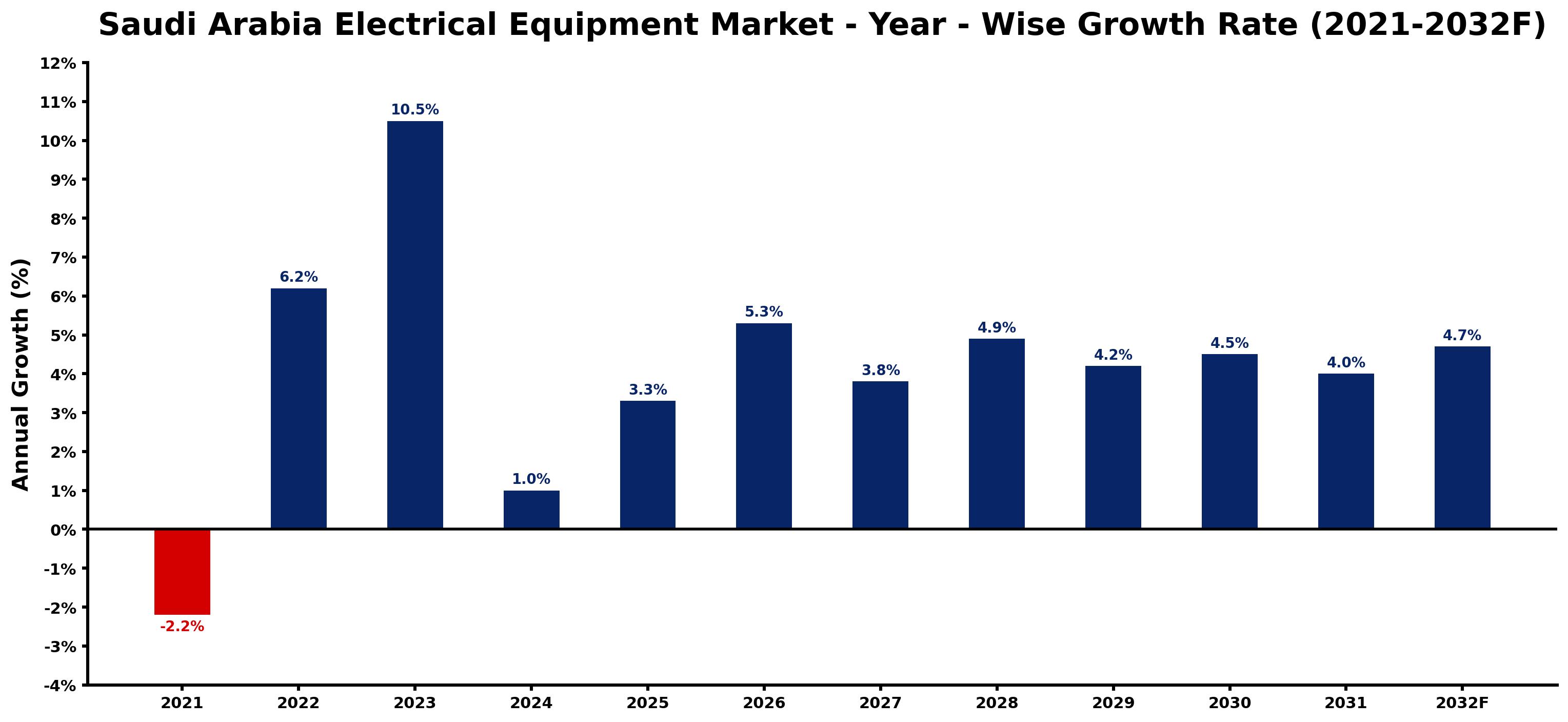
The table below presents the year wise growth rates along with the key drivers influencing the market
| Year | Growth Rate | Major Drivers |
| 2021 | -2.2% | Supply chain disruptions due to logistical bottlenecks hindered timely delivery of essential electrical components. |
| 2022 | 6.2% | Increased urbanization in Riyadh fuels demand for advanced electrical infrastructure solutions. |
| 2023 | 10.5% | Interconnected renewable projects position solar energy as a game-changer for electricity distribution. |
| 2024 | 1.0% | Local manufacturers expand capabilities to reduce dependence on foreign electrical equipment imports. |
| 2025 | 3.3% | Construction activities related to NEOM project create substantial requirements for electrical installations. |
| 2026 | 5.3% | Emerging technologies in IoT open avenues for smarter energy management systems nationwide. |
| 2027 | 3.8% | Collaboration between utility providers and tech firms improves grid resilience in extreme climates. |
| 2028 | 4.9% | Rising consumer awareness drives interest in energy-efficient home appliances and systems. |
| 2029 | 4.2% | Major international firms consider Saudi Arabia as a hub for regional electrical manufacturing. |
| 2030 | 4.5% | Government-led educational initiatives shape a workforce skilled in modern electrical technologies. |
| 2031 | 4.0% | Integration of AI in energy management optimizes grid performance and reduces operational costs. |
| 2032 | 4.7% | Sustainable practices become essential, pushing innovations in eco-friendly electrical solutions. |
Note - Market size estimations and growth projections presented in this report are based on 6Wresearch's advanced forecasting approach, validated with industry datasets as of June 2026.
Saudi Arabia Electrical Equipment Market Synopsis
The Saudi Arabia Electrical Equipment Market is projected to reach 5.3% and witness significant growth during the forecast period (2026-2032). As one of the largest importers and consumers of electrical equipment in the Middle East, Saudi Arabia's electrical equipment market is influenced by various factors, including a burgeoning population and rapid industrialization.
Saudi Arabia Electrical Equipment Market Growth Drivers
The growth trajectory of the Saudi Arabia Electrical Equipment Market is primarily underpinned by several key drivers:
- The significant increase in population is placing substantial demands on electrical infrastructure, compelling suppliers to innovate and expand their offerings.
- A robust construction sector, propelled by major infrastructure projects and residential developments, necessitates efficient electrical solutions for lighting, HVAC systems, and more.
- The government's strategic efforts to diversify the economy away from oil dependency are fostering growth in manufacturing and services sectors, subsequently boosting demand for electrical equipment.
- Technological advancements, particularly in research and development, are enabling the production of energy-efficient solutions such as solar panels and LED lighting, promoting their adoption across various sectors.
- Increased awareness regarding energy efficiency and sustainability is pushing consumers and businesses towards solutions that reduce energy consumption and operating costs.
Saudi Arabia Electrical Equipment Market Challenges and Restraints
While the market presents numerous opportunities, several challenges could impede its growth:
- Substantial capital investment is necessary for establishing new manufacturing facilities or expanding existing ones, which may be prohibitive given the current financing landscape.
- The struggle to access finance due to stringent banking regulations can stymie potential market entrants and limit expansion for established players.
- A lack of skilled labor, particularly in emerging sectors, can delay project timelines and hinder the capacity to meet burgeoning demand, disrupting supply chains.
- The ongoing impact of global supply chain disruptions has made it increasingly difficult for manufacturers to deliver products on time, resulting in lost revenue opportunities.
- Economic fluctuations and downturns can result in reduced customer demand, particularly in a market that is already sensitive to shifts in economic conditions.
Saudi Arabia Electrical Equipment Market Government Investment and Initiatives
The Saudi government has implemented various initiatives aimed at fostering growth within the electrical equipment sector:
- Investment in large-scale infrastructure projects under the Vision 2030 framework is expected to drive significant demand for electrical equipment, with public-private partnerships being actively encouraged.
- Government funding for clean energy projects is promoting research and development in renewable technologies, providing an impetus for the electrical equipment market.
- Policy frameworks supporting economic diversification are creating new avenues for investment in sectors that rely heavily on electrical equipment.
- Incentives for manufacturers that prioritize energy-efficient solutions are contributing to a shift towards sustainable practices within the electrical equipment sector.
- Collaboration with international firms for knowledge transfer and technology adoption is being promoted, further enhancing the capabilities of local manufacturers.
Saudi Arabia Electrical Equipment Market Latest Developments (May 2025 - June 2026)
Recent trends in the Saudi Arabia Electrical Equipment Market reflect a move towards sustainability and smart technologies:
- From May 2025 to June 2026, there has been a notable increase in partnerships between local manufacturers and technological firms for the development of advanced electrical solutions.
- Government-led initiatives focusing on smart cities have spurred demand for integrated electrical systems, enhancing the efficiency of energy distribution.
- Investments in renewable energy, particularly solar power projects, are reshaping the electrical equipment landscape, necessitating innovative product offerings.
- Workforce training programs have been initiated to address the skill gap in the electrical sector, aiming to equip local talent with necessary skills for future demands.
- The market has seen a surge in demand for energy management systems, driven by increased awareness of energy conservation among both residential and commercial sectors.
Saudi Arabia Electrical Equipment Market - Key Attractiveness of the Report
- 10 Years of Market Numbers
- Historical Data Starting from 2022 to 2025
- Base Year: 2025
- Forecast Data until 2032
- Key Performance Indicators Impacting the Market
- Major Upcoming Developments and Projects
Key Highlights of the Report:
- Saudi Arabia Electrical Equipment Market Outlook
- Market Size of Saudi Arabia Electrical Equipment Market, 2025
- Forecast of Saudi Arabia Electrical Equipment Market, 2032
- Historical Data and Forecast of Saudi Arabia Electrical Equipment Revenues & Volume for the Period 2022-2032F
- Saudi Arabia Electrical Equipment Market Trend Evolution
- Saudi Arabia Electrical Equipment Market Drivers and Challenges
- Saudi Arabia Electrical Equipment Price Trends
- Saudi Arabia Electrical Equipment Porter's Five Forces
- Saudi Arabia Electrical Equipment Industry Life Cycle
- Historical Data and Forecast of Saudi Arabia Electrical Equipment Market Revenues & Volume By Types for the Period 2022-2032F
- Historical Data and Forecast of Saudi Arabia Electrical Equipment Market Revenues & Volume By Electronic and electrical wires and cables for the Period 2022-2032F
- Historical Data and Forecast of Saudi Arabia Electrical Equipment Market Revenues & Volume By Batteries and accumulators for the Period 2022-2032F
- Historical Data and Forecast of Saudi Arabia Electrical Equipment Market Revenues & Volume By Wiring devices for the Period 2022-2032F
- Historical Data and Forecast of Saudi Arabia Electrical Equipment Market Revenues & Volume By Electric lighting equipment for the Period 2022-2032F
- Historical Data and Forecast of Saudi Arabia Electrical Equipment Market Revenues & Volume By Others for the Period 2022-2032F
- Historical Data and Forecast of Saudi Arabia Electrical Equipment Market Revenues & Volume By Applications for the Period 2022-2032F
- Historical Data and Forecast of Saudi Arabia Electrical Equipment Market Revenues & Volume By Residential end-users for the Period 2022-2032F
- Historical Data and Forecast of Saudi Arabia Electrical Equipment Market Revenues & Volume By Non-residential end-users for the Period 2022-2032F
- Saudi Arabia Electrical Equipment Import Export Trade Statistics
- Market Opportunity Assessment By Types
- Market Opportunity Assessment By Applications
- Saudi Arabia Electrical Equipment Top Companies Market Share
- Saudi Arabia Electrical Equipment Competitive Benchmarking By Technical and Operational Parameters
- Saudi Arabia Electrical Equipment Company Profiles
- Saudi Arabia Electrical Equipment Key Strategic Recommendations






































