Saudi Arabia Emission Control Catalyst Market: Import Trend Analysis
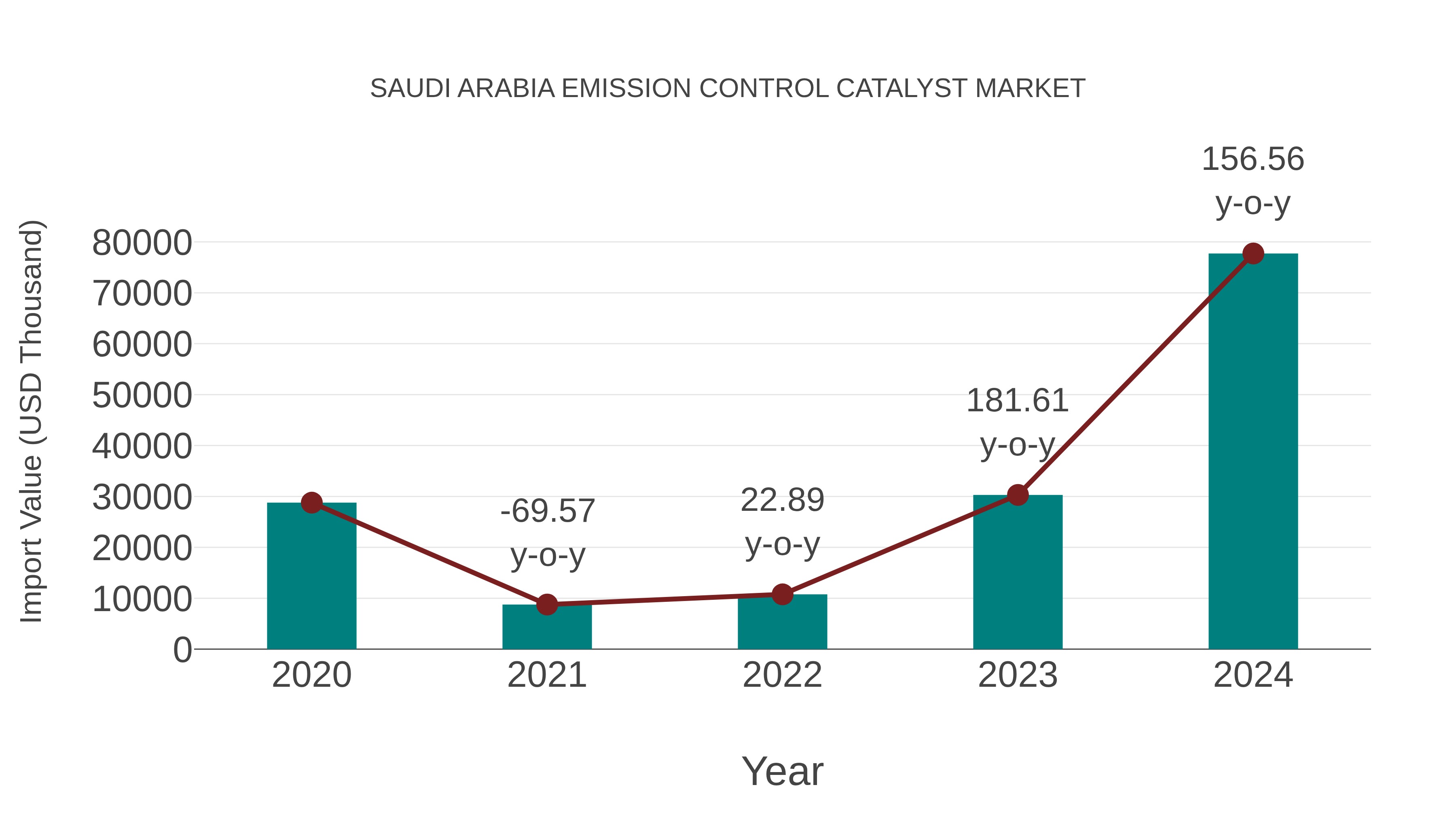
Between 2023 and 2024, Saudi Arabia`s import trend for emission control catalysts experienced a significant growth rate of 156.56%. The compound annual growth rate (CAGR) for the period from 2020 to 2024 stood at 28.2%. This surge in imports can be attributed to a notable demand shift towards cleaner technologies in response to stringent environmental regulations and an increased focus on reducing emissions in the region.
Saudi Arabia Emission Control Catalyst Market Overview
The Saudi Arabia emission control catalyst market is experiencing steady growth driven by increasing environmental regulations and growing awareness about air pollution. The market is primarily dominated by demand from the automotive sector due to the rising number of vehicles on the road. Additionally, the country`s focus on reducing emissions and improving air quality is leading to a higher adoption of emission control catalysts in industrial applications as well. Key players in the market are investing in research and development to introduce advanced catalyst technologies to meet the stringent emission standards set by the government. The market is expected to continue growing as the country strives to achieve its environmental goals, presenting opportunities for both local and international catalyst manufacturers to expand their presence in the region.
Saudi Arabia Emission Control Catalyst Market Trends
The Saudi Arabia emission control catalyst market is experiencing a shift towards stricter environmental regulations and a growing focus on reducing emissions from industries such as petrochemicals, oil & gas, and automotive sectors. The demand for emission control catalysts is increasing as companies seek to comply with government regulations aimed at reducing air pollution and greenhouse gas emissions. Additionally, there is a rising awareness among consumers about the importance of sustainable practices, driving the adoption of emission control catalysts in various industrial processes. Key trends in the market include a growing preference for advanced catalyst technologies, such as selective catalytic reduction (SCR) and diesel oxidation catalysts (DOC), to achieve higher efficiency and performance in emission reduction. Overall, the Saudi Arabia emission control catalyst market is poised for steady growth in the coming years.
Saudi Arabia Emission Control Catalyst Market Challenges
In the Saudi Arabia emission control catalyst market, challenges include increasing regulatory pressure to reduce emissions, the need for continuous technological advancements to meet stringent emission standards, and the high cost associated with developing and implementing advanced catalyst technologies. Additionally, the market faces the challenge of limited awareness among industries regarding the benefits of emission control catalysts, which may hinder the adoption rate. Furthermore, the fluctuation in oil prices and economic uncertainties in the region can impact investments in environmental technologies, posing a challenge to the growth of the emission control catalyst market in Saudi Arabia. Overall, overcoming these challenges will require collaboration between industry players, government bodies, and technology developers to drive innovation and promote sustainable practices in the country`s industrial sector.
Saudi Arabia Emission Control Catalyst Market Investment Opportunities
In Saudi Arabia, the emission control catalyst market presents promising investment opportunities due to the government`s increasing focus on environmental sustainability and regulations to reduce air pollution. As the country aims to diversify its economy and reduce its reliance on oil, there is a growing demand for emission control catalysts in industries such as automotive, power generation, and petrochemicals. Investing in companies that offer advanced emission control technologies, such as selective catalytic reduction (SCR) systems or diesel oxidation catalysts, could be lucrative. Additionally, partnerships with local manufacturers or distributors to cater to the specific needs of the Saudi market can be a strategic move. Overall, the Saudi Arabia emission control catalyst market is poised for growth, making it an attractive sector for potential investors.
Saudi Arabia Emission Control Catalyst Market Government Policy
The Saudi Arabian government has implemented several policies to regulate and control emissions in the country, leading to a demand for emission control catalysts. One key policy is the Saudi Vision 2030, which aims to diversify the economy and reduce the country`s dependence on oil. This vision includes targets for reducing greenhouse gas emissions, incentivizing the adoption of clean technologies, and promoting sustainable development. Additionally, the government has introduced regulations that require industries to comply with emissions standards and invest in technologies such as catalytic converters to reduce harmful pollutants. These policies have created a growing market for emission control catalysts in Saudi Arabia, as companies seek to meet the regulatory requirements and contribute to a cleaner environment.
Saudi Arabia Emission Control Catalyst Market Future Outlook
The Saudi Arabia emission control catalyst market is expected to witness significant growth in the coming years due to increasing government regulations aimed at reducing air pollution and carbon emissions. The country`s commitment to diversifying its economy and reducing its reliance on oil is driving investments in clean technologies, including emission control catalysts. Additionally, the growing automotive industry and the expansion of industrial sectors are likely to boost the demand for emission control catalysts in the region. Technological advancements in catalyst materials and manufacturing processes are also expected to drive innovation and efficiency in the market. Overall, the future outlook for the Saudi Arabia emission control catalyst market appears promising, with opportunities for growth and development in line with global sustainability trends.
Key Highlights of the Report:
- Saudi Arabia Emission Control Catalyst Market Outlook
- Market Size of Saudi Arabia Emission Control Catalyst Market,2025
- Forecast of Saudi Arabia Emission Control Catalyst Market, 2032
- Historical Data and Forecast of Saudi Arabia Emission Control Catalyst Revenues & Volume for the Period 2022-2032F
- Saudi Arabia Emission Control Catalyst Market Trend Evolution
- Saudi Arabia Emission Control Catalyst Market Drivers and Challenges
- Saudi Arabia Emission Control Catalyst Price Trends
- Saudi Arabia Emission Control Catalyst Porter's Five Forces
- Saudi Arabia Emission Control Catalyst Industry Life Cycle
- Historical Data and Forecast of Saudi Arabia Emission Control Catalyst Market Revenues & Volume By Product for the Period 2022-2032F
- Historical Data and Forecast of Saudi Arabia Emission Control Catalyst Market Revenues & Volume By Palladium for the Period 2022-2032F
- Historical Data and Forecast of Saudi Arabia Emission Control Catalyst Market Revenues & Volume By Platinum for the Period 2022-2032F
- Historical Data and Forecast of Saudi Arabia Emission Control Catalyst Market Revenues & Volume By Rhodium for the Period 2022-2032F
- Historical Data and Forecast of Saudi Arabia Emission Control Catalyst Market Revenues & Volume By Others for the Period 2022-2032F
- Historical Data and Forecast of Saudi Arabia Emission Control Catalyst Market Revenues & Volume By Application for the Period 2022-2032F
- Historical Data and Forecast of Saudi Arabia Emission Control Catalyst Market Revenues & Volume By Mobile Sources (Off Road and On Road) for the Period 2022-2032F
- Historical Data and Forecast of Saudi Arabia Emission Control Catalyst Market Revenues & Volume By Stationary Sources for the Period 2022-2032F
- Historical Data and Forecast of Saudi Arabia Emission Control Catalyst Market Revenues & Volume By Catalic Converter for the Period 2022-2032F
- Historical Data and Forecast of Saudi Arabia Emission Control Catalyst Market Revenues & Volume By Diesel Oxidation Catalyst for the Period 2022-2032F
- Historical Data and Forecast of Saudi Arabia Emission Control Catalyst Market Revenues & Volume By Selective Catalytic Reduction for the Period 2022-2032F
- Historical Data and Forecast of Saudi Arabia Emission Control Catalyst Market Revenues & Volume By Lean NOx Trap for the Period 2022-2032F
- Historical Data and Forecast of Saudi Arabia Emission Control Catalyst Market Revenues & Volume By Three-way Catalytic Converter for the Period 2022-2032F
- Historical Data and Forecast of Saudi Arabia Emission Control Catalyst Market Revenues & Volume By Four-way Catalytic Converter for the Period 2022-2032F
- Saudi Arabia Emission Control Catalyst Import Export Trade Statistics
- Market Opportunity Assessment By Product
- Market Opportunity Assessment By Application
- Market Opportunity Assessment By Catalic Converter
- Saudi Arabia Emission Control Catalyst Top Companies Market Share
- Saudi Arabia Emission Control Catalyst Competitive Benchmarking By Technical and Operational Parameters
- Saudi Arabia Emission Control Catalyst Company Profiles
- Saudi Arabia Emission Control Catalyst Key Strategic Recommendations






































