Saudi Arabia Engineered Wood Market Size, Share & Growth Rate
The Saudi Arabia Engineered Wood Market was estimated at USD 225 Million in 2025 and is projected to reach USD 288 Million by 2032, growing at a CAGR of 3.6% from 2026 to 2032. This growth trajectory is driven by the increasing focus on sustainable construction practices and the rising demand for engineered wood products within the residential and commercial building sectors. Furthermore, as the government promotes eco-friendly building materials, the appeal of engineered wood continues to strengthen in the face of a burgeoning construction landscape.
Saudi Arabia Engineered Wood Market Year-wise Growth Rate and Key Drivers
This graph highlights how the Saudi Arabia Engineered Wood Market has steadily grown over the years, supported by major growth factors.
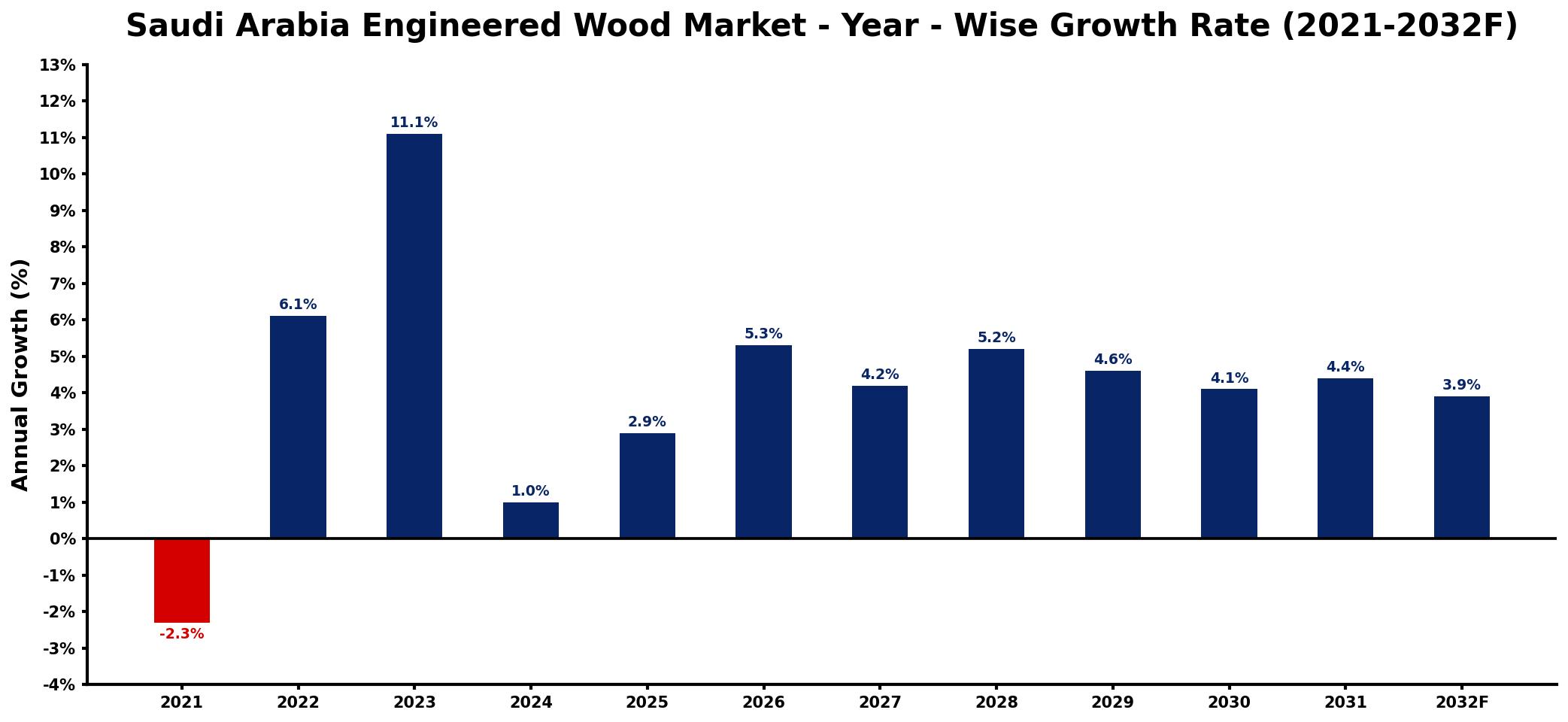
The table below presents the year‑wise growth rates along with the key drivers influencing the market
| Year | Growth Rate | Major Drivers |
| 2021 | -2.3% | reduced construction project investments |
| 2022 | 6.1% | increased residential housing demand |
| 2023 | 11.1% | growing sustainability building trends |
| 2024 | 1.0% | expansion of commercial developments |
| 2025 | 2.9% | rising urbanization and population growth |
| 2026 | 5.3% | increased demand for renewable materials |
| 2027 | 4.2% | enhanced government infrastructure initiatives |
| 2028 | 5.2% | growing interest in eco-friendly solutions |
| 2029 | 4.6% | growing downstream application demand |
| 2030 | 4.1% | rising demand for interior design |
| 2031 | 4.4% | growing popularity of modular construction |
| 2032 | 3.9% | increased focus on energy efficiency |
Note: Market size estimations and growth projections presented in this report are based on 6Wresearch's proprietary forecasting methodology, utilizing the latest available industry data, government publications, and primary research inputs.
Saudi Arabia Engineered Wood Market Synopsis
The surge in residential and commercial projects across Saudi Arabia is fueling demand for engineered wood, particularly as builders seek sustainable alternatives to traditional timber. Engineered wood products are gaining recognition for their strength, cost-effectiveness, and versatility, making them ideal for modern construction demands.
As the market evolves, innovations in engineered wood technology are enhancing product offerings, such as improved moisture resistance and aesthetic finishes. This continual enhancement aligns with the increasing consumer awareness of the ecological benefits of engineered wood, thus further solidifying its market position.
Saudi Arabia Engineered Wood Market Key Takeaways
- The market is projected to reach USD 288 Million by 2032, showcasing significant growth potential.
- Demand is primarily driven by the construction and furniture manufacturing sectors shift towards sustainable materials.
- Innovations in engineered wood technology are broadening the application range, enhancing product attractiveness.
- Consumer awareness regarding environmental sustainability is fostering a stronger preference for engineered wood.
- The market's resilience during the COVID-19 pandemic indicates robust adaptability in response to changing consumer behaviors.
Evaluation of Restraints in Saudi Arabia Engineered Wood Market
While the Saudi Arabia engineered wood market is poised for growth, challenges persist. The sustainability of sourcing raw materials remains a significant concern, necessitating adherence to responsible forestry practices to mitigate environmental impacts. Moreover, there is a strong competitive landscape from traditional solid wood products that can pose barriers to entry and require strategic marketing to promote the benefits of engineered alternatives. Education efforts aimed at consumers and industry stakeholders are essential to ensure the long-term growth and acceptance of engineered wood in various applications.
Saudi Arabia Engineered Wood Market Trends
Current trends indicate a marked shift toward multi-functional engineered wood products that cater to diverse consumer needs. Additionally, the rise of smart home technology is prompting innovative applications of engineered wood in home design. Another emerging trend is the increasing integration of artificial intelligence in manufacturing processes, which enhances precision and efficiency, further driving down costs while maintaining quality.
Saudi Arabia Engineered Wood Market Opportunities
The engineered wood market in Saudi Arabia holds significant growth opportunities, particularly as urbanization continues to accelerate. Investment in infrastructural developments, driven by government initiatives, creates a fertile ground for engineered wood products. Additionally, rising disposable incomes are leading consumers to invest in home improvements, further increasing demand. The ongoing emphasis on eco-friendly practices also opens avenues for innovative product development that can cater to environmentally conscious consumers.
Government Initiatives in the Saudi Arabia Engineered Wood Market
The Saudi Arabian government is actively promoting sustainable construction through various initiatives. Investment in green building practices is encouraged, with regulations that favor the use of eco-friendly materials such as engineered wood. Furthermore, public spending in infrastructure projects under the Vision 2030 framework is set to enhance the demand for engineered wood, driving forward the industrys growth and adoption.
Future Insights of the Saudi Arabia Engineered Wood Market
Looking ahead to 2026-2032, the Saudi Arabia engineered wood market is expected to capitalize on ongoing advancements in production technology and sustainable practices. As the economy diversifies, new applications for engineered wood in commercial, residential, and even industrial sectors will emerge. With sustainability at the forefront of consumer consciousness, products that demonstrate eco-friendly attributes are likely to command premium pricing and garner strong market presence.
Saudi Arabia Engineered Wood Market Latest Developments (2025 - 2026)
Recent developments in the Saudi Arabia engineered wood market indicate a growing focus on environmentally sustainable practices, as manufacturers are increasingly adopting responsible sourcing and production methods. Innovations are emerging in engineered wood products to meet consumer preferences for both functionality and aesthetics, while partnerships are being formed to strengthen supply chains amid fluctuating market conditions. The industry is adapting to new consumer demands, ensuring resilience in a post-pandemic economy.
Saudi Arabia Engineered Wood Market - Key Attractiveness of the Report
- 10 Years of Market Numbers
- Historical Data Starting from 2022 to 2025
- Base Year: 2025
- Forecast Data until 2032
- Key Performance Indicators Impacting the Market
- Major Upcoming Developments and Projects
Key Highlights of the Report:
- Saudi Arabia Engineered Wood Market Outlook
- Market Size of Saudi Arabia Engineered Wood Market, 2025
- Forecast of Saudi Arabia Engineered Wood Market, 2032
- Historical Data and Forecast of Saudi Arabia Engineered Wood Revenues & Volume for the Period 2022-2032F
- Saudi Arabia Engineered Wood Market Trend Evolution
- Saudi Arabia Engineered Wood Market Drivers and Challenges
- Saudi Arabia Engineered Wood Price Trends
- Saudi Arabia Engineered Wood Porter's Five Forces
- Saudi Arabia Engineered Wood Industry Life Cycle
- Historical Data and Forecast of Saudi Arabia Engineered Wood Market Revenues & Volume By Type for the Period 2022-2032F
- Historical Data and Forecast of Saudi Arabia Engineered Wood Market Revenues & Volume By I-Beams for the Period 2022-2032F
- Historical Data and Forecast of Saudi Arabia Engineered Wood Market Revenues & Volume By Plywood for the Period 2022-2032F
- Historical Data and Forecast of Saudi Arabia Engineered Wood Market Revenues & Volume By Laminated Veneer Lumber (LVL) for the Period 2022-2032F
- Historical Data and Forecast of Saudi Arabia Engineered Wood Market Revenues & Volume By Glulam (Glued Laminated Timber) for the Period 2022-2032F
- Historical Data and Forecast of Saudi Arabia Engineered Wood Market Revenues & Volume By Oriented Strand Boards (OSB) for the Period 2022-2032F
- Historical Data and Forecast of Saudi Arabia Engineered Wood Market Revenues & Volume By Cross-Laminated Timber (CLT) for the Period 2022-2032F
- Historical Data and Forecast of Saudi Arabia Engineered Wood Market Revenues & Volume By Others for the Period 2022-2032F
- Historical Data and Forecast of Saudi Arabia Engineered Wood Market Revenues & Volume By Application for the Period 2022-2032F
- Historical Data and Forecast of Saudi Arabia Engineered Wood Market Revenues & Volume By Construction for the Period 2022-2032F
- Historical Data and Forecast of Saudi Arabia Engineered Wood Market Revenues & Volume By Furniture for the Period 2022-2032F
- Historical Data and Forecast of Saudi Arabia Engineered Wood Market Revenues & Volume By Flooring for the Period 2022-2032F
- Historical Data and Forecast of Saudi Arabia Engineered Wood Market Revenues & Volume By Packaging for the Period 2022-2032F
- Historical Data and Forecast of Saudi Arabia Engineered Wood Market Revenues & Volume By Others for the Period 2022-2032F
- Historical Data and Forecast of Saudi Arabia Engineered Wood Market Revenues & Volume By End-User for the Period 2022-2032F
- Historical Data and Forecast of Saudi Arabia Engineered Wood Market Revenues & Volume By Residential for the Period 2022-2032F
- Historical Data and Forecast of Saudi Arabia Engineered Wood Market Revenues & Volume By Commercial & Industrial for the Period 2022-2032F
- Saudi Arabia Engineered Wood Import Export Trade Statistics
- Market Opportunity Assessment By Type
- Market Opportunity Assessment By Application
- Market Opportunity Assessment By End-User
- Saudi Arabia Engineered Wood Top Companies Market Share
- Saudi Arabia Engineered Wood Competitive Benchmarking By Technical and Operational Parameters
- Saudi Arabia Engineered Wood Company Profiles
- Saudi Arabia Engineered Wood Key Strategic Recommendations






































