Saudi Arabia Enterprise AI Market Size & Growth Rate (2026-2032)
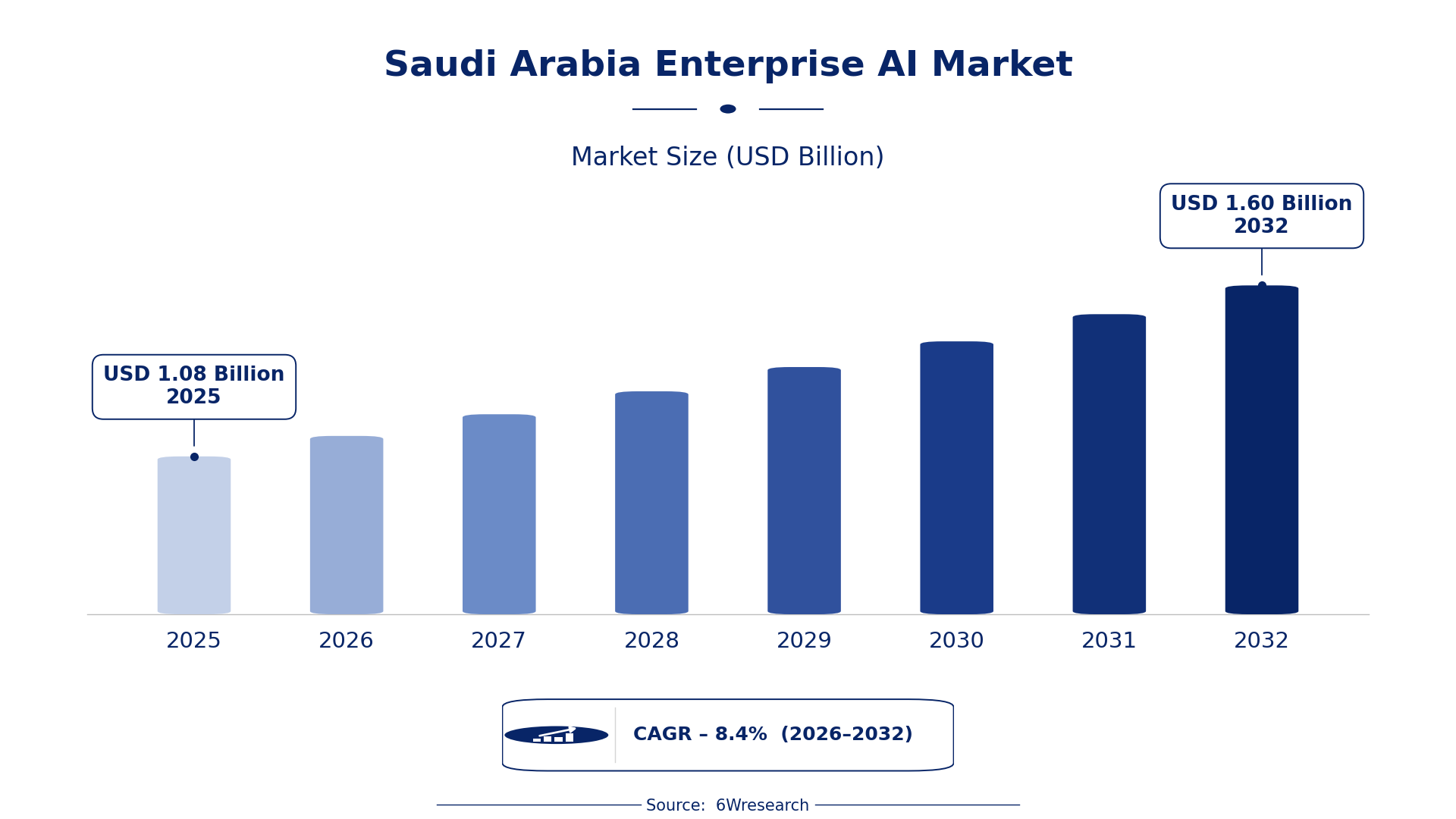
The Saudi Arabia Enterprise AI Market was estimated at USD 1077 Million in 2025 and is projected to reach USD 1602 Million by 2032, growing at a CAGR of 8.4% from 2026 to 2032.
Saudi Arabia Enterprise AI Market Synopsis
The most powerful catalyst currently influencing the Saudi Arabia Enterprise AI market is the accelerating digital transformation across various sectors. Organizations are increasingly adopting artificial intelligence technologies to streamline their operations and improve customer interactions, recognizing that staying competitive demands innovation.
This market is seeing a diverse array of applications, from healthcare to finance, where AI is not just a luxury but a necessity for driving operational efficiency. As firms strive for enhanced productivity and data-driven decision-making, the integration of AI solutions is expected to surge.
Saudi Arabia Enterprise AI Market Year-wise Growth Rate and Key Drivers
This graph illustrates the annual growth rates of the Saudi Arabia Enterprise AI Market from 2021 to 2032, highlighting a steady upward trajectory and projected expansion over the forecast period.
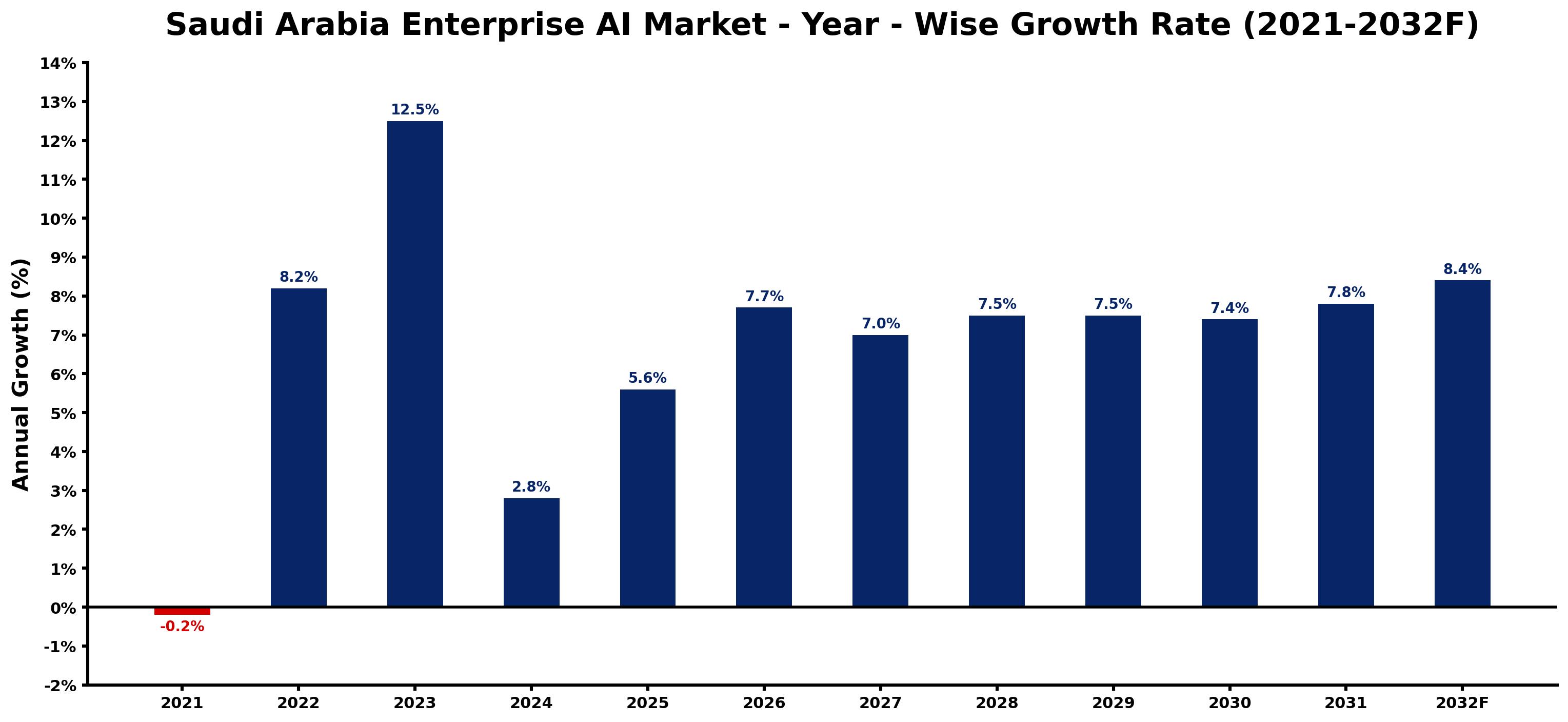
The table below presents the year‑wise growth rates along with the key drivers influencing the market
| Year | Growth Rate | Major Drivers |
| 2021 | -0.2% | Increased scrutiny from Saudi Data and Artificial Intelligence Authority |
| 2022 | 8.2% | Government Vision 2030 driving digital transformation initiatives. |
| 2023 | 12.5% | Increased investment in tech startups through Saudi venture funds. |
| 2024 | 2.8% | Local universities enhancing AI curricula and research programs. |
| 2025 | 5.6% | Telecommunications expansion enabling advanced AI applications adoption. |
| 2026 | 7.7% | Local industries prioritizing digitalization for operational efficiency. |
| 2027 | 7.0% | Regulatory support from Saudi Data and Artificial Intelligence Authority. |
| 2028 | 7.5% | Growing local AI talent pool from international partnerships. |
| 2029 | 7.5% | Rising acceptance of AI in public sector services. |
| 2030 | 7.4% | Corporate demand for AI-driven insights in decision-making. |
| 2031 | 7.8% | Increased use of AI in healthcare data management. |
| 2032 | 8.4% | Growing e-commerce sector boosting AI for personalized experiences. |
Note: Market size estimations and growth projections presented in this report are based on 6Wresearch's proprietary forecasting methodology, utilizing the latest available industry data, government publications, and primary research inputs.
Saudi Arabia Enterprise AI Market Key Takeaways
Below are some of the specific key takeaways from the market, including:
- The market is driven by the need for improved operational efficiency and customer engagement.
- Key sectors adopting enterprise AI include healthcare, finance, and manufacturing.
- Data security and compliance remain pressing challenges for businesses implementing AI solutions.
- The COVID-19 pandemic has significantly accelerated the adoption of AI technologies.
- Leading companies are pushing innovations that cater specifically to the unique needs of Saudi businesses.
Evaluation of Restraints in Saudi Arabia Enterprise AI Market
Despite its growth, the Saudi Arabia Enterprise AI market faces several restraints that could impede its progress. Many organizations grapple with the complexities of implementing AI solutions across their existing processes. There's a pronounced need for skilled professionals who can harness AI effectively, and the current shortage of expertise can slow down adoption rates. Additionally, concerns around data security and compliance with local regulations add layers of complexity, making organizations hesitant to fully embrace AI technologies.
Saudi Arabia Enterprise AI Market Trends
Several trends are shaping the Saudi Arabia Enterprise AI market. The increasing integration of machine learning and natural language processing into business operations is one. Companies are not just automating tasks but are also utilizing predictive analytics to forecast market shifts. Another trend is the growing collaboration between public and private sectors to develop AI frameworks that can enhance overall technological capability in the region. As organizations gain confidence in AI, expect a rise in investment for R&D in this area.
Saudi Arabia Enterprise AI Market Opportunities
The landscape is ripe with opportunities for growth and investment. As more businesses recognize the potential of AI, sectors like retail and logistics are beginning to explore AI-driven solutions for inventory management and customer analytics. on top of that, government initiatives aimed at fostering a digital economy will further open doors for AI integration. Startups focusing on niche AI applications also present compelling investment avenues as they emerge to meet specific market needs.
Government Initiatives in the Saudi Arabia Enterprise AI Market
The Saudi government is playing a crucial role in shaping the Enterprise AI market through various initiatives. Public policy is heavily focused on digital transformation, aiming to position the country as a leader in technology adoption. By fostering a regulatory environment conducive to innovation, the government is actively encouraging both local and international investments in AI solutions.
- A national digital infrastructure upgrade programme now in its rollout phase aims to enhance connectivity and data access across regions.
- A regulatory framework introduced in 2025 mandating transparency in AI algorithms and applications is currently underway.
- A planned public-private initiative expected to expand AI research and development collaborations by 2028 is in the pipeline.
- The establishment of an AI training and certification program launched in 2024 aims to address the skills gap in the industry.
- Current efforts to boost AI integration in public services are ongoing, enhancing efficiency and service delivery.
Future Insights of the Saudi Arabia Enterprise AI Market
Looking ahead to 2026-2032, the Saudi Arabia Enterprise AI market is expected to witness substantial growth as businesses continue to embed AI into their operations. The increasing emphasis on data analytics and intelligent automation will likely redefine business strategies. With ongoing government support and an expanding talent pool, the market stands to benefit from both local and global partnerships, setting the stage for innovative solutions tailored to regional challenges.
Saudi Arabia Enterprise AI Market Latest Developments
In the past year, the Saudi Arabia Enterprise AI market has seen a flurry of activity as organizations pivot towards advanced technological solutions. Companies are rapidly rolling out AI applications that enhance operational efficiency and customer experiences. This surge reflects a broader commitment to digital transformation across various sectors.
- A major technology vendor launched a comprehensive AI-driven analytics platform in Q1 2025, aimed at transforming data management for enterprises.
- An initiative that began in mid-2025 and remains underway focuses on integrating AI into public sector services, enhancing efficiency.
- A rollout expected to begin in the second half of 2026 aims to implement AI solutions in the healthcare sector to improve patient care.
- A collaboration between tech firms to develop AI training modules has been established and is set to begin deployment in early 2026.
- Recent partnerships formed between local universities and technology companies aim to foster innovation and research in AI applications, currently in the planning stage.
Saudi Arabia Enterprise AI Market - Key Attractiveness of the Report
- 10 Years of Market Numbers
- Historical Data Starting from 2022 to 2025
- Base Year: 2025
- Forecast Data until 2032
- Key Performance Indicators Impacting the Market
- Major Upcoming Developments and Projects
Key Highlights of the Report:
- Saudi Arabia Enterprise AI Market Outlook
- Market Size of Saudi Arabia Enterprise AI Market, 2025
- Forecast of Saudi Arabia Enterprise AI Market, 2032
- Historical Data and Forecast of Saudi Arabia Enterprise AI Revenues & Volume for the Period 2022-2032F
- Saudi Arabia Enterprise AI Market Trend Evolution
- Saudi Arabia Enterprise AI Market Drivers and Challenges
- Saudi Arabia Enterprise AI Price Trends
- Saudi Arabia Enterprise AI Porter's Five Forces
- Saudi Arabia Enterprise AI Industry Life Cycle
- Historical Data and Forecast of Saudi Arabia Enterprise AI Market Revenues & Volume By Component for the Period 2022-2032F
- Historical Data and Forecast of Saudi Arabia Enterprise AI Market Revenues & Volume By Solution for the Period 2022-2032F
- Historical Data and Forecast of Saudi Arabia Enterprise AI Market Revenues & Volume By Services for the Period 2022-2032F
- Historical Data and Forecast of Saudi Arabia Enterprise AI Market Revenues & Volume By Technology for the Period 2022-2032F
- Historical Data and Forecast of Saudi Arabia Enterprise AI Market Revenues & Volume By Machine learning and deep learning for the Period 2022-2032F
- Historical Data and Forecast of Saudi Arabia Enterprise AI Market Revenues & Volume By Natural Language Processing (NLP) for the Period 2022-2032F
- Historical Data and Forecast of Saudi Arabia Enterprise AI Market Revenues & Volume By Application Area for the Period 2022-2032F
- Historical Data and Forecast of Saudi Arabia Enterprise AI Market Revenues & Volume By Security and risk management for the Period 2022-2032F
- Historical Data and Forecast of Saudi Arabia Enterprise AI Market Revenues & Volume By Marketing management for the Period 2022-2032F
- Historical Data and Forecast of Saudi Arabia Enterprise AI Market Revenues & Volume By Customer support and experience for the Period 2022-2032F
- Historical Data and Forecast of Saudi Arabia Enterprise AI Market Revenues & Volume By Human resource and recruitment management for the Period 2022-2032F
- Historical Data and Forecast of Saudi Arabia Enterprise AI Market Revenues & Volume By Analytics application for the Period 2022-2032F
- Historical Data and Forecast of Saudi Arabia Enterprise AI Market Revenues & Volume By Process automation for the Period 2022-2032F
- Historical Data and Forecast of Saudi Arabia Enterprise AI Market Revenues & Volume By Deployment Type for the Period 2022-2032F
- Historical Data and Forecast of Saudi Arabia Enterprise AI Market Revenues & Volume By Cloud for the Period 2022-2032F
- Historical Data and Forecast of Saudi Arabia Enterprise AI Market Revenues & Volume By On-premises for the Period 2022-2032F
- Historical Data and Forecast of Saudi Arabia Enterprise AI Market Revenues & Volume By Organization Size for the Period 2022-2032F
- Historical Data and Forecast of Saudi Arabia Enterprise AI Market Revenues & Volume By Small and Medium-sized Businesses (SMBs) for the Period 2022-2032F
- Historical Data and Forecast of Saudi Arabia Enterprise AI Market Revenues & Volume By Large enterprises for the Period 2022-2032F
- Saudi Arabia Enterprise AI Import Export Trade Statistics
- Market Opportunity Assessment By Component
- Market Opportunity Assessment By Technology
- Market Opportunity Assessment By Application Area
- Market Opportunity Assessment By Deployment Type
- Market Opportunity Assessment By Organization Size
- Saudi Arabia Enterprise AI Top Companies Market Share
- Saudi Arabia Enterprise AI Competitive Benchmarking By Technical and Operational Parameters
- Saudi Arabia Enterprise AI Company Profiles
- Saudi Arabia Enterprise AI Key Strategic Recommendations






































