Saudi Arabia Ergonomic Chair Market Size, Share & Growth Rate
The Saudi Arabia Ergonomic Chair Market was estimated at USD 1464 Million in 2025 and is projected to reach USD 2172 Million by 2032, growing at a CAGR of 5.8% from 2026 to 2032. This robust growth trajectory is driven by an increasing awareness of ergonomic designs in reducing health-related issues associated with prolonged sitting. Additionally, the ongoing shift towards flexible work environments has heightened the demand for ergonomic solutions that blend comfort and productivity.
Saudi Arabia Ergonomic Chair Market Year-wise Growth Rate and Key Drivers
This graph highlights how the Saudi Arabia Ergonomic Chair Market has steadily grown over the years, supported by major growth factors.
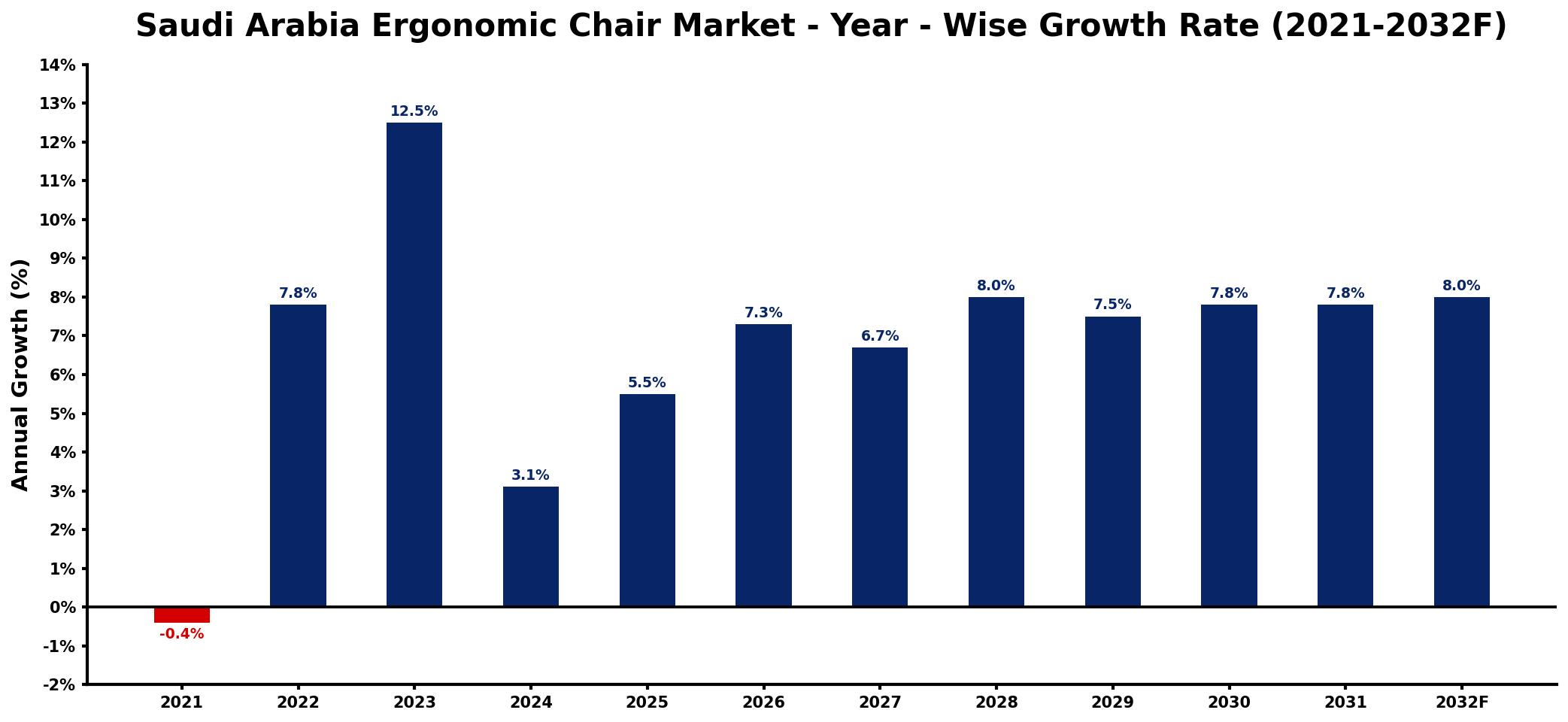
The table below presents the year‑wise growth rates along with the key drivers influencing the market
| Year | Growth Rate | Major Drivers |
| 2021 | -0.4% | workplace safety regulations tightening |
| 2022 | 7.8% | increased remote working trends |
| 2023 | 12.5% | growing awareness of health benefits |
| 2024 | 3.1% | rising disposable income levels |
| 2025 | 5.5% | expansion of corporate wellness programs |
| 2026 | 7.3% | enhanced focus on productivity solutions |
| 2027 | 6.7% | increased construction of office spaces |
| 2028 | 8.0% | growing demand for home offices |
| 2029 | 7.5% | emphasis on sustainable furniture options |
| 2030 | 7.8% | expanding industrial usage applications |
| 2031 | 7.8% | stronger online retail presence |
| 2032 | 8.0% | increased investments in workplace design |
Note: Market size estimations and growth projections presented in this report are based on 6Wresearch's proprietary forecasting methodology, utilizing the latest available industry data, government publications, and primary research inputs.
Saudi Arabia Ergonomic Chair Market Synopsis
In Saudi Arabia, the demand for ergonomic chairs has surged as businesses recognize the importance of employee comfort in enhancing productivity. This is particularly noticeable in sectors that have recently adopted remote working, where the home office setup is now integral to daily operations. Ergonomic chairs featuring adjustable heights, lumbar support, and customizable designs cater to a diverse range of user preferences and needs.
The market is also seeing an increased focus on the long-term health benefits of ergonomic furniture. Consumers are becoming more educated about how proper seating can mitigate musculoskeletal disorders, leading to a more significant investment in ergonomic solutions across various environments, including educational institutions and commercial offices.
Saudi Arabia Ergonomic Chair Market Key Takeaways
- The market is rapidly growing due to heightened awareness of health benefits associated with ergonomic seating.
- Flexible work arrangements have significantly influenced the demand for ergonomic chairs in home office settings.
- Customization and adjustable features are essential selling points for consumers in Saudi Arabia.
- Investments in employee well-being are driving businesses to prioritize ergonomic solutions in their office environments.
- Key players are responding to market needs by expanding their product ranges and improving chair designs.
Evaluation of Restraints in Saudi Arabia Ergonomic Chair Market
Despite the promising growth potential, the Saudi Arabia Ergonomic Chair Market faces several challenges. One primary restraint is the pervasive misconception that ergonomic chairs are a luxury rather than a necessity. This perception can hinder widespread adoption, particularly among small businesses and individual consumers. Additionally, price sensitivity remains a significant concern, as ergonomic solutions often come with higher upfront costs compared to conventional chairs. Addressing these barriers requires comprehensive educational efforts about the long-term health benefits of ergonomic seating.
Saudi Arabia Ergonomic Chair Market Trends
Current trends in the Saudi Arabia Ergonomic Chair Market include a growing emphasis on sustainable materials and eco-friendly designs. Manufacturers are increasingly adopting sustainable practices as consumer demand shifts towards environmentally responsible products. Furthermore, technology integration is on the rise, with smart chairs that incorporate sensors to track posture and offer real-time feedback becoming more prevalent. As the market matures, the focus on aesthetics alongside functionality is also gaining traction, catering to the style-conscious consumer.
Saudi Arabia Ergonomic Chair Market Opportunities
The Saudi Arabia Ergonomic Chair Market presents several lucrative opportunities for growth. One significant area is the expansion into educational institutions, where promoting ergonomic furniture can enhance student comfort and productivity. Additionally, as remote work continues to dominate, companies are likely to invest in ergonomic solutions for their employees' home offices. Furthermore, there is potential for innovation in design and technology integration, such as developing chairs that adjust automatically to user movements.
Government Initiatives in the Saudi Arabia Ergonomic Chair Market
The Saudi government has recognized the importance of health and productivity in the workplace, implementing initiatives aimed at improving workplace environments across various sectors. Public spending on infrastructure and workplace improvement programs can also influence ergonomic chair adoption. In tandem with health awareness campaigns, these initiatives encourage businesses to invest in ergonomic solutions as part of broader employee well-being strategies.
Future Insights of the Saudi Arabia Ergonomic Chair Market
Looking forward to 2026-2032, the Saudi Arabia Ergonomic Chair Market is poised for significant advancements, particularly as businesses adopt hybrid work models. Increased investment in workplace ergonomics is anticipated to enhance overall employee satisfaction and productivity. Furthermore, ongoing innovations in design and materials will likely lead to more adaptive and user-friendly products that align with the evolving needs of consumers. The market will benefit from a sustained emphasis on health and well-being, positioning ergonomic chairs as essential rather than optional in workplace and home settings.
Saudi Arabia Ergonomic Chair Market Latest Developments (2025 - 2026)
Recent developments in the Saudi Arabia ergonomic chair market reflect a proactive approach by manufacturers to meet rising consumer demands. Companies are increasingly launching new product lines that integrate advanced ergonomic features and smart technology, responding to the trend of remote work. Additionally, partnerships between ergonomic furniture providers and corporate entities have emerged, focusing on creating tailored solutions that cater to specific employee needs in various work environments.
Saudi Arabia Ergonomic Chair Market - Key Attractiveness of the Report
- 10 Years of Market Numbers
- Historical Data Starting from 2022 to 2025
- Base Year: 2025
- Forecast Data until 2032
- Key Performance Indicators Impacting the Market
- Major Upcoming Developments and Projects
Key Highlights of the Report:
- Saudi Arabia Ergonomic Chair Market Outlook
- Market Size of Saudi Arabia Ergonomic Chair Market, 2025
- Forecast of Saudi Arabia Ergonomic Chair Market, 2032
- Historical Data and Forecast of Saudi Arabia Ergonomic Chair Revenues & Volume for the Period 2022-2032F
- Saudi Arabia Ergonomic Chair Market Trend Evolution
- Saudi Arabia Ergonomic Chair Market Drivers and Challenges
- Saudi Arabia Ergonomic Chair Price Trends
- Saudi Arabia Ergonomic Chair Porter's Five Forces
- Saudi Arabia Ergonomic Chair Industry Life Cycle
- Historical Data and Forecast of Saudi Arabia Ergonomic Chair Market Revenues & Volume By Application for the Period 2022-2032F
- Historical Data and Forecast of Saudi Arabia Ergonomic Chair Market Revenues & Volume By Enterprise Procurement for the Period 2022-2032F
- Historical Data and Forecast of Saudi Arabia Ergonomic Chair Market Revenues & Volume By Government Procurement for the Period 2022-2032F
- Historical Data and Forecast of Saudi Arabia Ergonomic Chair Market Revenues & Volume By School Procurement for the Period 2022-2032F
- Historical Data and Forecast of Saudi Arabia Ergonomic Chair Market Revenues & Volume By Individual Procurement for the Period 2022-2032F
- Historical Data and Forecast of Saudi Arabia Ergonomic Chair Market Revenues & Volume By Other for the Period 2022-2032F
- Saudi Arabia Ergonomic Chair Import Export Trade Statistics
- Market Opportunity Assessment By Application
- Saudi Arabia Ergonomic Chair Top Companies Market Share
- Saudi Arabia Ergonomic Chair Competitive Benchmarking By Technical and Operational Parameters
- Saudi Arabia Ergonomic Chair Company Profiles
- Saudi Arabia Ergonomic Chair Key Strategic Recommendations






































