Saudi Arabia Facility Management Market Size & Growth Rate (2026-2032)
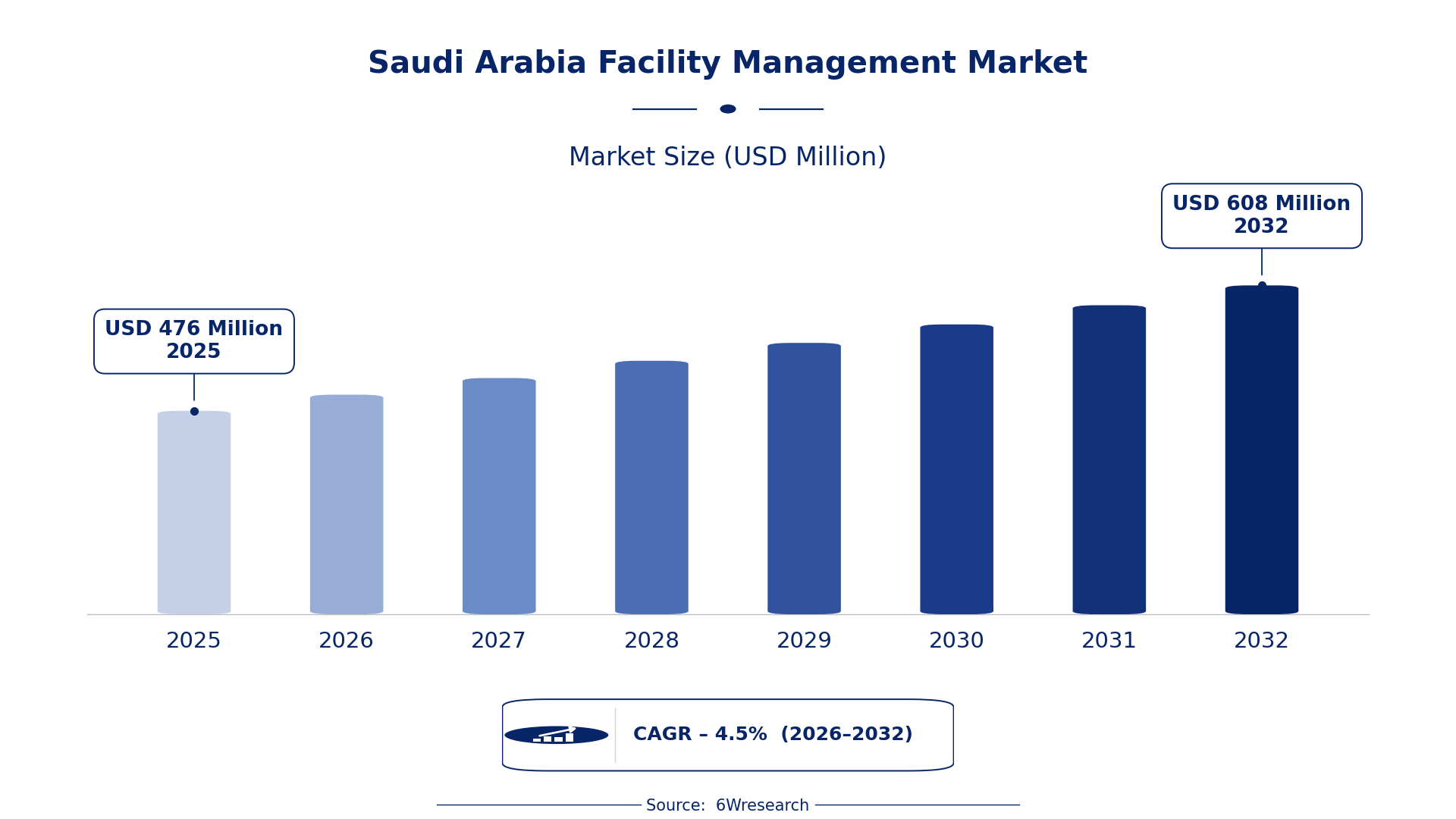
The Saudi Arabia Facility Management Market was estimated at USD 476 Million in 2025 and is projected to reach USD 608 Million by 2032, growing at a CAGR of 4.5% from 2026 to 2032.
Saudi Arabia Facility Management Market Synopsis
The Saudi Arabia Facility Management market is increasingly critical for companies striving to optimize their operational efficiency. With the growing emphasis on maintaining physical assets, organizations are seeking comprehensive solutions that encompass everything from maintenance to energy management, thereby ensuring their facilities run smoothly.
As the demand for well-managed facilities rises, the market is witnessing a transition towards advanced technological integration. Businesses are increasingly adopting smart technologies to enhance space utilization and streamline maintenance processes, which is transforming traditional facility management practices.
Saudi Arabia Facility Management Market Year-wise Growth Rate and Key Drivers
This graph illustrates the annual growth rates of the Saudi Arabia Facility Management Market from 2021 to 2032, highlighting a steady upward trajectory and projected expansion over the forecast period.
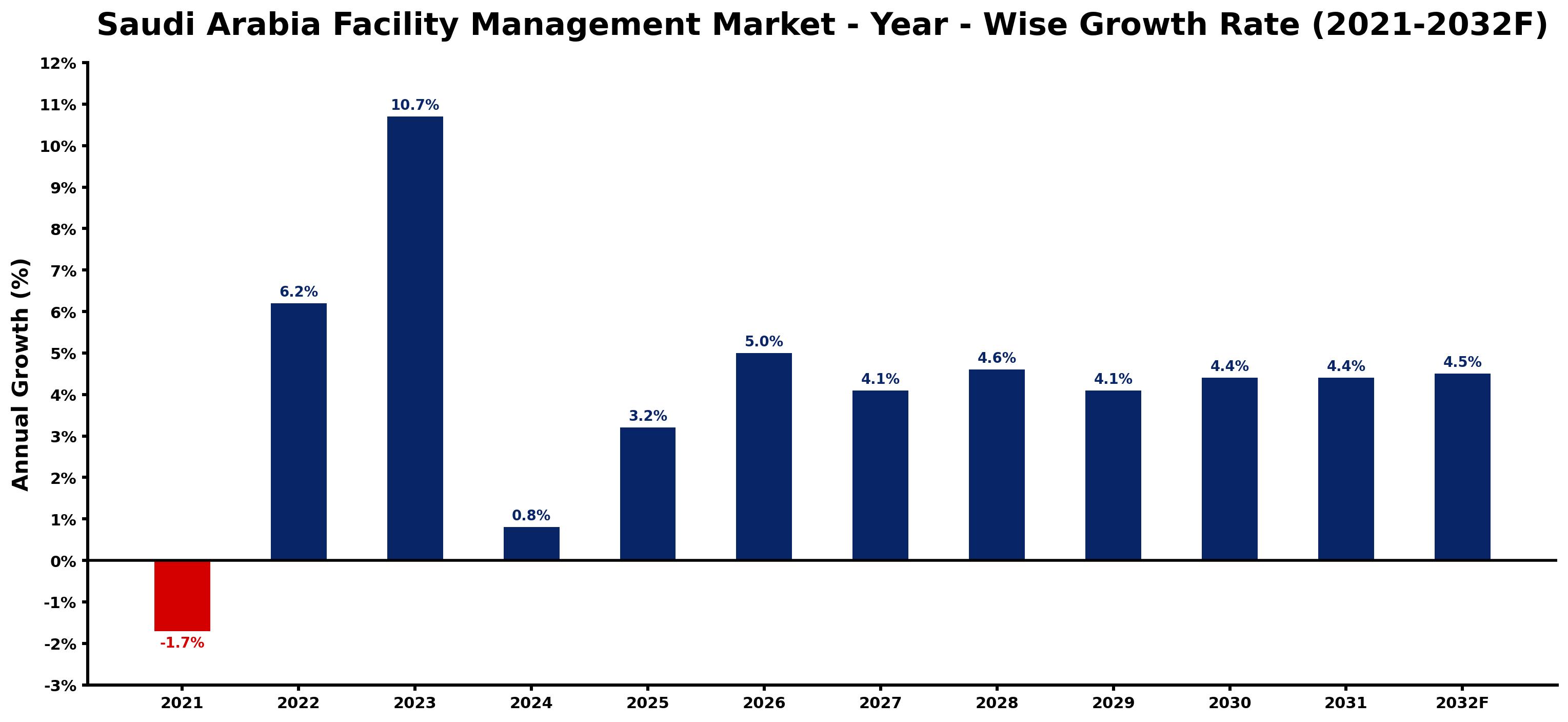
The table below presents the year‑wise growth rates along with the key drivers influencing the market
| Year | Growth Rate | Major Drivers |
| 2021 | -1.7% | Impact of Saudi Vision 2030 infrastructure delays |
| 2022 | 6.2% | Vision 2030 drives demand for efficient facilities management. |
| 2023 | 10.7% | Increased investments in mega-projects like NEOM boost services. |
| 2024 | 0.8% | Growing emphasis on sustainability mandates for facility operations. |
| 2025 | 3.2% | Rise in international events needing comprehensive management solutions. |
| 2026 | 5.0% | Local employment initiatives encourage hiring within facility management. |
| 2027 | 4.1% | Technology adoption in maintenance enhances operational efficiency. |
| 2028 | 4.6% | Regulatory changes support outsourcing of facility services. |
| 2029 | 4.1% | Tourism sector expansion increases facility management needs. |
| 2030 | 4.4% | Improved urban planning leads to higher facility management demand. |
| 2031 | 4.4% | Smart city developments require advanced facilities management solutions. |
| 2032 | 4.5% | Government focus on healthcare facilities boosts maintenance services. |
Note: Market size estimations and growth projections presented in this report are based on 6Wresearch's proprietary forecasting methodology, utilizing the latest available industry data, government publications, and primary research inputs.
Saudi Arabia Facility Management Market Key Takeaways
Below are some of the specific key takeaways from the market, including:
- Growing demand for facility management solutions is driven by the need for cost-effective operations and asset optimization.
- The integration of technology in facility management is reshaping service delivery and enhancing efficiency.
- Healthcare and commercial sectors are leading the charge in adopting advanced facility management practices.
- Government initiatives are increasingly supportive of the facility management sector, providing a conducive regulatory environment.
- COVID-19 has accelerated the need for enhanced safety measures in facility management solutions.
Evaluation of Restraints in Saudi Arabia Facility Management Market
Despite the growth potential, the Saudi Arabia Facility Management market faces notable restraints. Many organizations struggle with optimizing facility operations due to outdated management systems and a lack of accurate data. This inefficiency can lead to increased maintenance costs and hinder the overall workplace experience. Additionally, the limited awareness of advanced facility management solutions and their benefits restricts market adoption, particularly among smaller enterprises.
Saudi Arabia Facility Management Market Trends
One of the most significant trends shaping the Saudi Arabia Facility Management market is the adoption of smart building technologies. Companies are increasingly investing in IoT and AI-driven solutions that enhance energy management and predictive maintenance. on top of that, there is a growing focus on sustainability, with many organizations looking to reduce their environmental footprint through eco-friendly practices and energy-efficient systems.
Additionally, the rise of flexible workspaces is prompting organizations to rethink their facility management strategies. As businesses adapt to hybrid work models, the demand for versatile spaces that cater to different work styles is increasing, necessitating innovative space management solutions.
Saudi Arabia Facility Management Market Opportunities
The future of the Saudi Arabia Facility Management market is ripe with opportunities. Organizations are increasingly investing in technology to streamline operations, leading to a demand for innovative facility management software. This trend is particularly evident in sectors like healthcare, where the need for efficient management of facilities is paramount. on top of that, government-backed infrastructure projects present significant opportunities for facility management firms to engage in large-scale operations.
As businesses continue to prioritize employee wellbeing and sustainability, there is an opportunity for facility management providers to offer tailored solutions that meet these evolving demands. The market is set for growth, driven by a combination of technological advancements and shifting organizational priorities.
Government Initiatives in the Saudi Arabia Facility Management Market
Government policies are increasingly shaping the dynamics of the Saudi Arabia Facility Management market, promoting modernization and efficiency. The focus on improving public-sector infrastructure and ensuring regulatory compliance is paving the way for enhanced facility management practices across various sectors.
- A recently completed initiative aimed at upgrading public healthcare facilities has emphasized the importance of effective facility management in improving service delivery.
- Current efforts include the implementation of a national strategy to promote smart city initiatives, enhancing facility management integration into urban development projects.
- Upcoming regulations planned for 2026 will mandate stricter compliance with safety and maintenance standards in facility operations.
- Ongoing public-private partnerships are being established to facilitate investment in advanced facility management technologies.
- A regulatory framework introduced in 2024 aims to streamline facility management services across various sectors, ensuring quality and efficiency.
Future Insights of the Saudi Arabia Facility Management Market
Looking ahead to 2026-2032, the Saudi Arabia Facility Management market is likely to experience substantial growth. The integration of technology will continue to play a crucial role, with organizations increasingly adopting smart solutions to enhance operational efficiency. As the market matures, the focus will shift towards creating sustainable and adaptable facilities that meet the evolving needs of businesses and their employees. The emphasis on compliance with government regulations will also drive the demand for high-quality facility management services.
Saudi Arabia Facility Management Market Latest Developments
In the past year, the Saudi Arabia Facility Management market has seen a surge in activity, reflecting the heightened demand for advanced solutions. Companies are actively exploring partnerships and investing in new technologies to stay competitive. This momentum indicates a clear trend towards modernization and efficiency in facility management practices.
- A leading regional operator launched a new facility management software platform in early 2025, designed to enhance operational efficiency and data accuracy.
- An ongoing initiative, started in mid-2025, focuses on training programs aimed at upskilling facility management professionals in emerging technologies.
- A significant service upgrade was rolled out in Q1 2025, enhancing energy management capabilities across various commercial properties.
- A major technology vendor announced plans for a rollout of IoT-enabled devices for facility management solutions expected to begin in the second half of 2026.
- A collaboration between several firms is currently underway, aimed at developing a comprehensive facility management framework to support sustainability initiatives.
Saudi Arabia Facility Management Market - Key Attractiveness of the Report
- 10 Years of Market Numbers
- Historical Data Starting from 2022 to 2025
- Base Year: 2025
- Forecast Data until 2032
- Key Performance Indicators Impacting the Market
- Major Upcoming Developments and Projects
Key Highlights of the Report:
- Saudi Arabia Facility Management Market Outlook
- Market Size of Saudi Arabia Facility Management Market, 2025
- Forecast of Saudi Arabia Facility Management Market, 2032
- Historical Data and Forecast of Saudi Arabia Facility Management Revenues & Volume for the Period 2022-2032F
- Saudi Arabia Facility Management Market Trend Evolution
- Saudi Arabia Facility Management Market Drivers and Challenges
- Saudi Arabia Facility Management Price Trends
- Saudi Arabia Facility Management Porter's Five Forces
- Saudi Arabia Facility Management Industry Life Cycle
- Historical Data and Forecast of Saudi Arabia Facility Management Market Revenues & Volume By Component for the Period 2022-2032F
- Historical Data and Forecast of Saudi Arabia Facility Management Market Revenues & Volume By Solutions for the Period 2022-2032F
- Historical Data and Forecast of Saudi Arabia Facility Management Market Revenues & Volume By Services for the Period 2022-2032F
- Historical Data and Forecast of Saudi Arabia Facility Management Market Revenues & Volume By Deployment Mode for the Period 2022-2032F
- Historical Data and Forecast of Saudi Arabia Facility Management Market Revenues & Volume By Cloud for the Period 2022-2032F
- Historical Data and Forecast of Saudi Arabia Facility Management Market Revenues & Volume By On-premises for the Period 2022-2032F
- Historical Data and Forecast of Saudi Arabia Facility Management Market Revenues & Volume By Organization Size for the Period 2022-2032F
- Historical Data and Forecast of Saudi Arabia Facility Management Market Revenues & Volume By Large enterprises for the Period 2022-2032F
- Historical Data and Forecast of Saudi Arabia Facility Management Market Revenues & Volume By Small and medium-sized enterprises (SMEs) for the Period 2022-2032F
- Historical Data and Forecast of Saudi Arabia Facility Management Market Revenues & Volume By Vertical for the Period 2022-2032F
- Historical Data and Forecast of Saudi Arabia Facility Management Market Revenues & Volume By BFSI for the Period 2022-2032F
- Historical Data and Forecast of Saudi Arabia Facility Management Market Revenues & Volume By IT and Telecom for the Period 2022-2032F
- Historical Data and Forecast of Saudi Arabia Facility Management Market Revenues & Volume By Government and Public Administration for the Period 2022-2032F
- Historical Data and Forecast of Saudi Arabia Facility Management Market Revenues & Volume By Healthcare for the Period 2022-2032F
- Historical Data and Forecast of Saudi Arabia Facility Management Market Revenues & Volume By Education for the Period 2022-2032F
- Historical Data and Forecast of Saudi Arabia Facility Management Market Revenues & Volume By Retail for the Period 2022-2032F
- Historical Data and Forecast of Saudi Arabia Facility Management Market Revenues & Volume By Energy and Utilities for the Period 2022-2032F
- Historical Data and Forecast of Saudi Arabia Facility Management Market Revenues & Volume By Manufacturing for the Period 2022-2032F
- Saudi Arabia Facility Management Import Export Trade Statistics
- Market Opportunity Assessment By Component
- Market Opportunity Assessment By Deployment Mode
- Market Opportunity Assessment By Organization Size
- Market Opportunity Assessment By Vertical
- Saudi Arabia Facility Management Top Companies Market Share
- Saudi Arabia Facility Management Competitive Benchmarking By Technical and Operational Parameters
- Saudi Arabia Facility Management Company Profiles
- Saudi Arabia Facility Management Key Strategic Recommendations






































