Saudi Arabia Fatty alcohols Market (2026-2032) | Share, Revenue, Value, Growth, Forecast, Analysis, Size, Trends, Companies, Industry
Market Forecast By Type (Short Chain, Pure and Mid Cut, Long Chain, Higher Chain), By Application (Industrial & Domestic Cleaning, Personal Care, Plasticizers, Lubricants, Pharmaceutical Formulation, Food & Nutrition, Others) And Competitive Landscape
| Product Code: ETC096058 | Publication Date: Jun 2021 | Updated Date: Mar 2026 | Product Type: Report | |
| Publisher: 6Wresearch | Author: Ravi Bhandari | No. of Pages: 70 | No. of Figures: 35 | No. of Tables: 5 |
Saudi Arabia Fatty Alcohols Market: Import Trend Analysis
In 2024, Saudi Arabia`s import trend for fatty alcohols experienced a notable decline, with a growth rate of -22.04% compared to the previous year. However, the compound annual growth rate (CAGR) for the period 2020-2024 stood at a robust 40.32%. This dip in import momentum could be attributed to shifts in demand dynamics or alterations in trade policies impacting the market stability.
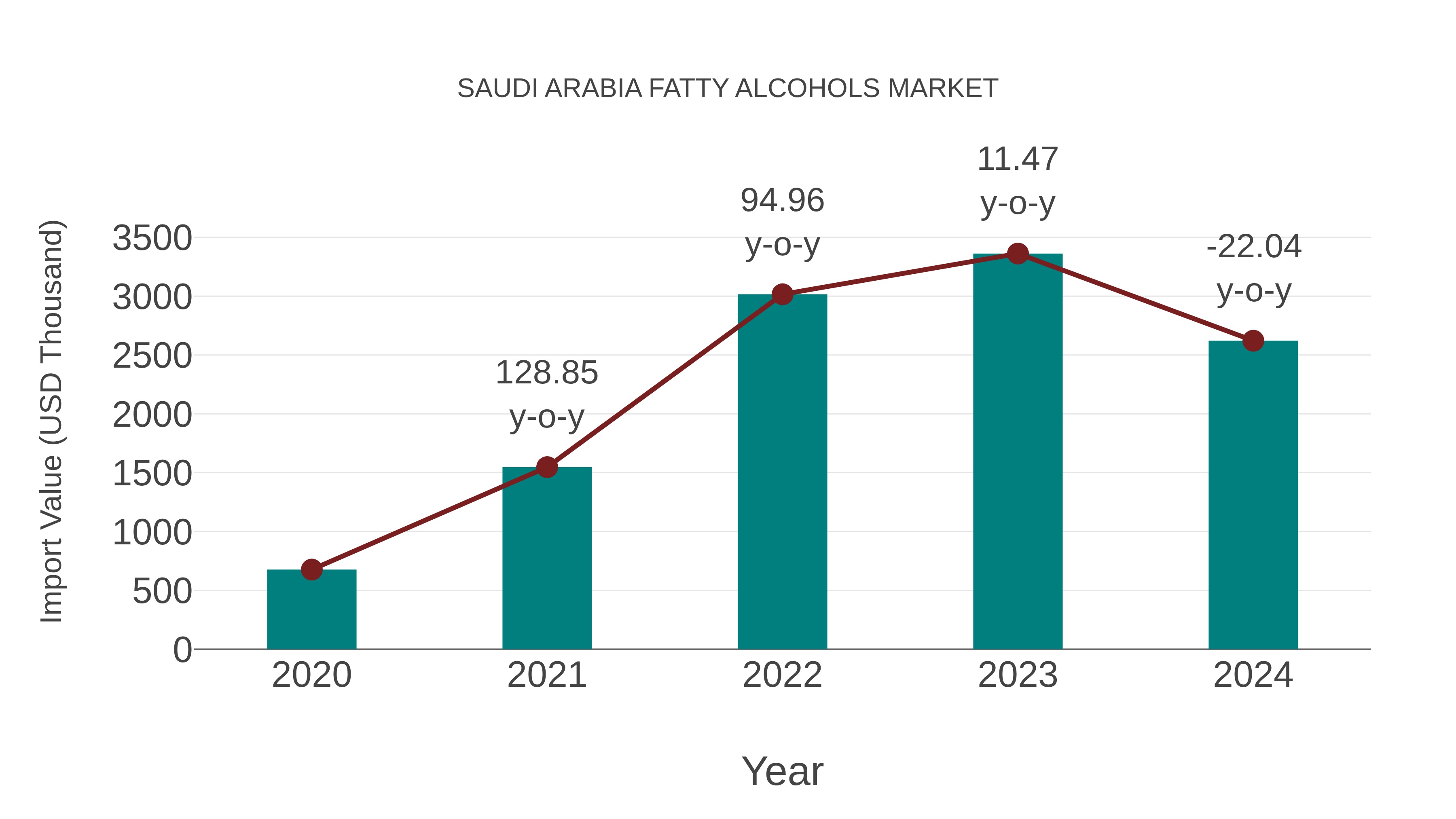
Saudi Arabia Fatty Alcohols Market Growth Rate
According to 6Wresearch internal database and industry insights, the Saudi Arabia Fatty Alcohols Market is projected to grow at a compound annual growth rate (CAGR) of 6.1% during the forecast period 2026–2032.
Topics Covered in the Saudi Arabia Fatty Alcohols Market Report
The Saudi Arabia Fatty Alcohols Market report thoroughly covers the market by type and application. It provides an unbiased and detailed analysis of ongoing market trends, opportunities, challenges, and market drivers, helping stakeholders align their strategies with current and future market dynamics.
Saudi Arabia Fatty Alcohols Market Highlights
| Report Name | Saudi Arabia Fatty Alcohols Market |
| Forecast period | 2026-2032 |
| CAGR | 6.1% |
| Growing Sector |
Personal Care & Industrial Chemicals |
Saudi Arabia Fatty Alcohols Market Synopsis
The Saudi Arabia Fatty Alcohols Market is expected to witness steady growth during the forecast period, attributed to increasing demand from end‑use industries such as personal care, industrial and domestic cleaning, lubricants, and plasticizers. Fatty alcohols, which are key ingredients in surfactants, emulsifiers, and viscosity regulators, are critical for manufacturing detergents, shampoos, creams, and other consumer products. Growth in the FMCG sector, expansion of the chemical and pharmaceutical industries, and rising consumer spending are driving market expansion.
Evaluation of Growth Drivers in the Saudi Arabia Fatty Alcohols Market
Below mentioned are some prominent drivers and their influence on the Saudi Arabia Fatty Alcohols Market dynamics:
| Drivers | Primary Segment Affected | Why It Matters |
| Personal Care Industry Growth | Personal Care | Higher demand for shampoos, lotions, and creams increases fatty alcohol consumption. |
| Cleaning Products Demand | Industrial & Domestic Cleaning | Expansion of industrial and household cleaning product manufacturing boosts fatty alcohol usage. |
| Pharmaceutical Applications | Pharmaceutical Formulation | Market Growth is accelerated through usage of fatty alcohols as excipients in drug formulations. |
| Food & Nutrition Uses | Food & Nutrition | Rising applications of fatty alcohol derivatives in food emulsifiers accelerates demand. |
The Saudi Arabia Fatty Alcohols Market is expected to experience steady growth with a projected CAGR of 6.1% from 2026 to 2032. Rising deployment of fatty alcohols in personal care, industrial, and food & nutrition sectors, along with increasing allocation of funds in chemical production infrastructure, significantly influences market expansion. The rising concentration on sustainable and eco‑friendly formulations in personal care products and cleaning agents is expected to proliferate further need for bio‑based and natural fatty alcohol alternatives, further spurring Saudi Arabia Fatty Alcohols Market Growth.
Evaluation of Restraints in the Saudi Arabia Fatty Alcohols Market
Below mentioned are some major restraints and their influence on the Saudi Arabia Fatty Alcohols Market dynamics:
| Restraints | Primary Segment Affected | What This Means |
| Fluctuating Raw Material Prices | All Segments | Volatility in feedstock costs (e.g., palm oil, lauryl alcohol precursors) can impact product pricing. |
| Environmental Compliance Costs | All Segments | Due to meeting with environmental norms there is a rise in functional performance prices. |
| Import Dependency | All Segments | Dependability on imported fatty alcohols might obstruct capabilities of local production. |
| Technical Barriers | Specialty Applications | Advanced processing technology is required by high‑purity grades which are needed for pharmaceuticals |
Saudi Arabia Fatty Alcohols Market Challenges
The Saudi Arabia Fatty Alcohols Industry go through various challenges. They consist of volatility in raw material costs, strict environmental compliance standards, and a increased dependability on imports for certain fatty alcohol grades. Manufacturers must allocate money in advanced production technologies, to align with quality standards for high‑value applications like pharmaceuticals and food additives, domestic. Balancing price efficiency with sustainability objectives needs persistent creative innovation and optimization of manufacturing practices. The industry go through the challenge of aligning the rising need for customized fatty alcohols, which need major allocation of funds in R&D and specialized production capabilities.
Saudi Arabia Fatty Alcohols Market Trends
Several notable trends are shaping the Saudi Arabia Fatty Alcohols Market dynamics:
- Rising Surfactant Demand in Personal Care: rising consumption of fatty alcohols in surfactants for shampoos, soaps, and lotions.
- Growth of Cleaning Products: Higher fatty alcohol demand is proliferating owing to the growth of industrial & domestic cleaning segments.
- Pharmaceutical & Nutraceutical Growth: In nutraceutical formulations and pharmaceutical excipients there is high consumption of fatty alcohols which helps in their growth.
- Increased Consumption in Food Industry: Emulsifiers and stabilizers are there in food products in the form of fatty alcohols and derivatives.
Investment Opportunities in the Saudi Arabia Fatty Alcohols Industry
Some notable investment opportunities in the Saudi Arabia Fatty Alcohols Market include:
- Bio‑based Fatty Alcohol Production: To align with increasing demand for eco‑friendly products allocation of funds is there in manufacturing bio‑derived fatty alcohols from sustainable feedstocks.
- Specialty Grade Fatty Alcohols: Concentration on creating high‑purity fatty alcohols for pharmaceuticals and food applications, providing to regulatory and quality standards.
- Local Manufacturing Expansion: To decrease dependency on imported fatty alcohols and augmenting supply chain stability there is allocation of funds in setting up local production plants.
Top 5 Leading Players in the Saudi Arabia Fatty Alcohols Market
Below is the list of prominent companies leading in the Saudi Arabia Fatty Alcohols Market:
1. SABIC (Saudi Basic Industries Corporation)
| Company Name | SABIC (Saudi Basic Industries Corporation) |
|---|---|
| Established Year | 1976 |
| Headquarters | Riyadh, Saudi Arabia |
| Official Website | Click Here |
SABIC is a world-wide leader in the chemicals and petrochemicals industry and a key producer of fatty alcohols and related oleochemical products.
2. Sasol
| Company Name | Sasol |
|---|---|
| Established Year | 1950 |
| Headquarters | Sandton, South Africa |
| Official Website | Click Here |
Sasol is an incorporated energy and chemical company with a robust portfolio in specialty chemicals including fatty alcohols.
3. Wilmar International Ltd
| Company Name | Wilmar International Ltd |
|---|---|
| Established Year | 1991 |
| Headquarters | Singapore |
| Official Website | Click Here |
Wilmar International is a dominant agribusiness and oleochemicals supplier with a significant fatty alcohols portfolio. The company provides a range of intermediate and specialty fatty alcohols into Saudi Arabia’s competitive markets, including personal care and industrial formulations.
4. KLK OLEO
| Company Name | KLK OLEO |
|---|---|
| Established Year | 1907 |
| Headquarters | Kuala Lumpur, Malaysia |
| Official Website | Click Here |
KLK OLEO is a leading oleochemicals producer with extensive fatty alcohol offerings for global markets.
5. BASF SE
| Company Name | BASF SE |
|---|---|
| Established Year | 1865 |
| Headquarters | Ludwigshafen, Germany |
| Official Website | Click Here |
BASF SE is one of the world’s largest chemical producers, providing a broad range of fatty alcohols and derivatives.
Government Regulations Introduced in the Saudi Arabia Fatty Alcohols Market
According to Saudi Arabia’s government data, industrial policies and regulatory frameworks like the Chemical Safety Regulation, Environmental Protection Standards, and industrial licensing norms accelerate the fatty alcohols market. The Communications and Information Technology Commission (CITC) and Ministry of Energy makes guidelines for chemical import/export compliance, safety handling, and environmental affect mitigation. Policies aligned with Vision 2030 focusses on advancement of local chemical industries and sustainable manufacturing practices, encouraging downstream chemical production.
Future Insights of the Saudi Arabia Fatty Alcohols Market
The Saudi Arabia Fatty Alcohols Market is forecast to grow steadily as demand from personal care, cleaning products, and industrial applications increases. Future product offerings will get evolved through developments in bio‑based feedstock utilization and sustainable production technologies. To decrease reliability on imports, there are rising local manufacturing efforts which are encouraged by government initiatives. Improved concentration on specialty fatty alcohol grades for high‑value sectors like pharmaceuticals and food will make additional growth avenues. The increasing need for green and biodegradable substitutes in consumer products will further proliferate creative innovation in fatty alcohol formulations, making them more sustainable and eco‑friendly.
Market Segmentation Analysis
The report offers a comprehensive study of the subsequent market segments and their leading categories:
By Type – Pure and Mid Cut to Dominate the Market:
According to Mansi Ahuja, Senior Research Analyst at 6Wresearch, Pure and mid cut fatty alcohols are expected to dominate due to their versatile usage across detergents, personal care, and industrial applications.
By Application – Personal Care to Dominate the Market:
The personal care segment is projected to lead the Saudi Arabia Fatty Alcohols Market Share as demand for surfactants, emulsifiers, and conditioning agents continues to grow in grooming and cosmetic products.
Key Attractiveness of the Report
- 10 Years of Market Numbers.
- Historical Data Starting from 2022 to 2025.
- Base Year: 2025.
- Forecast Data until 2032.
- Key Performance Indicators Impacting the Market.
- Major Upcoming Developments and Projects.
Key Highlights of the Report:
- Saudi Arabia Fatty alcohols Market Outlook
- Market Size of Saudi Arabia Fatty alcohols Market, 2025
- Forecast of Saudi Arabia Fatty alcohols Market, 2032
- Historical Data and Forecast of Saudi Arabia Fatty alcohols Revenues & Volume for the Period 2022-2032
- Saudi Arabia Fatty alcohols Market Trend Evolution
- Saudi Arabia Fatty alcohols Market Drivers and Challenges
- Saudi Arabia Fatty alcohols Price Trends
- Saudi Arabia Fatty alcohols Porter's Five Forces
- Saudi Arabia Fatty alcohols Industry Life Cycle
- Historical Data and Forecast of Saudi Arabia Fatty alcohols Market Revenues & Volume By Type for the Period 2022-2032
- Historical Data and Forecast of Saudi Arabia Fatty alcohols Market Revenues & Volume By Short Chain for the Period 2022-2032
- Historical Data and Forecast of Saudi Arabia Fatty alcohols Market Revenues & Volume By Pure and Mid Cut for the Period 2022-2032
- Historical Data and Forecast of Saudi Arabia Fatty alcohols Market Revenues & Volume By Long Chain for the Period 2022-2032
- Historical Data and Forecast of Saudi Arabia Fatty alcohols Market Revenues & Volume By Higher Chain for the Period 2022-2032
- Historical Data and Forecast of Saudi Arabia Fatty alcohols Market Revenues & Volume By Application for the Period 2022-2032
- Historical Data and Forecast of Saudi Arabia Fatty alcohols Market Revenues & Volume By Industrial & Domestic Cleaning for the Period 2022-2032
- Historical Data and Forecast of Saudi Arabia Fatty alcohols Market Revenues & Volume By Personal Care for the Period 2022-2032
- Historical Data and Forecast of Saudi Arabia Fatty alcohols Market Revenues & Volume By Plasticizers for the Period 2022-2032
- Historical Data and Forecast of Saudi Arabia Fatty alcohols Market Revenues & Volume By Lubricants for the Period 2022-2032
- Historical Data and Forecast of Saudi Arabia Fatty alcohols Market Revenues & Volume By Pharmaceutical Formulation for the Period 2022-2032
- Historical Data and Forecast of Saudi Arabia Fatty alcohols Market Revenues & Volume By Food & Nutrition for the Period 2022-2032
- Historical Data and Forecast of Saudi Arabia Fatty alcohols Market Revenues & Volume By Others for the Period 2022-2032
- Saudi Arabia Fatty alcohols Import Export Trade Statistics
- Market Opportunity Assessment By Type
- Market Opportunity Assessment By Application
- Saudi Arabia Fatty alcohols Top Companies Market Share
- Saudi Arabia Fatty alcohols Competitive Benchmarking By Technical and Operational Parameters
- Saudi Arabia Fatty alcohols Company Profiles
- Saudi Arabia Fatty alcohols Key Strategic Recommendations
Market Covered
The report offers a comprehensive study of the following segments:
By Type
- Short Chain
- Pure and Mid Cut
- Long Chain
- Higher Chain
By Application
- Industrial & Domestic Cleaning
- Personal Care
- Plasticizers
- Lubricants
- Pharmaceutical Formulation
- Food & Nutrition
- Others
Saudi Arabia Fatty alcohols Market (2026-2032): FAQs
The Saudi Arabia Fatty Alcohols Market is expected to grow at a CAGR of 6.1% during the forecast period.
Growth is driven by increasing demand from personal care, cleaning products, and industrial applications.
Challenges include raw material price volatility, environmental compliance, and import dependency.
Opportunities are present in bio based fatty alcohols, specialty grade development, and local manufacturing.
6Wresearch actively monitors the Saudi Arabia Fatty alcohols Market and publishes its comprehensive annual report, highlighting emerging trends, growth drivers, revenue analysis, and forecast outlook. Our insights help businesses to make data-backed strategic decisions with ongoing market dynamics. Our analysts track relevent industries related to the Saudi Arabia Fatty alcohols Market, allowing our clients with actionable intelligence and reliable forecasts tailored to emerging regional needs.
Yes, we provide customisation as per your requirements. To learn more, feel free to contact us on sales@6wresearch.com
| 1 Executive Summary |
| 2 Introduction |
| 2.1 Key Highlights of the Report |
| 2.2 Report Description |
| 2.3 Market Scope & Segmentation |
| 2.4 Research Methodology |
| 2.5 Assumptions |
| 3 Saudi Arabia Fatty alcohols Market Overview |
| 3.1 Saudi Arabia Country Macro Economic Indicators |
| 3.2 Saudi Arabia Fatty alcohols Market Revenues & Volume, 2022 & 2032F |
| 3.3 Saudi Arabia Fatty alcohols Market - Industry Life Cycle |
| 3.4 Saudi Arabia Fatty alcohols Market - Porter's Five Forces |
| 3.5 Saudi Arabia Fatty alcohols Market Revenues & Volume Share, By Type, 2022 & 2032F |
| 3.6 Saudi Arabia Fatty alcohols Market Revenues & Volume Share, By Application, 2022 & 2032F |
| 4 Saudi Arabia Fatty alcohols Market Dynamics |
| 4.1 Impact Analysis |
| 4.2 Market Drivers |
| 4.2.1 Growing demand for personal care and home care products in Saudi Arabia |
| 4.2.2 Increasing use of fatty alcohols in the pharmaceutical industry |
| 4.2.3 Rise in disposable income and changing lifestyle preferences in the region |
| 4.3 Market Restraints |
| 4.3.1 Fluctuating prices of raw materials such as palm oil and coconut oil |
| 4.3.2 Stringent regulations and environmental concerns related to the production of fatty alcohols |
| 4.3.3 Competition from alternative surfactants and emollients in the market |
| 5 Saudi Arabia Fatty alcohols Market Trends |
| 6 Saudi Arabia Fatty alcohols Market, By Types |
| 6.1 Saudi Arabia Fatty alcohols Market, By Type |
| 6.1.1 Overview and Analysis |
| 6.1.2 Saudi Arabia Fatty alcohols Market Revenues & Volume, By Type, 2022-2032F |
| 6.1.3 Saudi Arabia Fatty alcohols Market Revenues & Volume, By Short Chain, 2022-2032F |
| 6.1.4 Saudi Arabia Fatty alcohols Market Revenues & Volume, By Pure and Mid Cut, 2022-2032F |
| 6.1.5 Saudi Arabia Fatty alcohols Market Revenues & Volume, By Long Chain, 2022-2032F |
| 6.1.6 Saudi Arabia Fatty alcohols Market Revenues & Volume, By Higher Chain, 2022-2032F |
| 6.2 Saudi Arabia Fatty alcohols Market, By Application |
| 6.2.1 Overview and Analysis |
| 6.2.2 Saudi Arabia Fatty alcohols Market Revenues & Volume, By Industrial & Domestic Cleaning, 2022-2032F |
| 6.2.3 Saudi Arabia Fatty alcohols Market Revenues & Volume, By Personal Care, 2022-2032F |
| 6.2.4 Saudi Arabia Fatty alcohols Market Revenues & Volume, By Plasticizers, 2022-2032F |
| 6.2.5 Saudi Arabia Fatty alcohols Market Revenues & Volume, By Lubricants, 2022-2032F |
| 6.2.6 Saudi Arabia Fatty alcohols Market Revenues & Volume, By Pharmaceutical Formulation, 2022-2032F |
| 6.2.7 Saudi Arabia Fatty alcohols Market Revenues & Volume, By Food & Nutrition, 2022-2032F |
| 7 Saudi Arabia Fatty alcohols Market Import-Export Trade Statistics |
| 7.1 Saudi Arabia Fatty alcohols Market Export to Major Countries |
| 7.2 Saudi Arabia Fatty alcohols Market Imports from Major Countries |
| 8 Saudi Arabia Fatty alcohols Market Key Performance Indicators |
| 8.1 Average selling price of fatty alcohols in Saudi Arabia |
| 8.2 Percentage of fatty alcohol usage in personal care and home care products |
| 8.3 Number of new product launches containing fatty alcohols in the market |
| 9 Saudi Arabia Fatty alcohols Market - Opportunity Assessment |
| 9.1 Saudi Arabia Fatty alcohols Market Opportunity Assessment, By Type, 2022 & 2032F |
| 9.2 Saudi Arabia Fatty alcohols Market Opportunity Assessment, By Application, 2022 & 2032F |
| 10 Saudi Arabia Fatty alcohols Market - Competitive Landscape |
| 10.1 Saudi Arabia Fatty alcohols Market Revenue Share, By Companies, 2025 |
| 10.2 Saudi Arabia Fatty alcohols Market Competitive Benchmarking, By Operating and Technical Parameters |
| 11 Company Profiles |
| 12 Recommendations |
| 13 Disclaimer |
Global Go To Market Strategy - 2030
Export potential enables firms to identify high-growth global markets with greater confidence by combining advanced trade intelligence with a structured quantitative methodology. The framework analyzes emerging demand trends and country-level import patterns while integrating macroeconomic and trade datasets such as GDP and population forecasts, bilateral import–export flows, tariff structures, elasticity differentials between developed and developing economies, geographic distance, and import demand projections. Using weighted trade values from 2020–2024 as the base period to project country-to-country export potential for 2030, these inputs are operationalized through calculated drivers such as gravity model parameters, tariff impact factors, and projected GDP per-capita growth. Through an analysis of hidden potentials, demand hotspots, and market conditions that are most favorable to success, this method enables firms to focus on target countries, maximize returns, and global expansion with data, backed by accuracy.
By factoring in the projected importer demand gap that is currently unmet and could be potential opportunity, it identifies the potential for the Exporter (Country) among 190 countries, against the general trade analysis, which identifies the biggest importer or exporter.
To discover high-growth global markets and optimize your business strategy:
Click Here
Pricing
- Single User License$ 1,995
- Department License$ 2,400
- Site License$ 3,120
- Global License$ 3,795

Leadership Perspectives from Industry Events
Search
Thought Leadership and Analyst Meet





Our Clients








6WResearch In News
- India Air Conditioner Market Set for Strong Rebound in 2026 After Weather-Led Correction and GST-Driven Recovery: 6Wresearch
- ADAS in India: How Automatic Emergency Braking, Blind Spot Detection & Driver Monitoring are Transforming Road Safety
- Doha a strategic location for EV manufacturing hub: IPA Qatar
- Demand for luxury TVs surging in the GCC, says Samsung
- Empowering Growth: The Thriving Journey of Bangladesh’s Cable Industry
- Demand for luxury TVs surging in the GCC, says Samsung
Latest Reports
- Nicaragua RPG Gaming Market (2026-2032)
- New Zealand RPG Gaming Market (2026-2032)
- Netherlands RPG Gaming Market (2026-2032)
- Nauru RPG Gaming Market (2026-2032)
- Namibia RPG Gaming Market (2026-2032)
- Mozambique RPG Gaming Market (2026-2032)
- Montenegro RPG Gaming Market (2026-2032)
- Mongolia RPG Gaming Market (2026-2032)
- Monaco RPG Gaming Market (2026-2032)
- Micronesia RPG Gaming Market (2026-2032)
Industry Events and Analyst Meet

EV India Expo 2026

HIMTEX 2026

India Refining Summit 2026

India EV Show 2026

EV tech India Expo 2026
Whitepaper
- Middle East & Africa Commercial Security Market Click here to view more.
- Middle East & Africa Fire Safety Systems & Equipment Market Click here to view more.
- GCC Drone Market Click here to view more.
- Middle East Lighting Fixture Market Click here to view more.
- GCC Physical & Perimeter Security Market Click here to view more.


