Saudi Arabia Ferrochrome Market: Import Trend Analysis
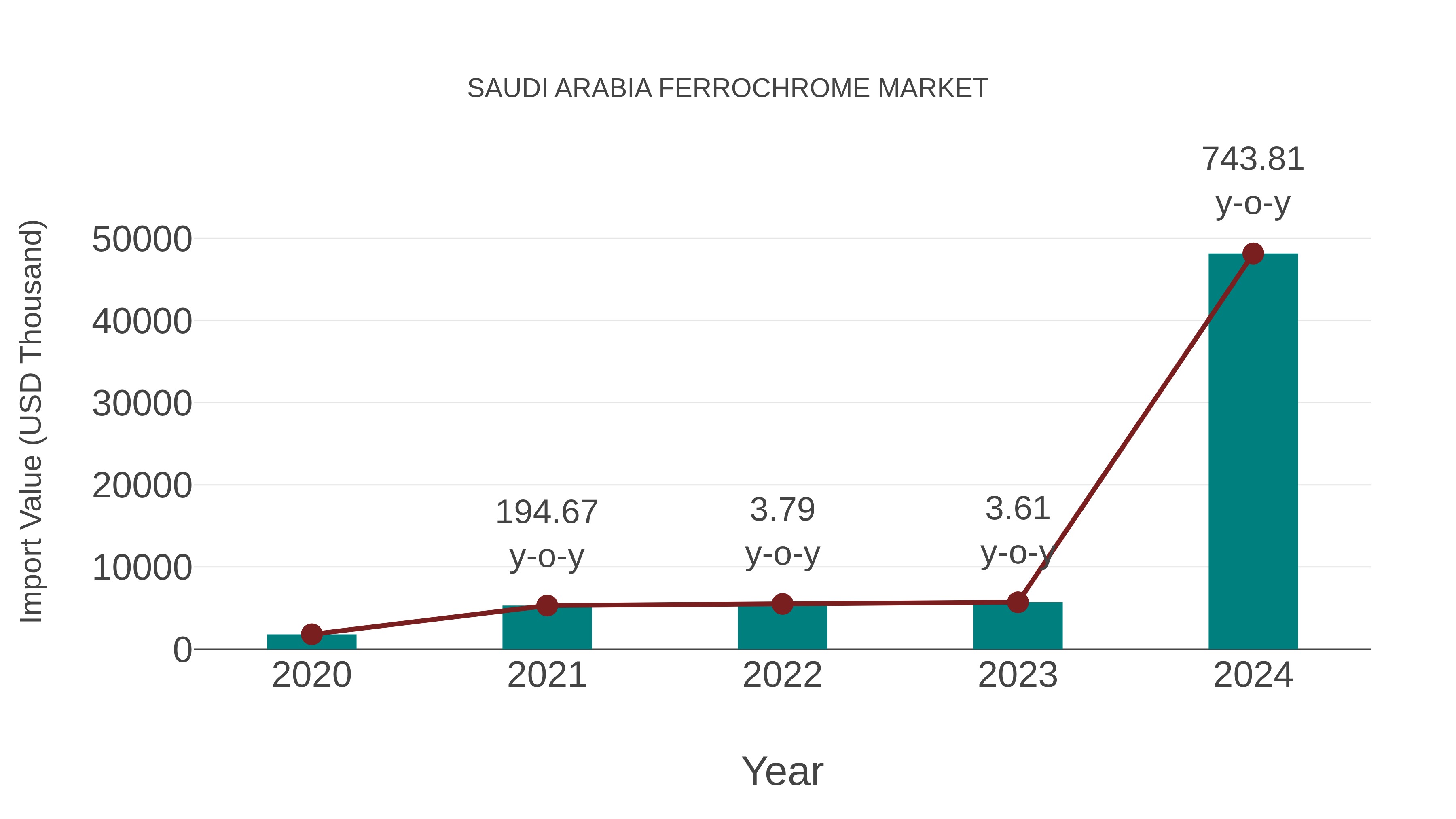
The Saudi Arabia ferrochrome market witnessed a substantial import momentum from 2023 to 2024, with a growth rate of 743.81%. The compound annual growth rate (CAGR) for imports during 2020-2024 stood at an impressive 127.4%. This surge in imports can be attributed to a significant demand shift within the market, likely driven by evolving industrial needs or changes in trade policies.
Saudi Arabia Ferrochrome Market Synopsis
The Saudi Arabia ferrochrome market is essential for the steel and metallurgy industries.Ferrochrome is used as an alloying agent in stainless steel production.Key market players supply high-quality ferrochrome products for steel manufacturing processes.As Saudi Arabia continues to invest in construction and infrastructure, the demand for stainless steel and ferrochrome is expected to grow, with potential for customized alloy formulations and corrosion-resistant materials.
Drivers of the Market
The Saudi Arabia ferrochrome market is set to grow due to its applications in stainless steel production and industrial sectors.Ferrochrome is an essential alloying element in stainless steel.As Saudi Arabia`s construction and manufacturing sectors expand, the demand for stainless steel products is likely to rise.The country`s industrial growth and infrastructure development contribute to the positive market outlook.
Challenges of the Market
The Saudi Arabia ferrochrome market may face challenges linked to raw material availability, energy efficiency, and market dynamics.Ferrochrome, used in stainless steel production, relies on chromite ore supply.Securing a stable and sustainable chromite ore supply poses challenges.Moreover, optimizing ferrochrome smelting processes to reduce energy consumption and environmental impact requires continuous improvement efforts.Addressing fluctuations in stainless steel demand and market competition for ferrochrome products presents complexities for market growth.
COVID-19 Impact on the Market
The Saudi Arabia Ferrochrome market faced challenges and opportunities during the COVID-19 pandemic.Initially, disruptions in global supply chains affected ferrochrome production.However, the market rebounded as ferrochrome found applications in stainless steel manufacturing and infrastructure projects.Manufacturers adapted by optimizing production processes and ensuring a stable supply of ferrochrome, addressing the demand from construction and metallurgical sectors, and contributing to market stability and growth.
Key Players in the Market
Prominent players in the Saudi Arabia ferrochrome market comprise Ferrochrome Arabia, Saudi Metal Alloys, and Arabia Ferro Alloys.These companies are engaged in the production and distribution of ferrochrome, a vital alloy used in the steel and stainless steel industries.They are essential suppliers, contributing to the enhancement of steel properties and corrosion resistance.These key players prioritize alloy composition, metallurgical expertise, and adherence to industry standards in their ferrochrome products.
Key Highlights of the Report:
- Saudi Arabia Ferrochrome Market Outlook
- Market Size of Saudi Arabia Ferrochrome Market, 2025
- Forecast of Saudi Arabia Ferrochrome Market, 2032
- Historical Data and Forecast of Saudi Arabia Ferrochrome Revenues & Volume for the Period 2022-2032F
- Saudi Arabia Ferrochrome Market Trend Evolution
- Saudi Arabia Ferrochrome Market Drivers and Challenges
- Saudi Arabia Ferrochrome Price Trends
- Saudi Arabia Ferrochrome Porter's Five Forces
- Saudi Arabia Ferrochrome Industry Life Cycle
- Historical Data and Forecast of Saudi Arabia Ferrochrome Market Revenues & Volume By Type for the Period 2022-2032F
- Historical Data and Forecast of Saudi Arabia Ferrochrome Market Revenues & Volume By High carbon for the Period 2022-2032F
- Historical Data and Forecast of Saudi Arabia Ferrochrome Market Revenues & Volume By Medium carbon for the Period 2022-2032F
- Historical Data and Forecast of Saudi Arabia Ferrochrome Market Revenues & Volume By Low carbon for the Period 2022-2032F
- Historical Data and Forecast of Saudi Arabia Ferrochrome Market Revenues & Volume By Applications for the Period 2022-2032F
- Historical Data and Forecast of Saudi Arabia Ferrochrome Market Revenues & Volume By Stainless steel for the Period 2022-2032F
- Historical Data and Forecast of Saudi Arabia Ferrochrome Market Revenues & Volume By Other steels for the Period 2022-2032F
- Saudi Arabia Ferrochrome Import Export Trade Statistics
- Market Opportunity Assessment By Type
- Market Opportunity Assessment By Applications
- Saudi Arabia Ferrochrome Top Companies Market Share
- Saudi Arabia Ferrochrome Competitive Benchmarking By Technical and Operational Parameters
- Saudi Arabia Ferrochrome Company Profiles
- Saudi Arabia Ferrochrome Key Strategic Recommendations






































