Saudi Arabia Fertilizer Market: Import Trend Analysis
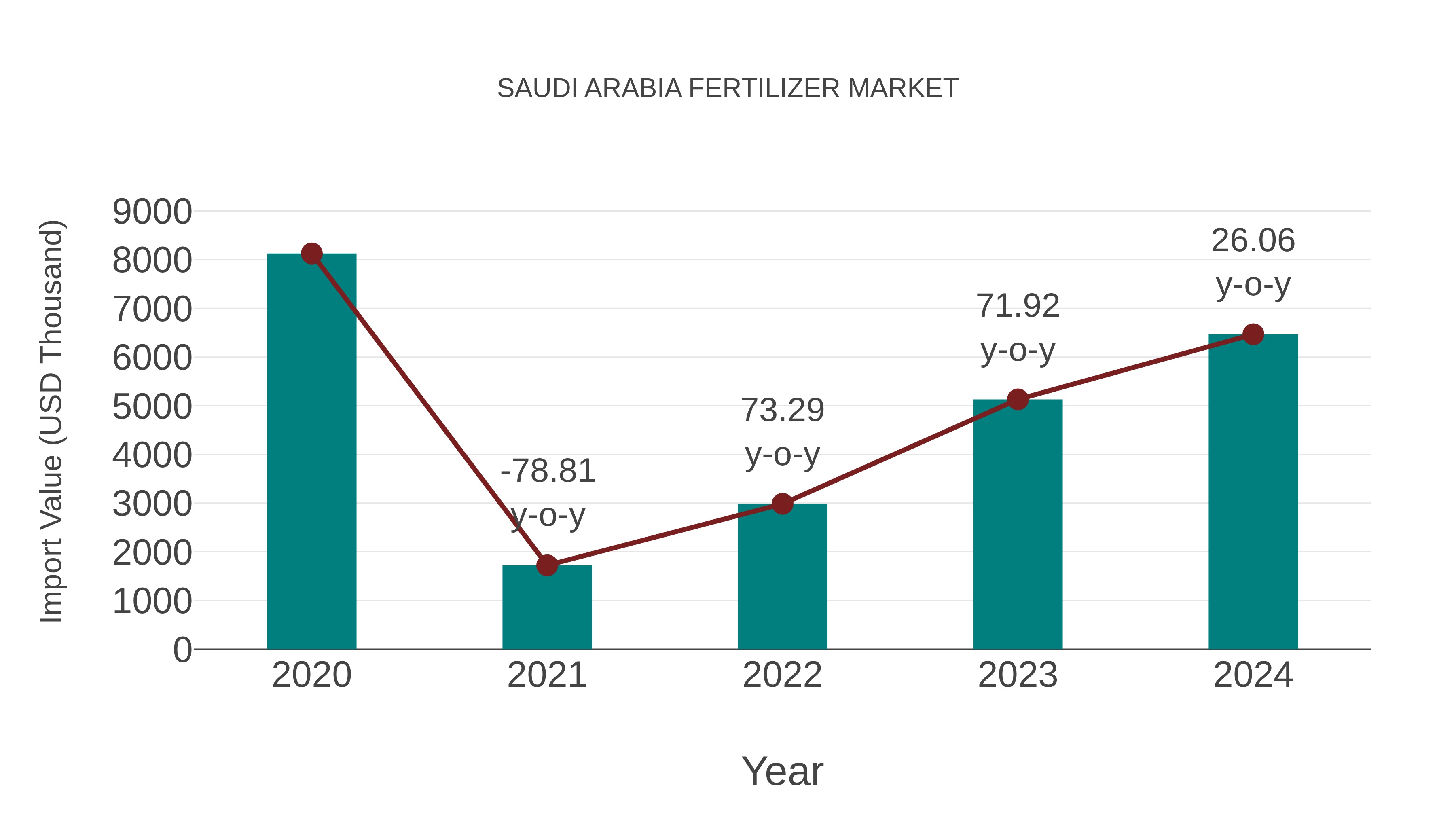
In the Saudi Arabia fertilizer market, the import trend showed a notable growth rate of 26.06% from 2023 to 2024, contrasting with a compound annual growth rate (CAGR) of -5.55% for the period of 2020-2024. This shift could be attributed to a potential recovery in market demand or adjustments in trade policies influencing import momentum.
Saudi Arabia Fertilizer Market Synopsis
The Saudi Arabia fertilizer market is estimated to grow at a CAGR of 5.5% during the forecast period 2025-2031 and reach US$ 3,588.3 million by 2031. The rising demand for food crops, increased production of cereals and other crops due to increasing population are some of the major factors driving the growth of Saudi Arabia fertilizer market. The country has emerged as one of the leading markets in Middle East & North Africa (MENA) region for various types of fertilizers such as nitrogenous, phosphate, and potash fertilizers among others owing to its strong agricultural sector which supports crop production activities with large scale use of modern inputs including crop protection chemicals and fertilizers.
Market Drivers
Increasing population has led to a rise in demand for food grains across the globe including Saudi Arabia which is expected to propel demand for fertilizer over the forecast period. In order to meet this surging requirement, farmers have started using extensive amount of chemical fertilizers along with manure/organic manures so as to enhance their overall yield from limited land resources available in countries like Saudi Arabia. This eventually will create positive impact on global fertilizer market over forthcoming years thus becoming a major driver behind its growth throughout forecast period 2025-2031 . Expansion in agriculture sector particularly due rising government initiatives towards development of farmlands mainly through financial schemes is further expected drive up sales within this industry over coming years coupled with increase in usage levels amongst farmers even more than before making it another important factor contributing towards projected expansion rate between 2025-2031 .
Challenges of the Market
Although many domestic players exist within landscape yet cost associated with input materials required for manufacturing remains high thus resulting higher prices being charged from customers ultimately hampering potential buyers ability purchase them within budget along time consuming process obtaining necessary approvals often adding fuel fire further limiting profitability margins these firms during course study period thereby challenging companies operating space adversely throughout same timeline frame 2025-2031.
Covid 19 Impact on the Market
The COVID-19 pandemic has had a significant negative impact on the agriculture sector which consequently led to a decline in demand for fertilizer from farmers leading to reduced shipment volumes both domestically as well as internationally reducing profitability and revenues of most companies operating within this space making it difficult for them to meet their financial commitments towards payment of debts etc.. This situation is however likely to improve gradually over time post easing of restrictions imposed by the government which will enable increased movement thus allowing resumption of trading activities among these firms thereby restoring normalcy back into this business domain enabling players like ARASCO, SABIC , MAADEN ,YANBU etc.,to continue operating profitably.
key players of the Market
Key players operating in Saudi Arabia Fertilizer Market include Yara International ASA (Norway), CF Industries Holdings Inc (US), Haifa Chemicals Limited (Israel), EuroChem Group AG (Switzerland) , Coromandel International Ltd.(India).
Key Highlights of the Report:
- Saudi Arabia Fertilizer Market Outlook
- Market Size of Saudi Arabia Fertilizer Market, 2025
- Forecast of Saudi Arabia Fertilizer Market, 2032
- Historical Data and Forecast of Saudi Arabia Fertilizer Revenues & Volume for the Period 2022-2032F
- Saudi Arabia Fertilizer Market Trend Evolution
- Saudi Arabia Fertilizer Market Drivers and Challenges
- Saudi Arabia Fertilizer Price Trends
- Saudi Arabia Fertilizer Porter's Five Forces
- Saudi Arabia Fertilizer Industry Life Cycle
- Historical Data and Forecast of Saudi Arabia Fertilizer Market Revenues & Volume By Type for the Period 2022-2032F
- Historical Data and Forecast of Saudi Arabia Fertilizer Market Revenues & Volume By Straight Fertilizers for the Period 2022-2032F
- Historical Data and Forecast of Saudi Arabia Fertilizer Market Revenues & Volume By Complex Fertilizers for the Period 2022-2032F
- Historical Data and Forecast of Saudi Arabia Fertilizer Market Revenues & Volume By Crop Type for the Period 2022-2032F
- Historical Data and Forecast of Saudi Arabia Fertilizer Market Revenues & Volume By Grains and Cereals for the Period 2022-2032F
- Historical Data and Forecast of Saudi Arabia Fertilizer Market Revenues & Volume By Pulses and Oilseeds for the Period 2022-2032F
- Historical Data and Forecast of Saudi Arabia Fertilizer Market Revenues & Volume By Commercial Crops for the Period 2022-2032F
- Historical Data and Forecast of Saudi Arabia Fertilizer Market Revenues & Volume By Fruits and Vegetables for the Period 2022-2032F
- Historical Data and Forecast of Saudi Arabia Fertilizer Market Revenues & Volume By Other for the Period 2022-2032F
- Saudi Arabia Fertilizer Import Export Trade Statistics
- Market Opportunity Assessment By Type
- Market Opportunity Assessment By Crop Type
- Saudi Arabia Fertilizer Top Companies Market Share
- Saudi Arabia Fertilizer Competitive Benchmarking By Technical and Operational Parameters
- Saudi Arabia Fertilizer Company Profiles
- Saudi Arabia Fertilizer Key Strategic Recommendations






































