Saudi Arabia Field Service Management Market Size, Share & Growth Rate
The Saudi Arabia Field Service Management Market was estimated at USD 219 Million in 2025 and is projected to reach USD 280 Million by 2032, growing at a CAGR of 3.6% from 2026 to 2032. This growth trajectory is largely driven by the increasing emphasis on digital transformation across various industries in Saudi Arabia, compelling organizations to adopt advanced FSM solutions. As businesses seek to enhance efficiency and customer satisfaction, the demand for effective resource allocation and operational cost reduction through FSM technologies continues to rise.
Saudi Arabia Field Service Management Market Year-wise Growth Rate and Key Drivers
This graph highlights how the Saudi Arabia Field Service Management Market has steadily grown over the years, supported by major growth factors.
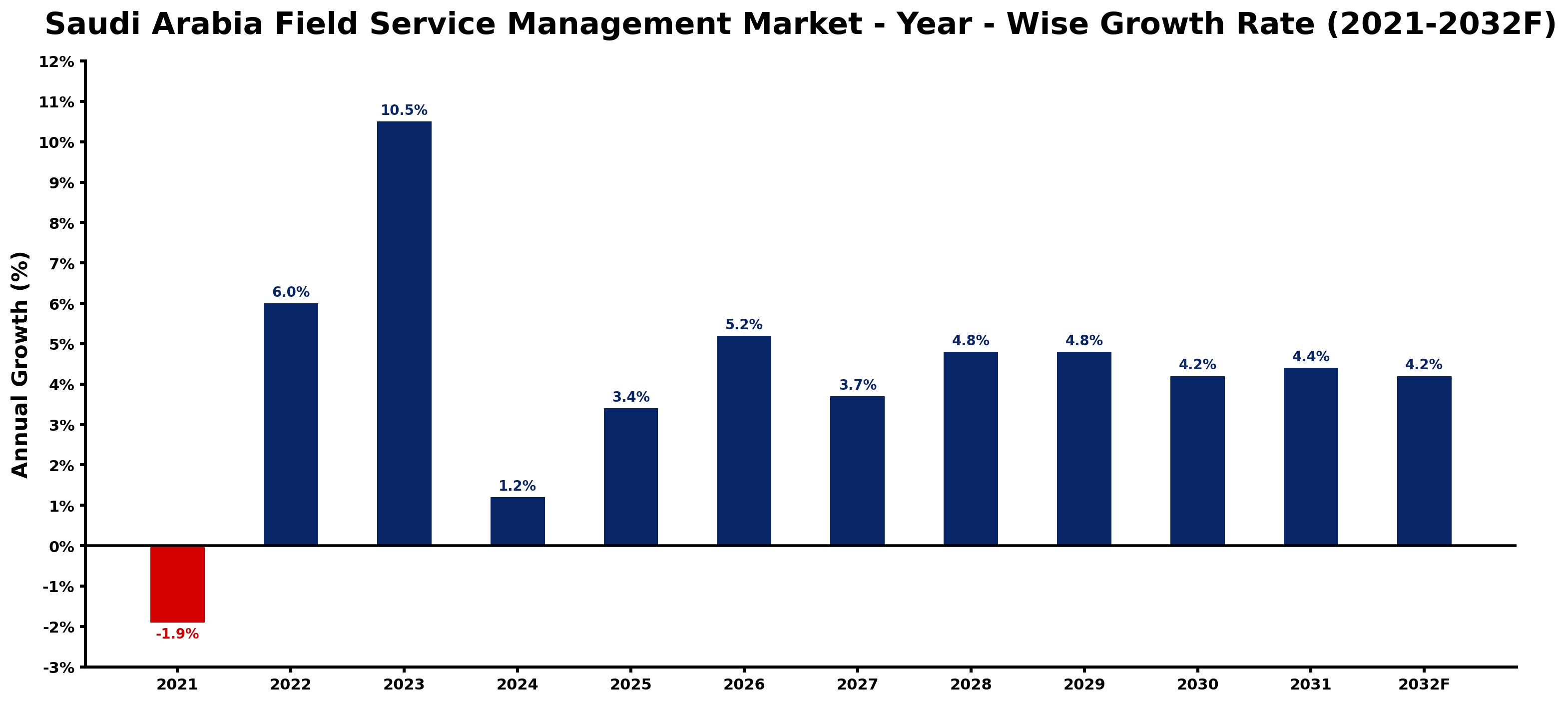
The table below presents the year‑wise growth rates along with the key drivers influencing the market
| Year | Growth Rate | Major Drivers |
| 2021 | -1.9% | Expansion of transportation and logistics networks |
| 2022 | 6.0% | Increasing adoption of advanced technologies |
| 2023 | 10.5% | Expansion of manufacturing activities |
| 2024 | 1.2% | Growing renewable energy integration projects |
| 2025 | 3.4% | Increasing smart city development projects |
| 2026 | 5.2% | Increasing smart city development projects |
| 2027 | 3.7% | Rapid growth in telecom and data center sectors |
| 2028 | 4.8% | Growing urbanization and commercial development |
| 2029 | 4.8% | Increasing industrial infrastructure investments |
| 2030 | 4.2% | Increasing adoption of advanced technologies |
| 2031 | 4.4% | Increasing industrial automation investments |
| 2032 | 4.2% | Increasing smart city development projects |
Note - Market size estimations and growth projections presented in this report are based on 6Wresearch’s advanced forecasting approach, validated with industry datasets as of June 2026.
Saudi Arabia Field Service Management Market Synopsis
In recent years, the Saudi Arabia Field Service Management market has experienced a significant paradigm shift, as companies strive to modernize their operations amid growing competition. FSM solutions have become essential tools for organizations aiming to improve service delivery and optimize workforce management.
With a burgeoning number of field workers and an increasing reliance on mobile technologies, the ability to communicate and collaborate in real-time is more crucial than ever. FSM solutions facilitate seamless integration of data and processes, thereby streamlining operational workflows and significantly enhancing customer satisfaction.
Saudi Arabia Field Service Management Market Key Takeaways
- The market is driven by the need for digital transformation and improved operational efficiency.
- Real-time communication tools are vital for increasing workforce productivity in field service operations.
- Cost optimization and effective resource management are key benefits of FSM solutions.
- Customer satisfaction has emerged as a critical competitive differentiator in the FSM landscape.
- Ongoing advancements in technology will further drive the adoption of FSM solutions.
Evaluation of Restraints in Saudi Arabia Field Service Management Market
Despite the positive outlook, the Saudi Arabia Field Service Management market faces several restraints. One prominent challenge is the integration of FSM solutions with existing enterprise systems, which can be a complex and resource-intensive process. Furthermore, the handling of sensitive customer data raises significant security concerns, necessitating robust data protection measures. Organizations must navigate these complexities carefully to realize the full potential of FSM technologies.
Saudi Arabia Field Service Management Market Trends
Several key trends are shaping the Saudi Arabia FSM market. The rise of automation and artificial intelligence is influencing how service operations are managed, allowing for predictive maintenance and improved decision-making. Additionally, there is a growing emphasis on mobile-first solutions, as technicians increasingly rely on smartphones and tablets to access real-time information and communicate with back-office teams. These trends are facilitating a more agile and responsive field service environment.
Saudi Arabia Field Service Management Market Opportunities
The FSM market in Saudi Arabia offers numerous opportunities for growth and investment. As organizations continue to embrace digital transformation, there is a strong demand for innovative FSM solutions that can enhance operational efficiency and customer engagement. Companies that invest in advanced technologies such as IoT and AI can gain a competitive edge by providing more effective and efficient services. Additionally, sectors like telecommunications, utilities, and logistics are ripe for FSM adoption, presenting significant growth avenues.
Government Initiatives in the Saudi Arabia Field Service Management Market
The Saudi government is actively promoting initiatives aimed at enhancing digital infrastructure and technology adoption across sectors. Public spending on digital transformation and support programs for private enterprises are contributing to a conducive environment for FSM solution providers. Moreover, national vision frameworks encourage businesses to innovate and optimize their service operations, further driving the growth of the FSM market in the region.
Future Insights of the Saudi Arabia Field Service Management Market
Looking ahead to the period from 2026 to 2032, the Saudi Arabia Field Service Management market is poised for transformative growth. With advancements in technology and a heightened focus on customer experience, organizations are expected to increasingly rely on sophisticated FSM solutions. The integration of AI, analytics, and machine learning will redefine service delivery models, enabling companies to respond to market demands swiftly. This evolution will not only enhance operational efficiency but also solidify customer loyalty in a competitive landscape.
Saudi Arabia Field Service Management Market Latest Developments (May 2025 - June 2026)
In recent months, the Saudi Arabia FSM market has witnessed a surge in the deployment of cloud-based solutions, facilitating more scalable and flexible service operations. Companies are increasingly focusing on enhancing user experience by integrating advanced analytics capabilities into their FSM systems. Additionally, partnerships among technology providers and local businesses are emerging, aimed at co-developing tailored FSM solutions that address unique regional challenges. Such developments reflect an ongoing commitment to innovate and adapt in the fast-evolving service management landscape.
Saudi Arabia Field Service Management Market - Key Attractiveness of the Report
- 10 Years of Market Numbers
- Historical Data Starting from 2022 to 2025
- Base Year: 2025
- Forecast Data until 2032
- Key Performance Indicators Impacting the Market
- Major Upcoming Developments and Projects
Key Highlights of the Report:
- Saudi Arabia Field Service Management Market Outlook
- Market Size of Saudi Arabia Field Service Management Market, 2025
- Forecast of Saudi Arabia Field Service Management Market, 2032
- Historical Data and Forecast of Saudi Arabia Field Service Management Revenues & Volume for the Period 2022-2032F
- Saudi Arabia Field Service Management Market Trend Evolution
- Saudi Arabia Field Service Management Market Drivers and Challenges
- Saudi Arabia Field Service Management Price Trends
- Saudi Arabia Field Service Management Porter's Five Forces
- Saudi Arabia Field Service Management Industry Life Cycle
- Historical Data and Forecast of Saudi Arabia Field Service Management Market Revenues & Volume By Component for the Period 2022-2032F
- Historical Data and Forecast of Saudi Arabia Field Service Management Market Revenues & Volume By Solutions for the Period 2022-2032F
- Historical Data and Forecast of Saudi Arabia Field Service Management Market Revenues & Volume By Services for the Period 2022-2032F
- Historical Data and Forecast of Saudi Arabia Field Service Management Market Revenues & Volume By Verticals for the Period 2022-2032F
- Historical Data and Forecast of Saudi Arabia Field Service Management Market Revenues & Volume By Telecom for the Period 2022-2032F
- Historical Data and Forecast of Saudi Arabia Field Service Management Market Revenues & Volume By Manufacturing & Construction for the Period 2022-2032F
- Historical Data and Forecast of Saudi Arabia Field Service Management Market Revenues & Volume By Healthcare for the Period 2022-2032F
- Historical Data and Forecast of Saudi Arabia Field Service Management Market Revenues & Volume By Energy & Utility for the Period 2022-2032F
- Historical Data and Forecast of Saudi Arabia Field Service Management Market Revenues & Volume By Others for the Period 2022-2032F
- Historical Data and Forecast of Saudi Arabia Field Service Management Market Revenues & Volume By Deployment Mode for the Period 2022-2032F
- Historical Data and Forecast of Saudi Arabia Field Service Management Market Revenues & Volume By Cloud for the Period 2022-2032F
- Historical Data and Forecast of Saudi Arabia Field Service Management Market Revenues & Volume By On-premise for the Period 2022-2032F
- Saudi Arabia Field Service Management Import Export Trade Statistics
- Market Opportunity Assessment By Component
- Market Opportunity Assessment By Verticals
- Market Opportunity Assessment By Deployment Mode
- Saudi Arabia Field Service Management Top Companies Market Share
- Saudi Arabia Field Service Management Competitive Benchmarking By Technical and Operational Parameters
- Saudi Arabia Field Service Management Company Profiles
- Saudi Arabia Field Service Management Key Strategic Recommendations






































