Saudi Arabia Fire Resistant Glass Market Size, Share & Growth Rate
The Saudi Arabia Fire Resistant Glass Market was estimated at USD 387 Million in 2025 and is projected to reach USD 496 Million by 2032, growing at a CAGR of 3.6% from 2026 to 2032. This growth trajectory is primarily driven by the relentless urbanization and a robust construction sector that emphasizes safety. As regulatory bodies enforce stricter safety norms, the demand for fire-resistant glass—capable of providing both protection and visibility—continues to gain momentum.
Saudi Arabia Fire Resistant Glass Market Year-wise Growth Rate and Key Drivers
This graph highlights how the Saudi Arabia Fire Resistant Glass Market has steadily grown over the years, supported by major growth factors.
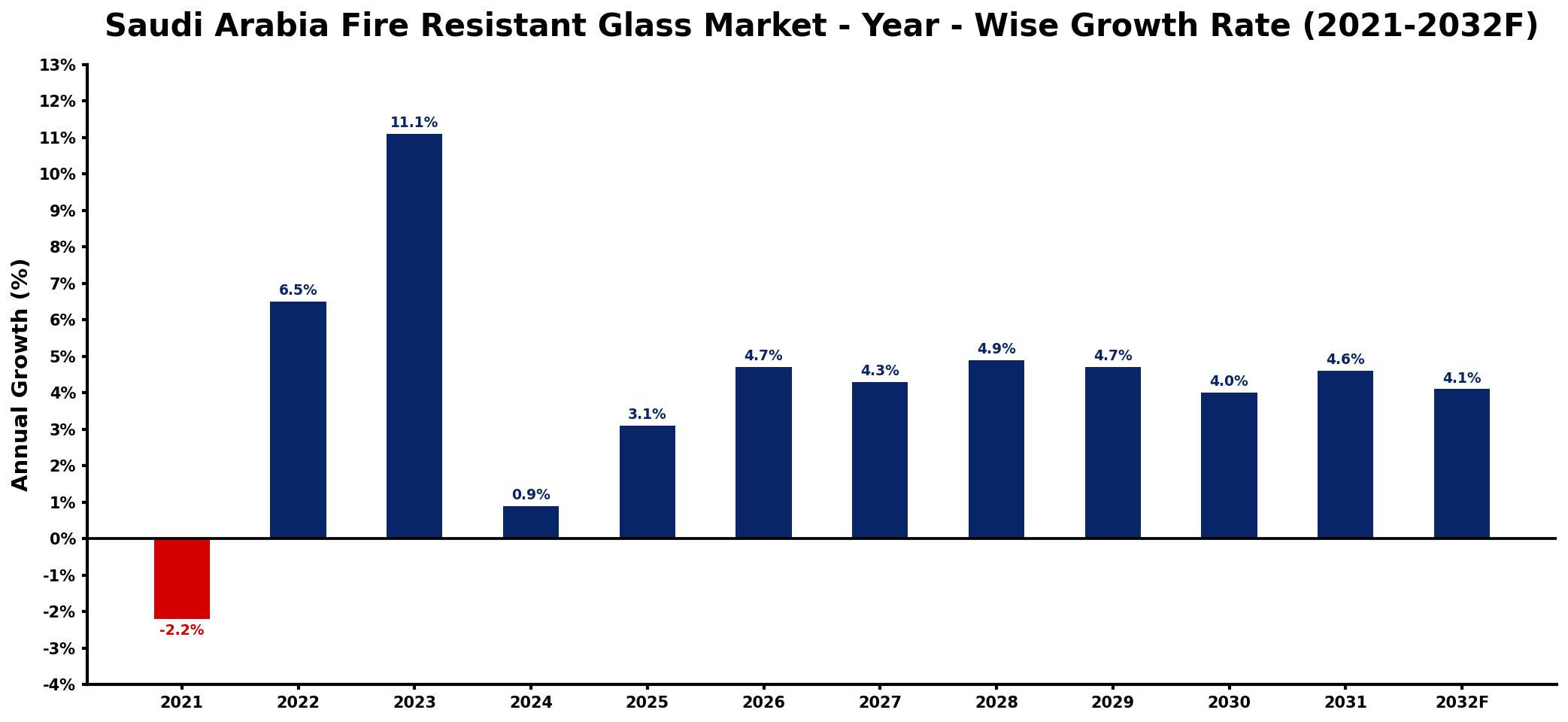
The table below presents the year‑wise growth rates along with the key drivers influencing the market
| Year | Growth Rate | Major Drivers |
| 2021 | -2.2% | decreased construction activity levels |
| 2022 | 6.5% | increased safety regulations enforcement |
| 2023 | 11.1% | rising demand for commercial buildings |
| 2024 | 0.9% | growing interest in energy efficiency |
| 2025 | 3.1% | expansion of infrastructure projects |
| 2026 | 4.7% | increased investment in green buildings |
| 2027 | 4.3% | higher urbanization rates observed |
| 2028 | 4.9% | enhanced focus on disaster management |
| 2029 | 4.7% | growing awareness of safety standards |
| 2030 | 4.0% | increased renovation and refurbishment projects |
| 2031 | 4.6% | rising technological advancements adoption |
| 2032 | 4.1% | strengthened international trade agreements |
Note: Market size estimations and growth projections presented in this report are based on 6Wresearch's proprietary forecasting methodology, utilizing the latest available industry data, government publications, and primary research inputs.
Saudi Arabia Fire Resistant Glass Market Synopsis
In Saudi Arabia, the importance of fire safety in architecture is paramount, with fire-resistant glass becoming a staple in modern construction. This material not only aids in protecting lives during emergencies but also enhances the aesthetic appeal of structures, making it an indispensable choice for both residential and commercial projects.
The evolving landscape of urban infrastructure, characterized by multi-story buildings and expansive commercial complexes, has led to a rising demand for fire-resistant solutions. Coupled with stringent compliance mandates, the market is poised for substantial growth as safety remains a top priority in building design.
Saudi Arabia Fire Resistant Glass Market Key Takeaways
- Growing emphasis on safety regulations in construction fuels market demand.
- Fire-resistant glass offers dual benefits: fire safety and aesthetic value.
- Urbanization and infrastructure expansion are key growth drivers.
- Increased awareness of fire risks promotes adoption across various sectors.
- Technological advancements in fire-resistant glass are enhancing product offerings.
Evaluation of Restraints in Saudi Arabia Fire Resistant Glass Market
Despite the positive outlook, the Saudi Arabia fire-resistant glass market faces several constraints. One significant barrier is the challenge of demonstrating the long-term value of fire-resistant glass to stakeholders who may prioritize initial costs over safety investments. Additionally, harmonizing aesthetic requirements with rigorous fire safety standards remains a complex endeavor, often causing delays in project approvals and installations. These factors may dampen market growth if not adequately addressed.
Saudi Arabia Fire Resistant Glass Market Trends
Several trends are shaping the fire-resistant glass landscape in Saudi Arabia. Firstly, the demand for innovative designs that integrate fire safety without compromising aesthetics is gaining traction. Moreover, advancements in technology are leading to improved thermal performance and enhanced resistance levels, making these products more appealing. Additionally, a growing focus on sustainability is prompting manufacturers to explore eco-friendly alternatives, aligning product offerings with contemporary building practices.
Saudi Arabia Fire Resistant Glass Market Opportunities
The fire-resistant glass market in Saudi Arabia presents numerous growth opportunities. Investment in public infrastructure projects, driven by government initiatives, is expected to boost demand significantly. Furthermore, as companies increasingly prioritize employee and customer safety, the commercial sector is likely to expand its usage of fire-resistant glass. The evolving nature of building designs, coupled with a rising middle class that values safety and quality, creates a fertile environment for market participants.
Government Initiatives in the Saudi Arabia Fire Resistant Glass Market
The Saudi government is actively promoting fire safety through various initiatives, including updated building codes and safety regulations that mandate the use of fire-resistant materials in construction. Public funding for infrastructure projects, along with awareness campaigns regarding fire safety, further supports the market's growth. These efforts underscore the government's commitment to enhancing public safety and encouraging the adoption of advanced building materials.
Future Insights of the Saudi Arabia Fire Resistant Glass Market
Looking ahead to 2026-2032, the Saudi Arabia fire-resistant glass market is set for continued expansion. As urban centers grow and building safety regulations become increasingly stringent, demand will surge. Innovations in product design, including enhanced fire resistance and aesthetics, are likely to attract a broader customer base. Moreover, as sustainability becomes a key concern, the industry is expected to adapt, leading to a new era of eco-friendly fire-resistant solutions.
Saudi Arabia Fire Resistant Glass Market Latest Developments (2025 - 2026)
In recent months, the fire-resistant glass market has experienced significant movement, with several manufacturers unveiling new product lines focused on both safety and design. Increased collaborations between construction firms and glass manufacturers have also been noted, aimed at meeting the latest safety standards. Moreover, educational seminars and workshops conducted by industry associations have helped raise awareness about the importance of fire-resistant materials in safeguarding lives and properties.
Saudi Arabia Fire Resistant Glass Market - Key Attractiveness of the Report
- 10 Years of Market Numbers
- Historical Data Starting from 2022 to 2025
- Base Year: 2025
- Forecast Data until 2032
- Key Performance Indicators Impacting the Market
- Major Upcoming Developments and Projects
Key Highlights of the Report:
- Saudi Arabia Fire Resistant Glass Market Outlook
- Market Size of Saudi Arabia Fire Resistant Glass Market, 2025
- Forecast of Saudi Arabia Fire Resistant Glass Market, 2032
- Historical Data and Forecast of Saudi Arabia Fire Resistant Glass Revenues & Volume for the Period 2022-2032F
- Saudi Arabia Fire Resistant Glass Market Trend Evolution
- Saudi Arabia Fire Resistant Glass Market Drivers and Challenges
- Saudi Arabia Fire Resistant Glass Price Trends
- Saudi Arabia Fire Resistant Glass Porter's Five Forces
- Saudi Arabia Fire Resistant Glass Industry Life Cycle
- Historical Data and Forecast of Saudi Arabia Fire Resistant Glass Market Revenues & Volume By Type for the Period 2022-2032F
- Historical Data and Forecast of Saudi Arabia Fire Resistant Glass Market Revenues & Volume By Integrity (E) for the Period 2022-2032F
- Historical Data and Forecast of Saudi Arabia Fire Resistant Glass Market Revenues & Volume By Integrity & Radiation Limitation (EW) for the Period 2022-2032F
- Historical Data and Forecast of Saudi Arabia Fire Resistant Glass Market Revenues & Volume By Integrity & Insulation (EI) for the Period 2022-2032F
- Historical Data and Forecast of Saudi Arabia Fire Resistant Glass Market Revenues & Volume By Application for the Period 2022-2032F
- Historical Data and Forecast of Saudi Arabia Fire Resistant Glass Market Revenues & Volume By Building and Construction for the Period 2022-2032F
- Historical Data and Forecast of Saudi Arabia Fire Resistant Glass Market Revenues & Volume By Other Applications for the Period 2022-2032F
- Saudi Arabia Fire Resistant Glass Import Export Trade Statistics
- Market Opportunity Assessment By Type
- Market Opportunity Assessment By Application
- Saudi Arabia Fire Resistant Glass Top Companies Market Share
- Saudi Arabia Fire Resistant Glass Competitive Benchmarking By Technical and Operational Parameters
- Saudi Arabia Fire Resistant Glass Company Profiles
- Saudi Arabia Fire Resistant Glass Key Strategic Recommendations






































